Omiš 2: On the ground

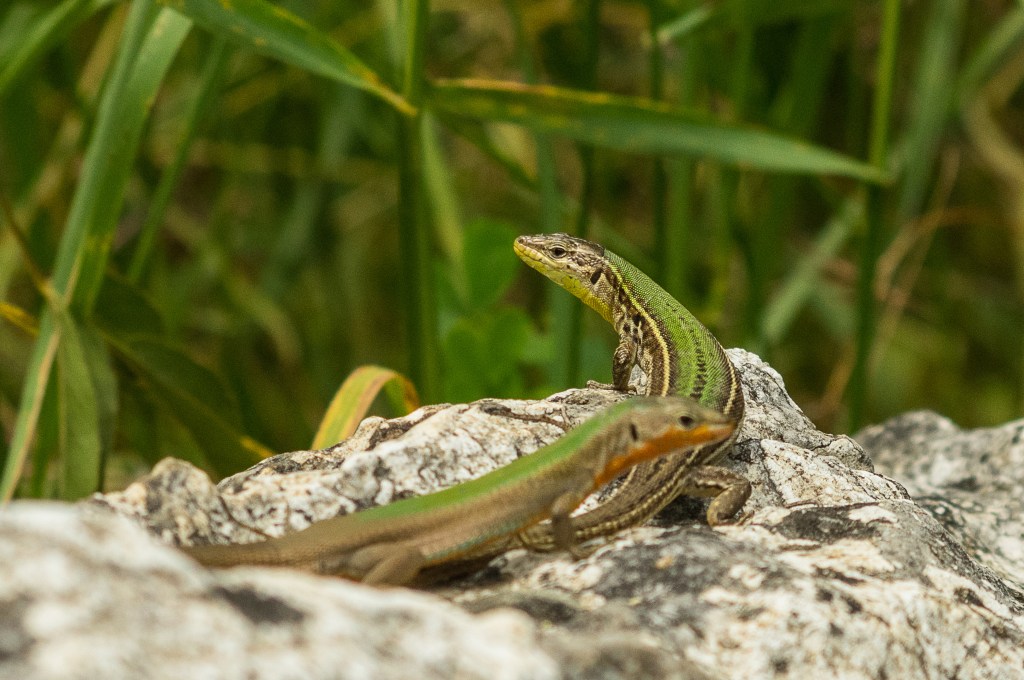
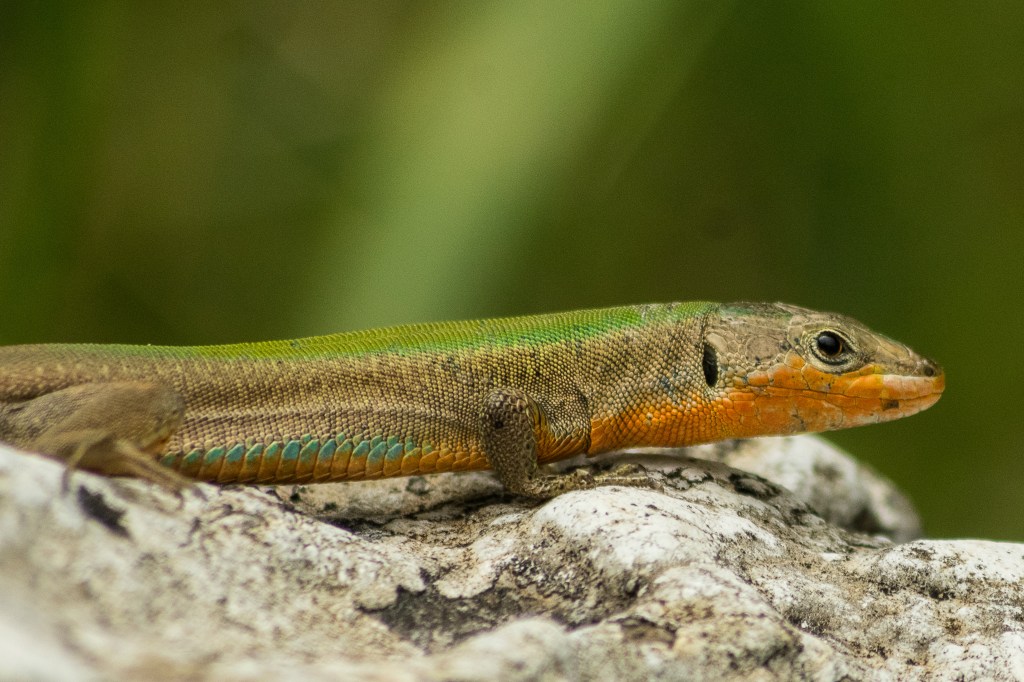
Hello again from Croatia! Our walks around Omiš provided some interesting sights close to and on the ground. The walk up the Lisicina Gorge to Naklice and on to Gospe od Sniga through the Karst had its terrestrial moments with some obliging lizards – I think these are Dalmatian Wall lizards Podarcis melisellensis.

As they are not trying to kill each other, I think we must have a male (with the orange throat) and a female (equally striking); I post an in-focus picture of each as my depth-of-field was not able to deliver the pair. The orange morph male is usually bigger than his yellow and white competitors, and has a stronger bite, attractive attributes in a lizard but it is also important to smell good – females can apparently tell a good deal from male lizard secretions, which appear to be the subject of a considerable literature.

Other more niche aspects of the behaviour of this reptile species have also attracted attention – who could resist a paper entitled “Where to do number two: Lizards prefer to defecate on the largest rock in the territory “? Oh to have returned a work with such a title under REF – clearly four star for the title alone.

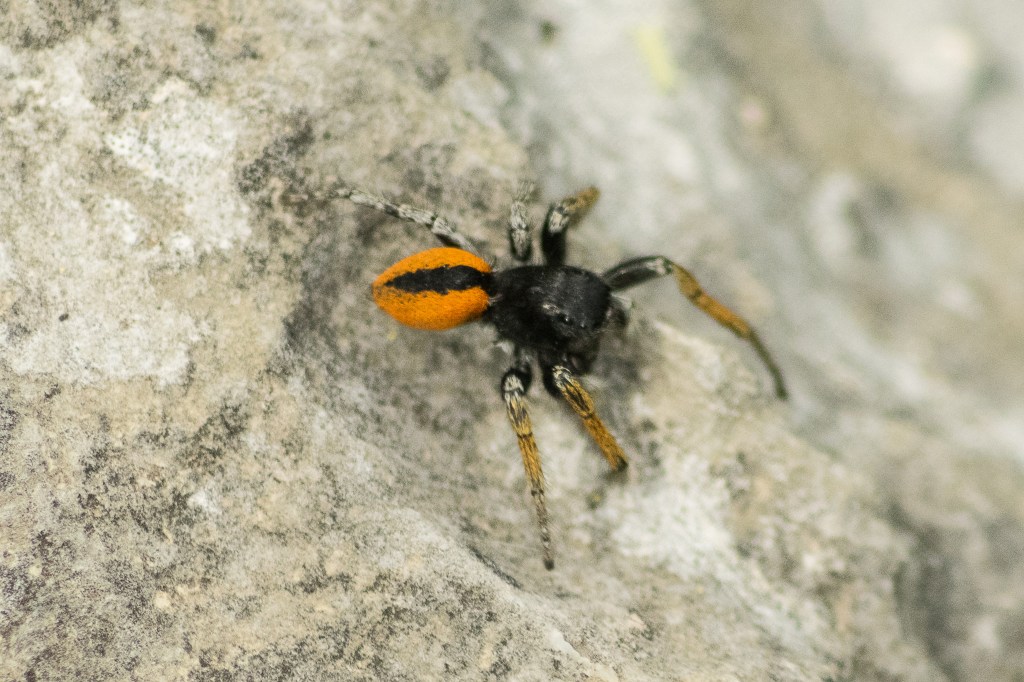
Not too far away, we found a male Jumping spider, Philaeus chrysops, making his way across the limestone. Spiders are not Backwoodsman’s best thing – the orange caught my eye and I followed it as a reflex action. That’s big enough I think (a whole cm at least). Has a bird relieved him of a couple of legs? His locomotion still looked pretty effective as he tore across the limestone.

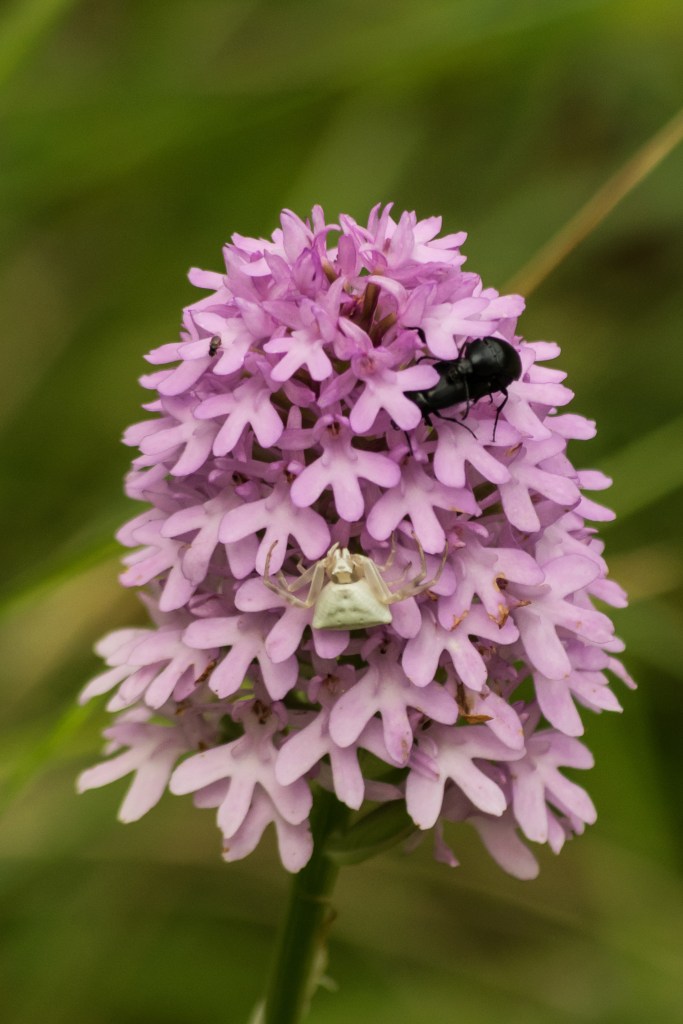
A few orchids stood out close to the path. This Pyramidal orchid appeared to be hosting a pair of mating beetles but closer inspection of the image revealed a lurking Pink crab spider  Thomisus onustus, a most effective ambush predator. The rapture of the beetles may have been short-lived.

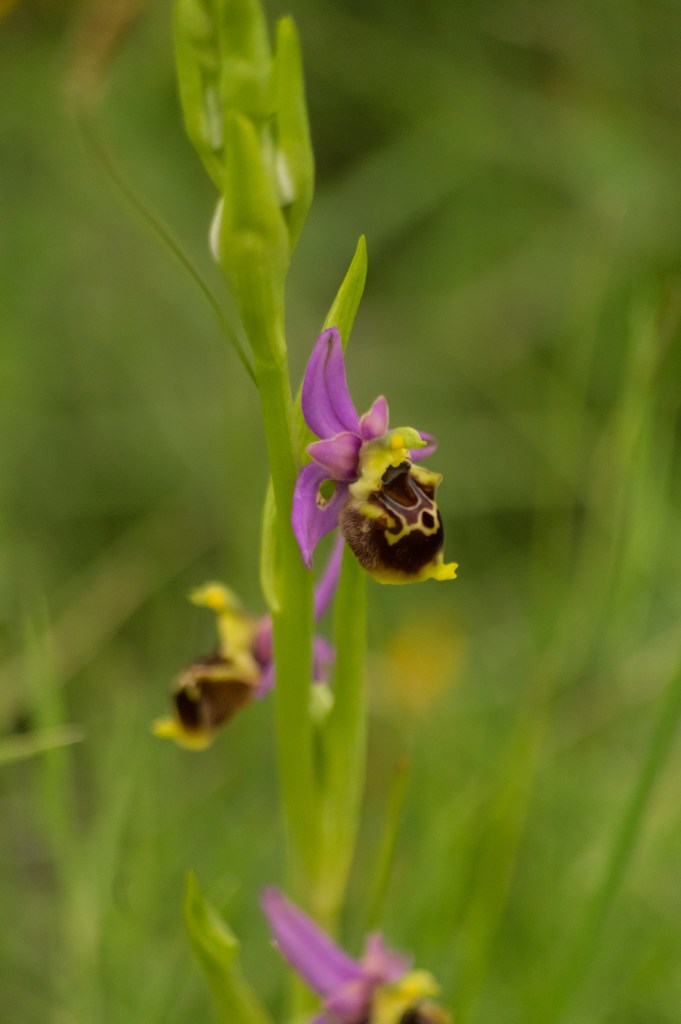
And then there were Bee orchids (Ophrys apifera), celebrated for their insect mimicry and the process known as pseudocopulation, in which an insect suitor inadvertently transfers the large pollen grains (pollinia) from one plant to another.

I haven’t seen this species many times before – the first time was at Thriplow Meadows near Cambridge forty years ago where a single specimen had emerged and been fenced off for its protection. I had been loaned a copy of The Military Orchid by Jocelyn Brooke and had read it enviously as the young Brooke ticked off most of the species native to the UK (and picked, painted and pressed them…). He recollected his excitement upon finding this species particularly well: “A miniature chalkpit dazzled our eyes a little way up the hill. Running ahead, I paused near the edge of it: a plant had caught my eye, a flower with pink petals on which a bee seemed to be resting. Suddenly, I realised this was the goal of our pilgrimage…Yes, there was no doubt of it; a single plant, standing stiff and aloof, bearing proudly aloft its extraordinary insect-flowers, like archaic jewels rifled from some tomb; I had found the bee orchid.”

We trod warily around several plants which had crowded up to the edge of the path seeking some light and space.

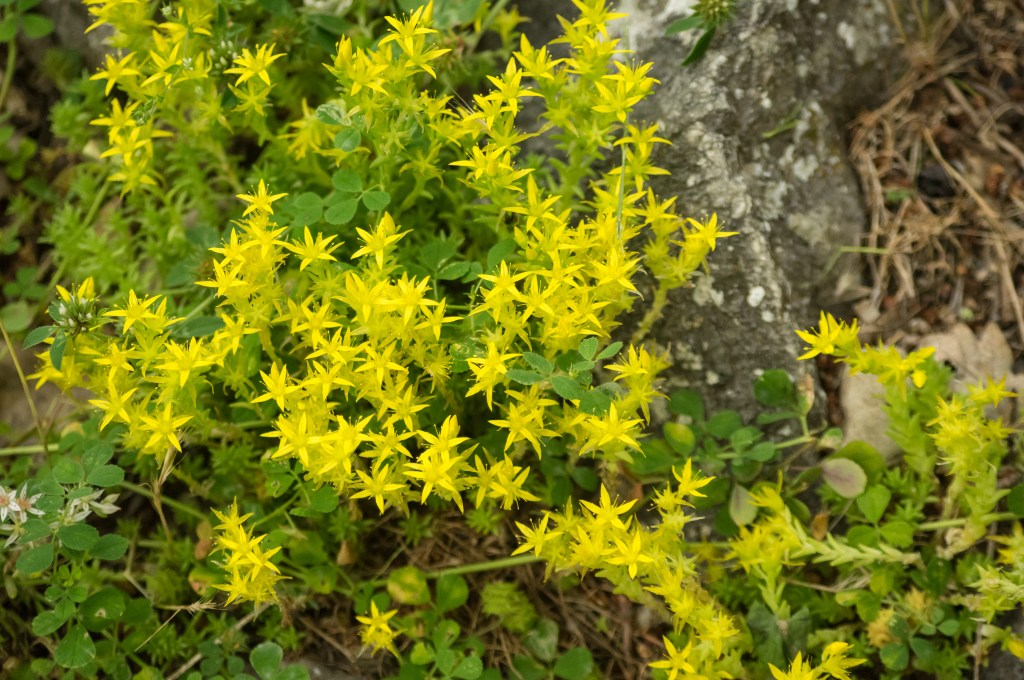
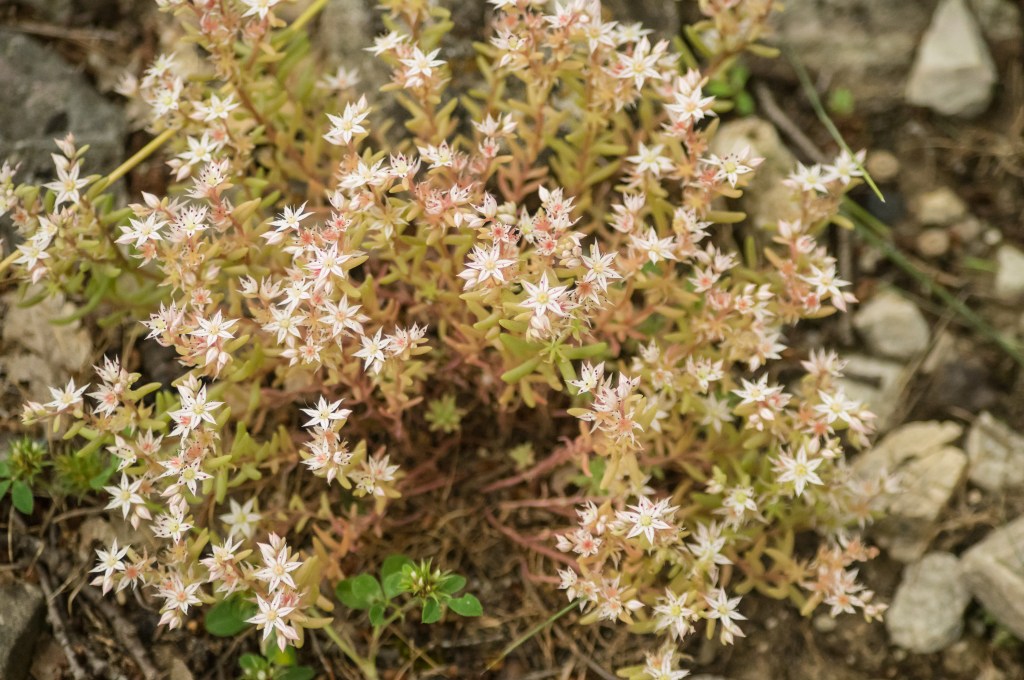
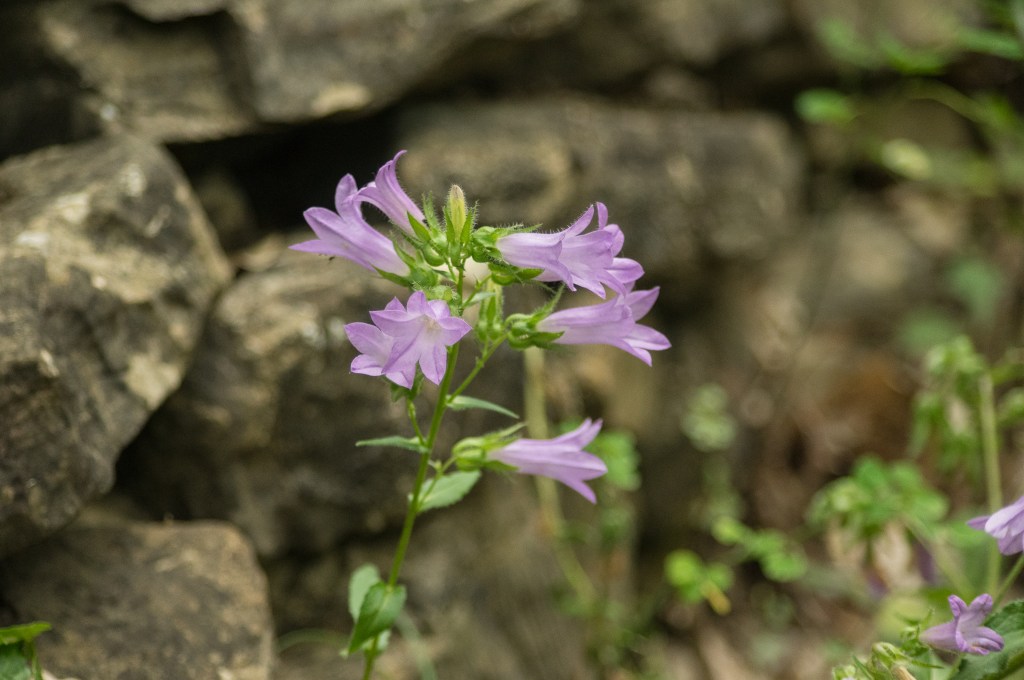
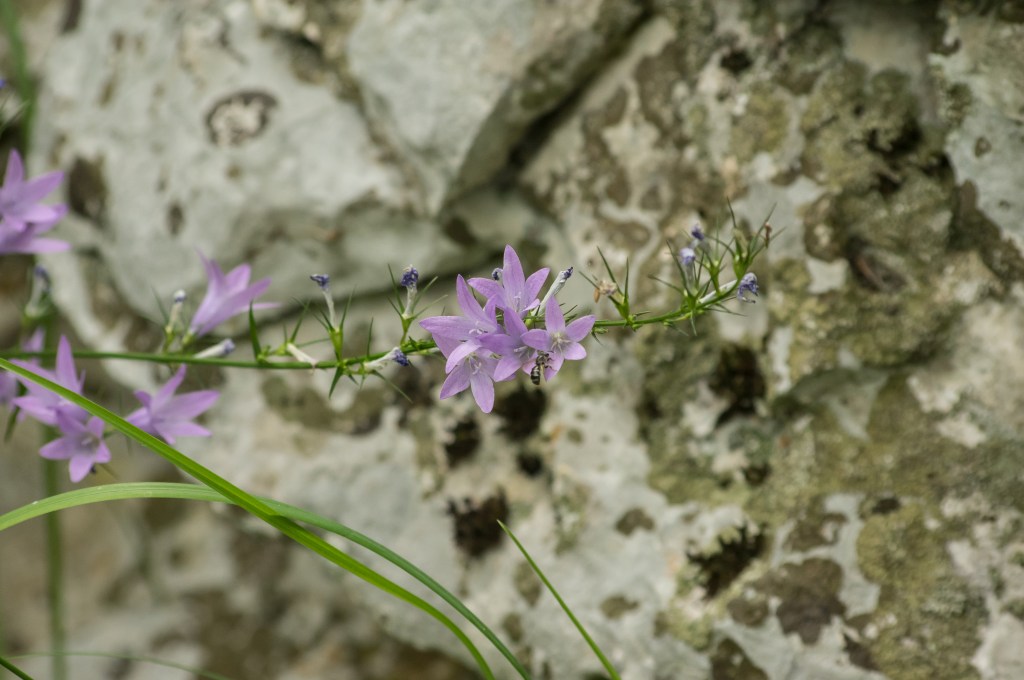
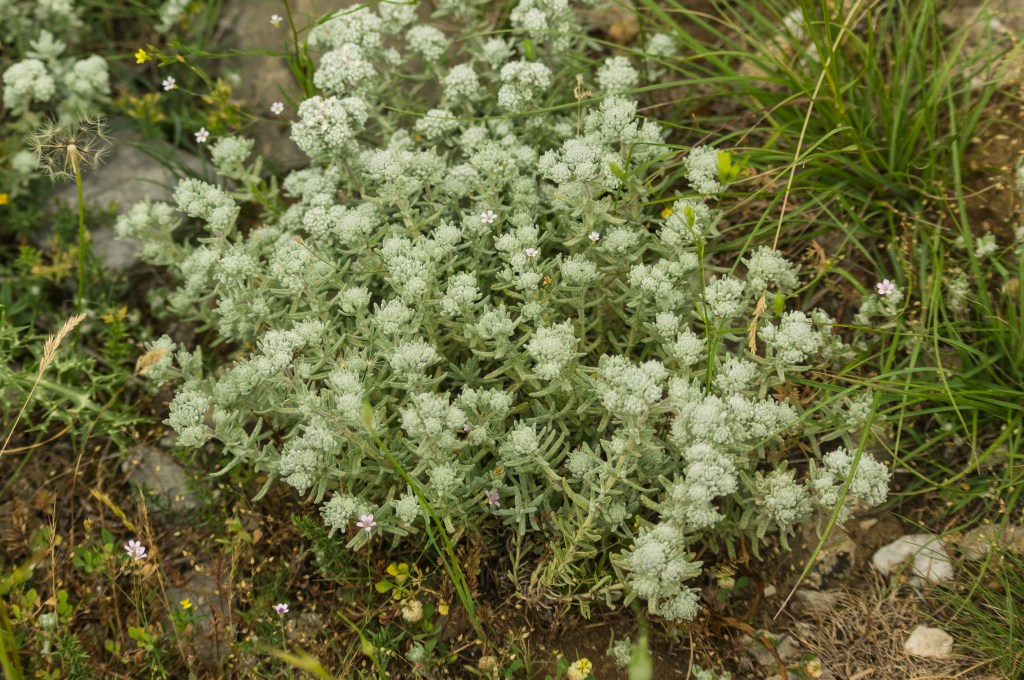
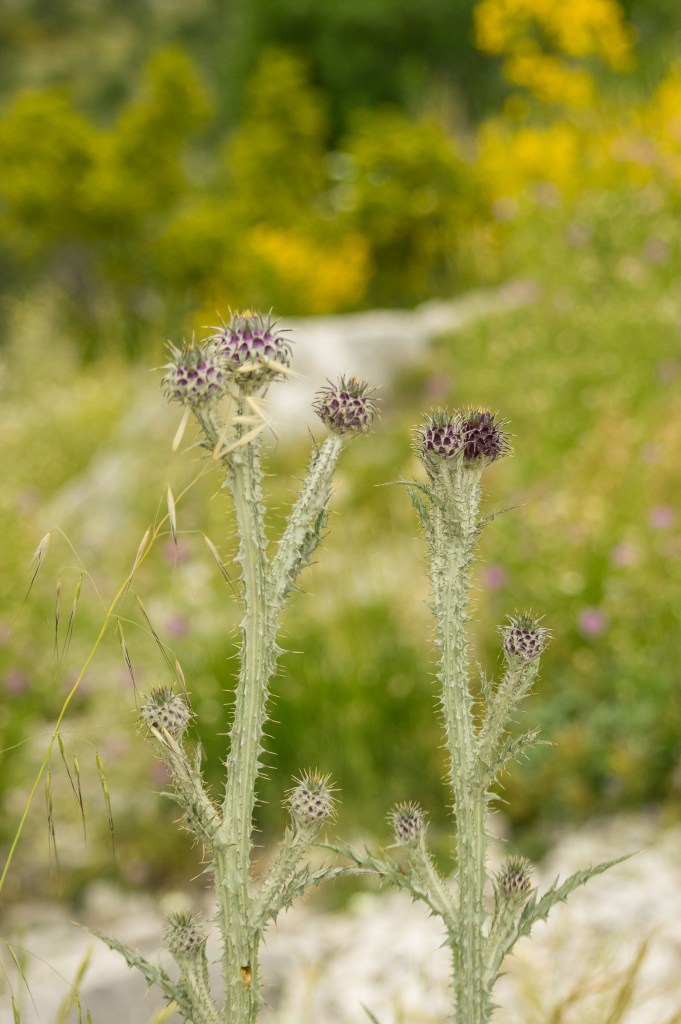
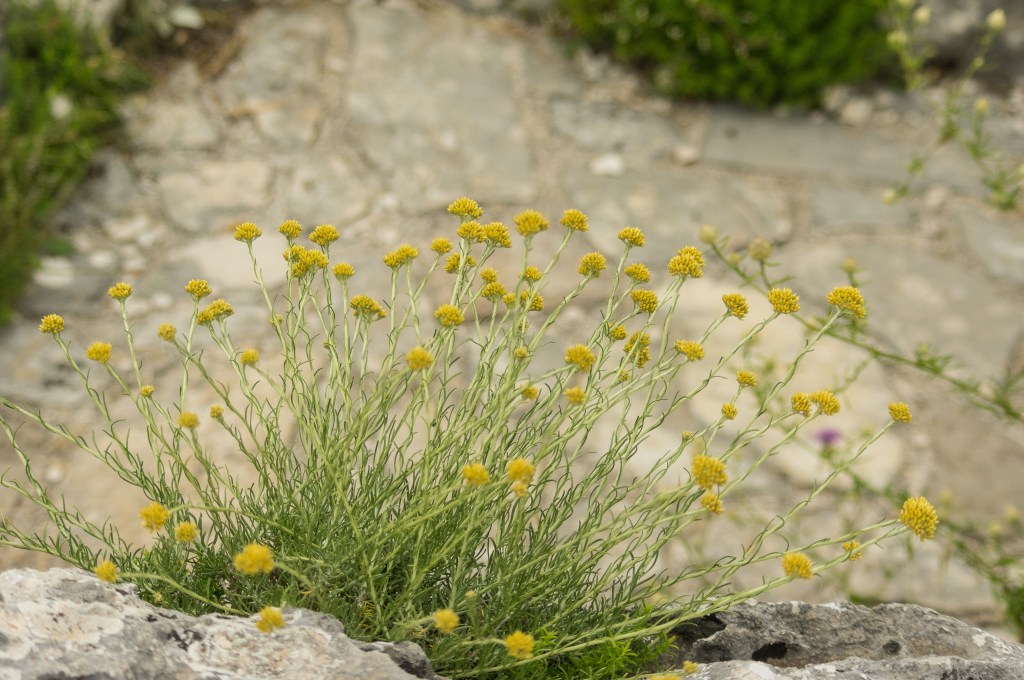
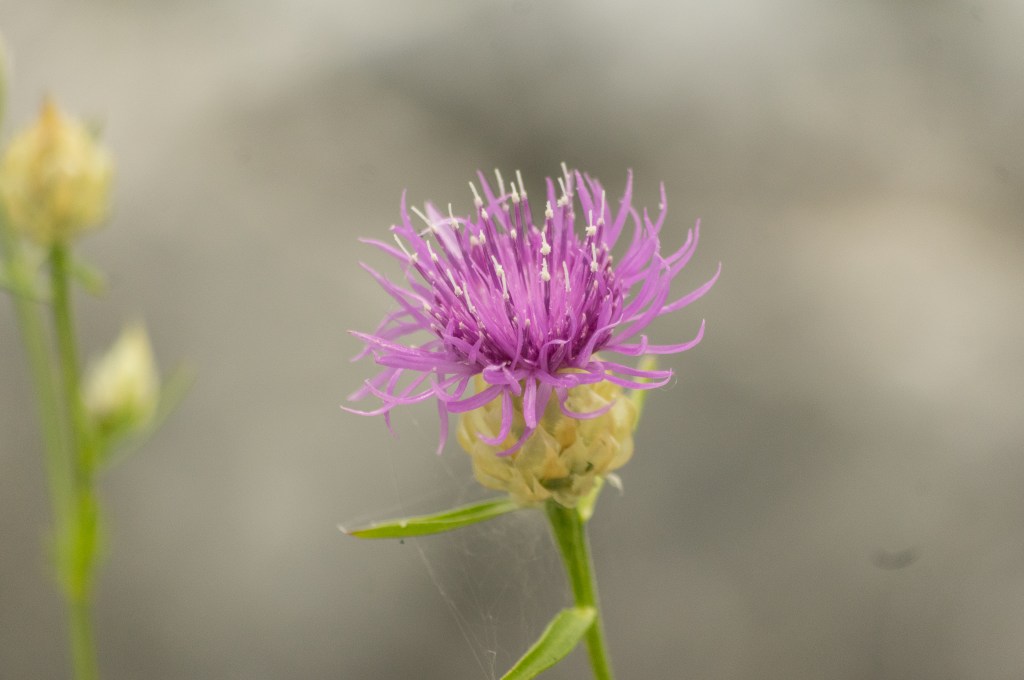
The hillside was ablaze with flowers. While I might recognise the types – Campanulas, Saxifrages, Thistles – I didn’t know the species so I have used the PictureThis App to make tentative identifications. I have not cross checked these with independent sources, and it is possible that many would be present on similar terrain in the UK. However, they are new and exciting to me  – I don’t usually get to see this limestone-fed abundance; wet Spagnum moss, and Sedge and Cotton grasses are much more familiar.

In order of appearance, we have Sedum acre (Biting stonecrop), Sedum hispanicum (Spanish stonecrop),Campanula trachelium (Nettle-leaved bellflower), Campanula rapunculus (Rapunzel), Carduus nutans (Nodding thistle), Teucrium polium (Felty germander), Petrohagia saxifraga (Tunicflower), Arctium tomentosum (Wooly burdock), Helichrysum italicum (Curry plant or immortelle), and Centaurea jacea (Brown knapweed or French hardheads).

A wet day took us to Zakučac, just to the north of Omiš. There is a huge HEP plant here from which a wide canal flows down into the Cetina river. As Backwoodsman usually says when viewing any body of water larger than a puddle, “I bet there’s some fish in that.” Under and cut into the sheer cliffs that plunge down behind the village is the Shrine of St Leopold Bogdan Mandić and a waymarked trail starts just below the shrine and heads south-east steeply up the limestone. The day grew wetter and wetter – not a day for butterflies, spiders or lizards to be out, but there were lots of these – cricket or grasshopper?

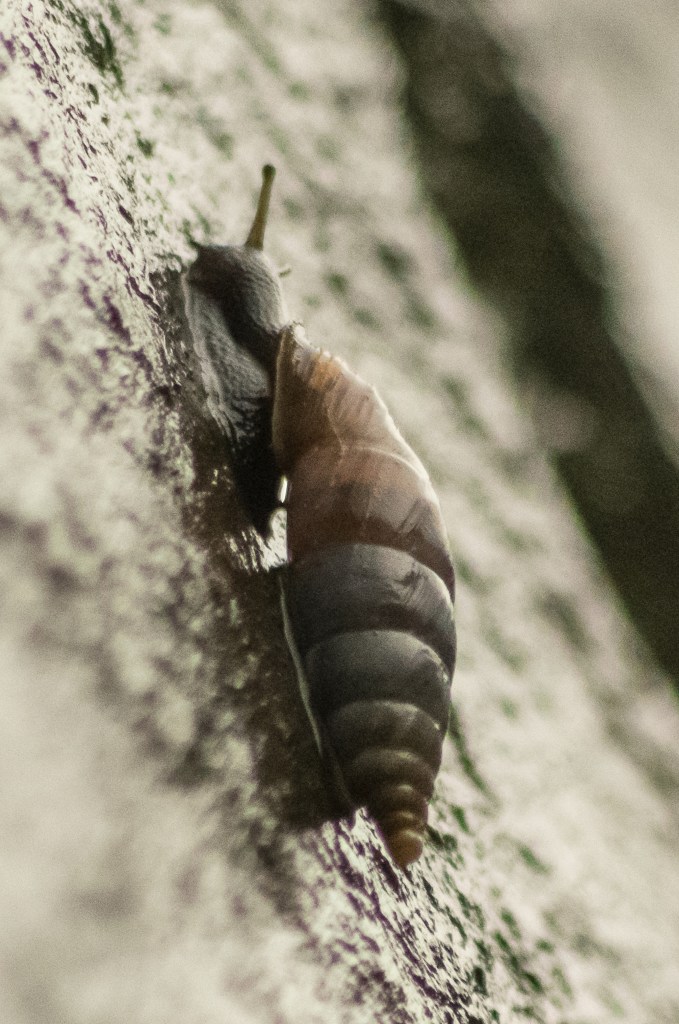
He has some serious antennae which suggests a cricket (grasshoppers have shorter gear). And it was great for snails. We found three types of snail – the nuances of species identification are beyond me but from the shape of the shell, this one looks like a member of the genus Poiretia.  There is a Dalmatian Predatory Snail (Poiretia cornea) which etches its way through the shells of prey to the goods inside.

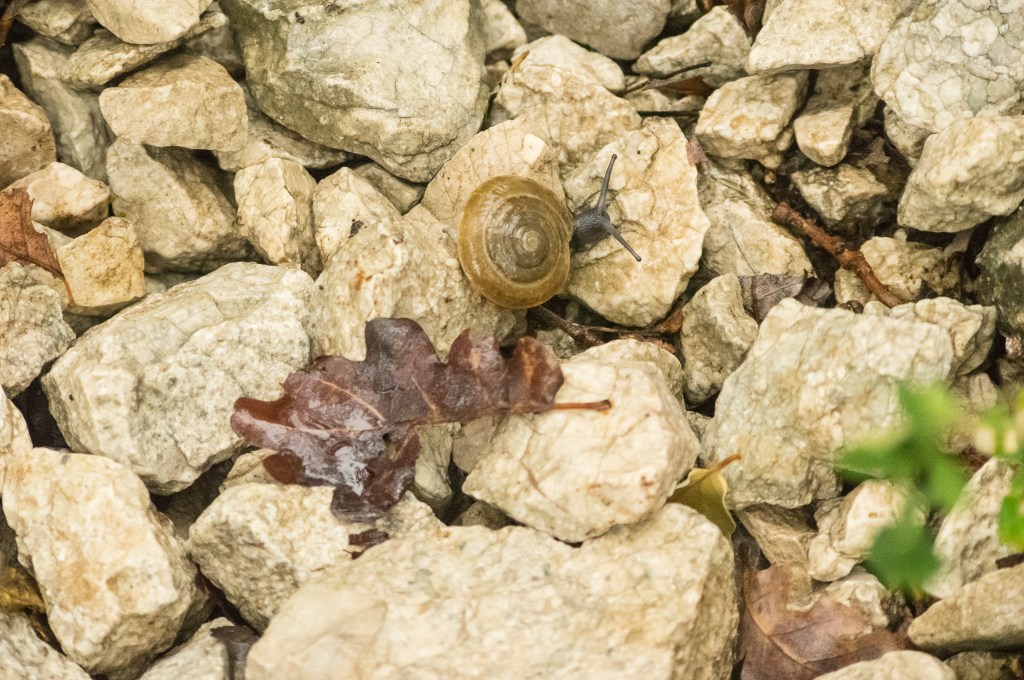
It was extremely hard not to tread on these Oxychilus snails as we climbed the path and they lingered upon it. There is an Oxychilus navarricus which looks about right, but the distribution data suggest it is a northern species. Oxychilus ionicus seems to present in Croatia but I failed to find any images which helped me.

Higher up the limestone, we found this brute which may be a Roman or Burgundy snail (Helix pomatia). The gardeners amongst you are already in the car to Homebase for a massive tub of slug pellets. There are a lot of native snails in Croatia – a daunting list which would suggest that the odds against my identifications being correct are very long indeed.

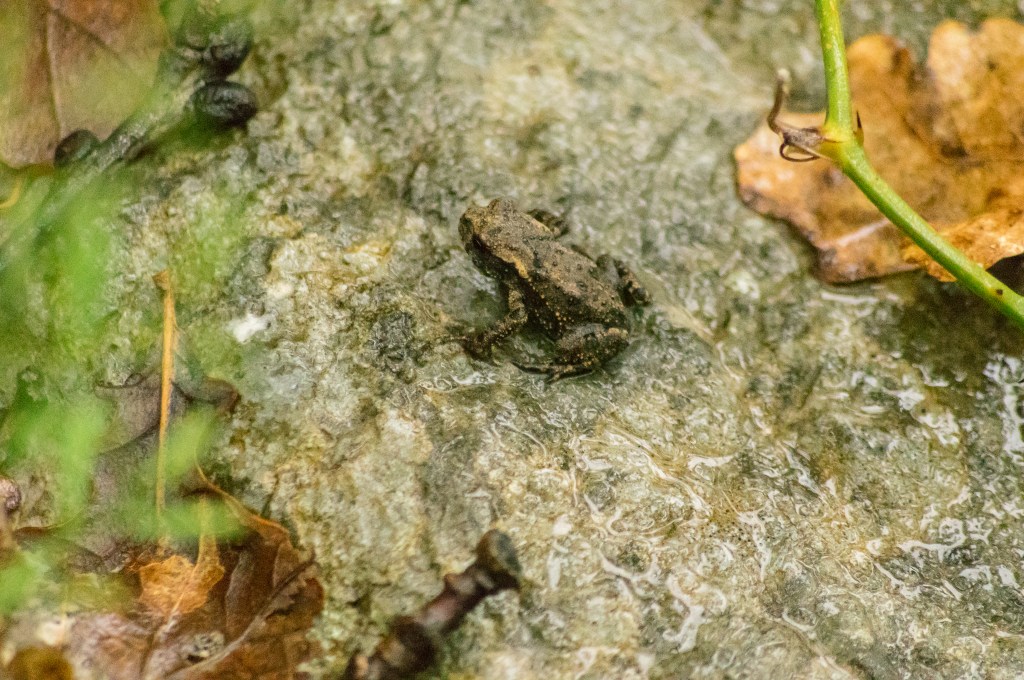
The tiny amphibian below was one of many, and they presented multiple hazards to navigation – they were everywhere. I found a list of Croatian amphibians with some great pictures but nothing looks like a good match for this chap.

The blunt nose and possibility of wartiness suggests a toad, as does the absence of standing water from this landscape (any ponds are at least 150m lower down the limestone). I rescued a few which had taken wrong turns onto really dry or sandy areas under cliffs.

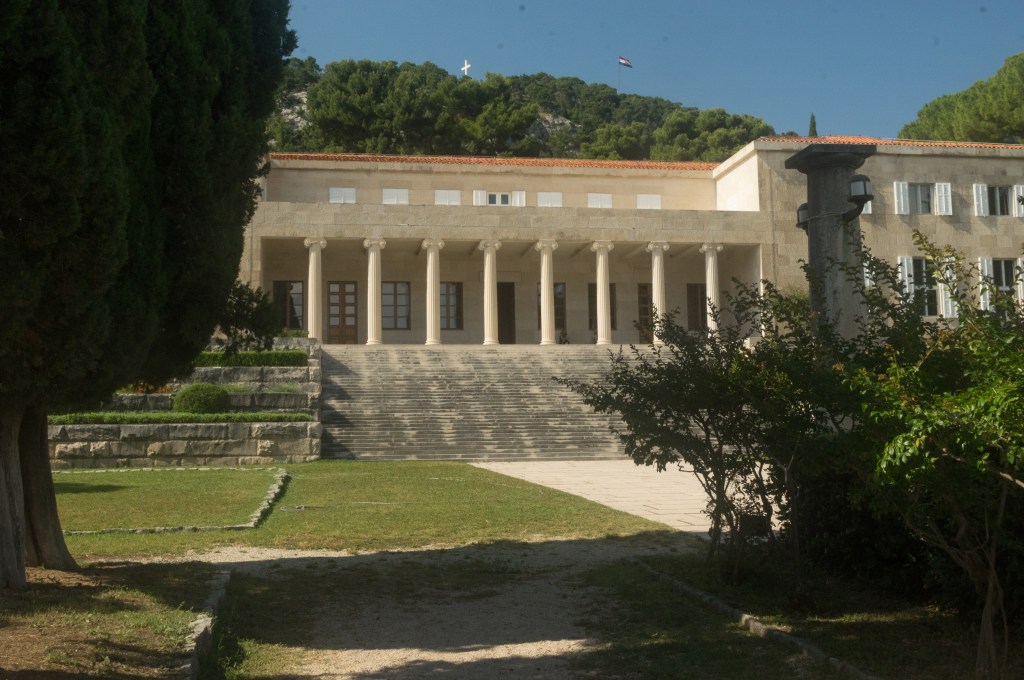
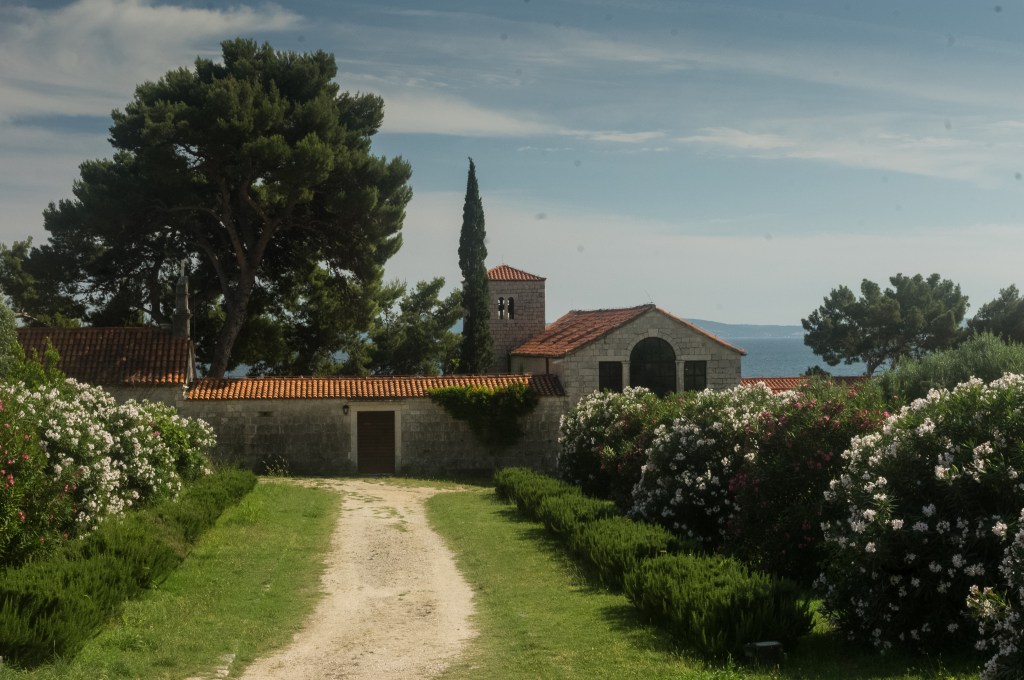
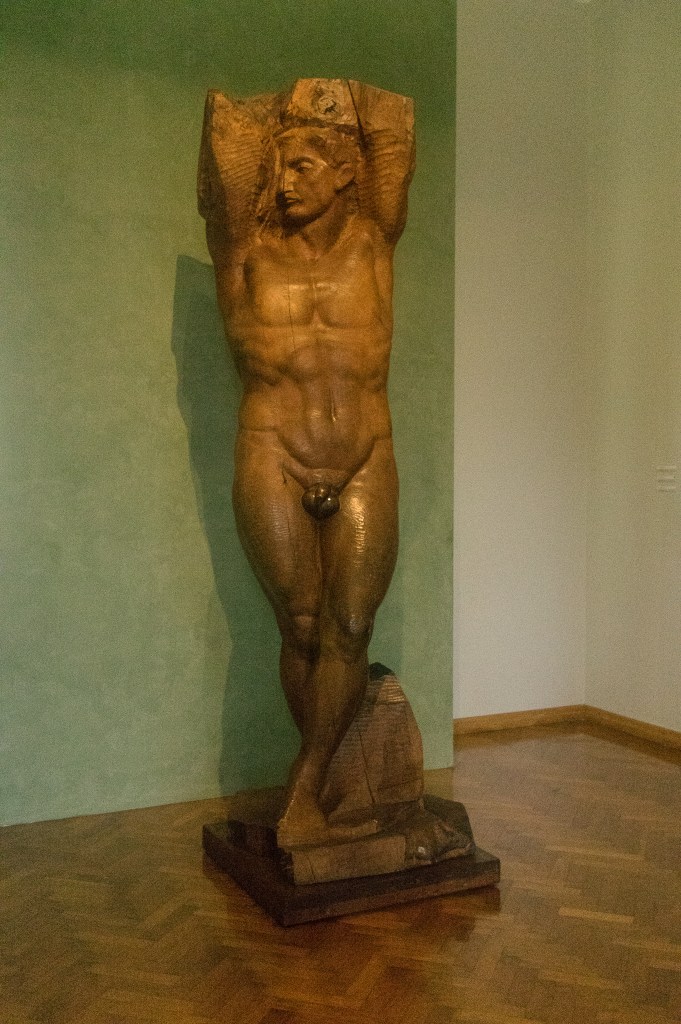
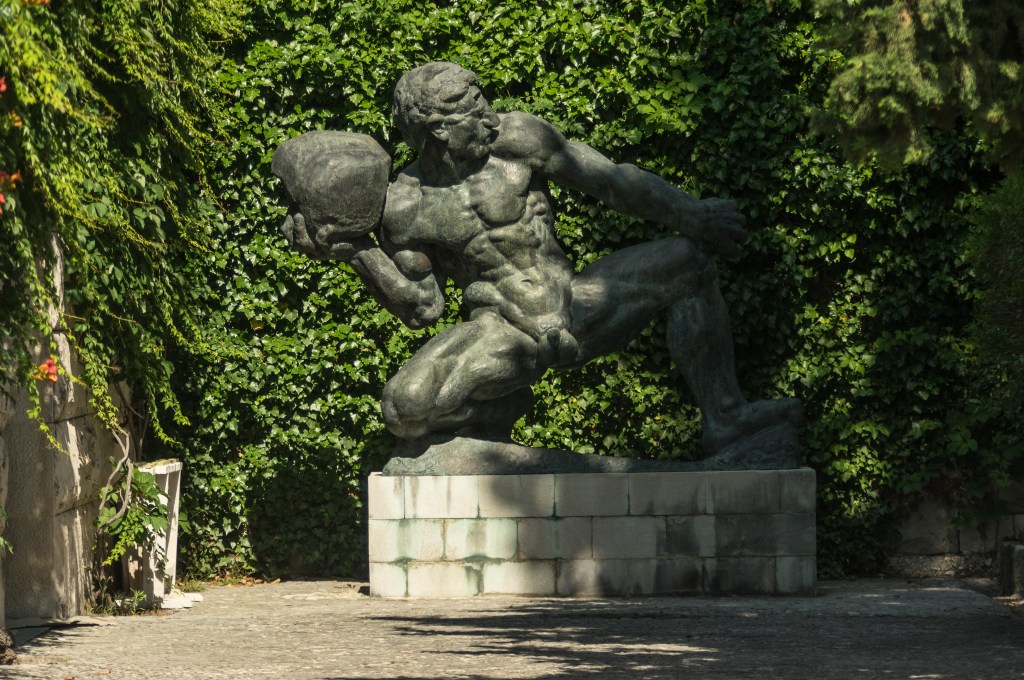
Perhaps the most unexpected sighting came in the grounds of the Ivan Meštrović Gallery just outside Split, as recommended by Faye’s colleague Martina; we’d spent a couple of really enjoyable hours looking at Meštrović sculptures in marble, wood and bronze and followed them with a visit to the church just down the road.

The museum offers the visitor a cool and uncluttered interior and displays Meštrović’s  sculptures to their advantage. The church is panelled throughout and took Meštrović  many years to complete. The panels vary in the degrees of relief and in aspects of technique used in the depiction of scenes from the gospels; the crucifix at the altar is monumental.

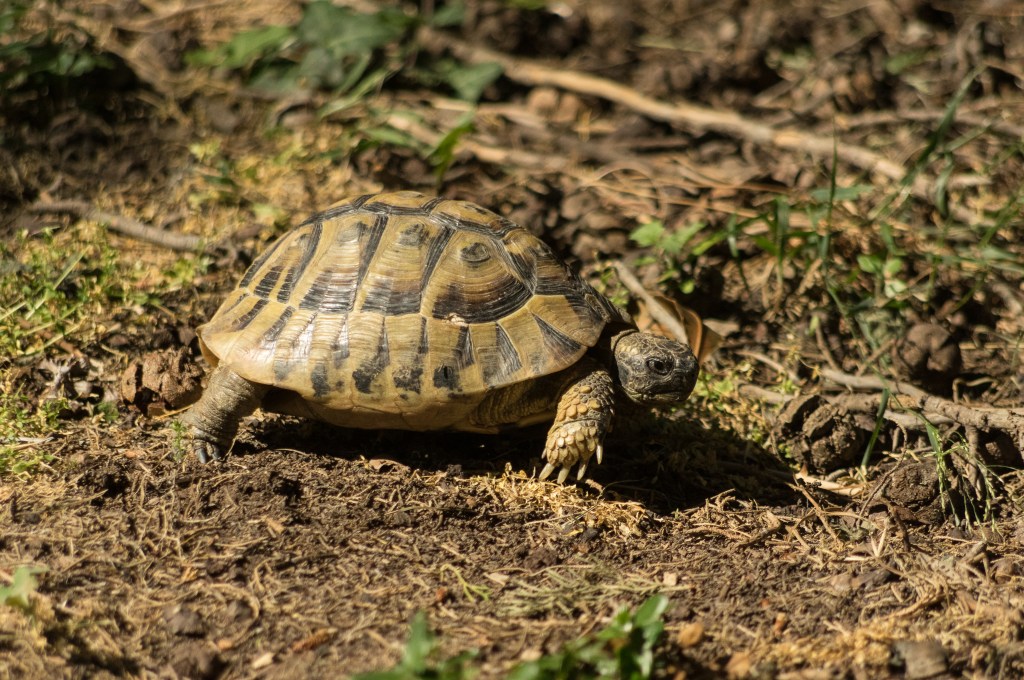
This is all very well but where’s the wildlife? Well, we were surprised by this tortoise in the grounds of the gallery – there is a subspecies of Hermann’s tortoise Testudo Hermanni hercegovinensis which populates the coasts of Bosnia and Herzegovina, Croatia, and Montenegro. Is this the chap, or are we looking at the groundsman’s pet on the prowl for some hot reptile action? If there are any expert herpetologists reading this, please would you put Backwoodsman from his misery?

We were fortunate to visit Croatia in this abundant season  – BBC Weather has Split in the low thirties today, less feverish than other parts of Europe but too hot for stoating around looking for wildlife. More suitable in fact for sitting beneath a fig tree – adieu to Croatia.

Omiš 1: On the wing

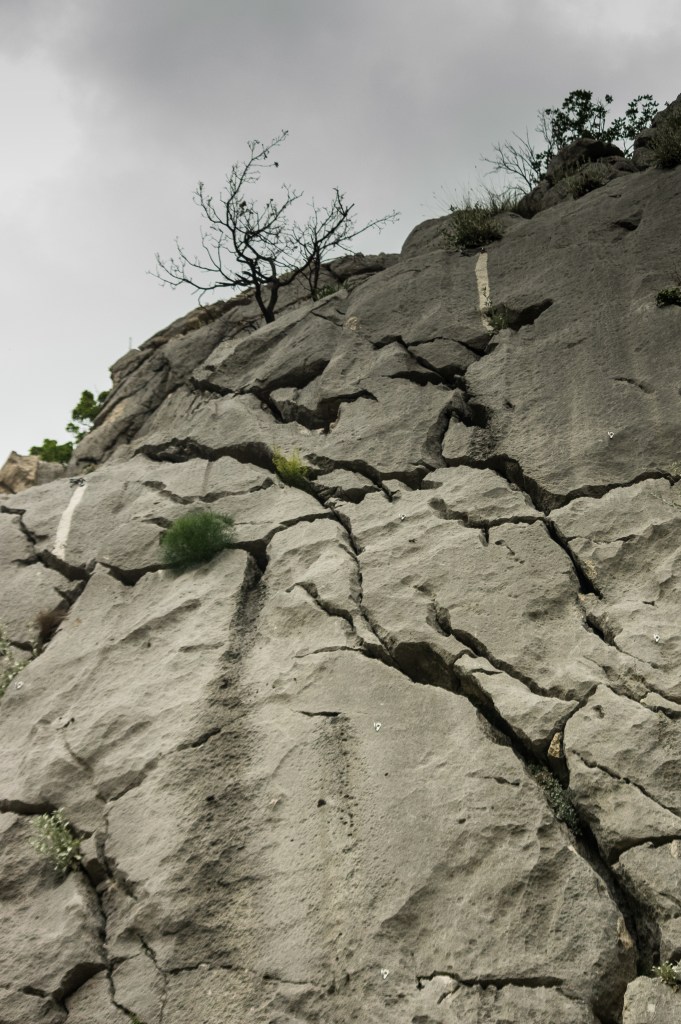
Omiš lies about half-an-hour’s drive south of Split in Croatia. The Cetina River cuts a spectacular gorge through a coastal limestone escarpment to reach the sea in the town. A second band of upland, this time exceeding Munro height, lies several miles inland and runs parallel to the coastal escarpment. The Omiška Dinara, a long finger of Corbett-height upland runs away for miles from Omiš to the South-East.  None of the heights are particularly intimidating but when the sun comes out, the limestone heats up fast; when the rain comes, the stone gets very smooth indeed. We chose our walks quite carefully (I mean, it’s a holiday, right, not the Duke of Edinburgh Award Scheme) and were really pleased with the range of wildlife we could find on the limestone pavement or Karst. The region had experienced two weeks of proper rain just before we arrived – this wet spell had probably extended the lifetime of some of the vegetation and possibly delayed some flowering. We were very lucky with what we saw, but I must say at the outset that only my lighter zoom lens made the trip to Croatia so my depth-of-field and general crispness are not what we’re used to. There are no great rarities here but I’m celebrating the diversity (by which I mean the many species) to be found in the Croatian countryside. Our worst day for seeing stuff was on an educational trail and the better experiences began just about where the houses stopped.

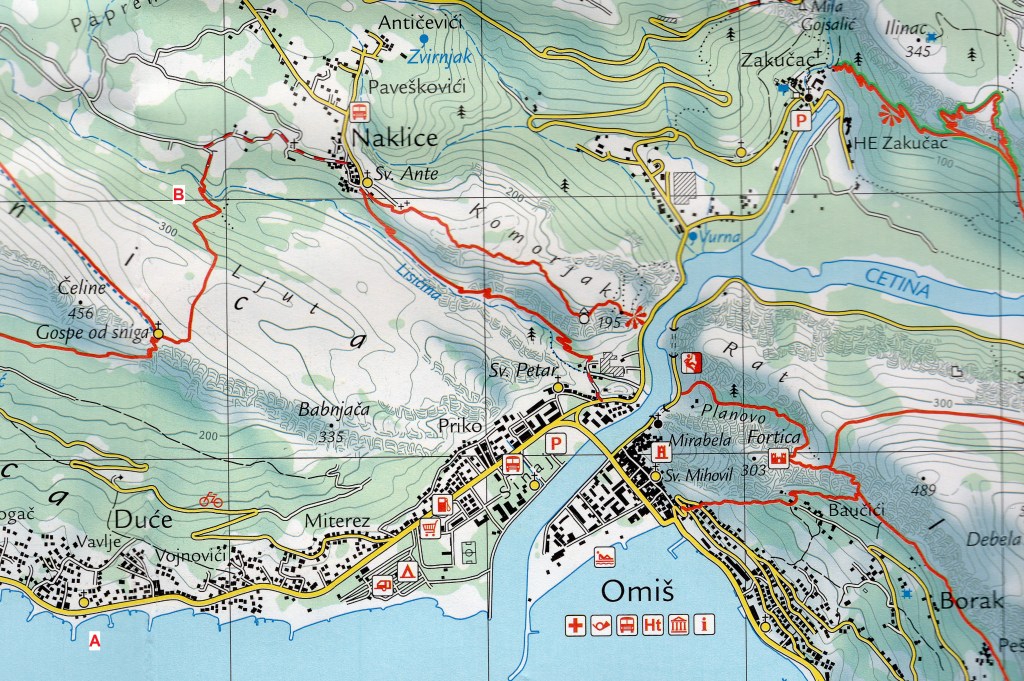
We stayed on the beach, just about where the A is by Vavlje (the map is standard Landranger scale, one square is one Km); our first walk took us East and then North east along the yellow road heading for the town past the slightly grim Camp Galeb in Miterez (Ms Braverman would fill it with migrants given half a chance). Around Sv. Petar, a laid stone path (just like an old drovers’ road) climbs the Lisicina Gorge up to Naklice. From there, a track, then a narrow path heads West, then drops South into a wooded valley, fording the Lisicina before climbing back up the limestone to the little chapel at Gospe od Sniga.

The return to A looks short and there is an interesting path which picks its way down steeply off the limestone cliffs but it then heads West for a long time – we tried this on a previous visit and found it attritional in the full sun. On the recent visit, simply retracing our steps from the chapel allowed a couple of beers to be had in Konoba Palacio in Naklice before the descent of the Gorge in warm rain.

It was also possible to walk up out of the houses behind our hotel onto the hillside below Gospe od Sniga. Access was helped by an old footway to the cemetery which crossed a numbered cycleway (162 I believe) heading North west. We followed the cycleway – no mamils, but some superb habitat with fauna and flora. What material I have is divided between on the wing and on the ground, in that order.   

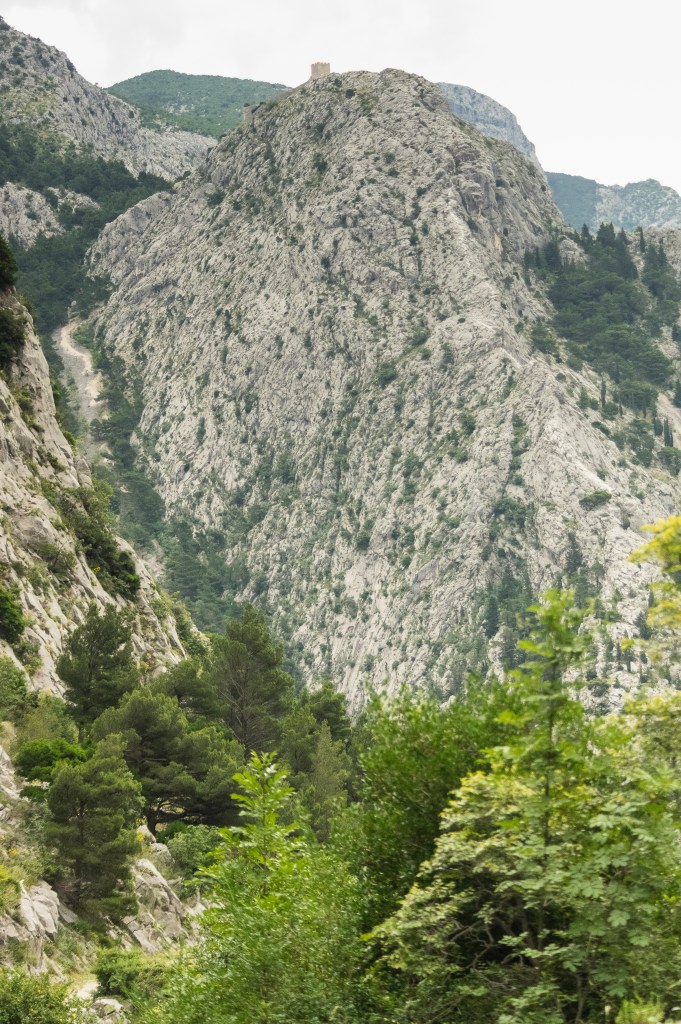
So, we’re heading up the Gorge and there is a nice view of the fortress (Starigrad) above the town and at the low end of the Omiška Dinara.

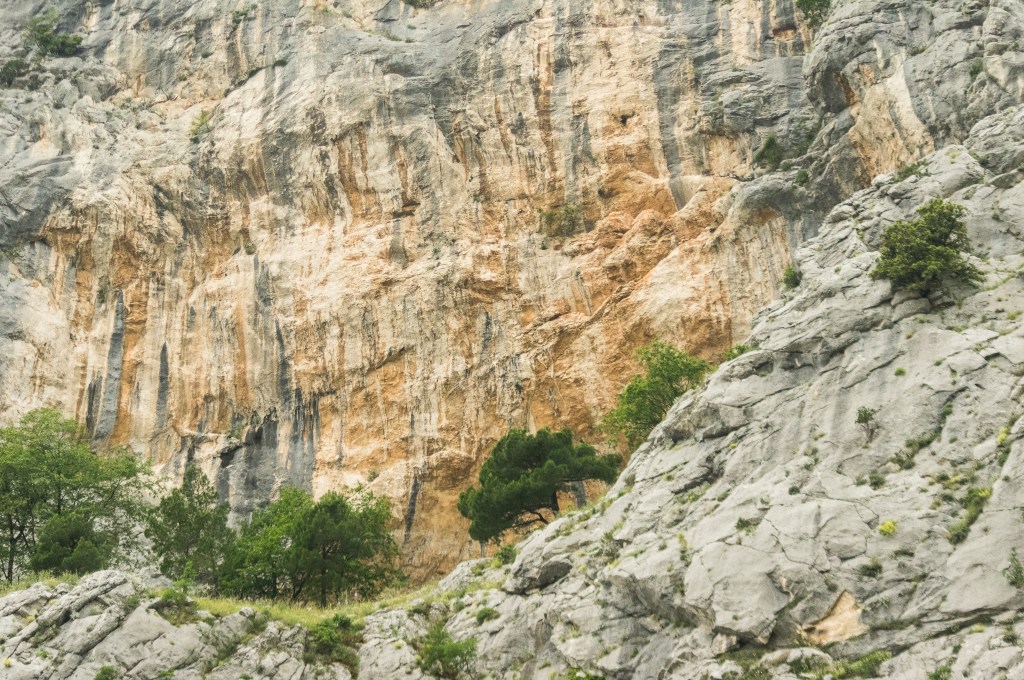
I always look at these sheer cliffs and hope to see a Wallcreeper – one day.

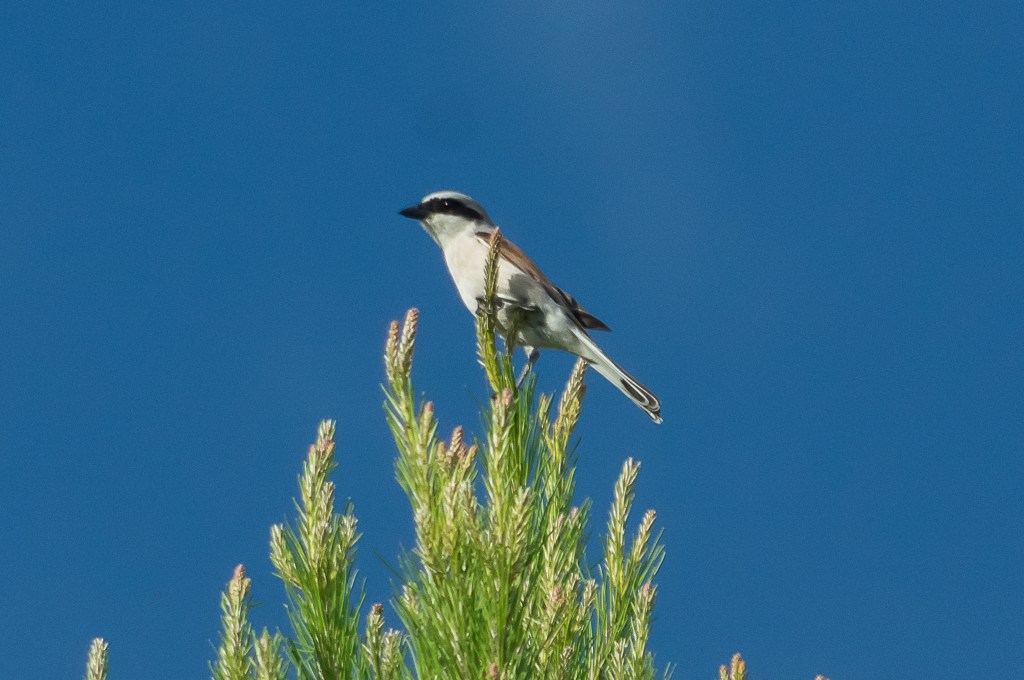
As we left Naklice, we spotted a Red-backed Shrike; I’ve used an image from a later walk which is the best I can do with this species.

The descent to the ford took us through woodland which was just alive with birds, including one or more Nightingales (according to the Merlin App).

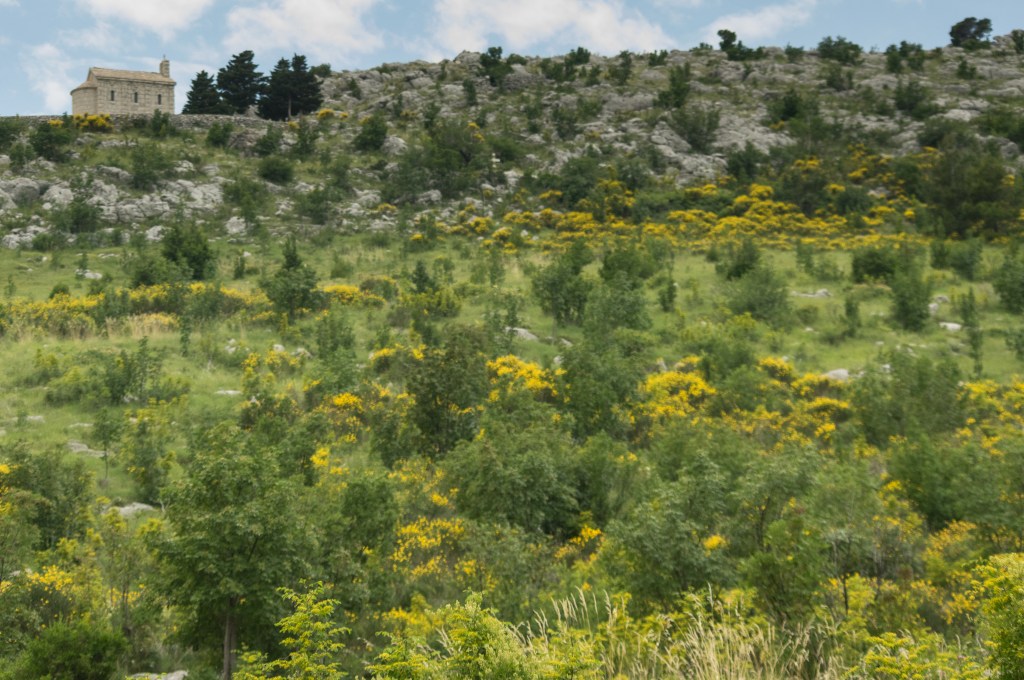
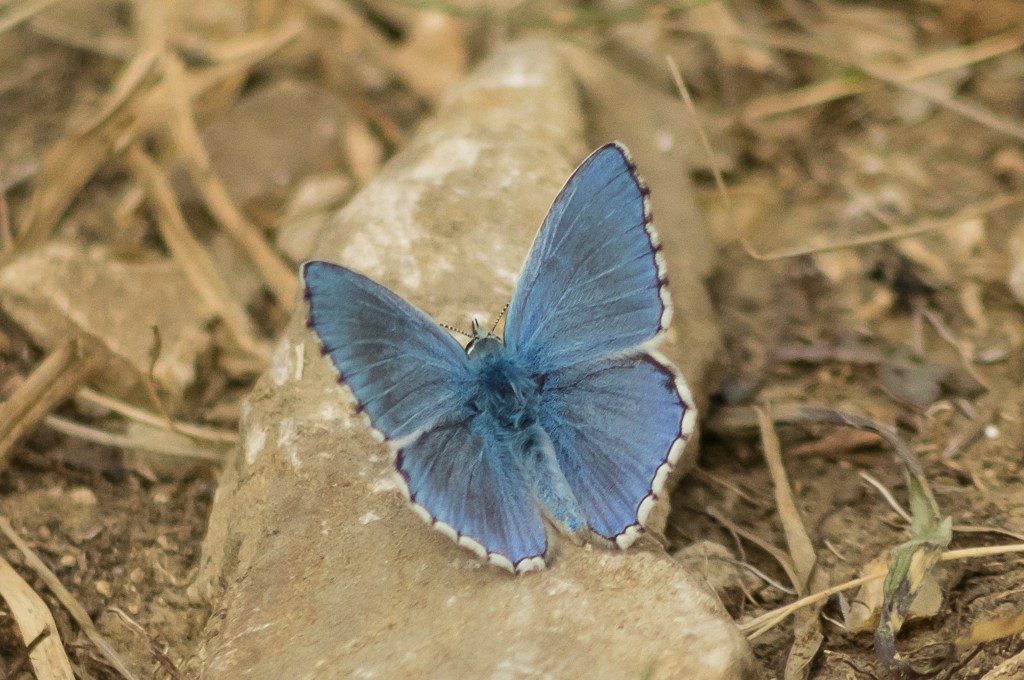
The Karst scenery began when we left the woodland and it was alive with flowering plants, many attended by butterflies. The photography of butterfIies in a hot place is a sure route to a headache and a great way to burn an afternoon with no outcome (Backwoodsman is very keen on getting an outcome). There were Clouded yellows on the wing but they were so fast and always seemed to want to be somewhere else. Some individuals seemed happy to sit. I found a male Adonis blue (rather than a Common blue) – species assignments are difficult to make on the basis of colour (sky blue versus violet blue in this case) but the UK Butterflies site drew my attention to the Chequered fringe of the wing of the male Adonis (the Common’s fringe is plain). I looked hard and in vain for the chocolate-brown female Adonis.

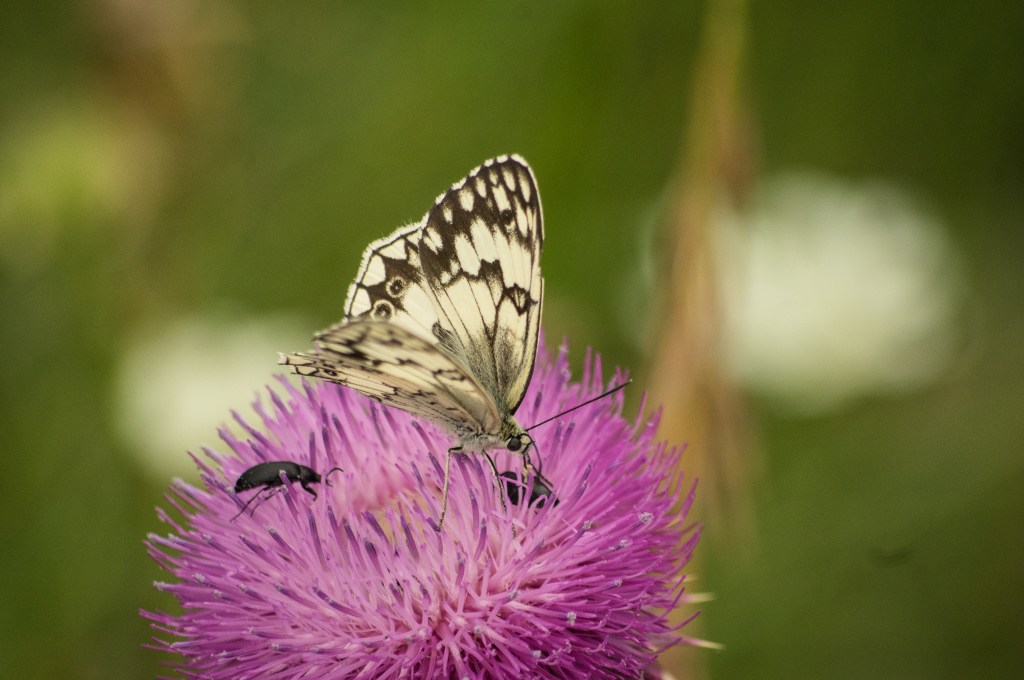
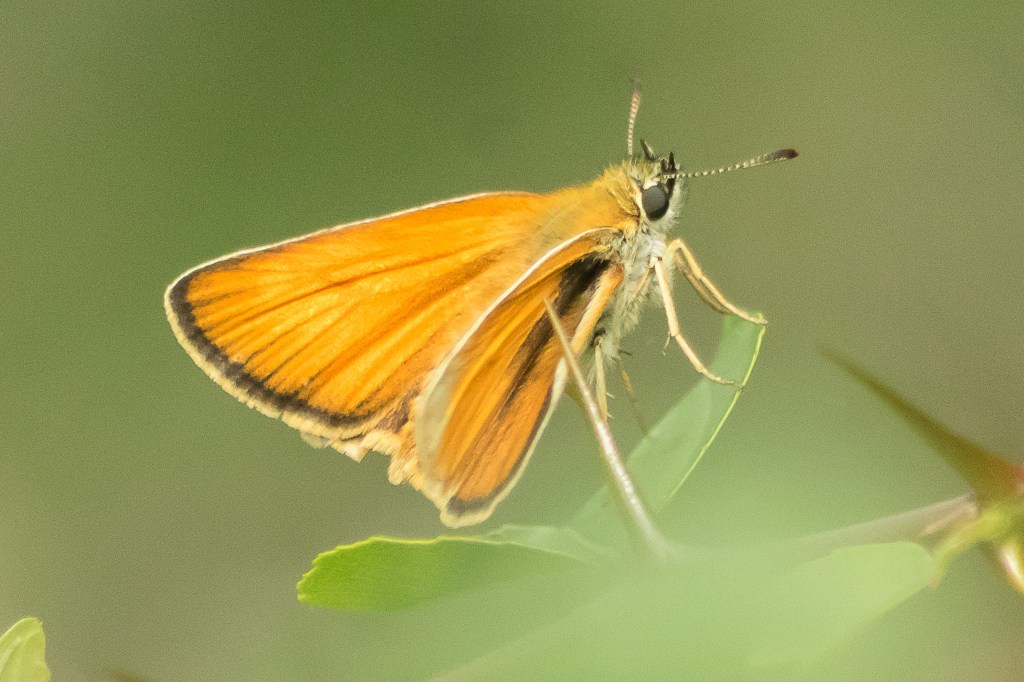
Marbled whites were looking to feed and helpfully chose plants which provided a nice colour contrast. A female Small skipper also chose to sit in a good exposed position for an unusually long time.

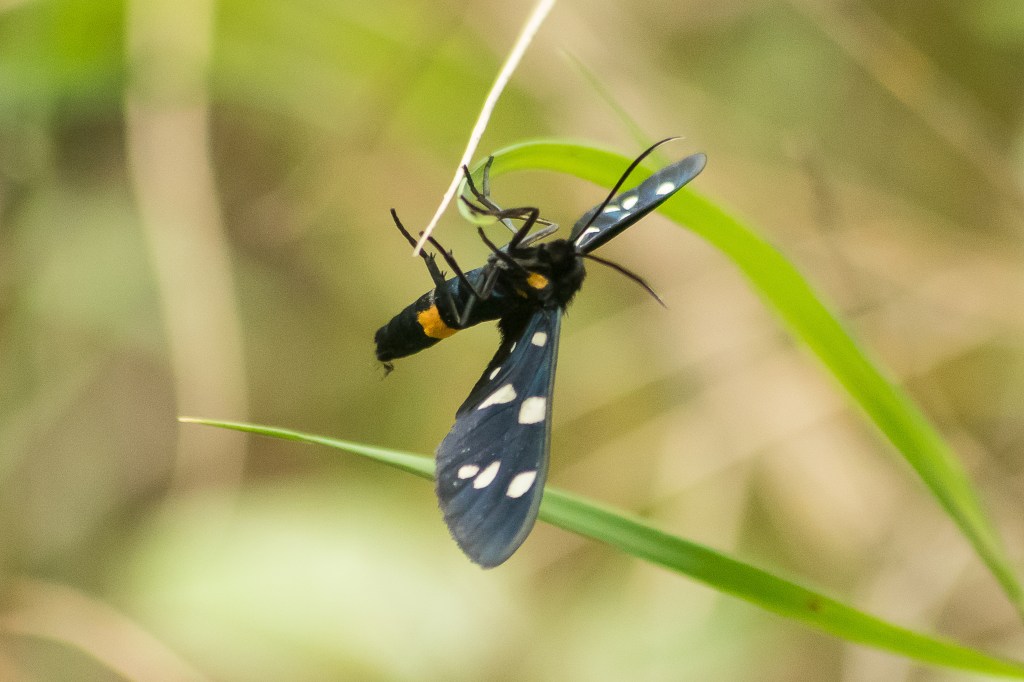
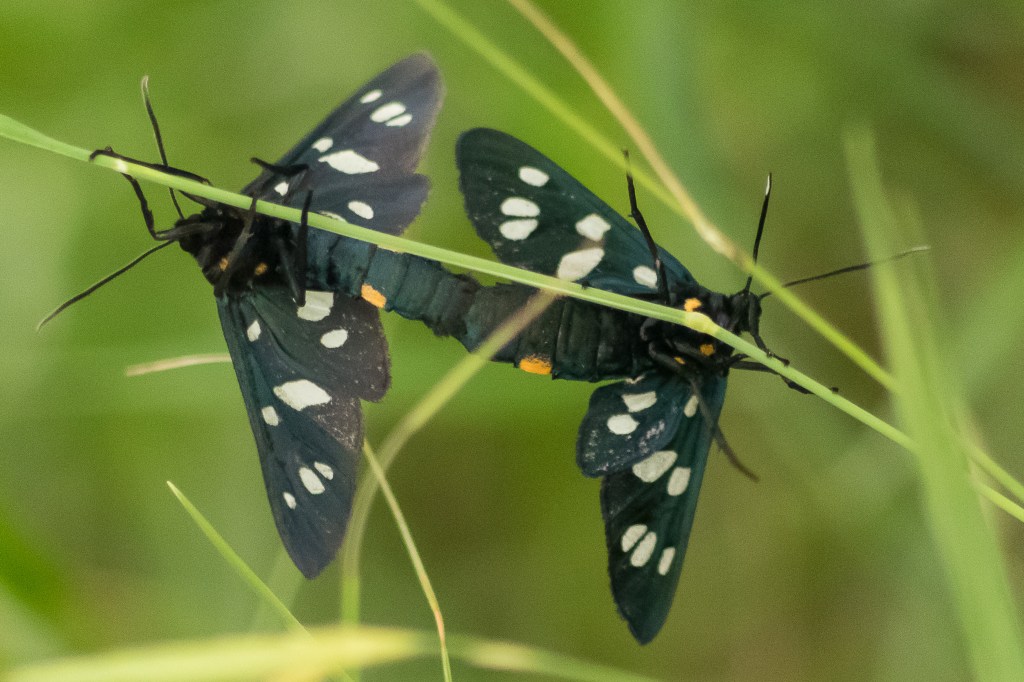
The Nine-spotted moth or Yellow-belted burnet (Amata phegea) was on the wing and mating. Zygaena ephialtes is a similar looking species, though with fewer spots. My moths seem to have eight white spots, matching the count from the images of the Nine-spotteds in the literature. If you follow the links, you’ll find some interesting material about different types of mimicry in insects.

Just before we dropped back into the woodland on the descent, we heard a distant fluting call, which was recorded. The Merlin App said Golden oriole and in the distance across the valley (ca. 100m away), we spotted a couple of brilliant yellow birds flitting in the canopy. We hoped to catch up with them – any image of these exotics would do but they were not to be found, alas.

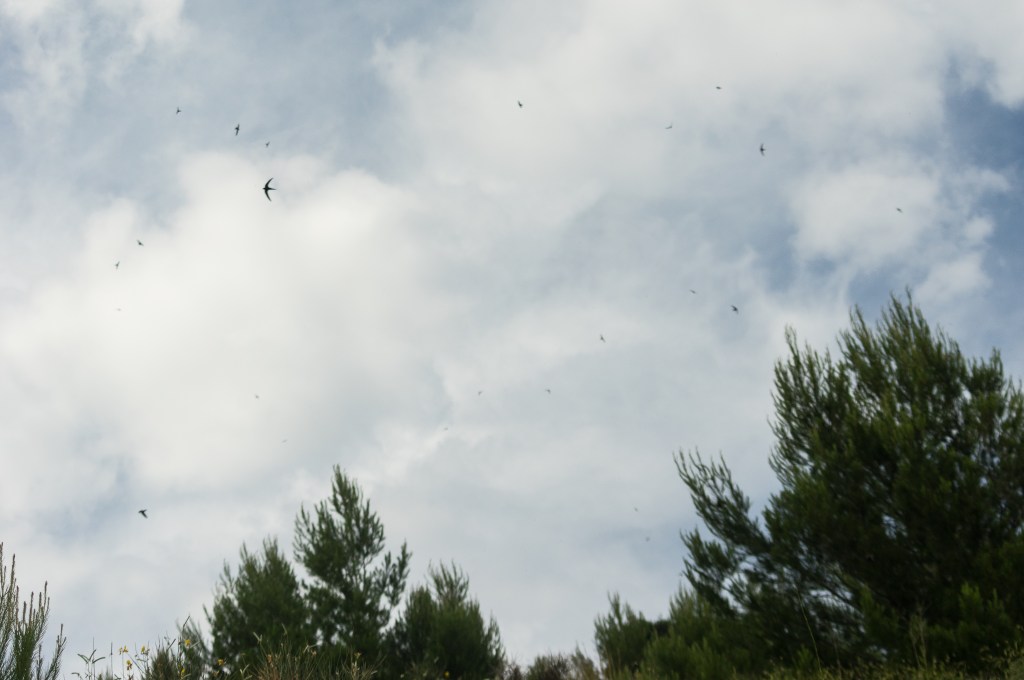
The walk behind the houses afforded our second sighting of Swifts (a visit to Split providing the first). We were very pleased to see a large group, though they are very hard to photograph. My best effort does at least have a recognisably Swift-shaped bird in the foreground. I think there were a couple of dozen in this group, exceeding my UK tally for the year by a good distance (one in Prescot, three in Callander).

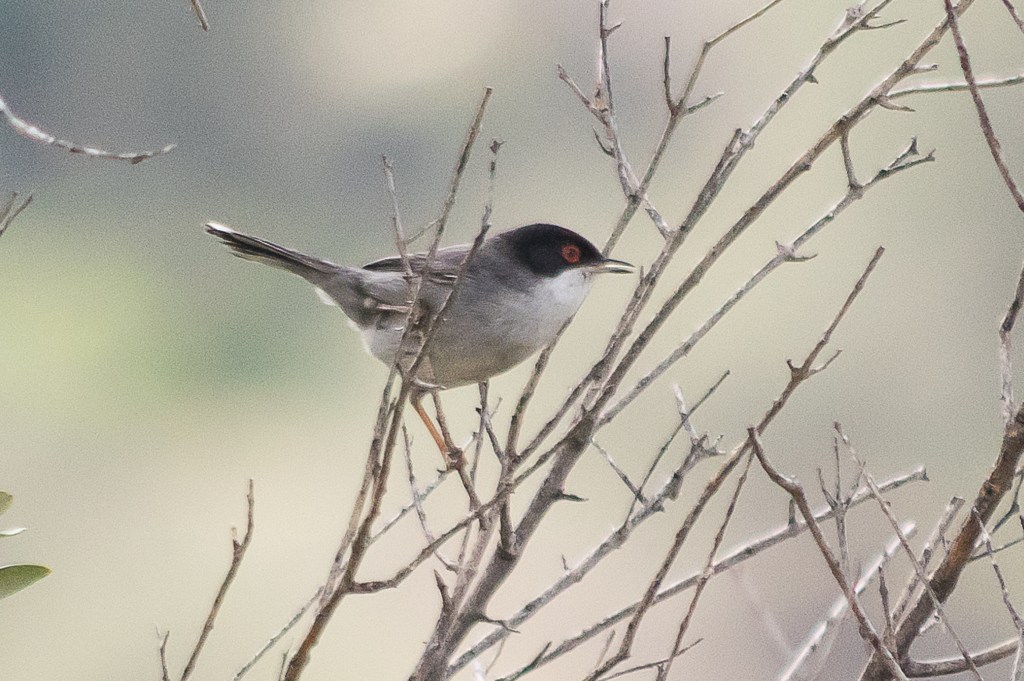
We also caught up with some very active Sardinian warblers; I’m using an image of a Majorcan cousin taken last year.

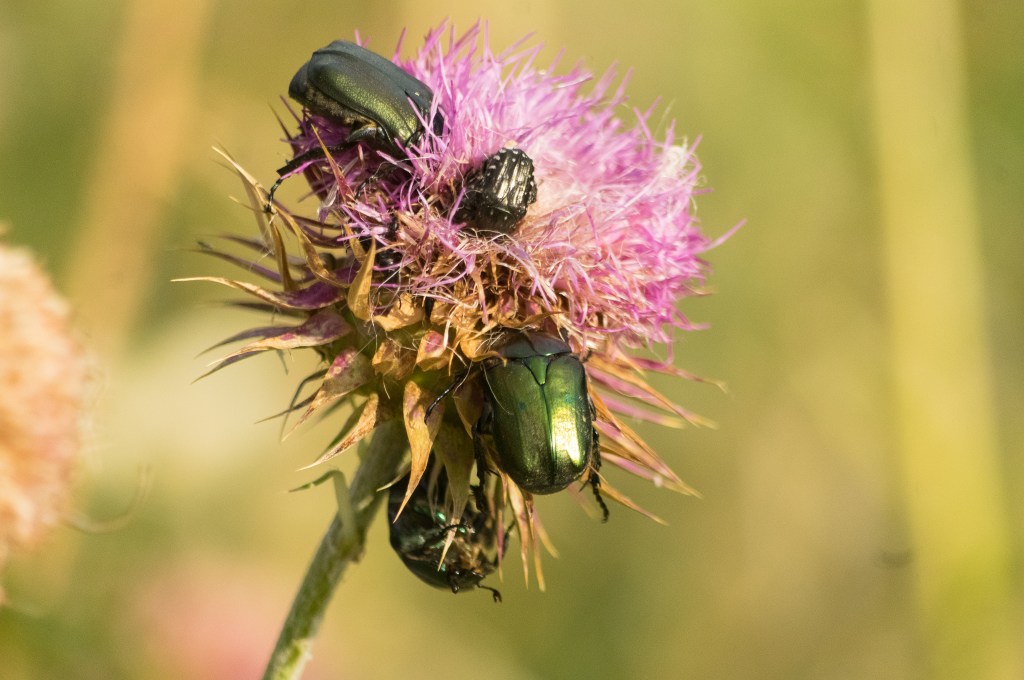
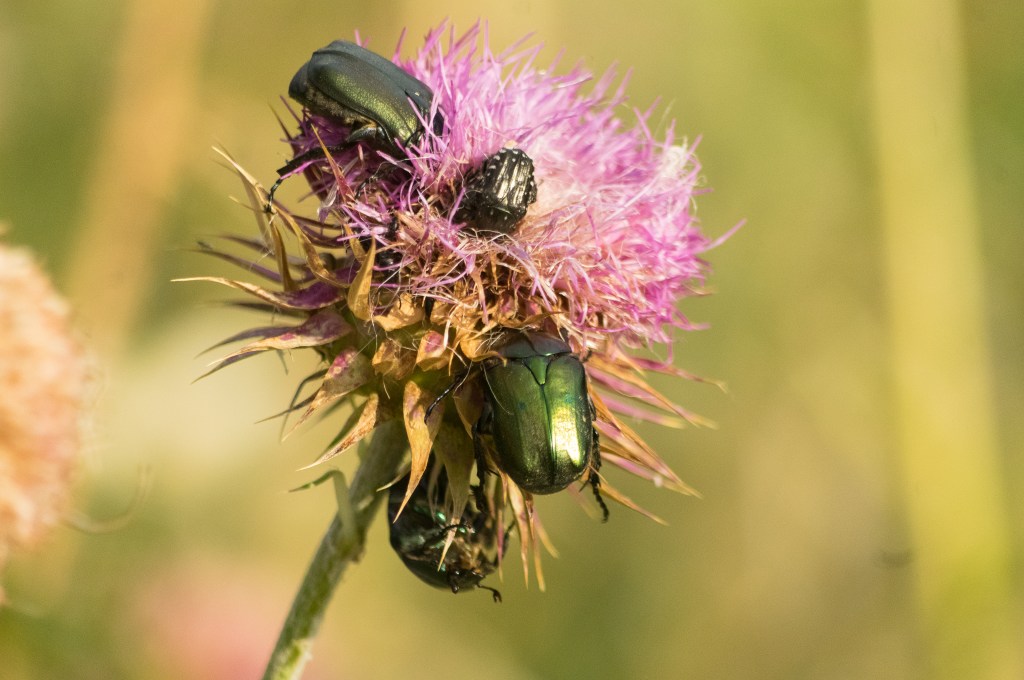
There were some good beetles too but the first is a bit confusing. My beetle book  (A Field Guide in Colour to Beetles, K. W. Harde, ed. by P. M. Hammond, Octopus Books, London, 1984, ISBN 0 7064 1937 5) identifies the big green chaps in the next image as Cetonia aeruginosa but my searches suggest that the Cetonia has been superseded in the accepted nomenclature by Protaetia or Cetonischema. Cetonia aurata, the Rose chafer appears to be similar. The smaller chap in the picture may be Tropinota hirta.

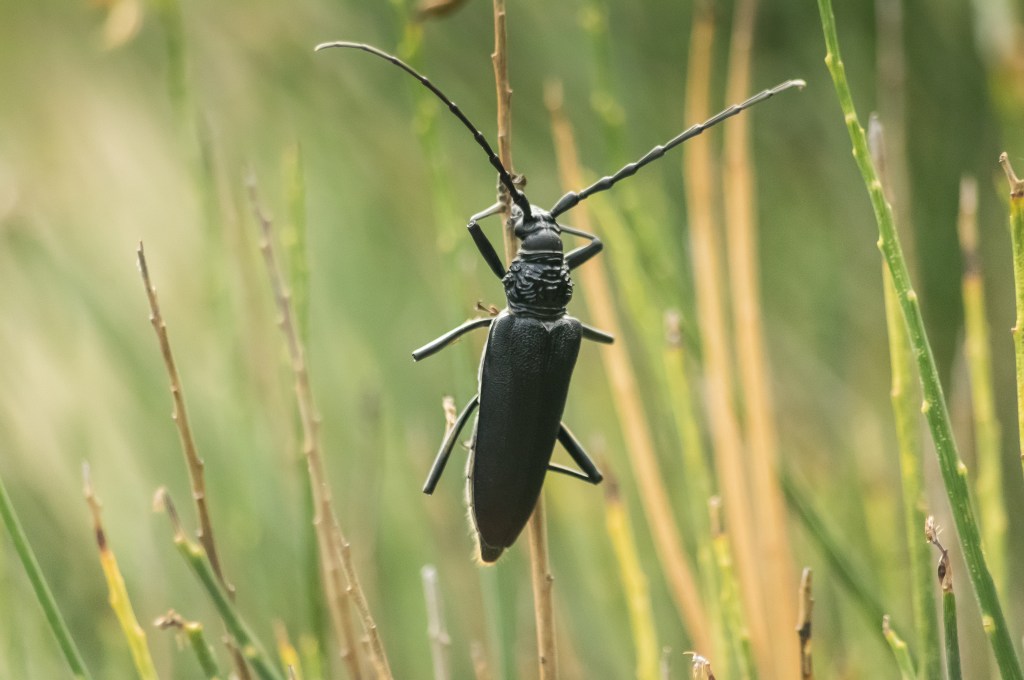
There isn’t much doubt about this chap; he flew unsteadily and noisily past us, and we went in pursuit.

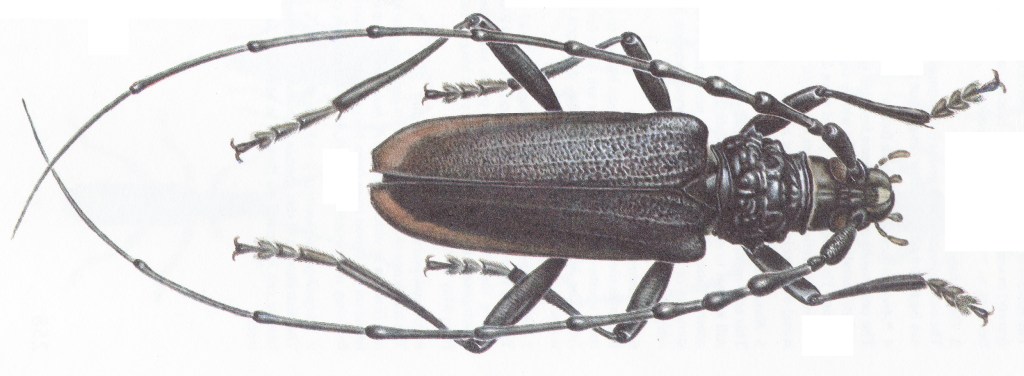
He’d only gone a few metres and was now swaying on a stem, all 5cm or so of him (antennae excluded). My beetle book identifies him as Cerambyx cerdo, The Capricorn beetle. I’ve included the beautiful graphic by František Severa, a prolific book illustrator about whom I can find absolutely nothing. The photographic image is of sufficiently high quality to reveal the illustrator’s powers of observation and technique.

While the species seems to be quite vulnerable in wild woodland (and useful, its tunnelling larvae open up old trees to a wider range of species), this longhorn can be a bit of a pest in Holm oak trees in urban environments. I always hope to come across some really outrageous beetles in the wild and this one will do very nicely. Those antennae! Longhorns use them to detect kairomones, signalling molecules with a wide range of functions.

We’d had two very rewarding walks and were thankful that the natural season was possibly a little late this year, and that we had travelled to Croatia some weeks earlier than for previous visits. The second post from Croatia will look at species on the ground and I suspect it will be Saturday July 1st before I can make it happen. I’m sorry if the images are slightly less crisp than usual but I hope you get a sense of the abundance of wildlife in this beautiful country.
Spring and Summer Swans

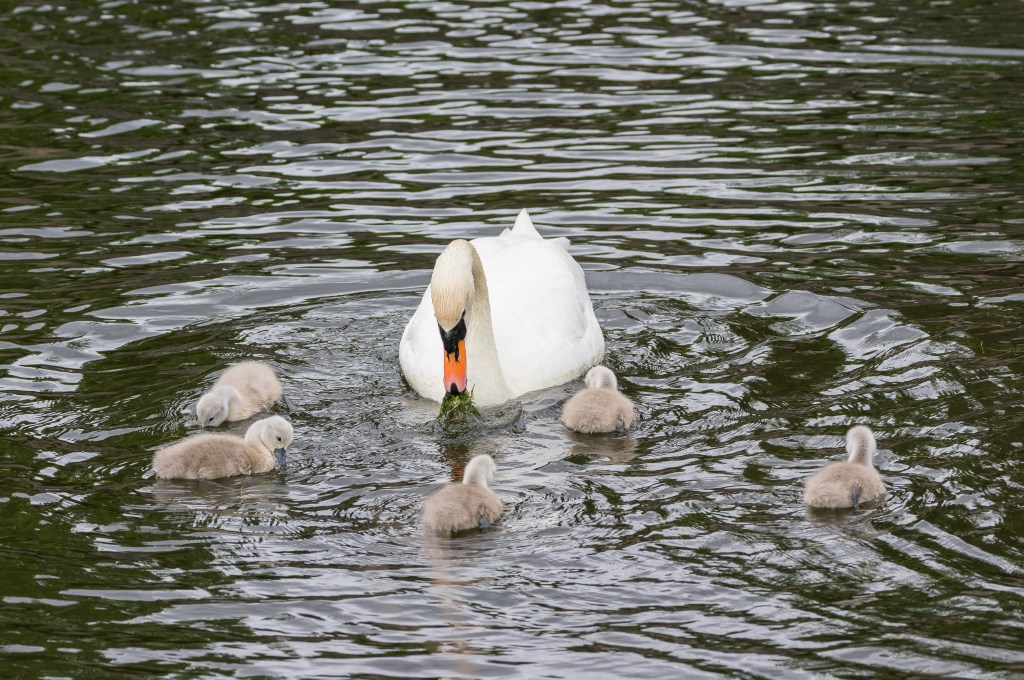
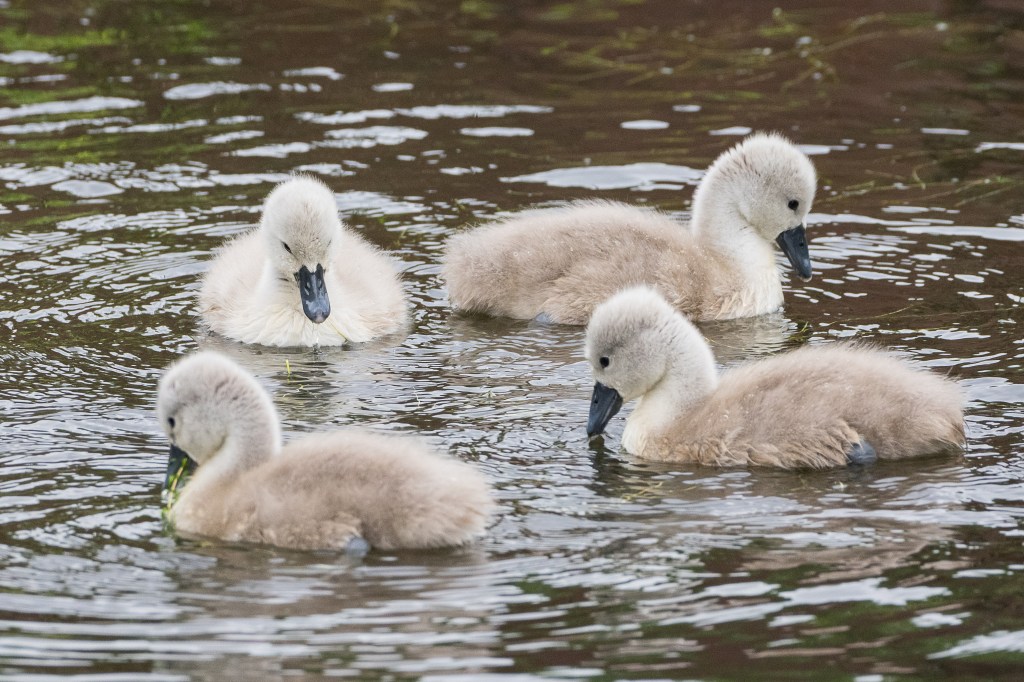
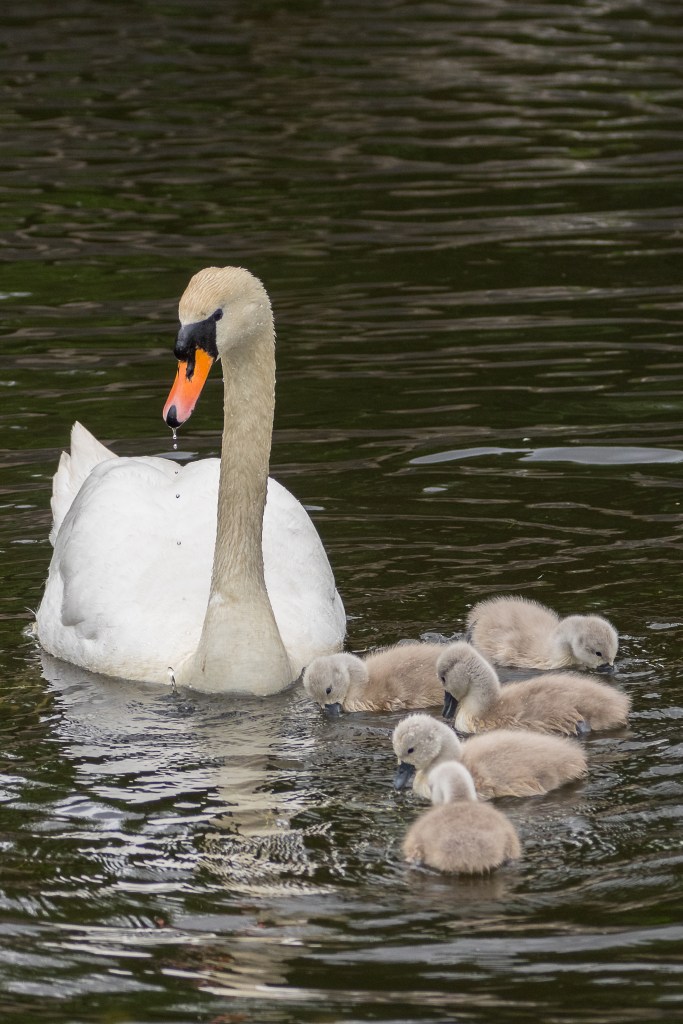
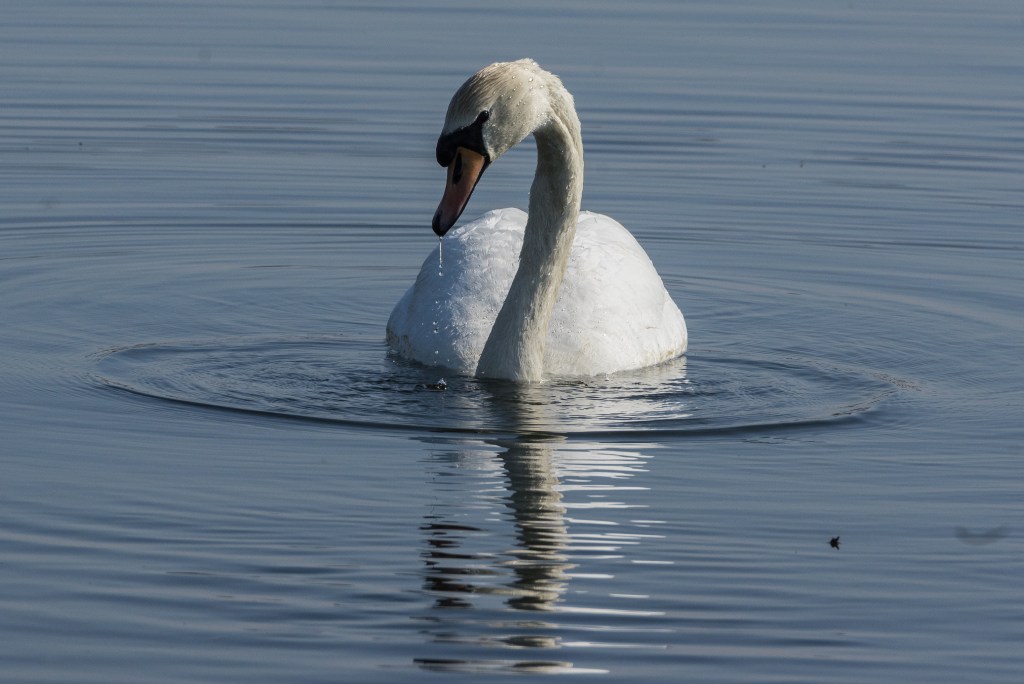
Spring and summer are eventful seasons for our Mute Swans. Backwoodsman sees them returning to old nest sites on the Forth and Clyde Canal. Some of these sites seem a bit accessible to annoying humans and potential predators; Mute Swans are quite handy in a scrap but they can be a worry. The Firhill Basin nest has always given most cause for concern. There was a chap who popped up a few years ago and used to walk the canal every day. He would hurl industrial quantities of bread at anything he could see on the water. When the swans nested at the Basin (right by Partick Thistle’s ground), he started to hang out by the nest and even began attempting to landscape it, digging them a moat and installing garden tat from the middle-of-Lidl while the swans looked on bemused. Backwoodsman grew increasingly uneasy and even telephoned the SSPCA to report this as an act of animal cruelty; they didn’t seem to think it was cruel to loom constantly within feet of wild birds attempting to go about their legitimate breeding business. There weren’t any cygnets that year. I haven’t seen him for a long time; his rubbish was cleared away and the swans got back into their groove. I found six cygnets when I ran on the canal last week . The images that follow were acquired in previous years.
Summer proper sees the rather extraordinary business of Swan Upping (the annual census of the swan population living on the River Thames). I became aware of this event from the painting “Swan Upping at Cookham” by Stanley Spencer. It’s in the Tate and the gallery note says that:  “This painting shows an annual ritual on the Thames that continues to this day. Unmarked swans on the river belong to the British Crown. Those owned by two guilds, the Companies of Vintners and Dyers, are marked in a ‘swan upping’ ceremony every year. Here the swans are being brought ashore at Cookham. Spencer said he was inspired to make this work while he was in church and could hear people on the river outside: ‘the village seemed as much a part of the atmosphere prevalent in the church as the most holy part of the church.’ This fusion of the everyday and the divine was typical of his attitude to his Christian faith.”

I first saw the painting in postcard form when I was in Cambridge in the early-to-mid ‘Eighties. Tales of the extravagance of College Fellows’ dining arrangements were popular among right-on students, and the right of Johnians to eat swan at High Table was the top item, and probably apocryphal to boot. I was never completely smitten by the overtly religious Stanley Spencers I came across in Cambridge but I was delighted to discover the Shipbuilding on the Clyde series which he executed in Port Glasgow during the 1940s.

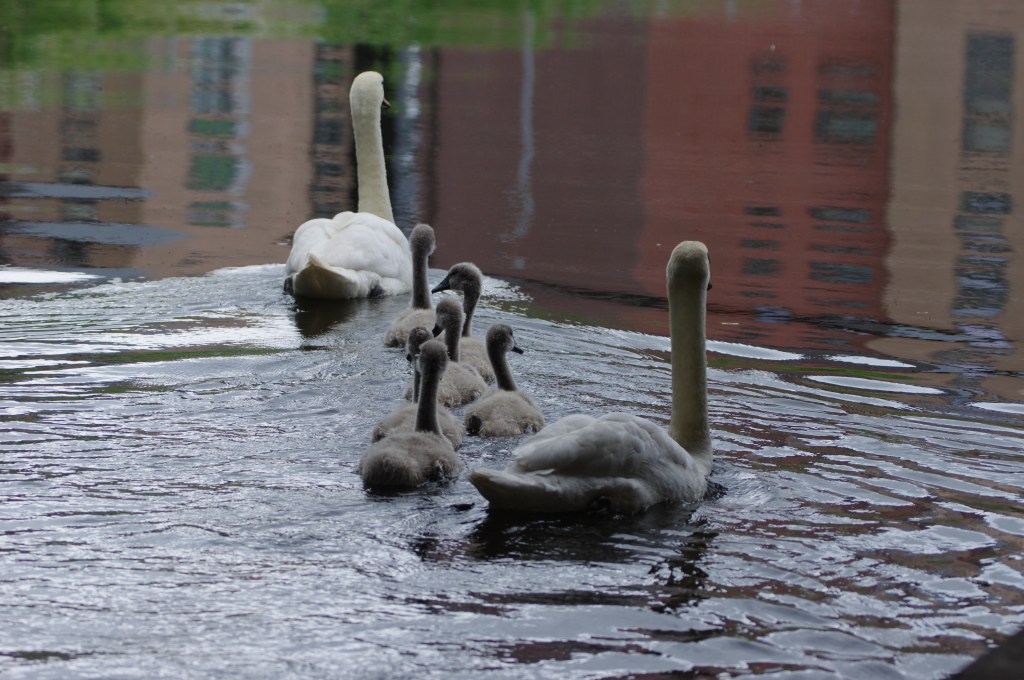
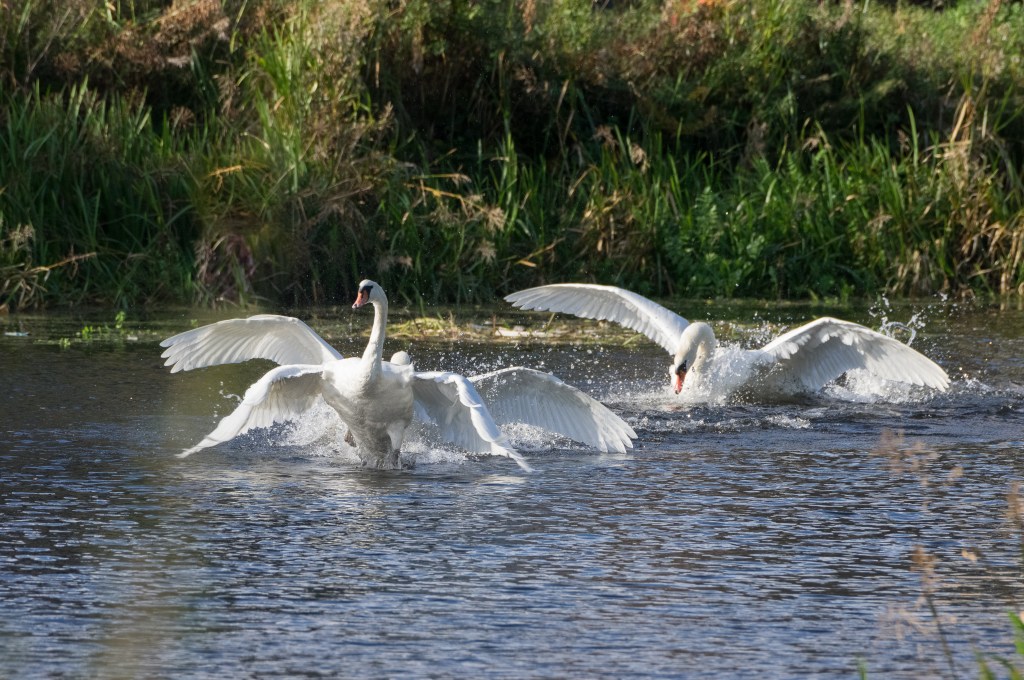
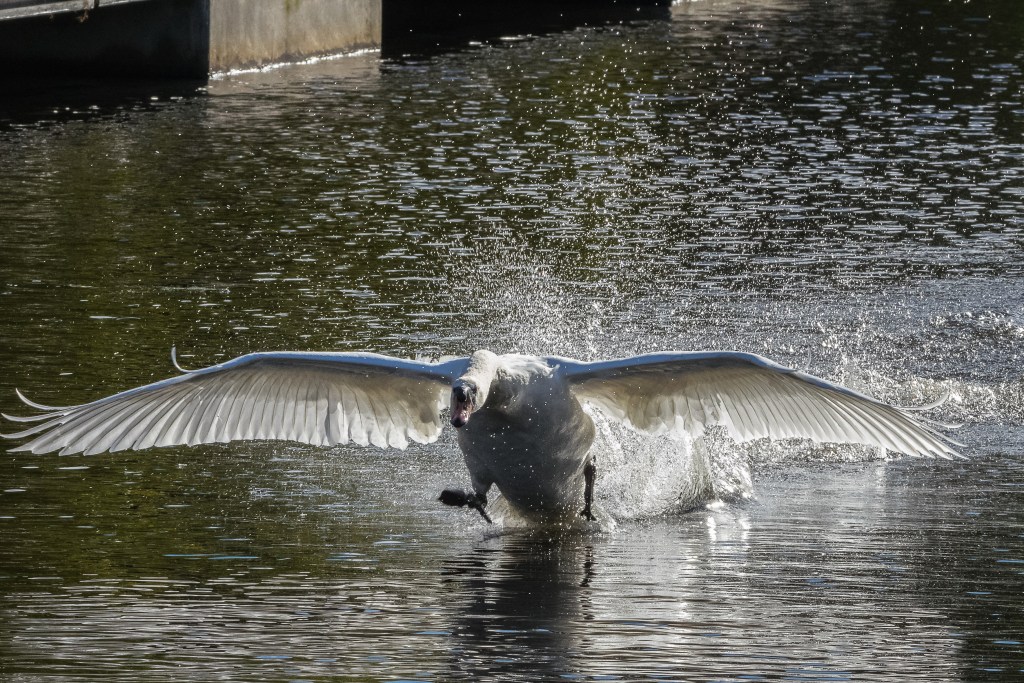
Swans usually nest at Pinkston Basin, Bilsland Drive Aqueduct and at Old Farm Lane – the latter two nests are practically on the towpath. The Cob from the third nest has been known to deny passage to walkers and cyclists. Cygnets grow up quickly and it’s very pleasing to see an adult pair hanging on to all or most of their progeny, even if the adults may well drive the young away in due course (their first Autumn). This group is sailing back onto Firhill Basin under the Nolly Brig.

I used to think that Swan Upping referred to some forced physical relocation of swans, perhaps moving them away from a weir or flight of locks. Had I convinced myself that these apparently serene creatures would defer to the Monarchy and stay where they had been put?

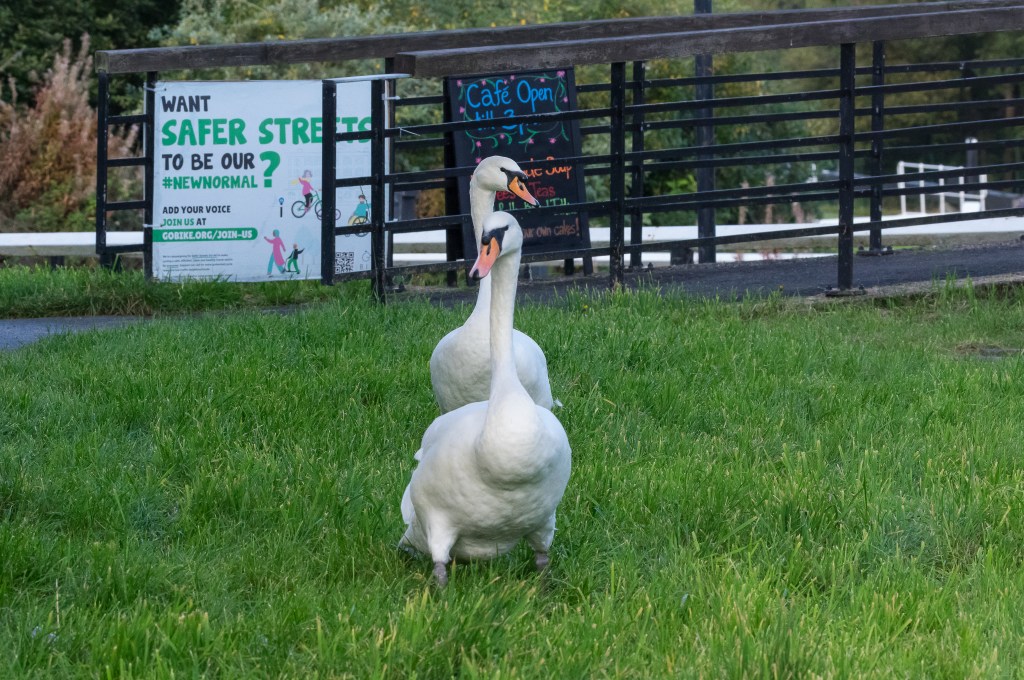
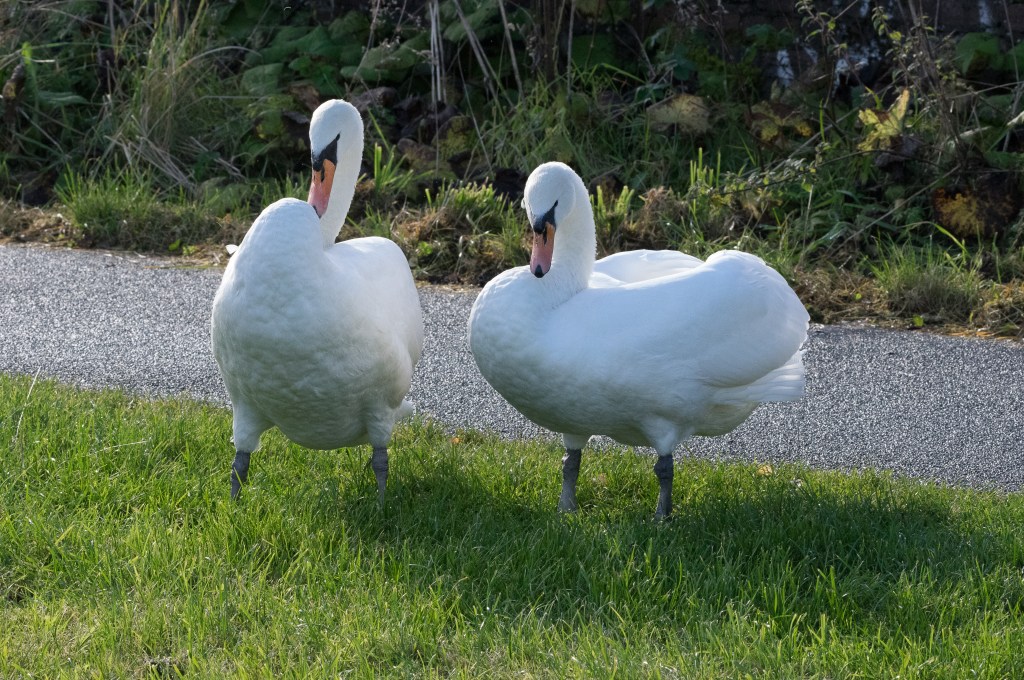
When we saw this pair walking up the Lock flight at Maryhill via the towpath to get to the Summit Pound, I joked to myself that these were republican Glasgow swans and no Queen was upping them, thank you.

The locals were waiting for them and defended their territory with vigour. I’m assuming we were watching a new pair looking for a breeding territory and finding the canal quite busy.

Backwoodsman apologises for a late posting this week – a fishing day on Friday, and Saturday on the Tarmachan Ridge rather threw out the schedule. There is holiday coming (hurrah!) and the next post is planned for Saturday 24th June.

Moorhens

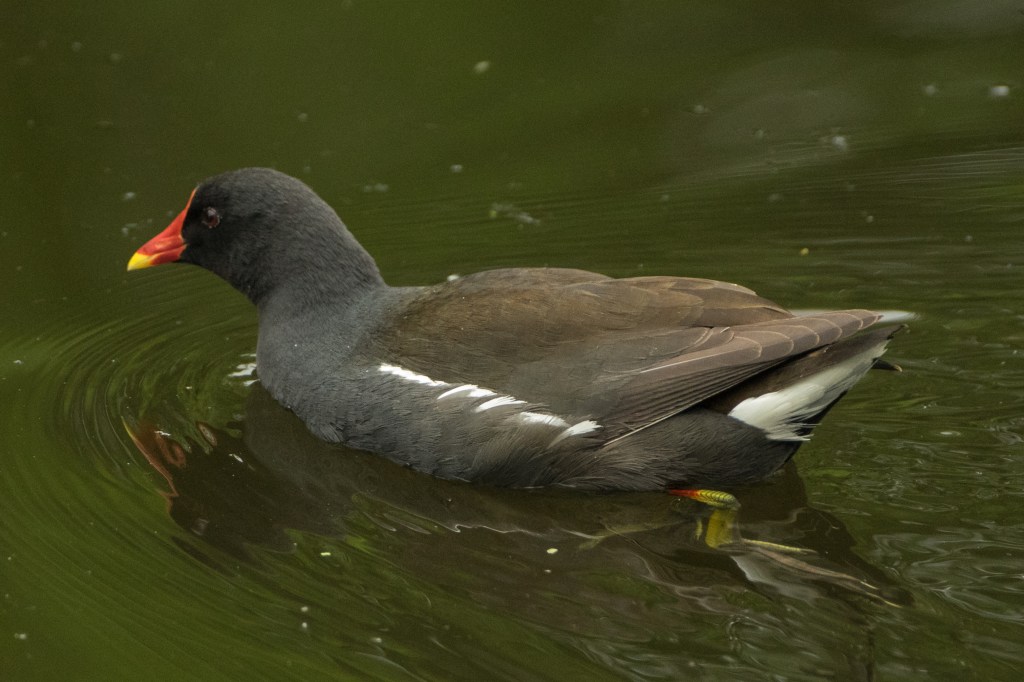
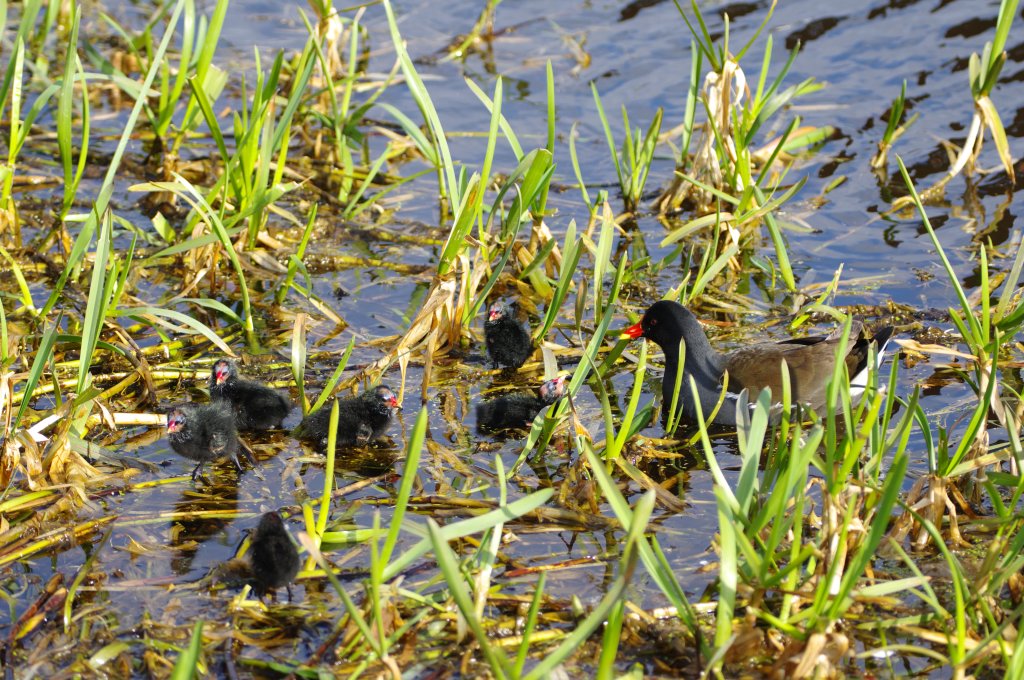
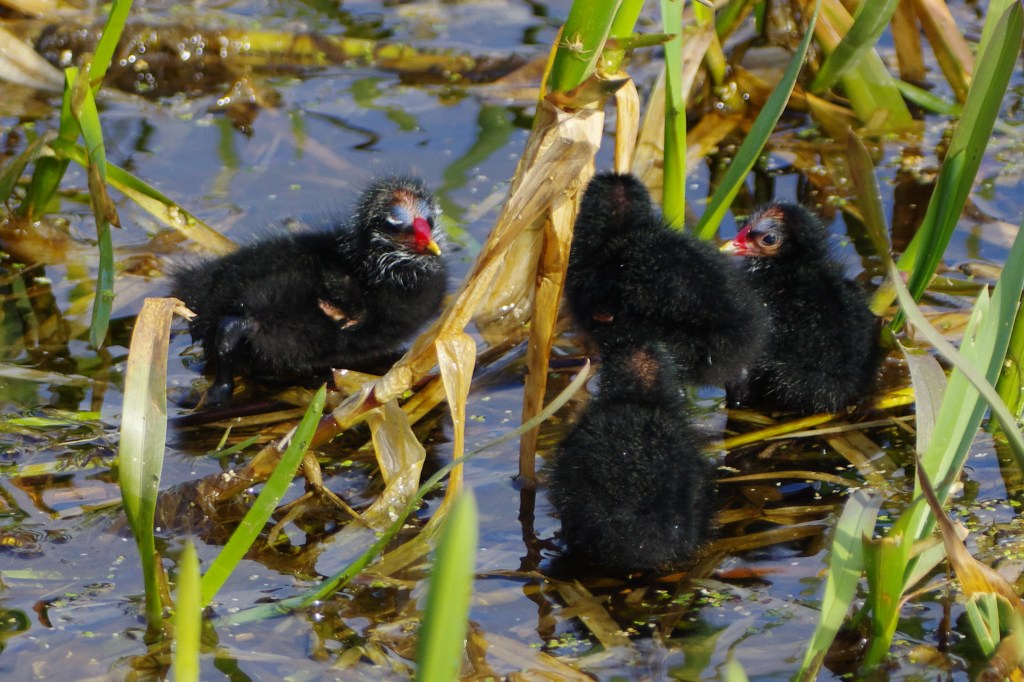
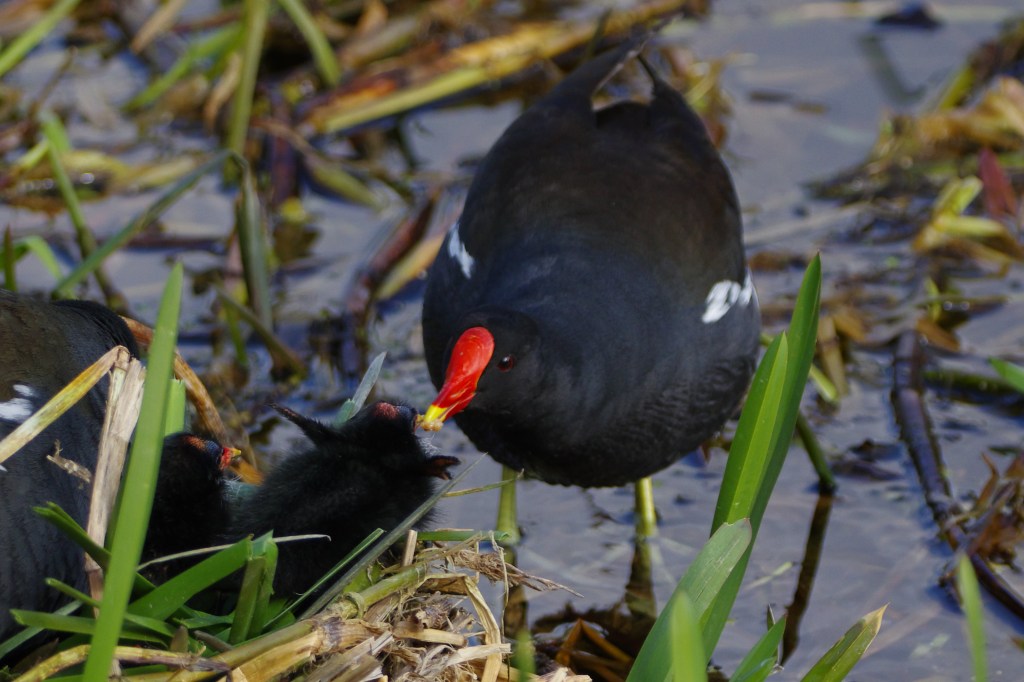
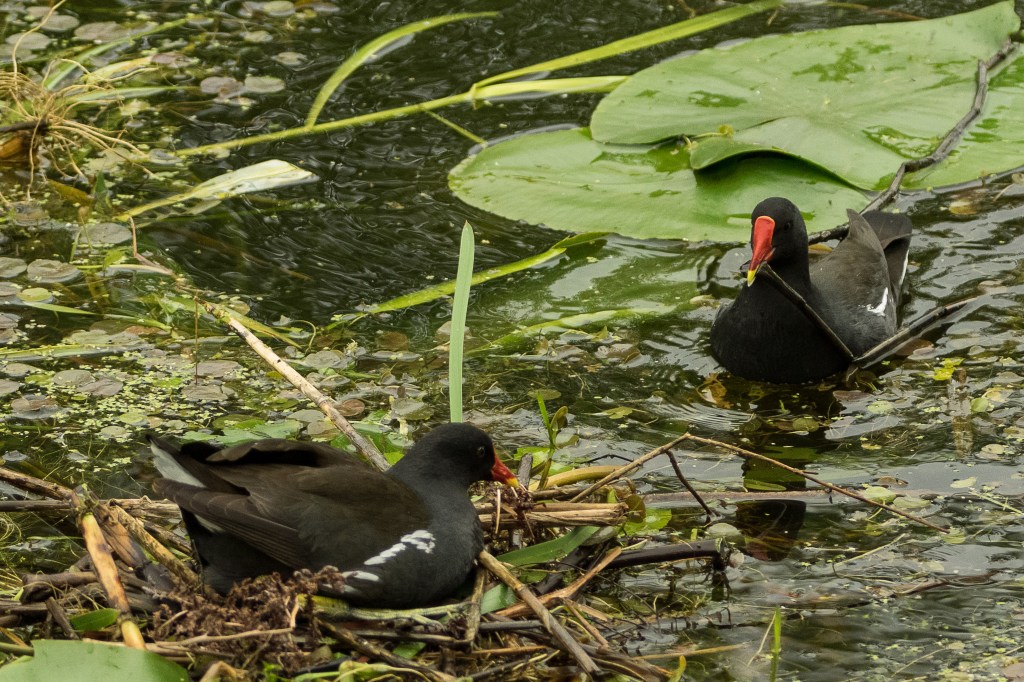
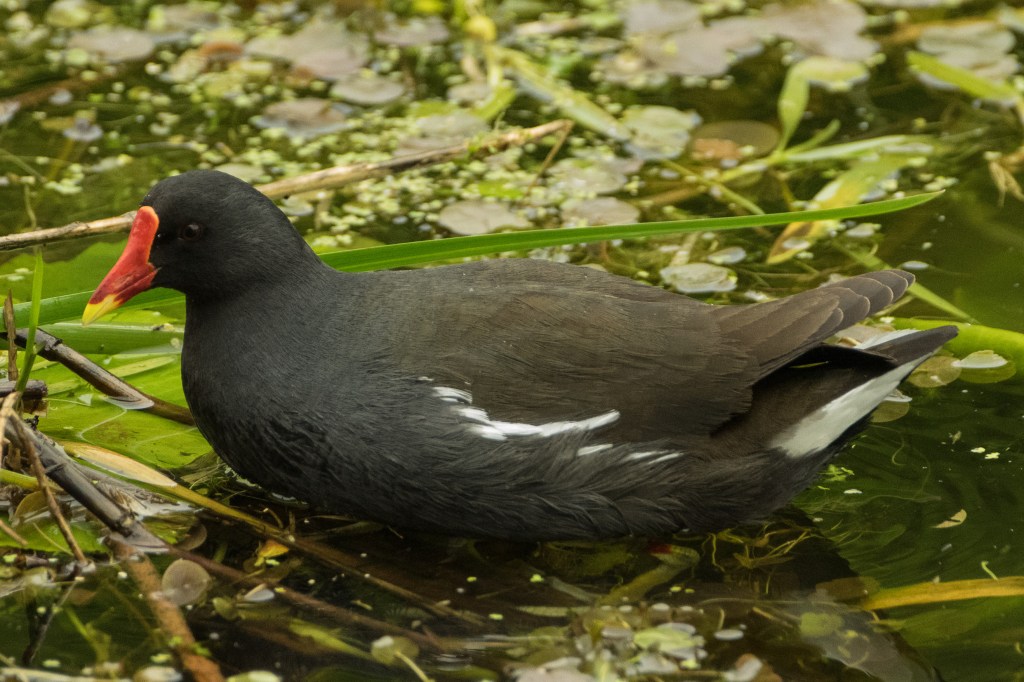
Early- to mid-May is the time for young birds around here. Though I haven’t seen any yet, we’ve had regular reports of young Moorhens in the area, so I’ve decided to post some old stock from previous seasons, all of it taken on the Forth and Clyde Canal between Speirs Wharf and Maryhill Locks. I run on this section of towpath giving me good opportunities to recce possible birdwatching sites. I can usually guarantee a Moorhen or two and they’re a cheering sight. Despite their size and ubiquity, I’ve found that my photographs are often disappointing; unless the birds have a very good reason to be still, they seem to be in perpetual and erratic motion and I rarely get the crispness I want in an image. I like this one – the colours seem true to life and the orange garter at the top of the leg is visible. There is a hint of blue sheen towards the base of the neck.

The WWT tells me that: “The orange-red bill with a bright yellow tip is actually coded so other moorhens can tell how healthy an individual is – much as flamingos do. Scientists have shown the different colours on the bird’s bill are actually health indicators. The red seems to be related to low levels of bacterial infection, and the yellow to blood parameters such as resistance to infection. The brighter the colours, the more attractive the bird is deemed.” One source for this is a paper by Fenoglio et al. (Bird Study, 2002, 49, 89–92). The authors endorse the yellow colour at the tip as a health indicator. I couldn’t find a source for the reference to the red colour. The colours arise from the presence of carotenoids – violet to green light is being absorbed hence the red to yellow coloration.

As usual, the BTO have interesting material on their website including this: “Moorhen courtship and territoriality has been well studied owing to their abundance in and around University towns.” I haven’t seen the delicate courtship or the rather spectacular fighting when I’ve had the camera in hand, alas.

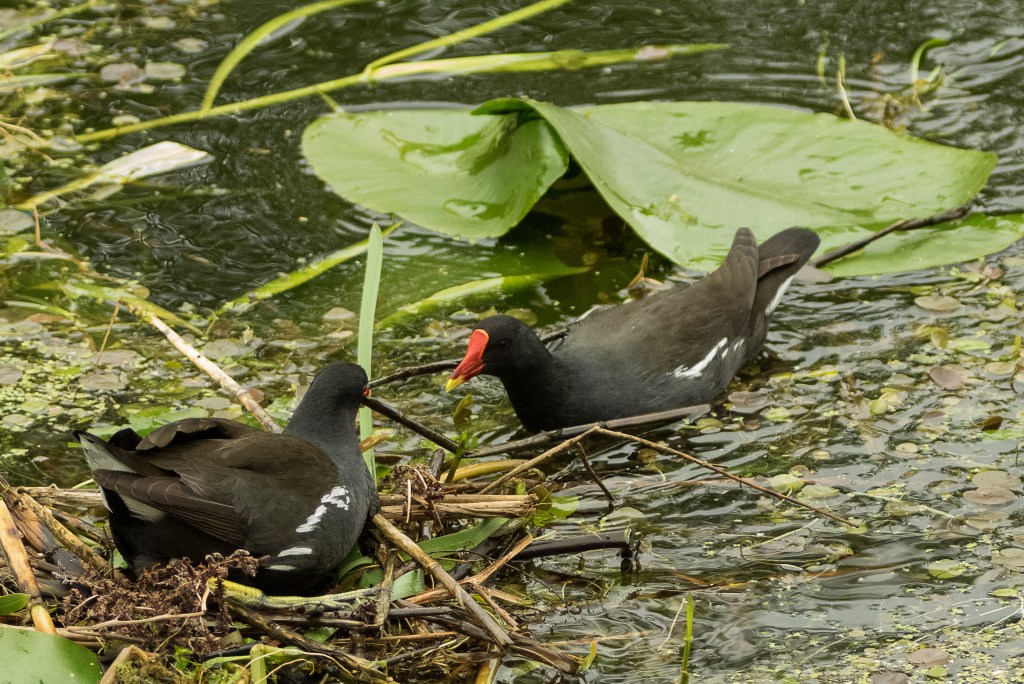
I have seen pairs nest building; the bird doing the leg work gets to make trip after trip across and up and down the canal. It’s tiring work and you can see how errors might creep in with growing fatigue. After what looks like a good start, this bird has gone wrong and started bringing items which need a good cut down. My copy of “The British Ornithologists Guide to Bird Life” (Blandford Press, Poole, 1980, ISBN 0 7137 0996 0) tells me that “The male builds the nest, the female helping by collecting nesting materials” which is not what I expected.

More successful construction projects will culminate in the pair taking turns to incubate five to seven eggs for up to twenty-one days. More than one female may lay eggs in a nest according to my RSPB book.

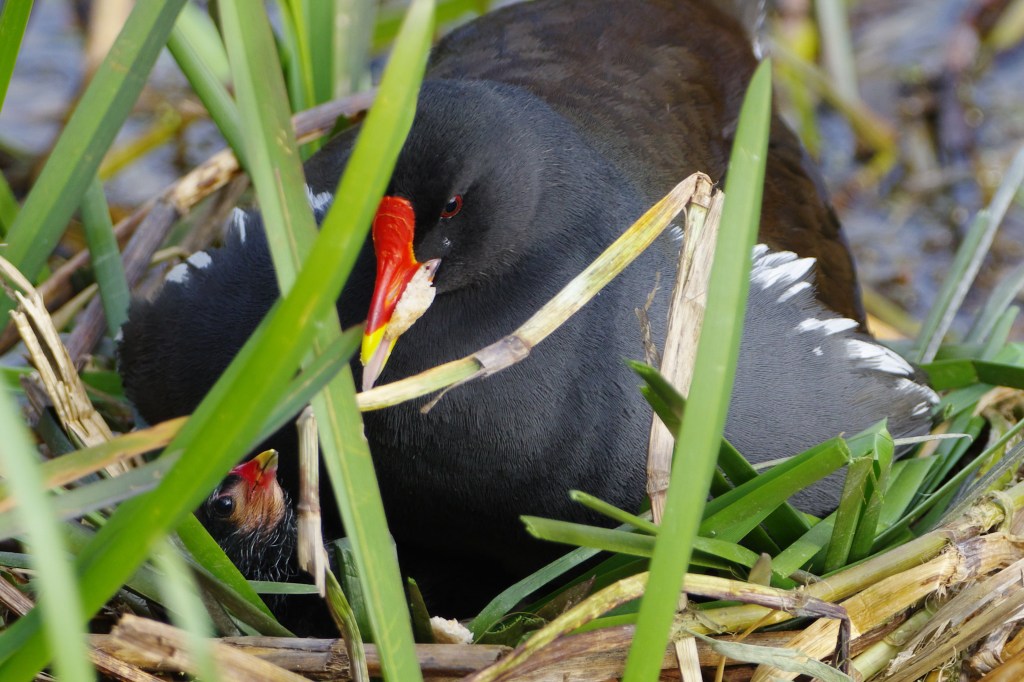
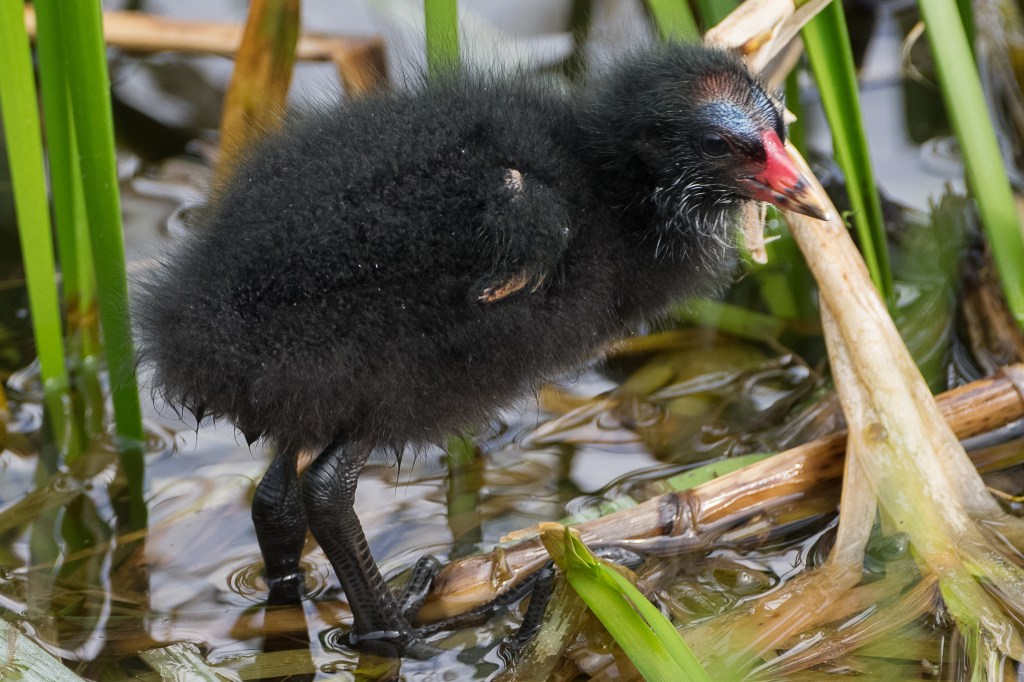
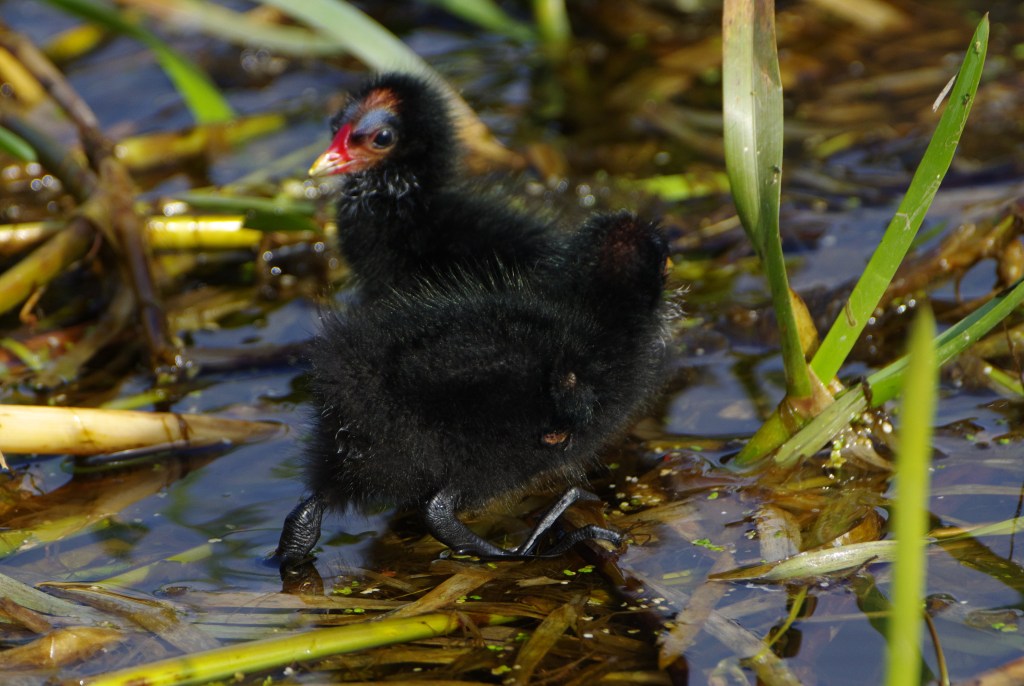
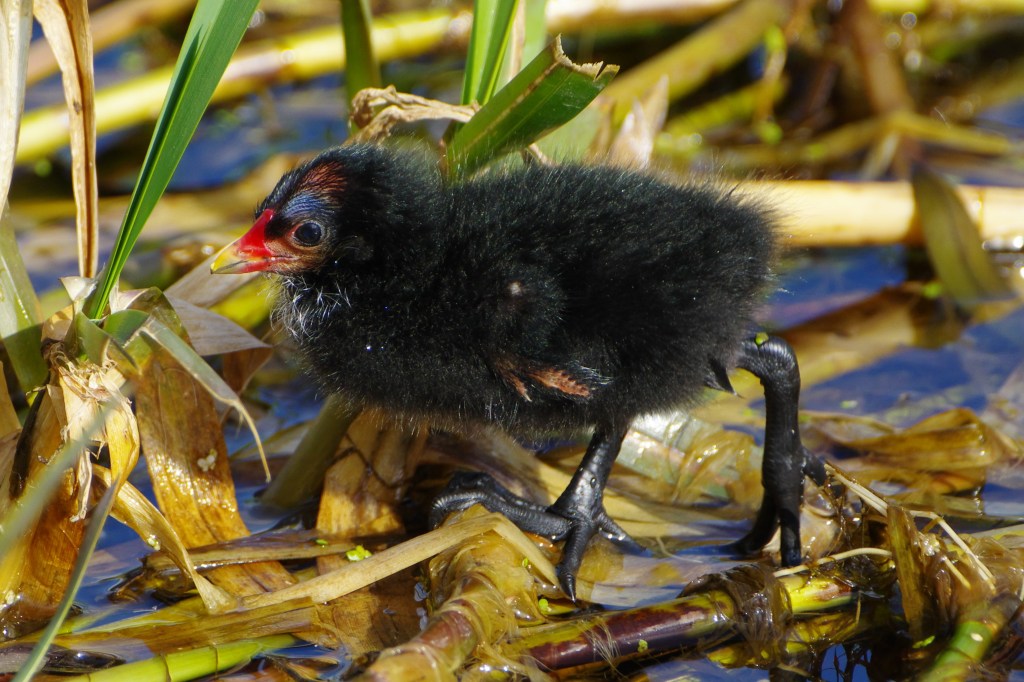
We had watched a nest being built on the canal by The Whisky Bond. This part of the  canal has the first reedy margins on offer after the stone banks of Speirs Wharf. The nest was tucked in right under the towpath making it quite difficult to see, unless you were looking for it. I followed up our weekend viewing with a run during the week; things had moved on, with a bird incubating eggs. I kept checking the nest and we timed a weekend walk to give us a chance of some chicks. We were blessed with sunshine and this sight.

May I stress that I am at quite a distance from the nest, using all the reach of my zoom lens so as not to loom? This piece in The Guardian writes nicely about the bird and describes chicks in a threatening situation.

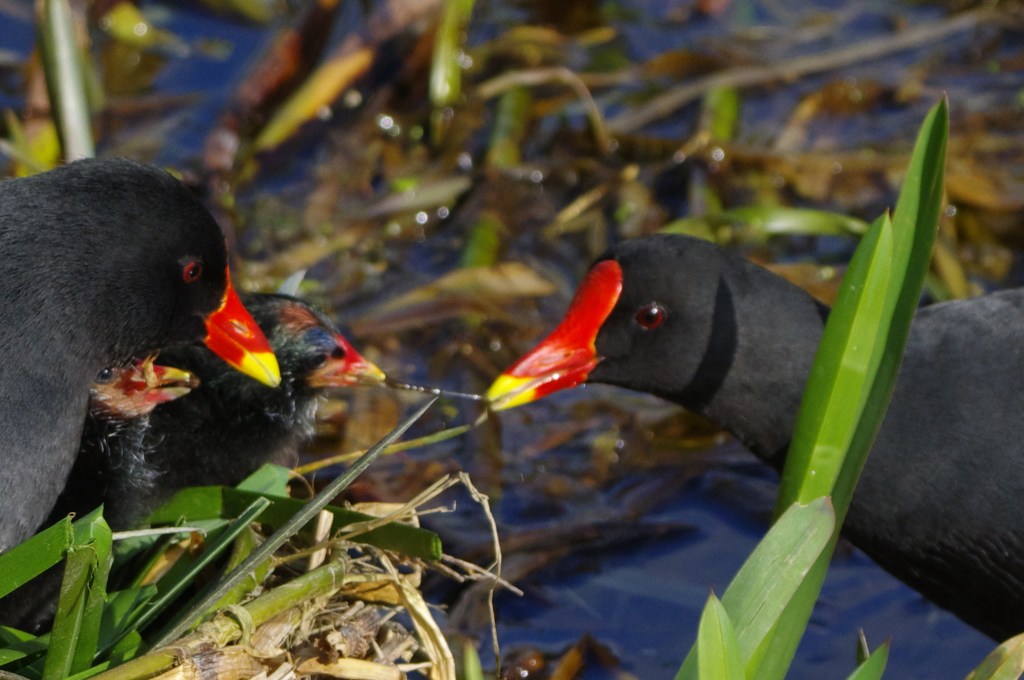
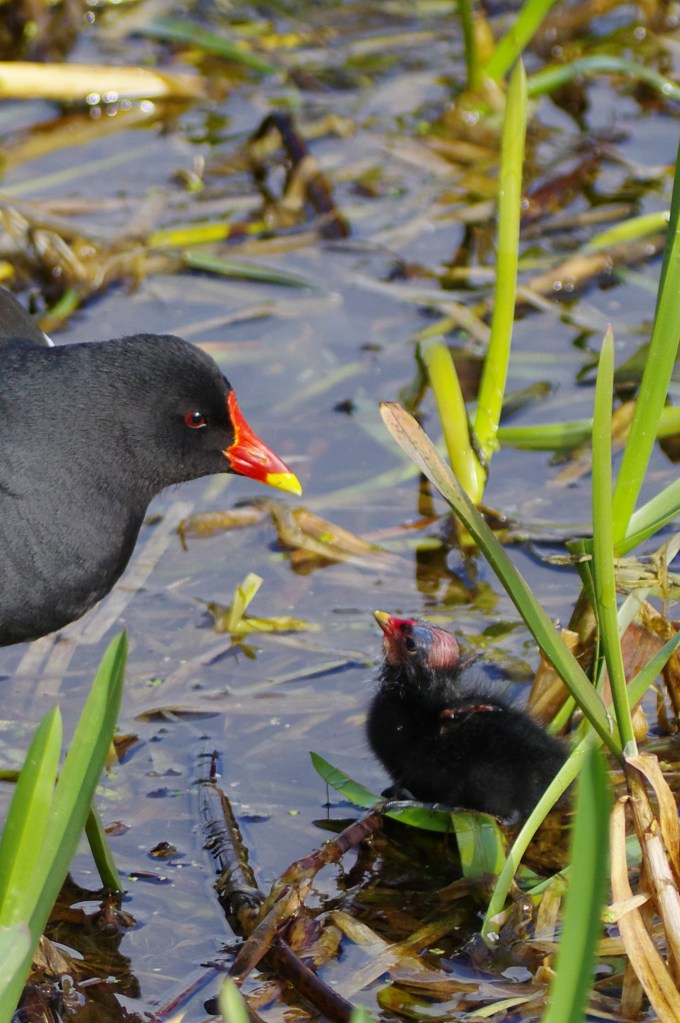
I took quite a lot of pictures and have posted some extras in a gallery at the end. I will limit myself to a few of the most appealing here in the main post.

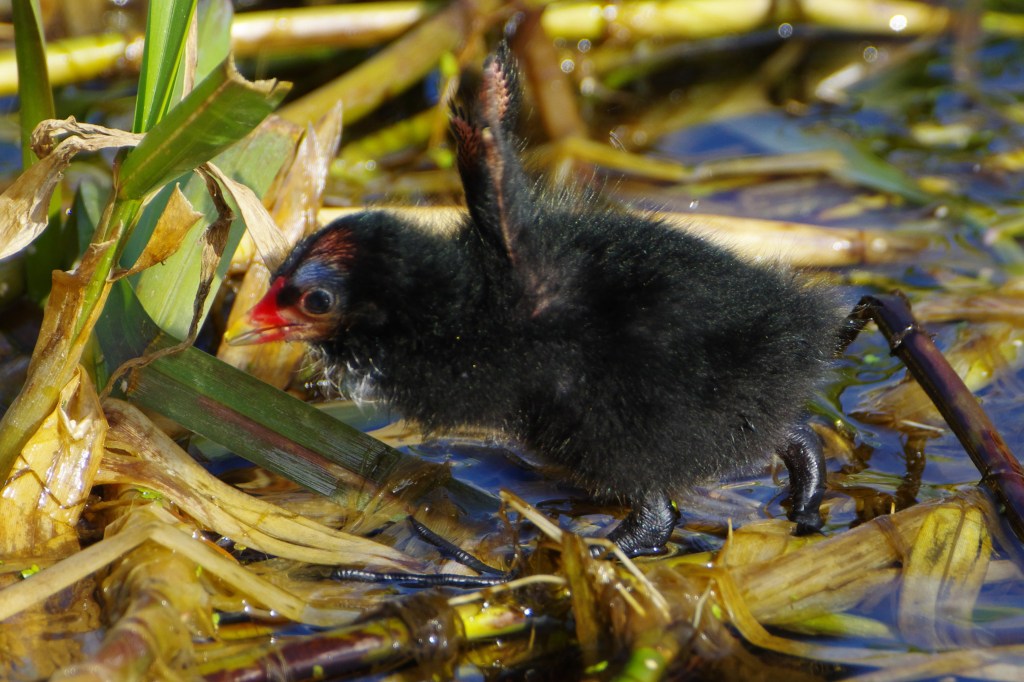
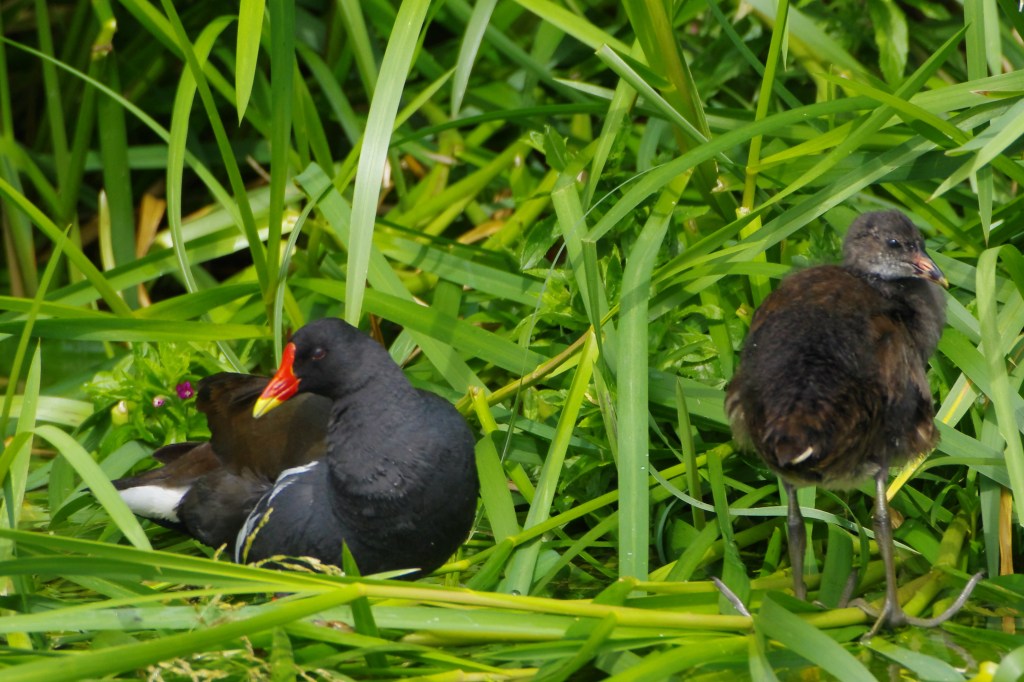
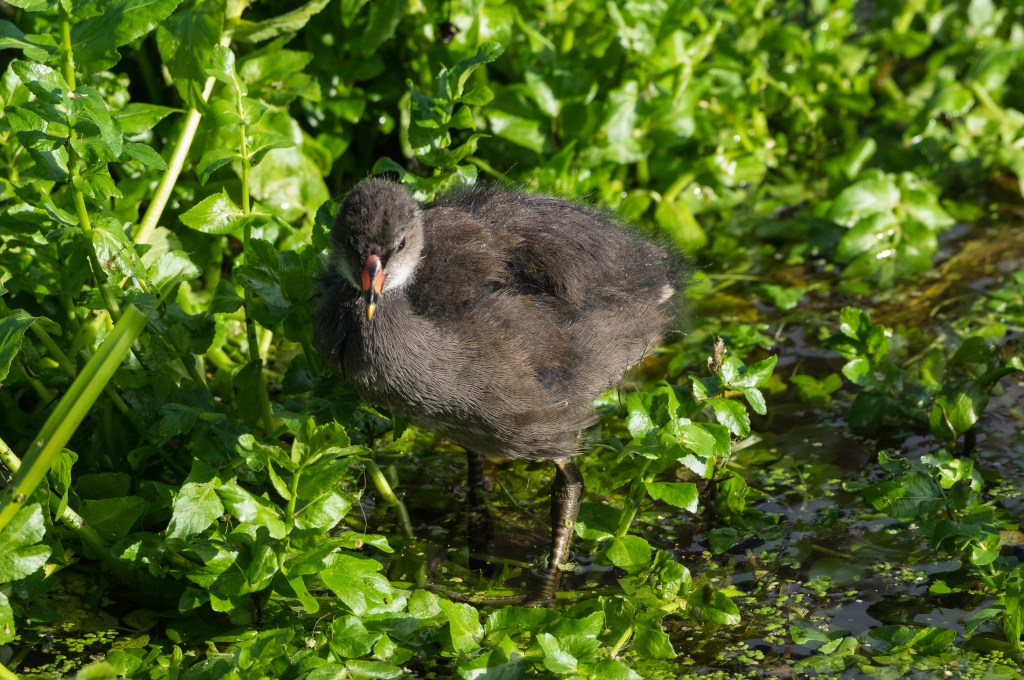
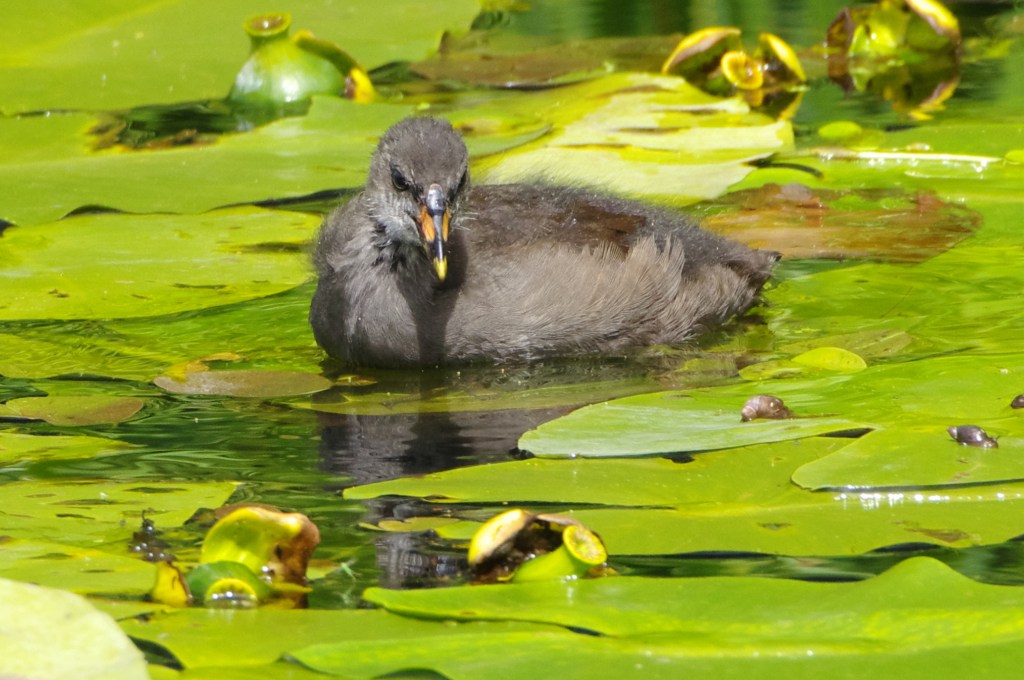
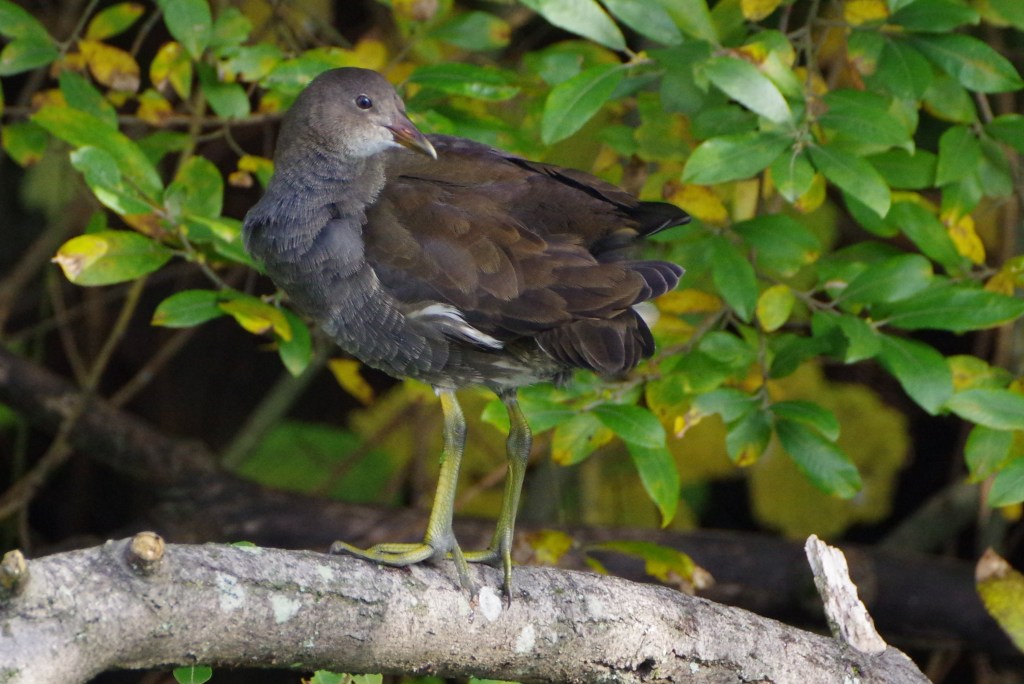
It really is amazing that any of these tiny creatures survive beyond a few days, given the number of potential threats, yet some do. The parents must move them away from nest sites pretty quickly and if I’m paying attention, I’ll hear them peeping away in the margins. Close inspection may then reveal them but they are usually very well concealed. The birds in the next images are much further on developmentally, and quite competent. I found them much closer to Maryhill on a stretch where the vegetation stretched from bank-to-bank (it has since been cleared). The individual in the third image must be pretty well fed because it is ignoring two large snails which are grazing on the lily pads. Had I realised the snails were there when I took the photograph, I would have tried a bit harder and perhaps managed to secure an image which I could have used to identify them.

This Moorhen looks well grown and may be part of the breeding population by now.

I always try to look for a work from visual or literary culture based on my species of the week. I thought a good countryman like John Clare might help me out with something charming about Moorhens but I was relying on Ecosia to find it. Ecosia appeared to have turned up some Burns but “The Bonie Moor-Hen” is clearly a grouse, even without the BBC’s helpful reference to “The Glorious 12th”. The giveaway is this couplet: “But still as the fairest she sat in their sight, Then, whirr! she was over, a mile at a flight.”

Moorhen flight is somewhat laboured and their take-off definitely not to be confused with a grouse exploding from the heather. British Moorhens are highly sedentary, but are joined in winter by migrants from continental Europe, especially the Netherlands, Germany and Denmark. The BTO have provided ringing data which confirms this result. I’m really surprised that they cover such distances.

I can live with not seeing any freshly-hatched  Moorhens this year; if I’m not seeing them, neither are the gulls or corvids and that’s definitely a good thing. I’m hoping to catch up with some slightly older birds a bit later in the season when they’re safer from harm and not such a worry.

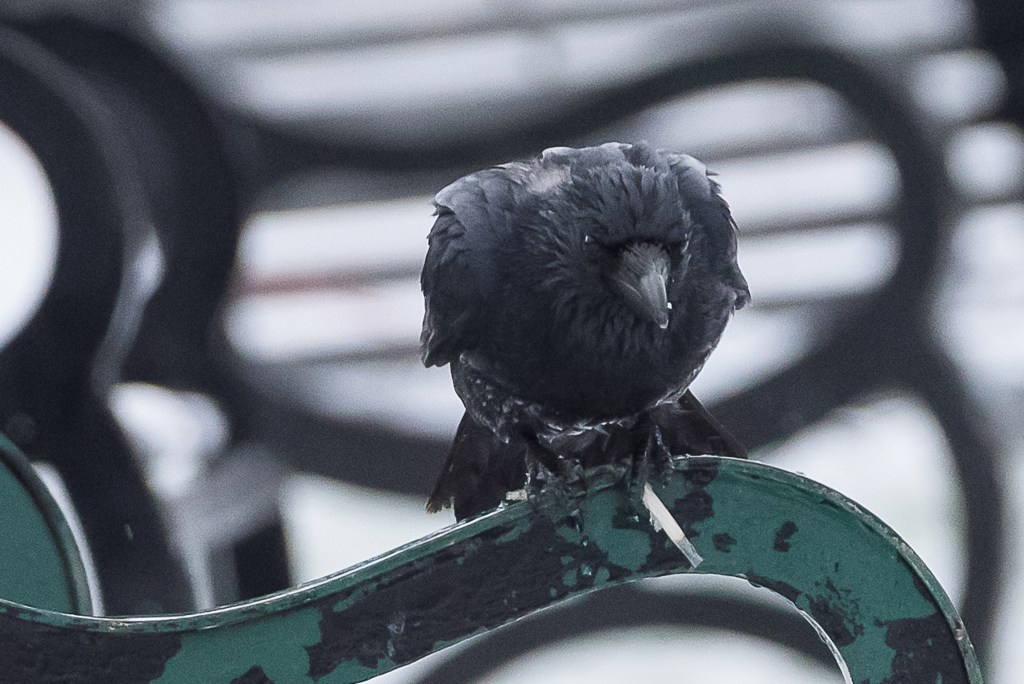
Carrion Crows

I was waiting for the Avanti on Wigan North Western station early yesterday morning. I saw a Buzzard circle in the distance and turned when I heard an unfamiliar rattling to the South. The only birds visible were a pair of crows perched on lighting stands, one by the northbound line into platform 5 and one across the way by platform 4. The latter bird flew across after another rattle and began what I can only describe as a curtsey to the former. The 08:38 to Glasgow Central swept in and I had to leave the crows behind. I found a similar sound around 1:20 on this clip from the Audubon Society.
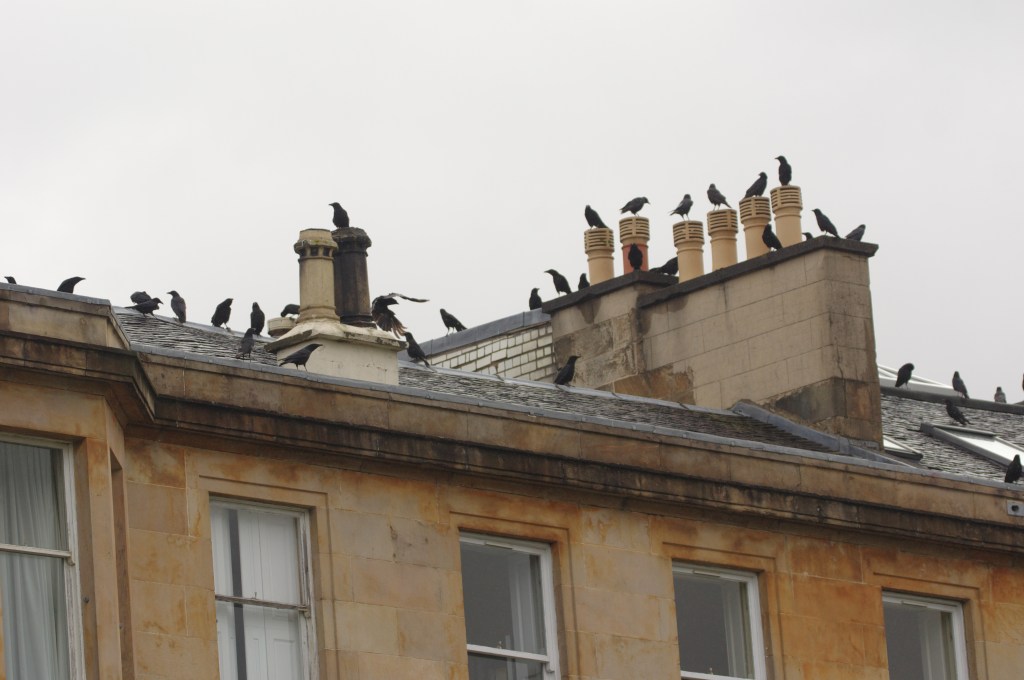
On some mornings, I wake up with a start at a noise overhead – it’s a crow bouncing ever so slightly sideways across our flat roof. In the vagueness of waking, it sounds a bit like the security services about to storm the flat, or ninja burglars. Sometimes the crows add the vocals. On one rather grey morning last June, a proper murder of crows settled on the rooftops of Woodlands Terrace – I’d never seen it before and they haven’t been back in these numbers (I counted over fifty) but there is a small subgroup which regularly plays a King of the Castle game on the TV aerials up there.
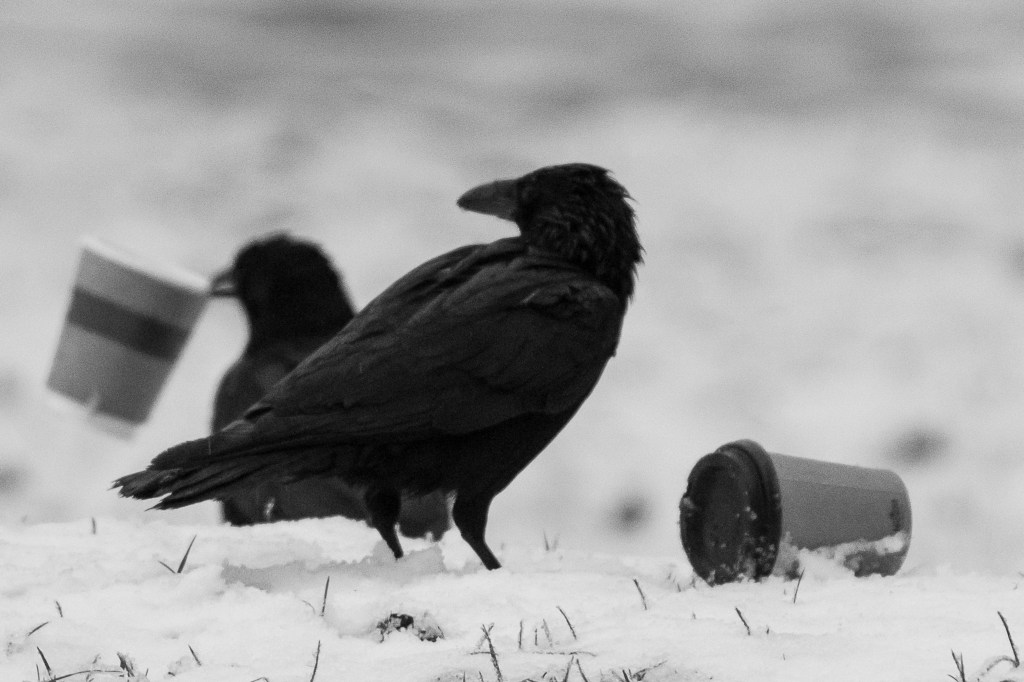
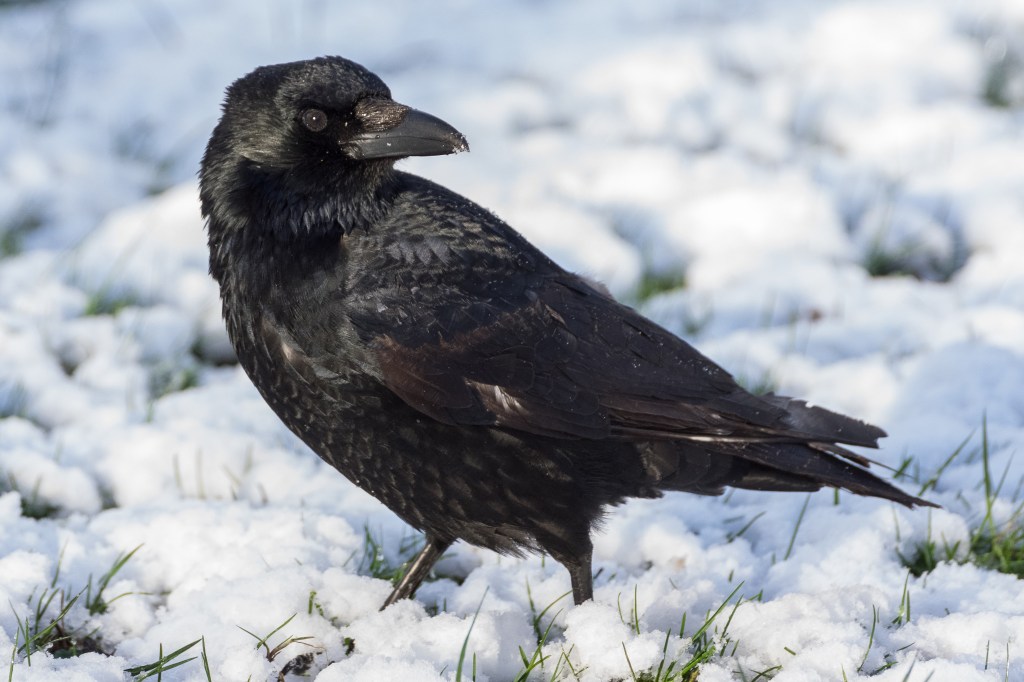
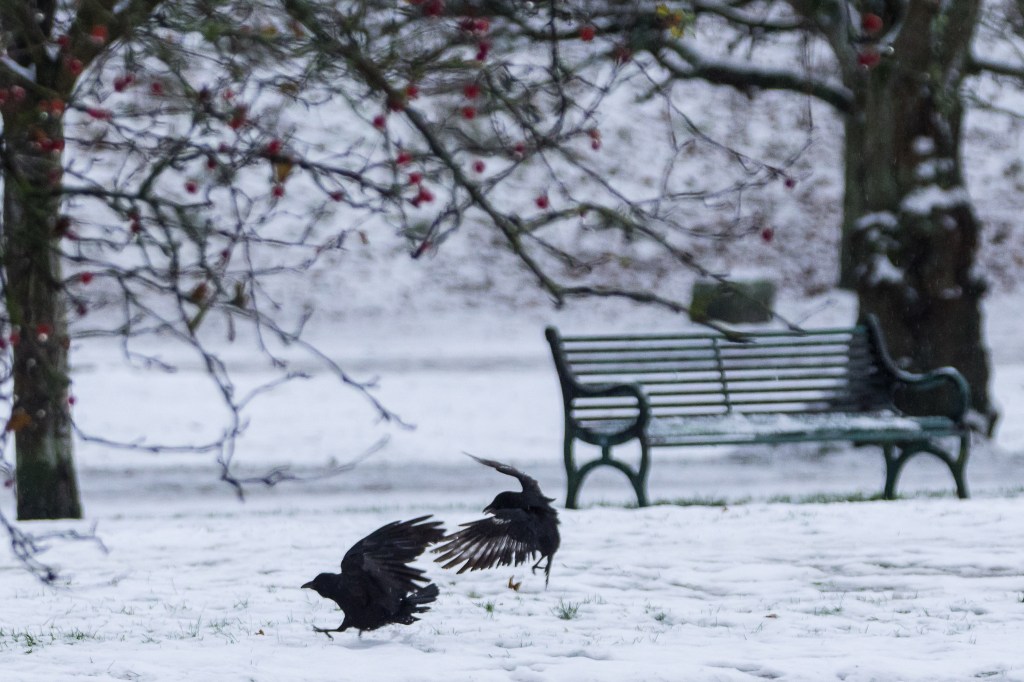
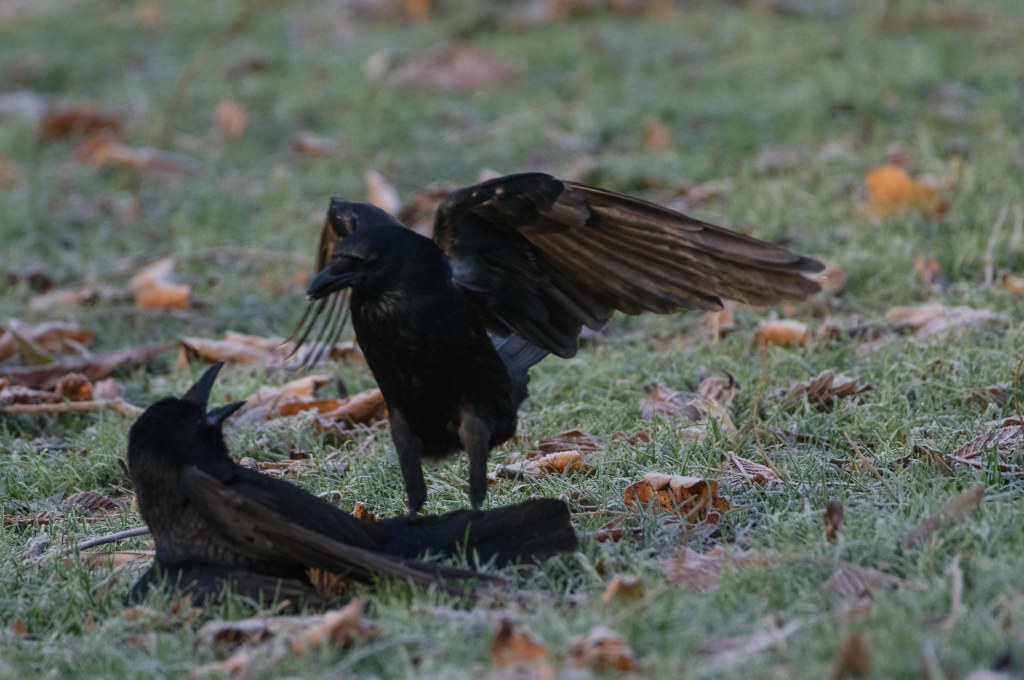
I like crows; I look at them and they look right back at me. I think they’re sizing me up, a bit like the way I look at a potential fishing place. One way or another, I’m a potential food source for them. I might well hand some out, or I might just be some in due course. The eyeballs first as an amuse bouche, and then something fleshier when it’s softened up a bit, an earlobe, then a cheek perhaps to start? Plenty of time for the larger muscle groups when they’re a bit gamey. I wanted some contrasty crow pictures and I took matters into my own hands in the Kelvingrove Park one snowy day. I thought the crows would be starving  and incautious – I’d forgotten about the profligacy of the coffee cup generations (just go home and put the kettle on, eh?).

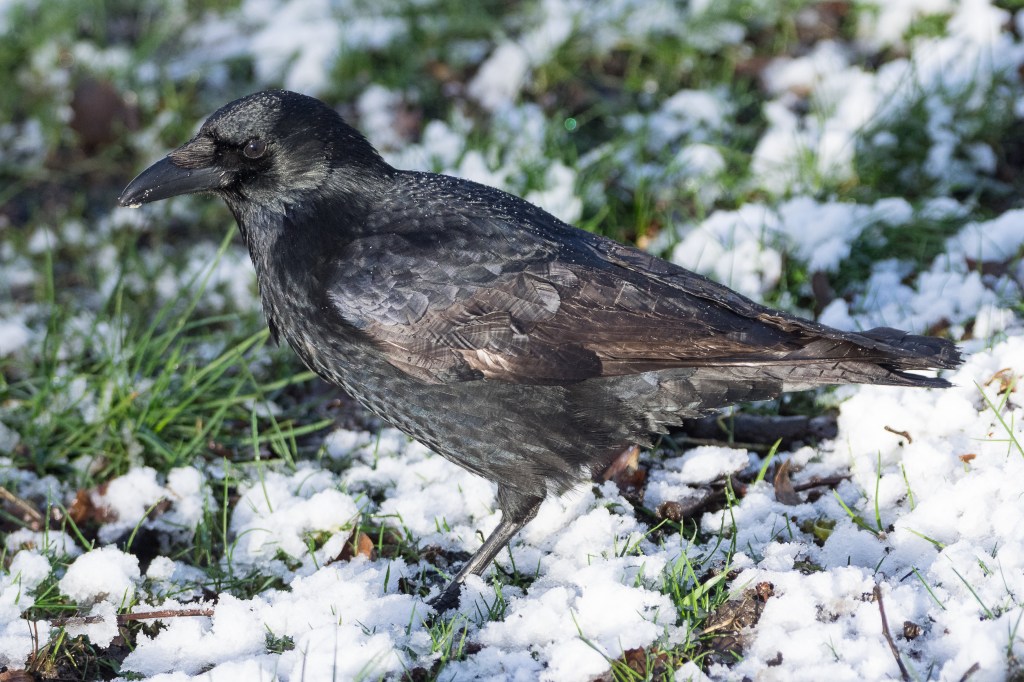
I had a small bag of sunflower hearts and pancetta and my fishing catapult; the plan was to treat the crows like the silvers I fish for, pinging a bit of bait at them and photographing them when they bounced into range. Massive crow fail! They either didn’t notice the offerings, or flew off if I dropped the food on their heads. A bit of loose feeding from the hand at close range was more effective and this chap came in close.

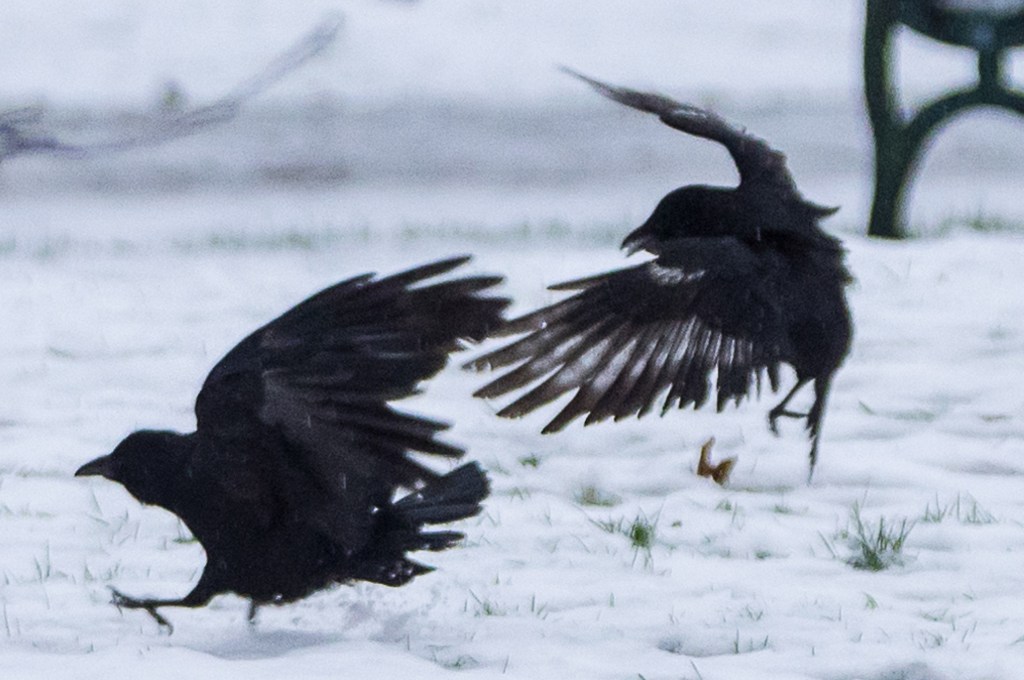
So I just drifted about, getting cold feet, and and I enjoyed a fair bit of what looks like play fighting.

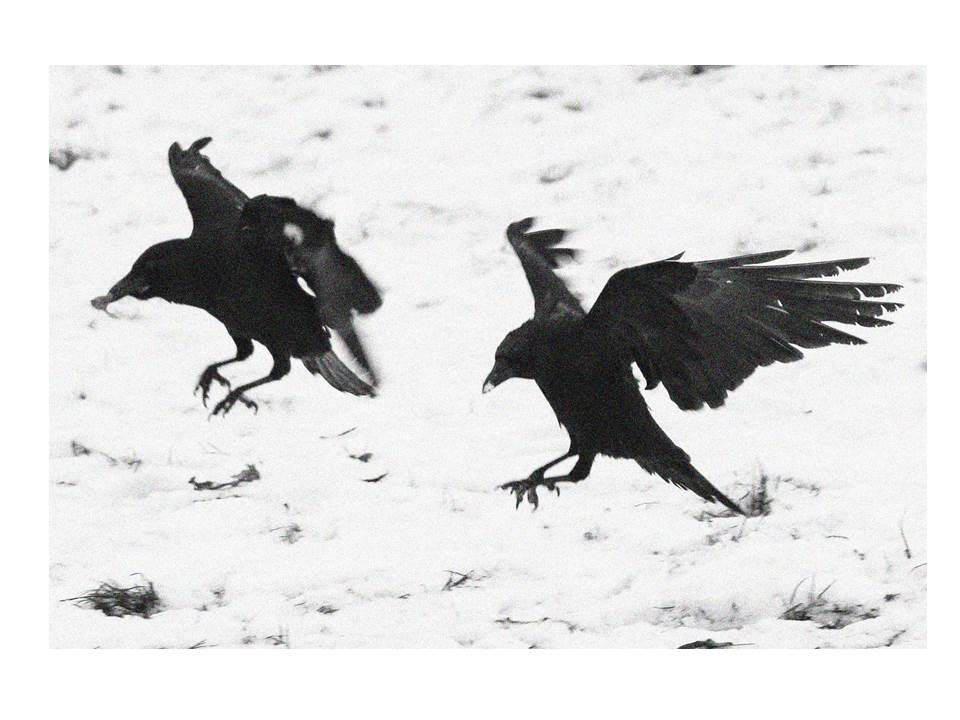
This image is a bit grainy and it probably looks better as this “digital print”.

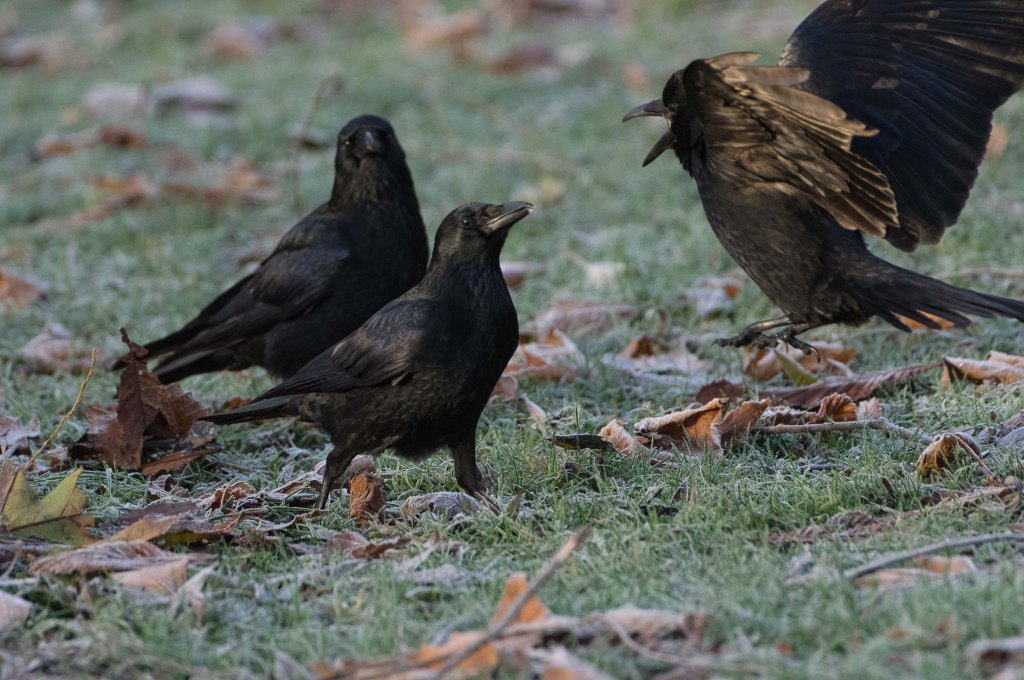
Crows can be solitary or they can occupy social groups  and there seems to be quite a bit of published work on Open Access. The term coalitionary aggression turns up – where a dominant individual recruits other members of a social group to attack (and perhaps kill) another individual, possibly as a way of manipulating a social group. The Kelvingrove Park population seems to at least contain one large group and certain individuals seem to play at attacking each other – no actual blows are exchanged in these encounters.

I also found a paper which discussed kin-based cooperative breeding. This involves grown offspring delaying natal dispersal and helping their parents to rear new young. The offspring of non-cooperative carrion crows from Switzerland were taken to Spain and raised in a cooperative population. Five out of six transplanted juveniles delayed dispersal, and two of those became helpers in the following breeding season, suggesting that the behaviour was learned in the new environment, rather than simply ancestral.

I enjoyed hearing about corvids in general on Radio 3 recently – Nicola Clayton described the raising of her pet Rook. I had thought of trying to make friends with some of the Park crows but lacked the commitment to make very frequent visits to them. I may well read Mark Cocker’s Crow Country in due course (it was mentioned in the broadcast and sounded interesting).

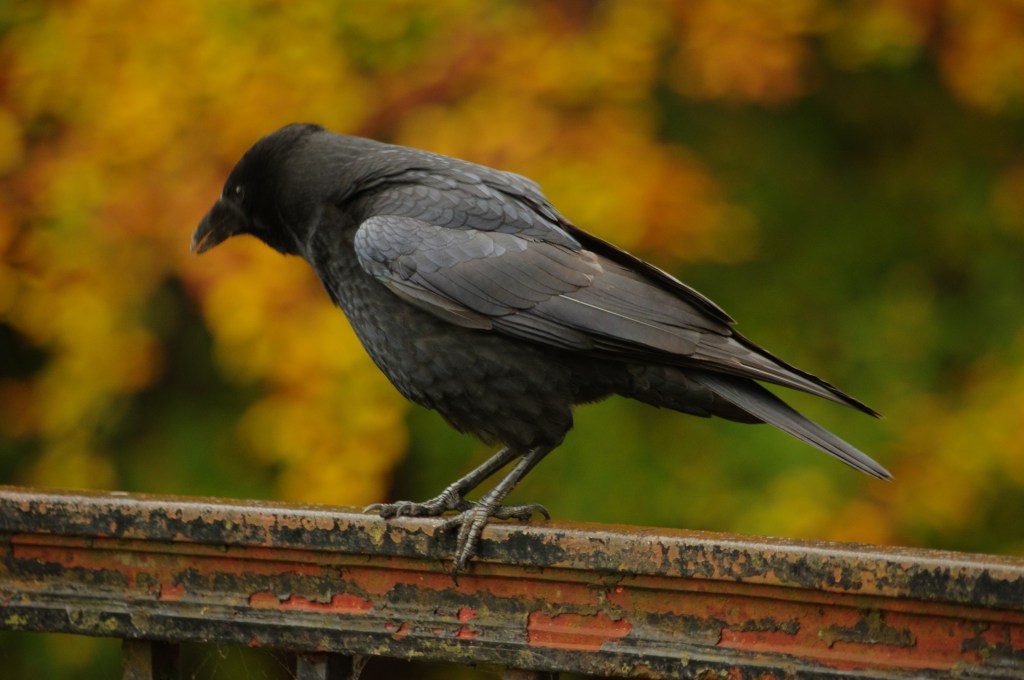
This autumnal crow had a good shout at me from the parapet of the bridge over the Kelvin into the Botanic Gardens. The picture dates from the days before the council decided to refurbish the bridge and paint it up like a public convenience (white and a remaindered shade of blue, like the Brighton and Hove Albion FC home kit). I like the distressed paintwork and the way it echoes the chap’s wonderfully leathery feet.

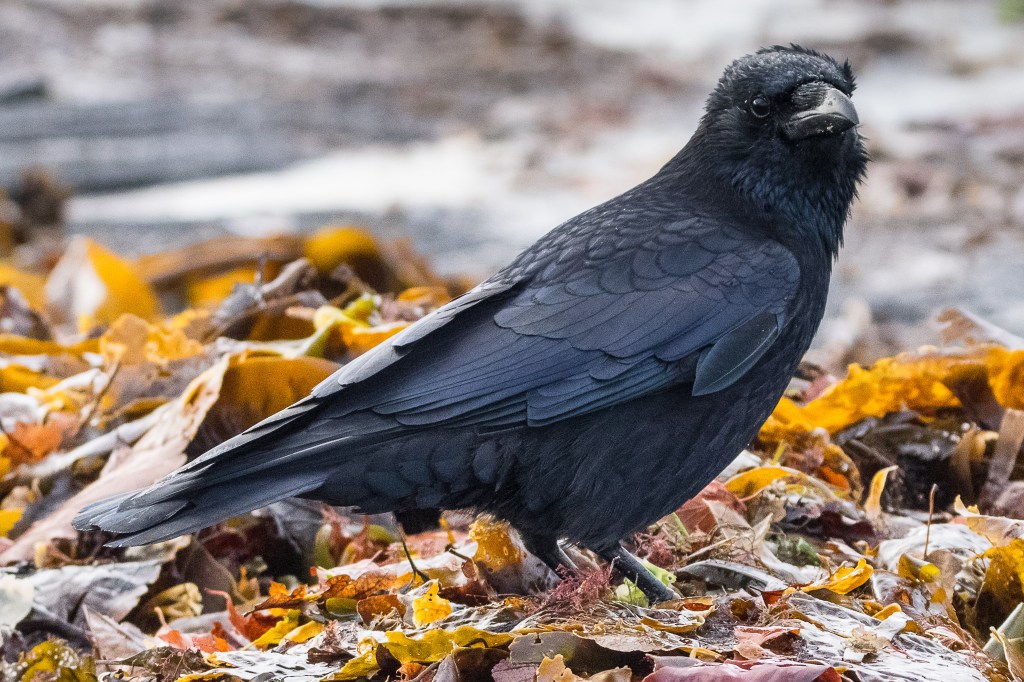
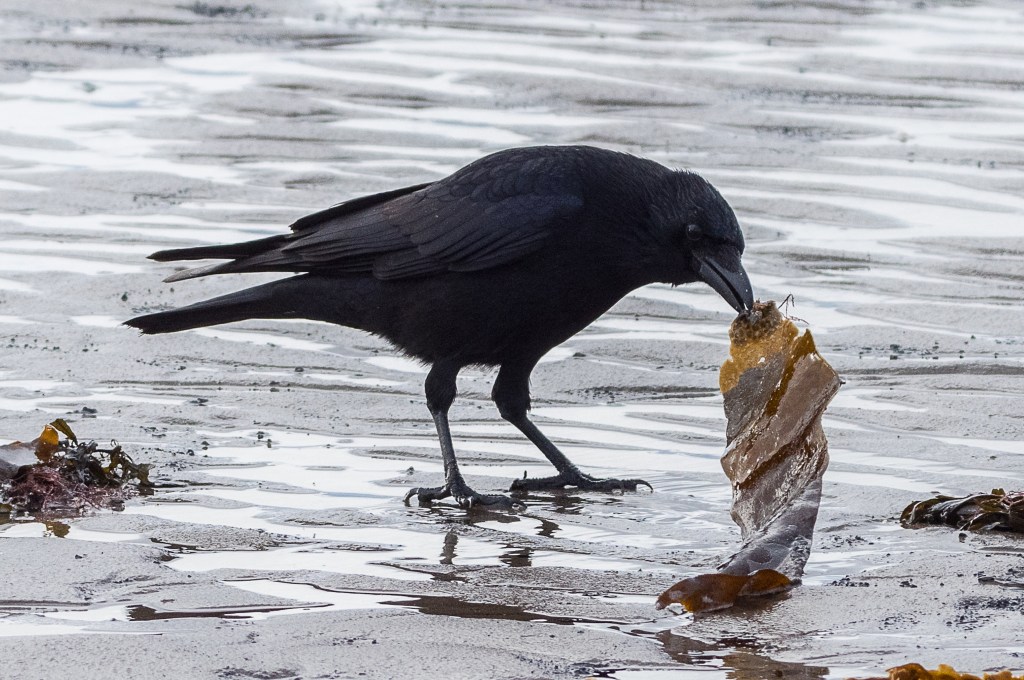
Seaside crows are always good value, indefatigably turning the seaweed. Are they eating insects or just speculating that a better morsel lurks under those piles of rotting vegetation? In Crow and the Birds, Ted Hughes has it as:

Crow spraddled head-down in the beach-garbage, guzzling a dropped ice-cream

No ice cream on these Ayrshire beaches, away with your English indulgences. My collected poems doesn’t tell me where  Crow and the Birds comes from (really annoyingly) but it seems to be from Crow: From the Life and Songs of the Crow from 1970.

The differences in scale between crows and the smaller birds are striking and if I were a Dunnock or a Robin, I would give them a wide berth.

However handsome crows may be, I would not like this to be the last thing I saw.

Glenarn Garden

On May 1st, we visited Glenarn Garden in Rhu. Our previous visit was in 2021, two years before and almost to the day.

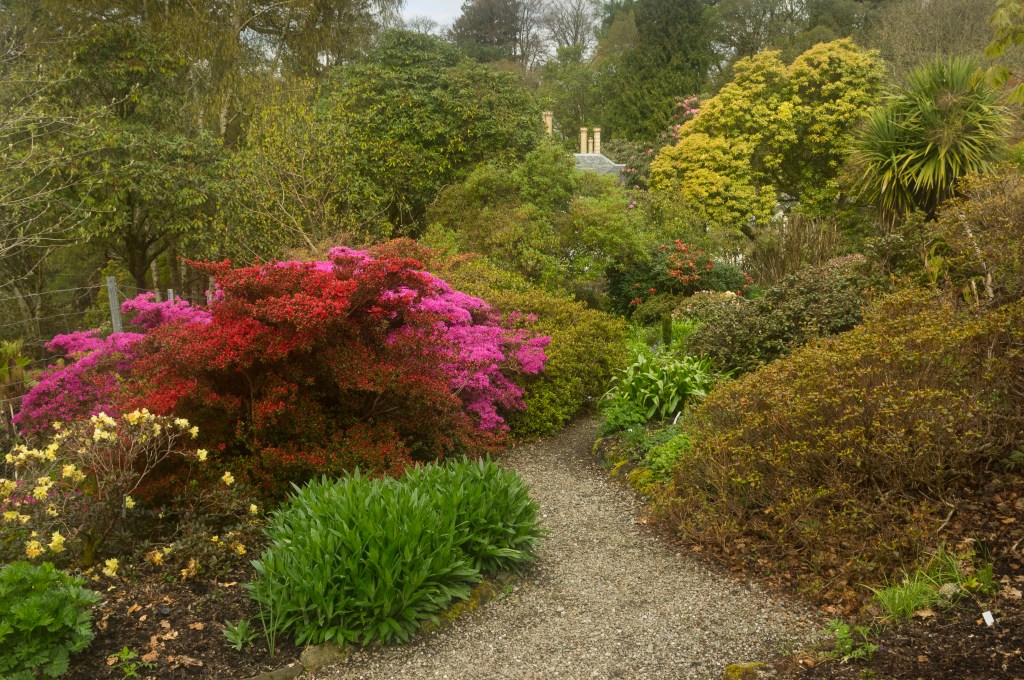
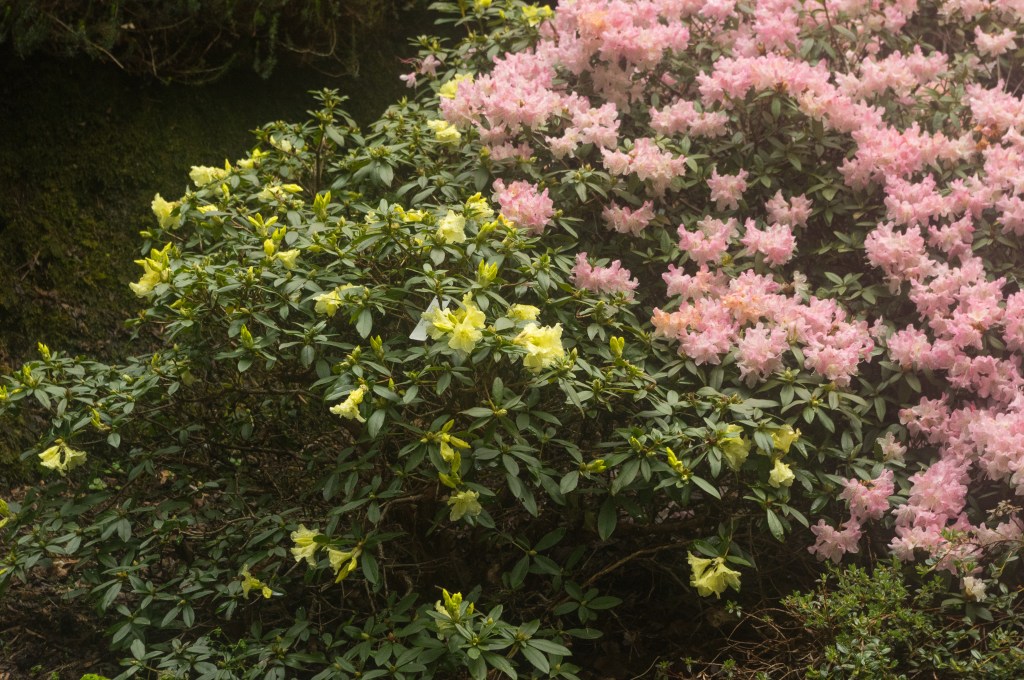
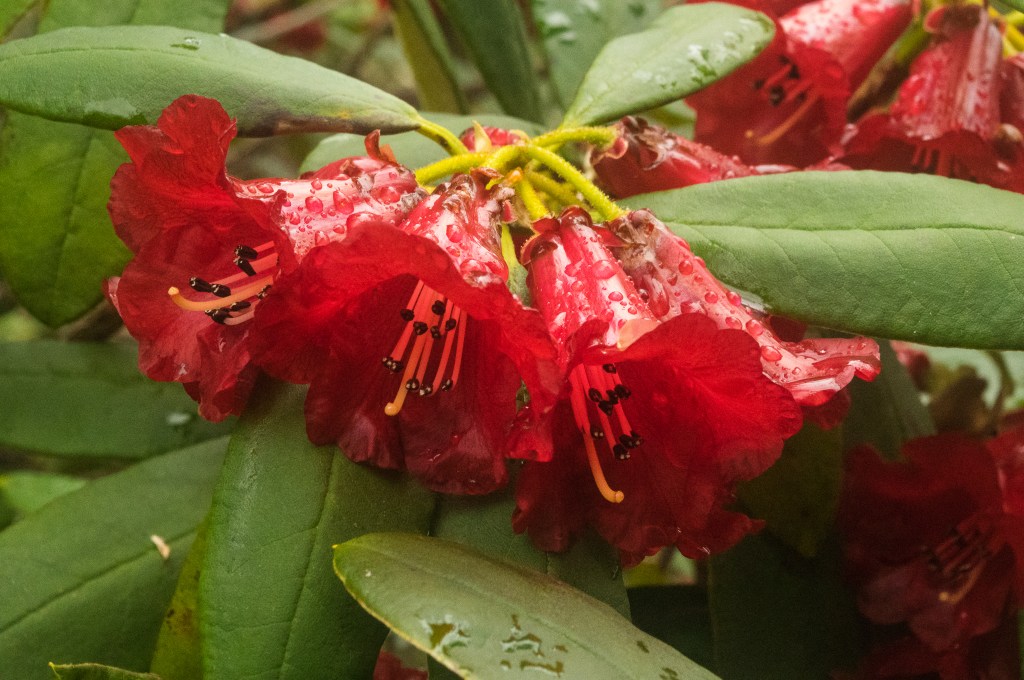
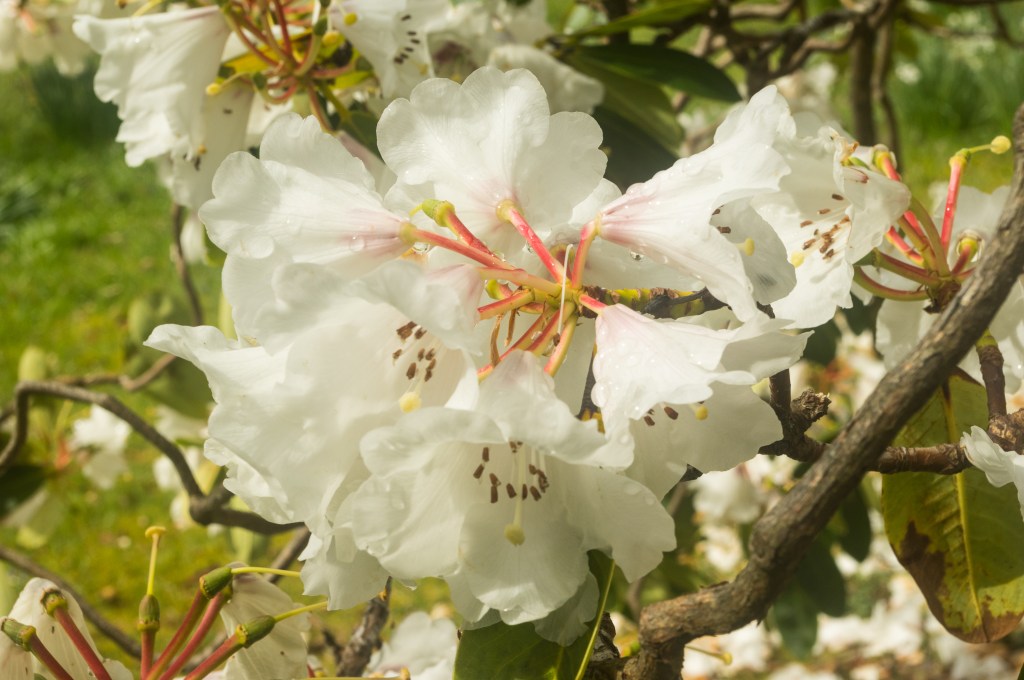
The garden occupies a hillside site and offers a range of environments which seem to favour, amongst other genera, Acers and Rhododendrons. If you take the West Highland Line north from Glasgow Queen Street, you’ll see Rhododendron ponticum everywhere so it looks that this damp, sheltered and mossy land should be a good place to grow species from mountain foothills. The big stars of this garden are the Rhododendrons, many of which are hybrids raised in the garden by previous owners. There are some huge plants but these major specimens were resting in 2023 after a bounteous display in the previous season. We bumped into Mrs Thornley who somehow manages to maintain this enormous project; she was holding a stem of large blooms from a scarlet-flowered species, gathered in reconnaissance for the local Rhododendron show, and told us that we were visiting in a quiet year. No matter – there was still much to see. The collection clearly blooms over an extended period with some species over and others in bud at the time of our visit.

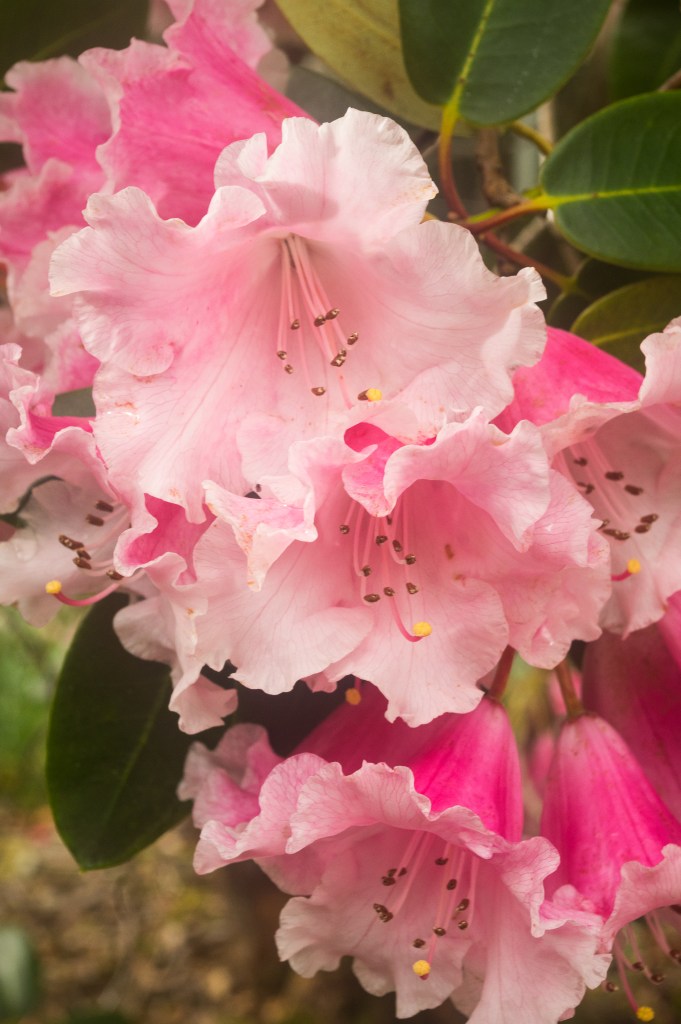
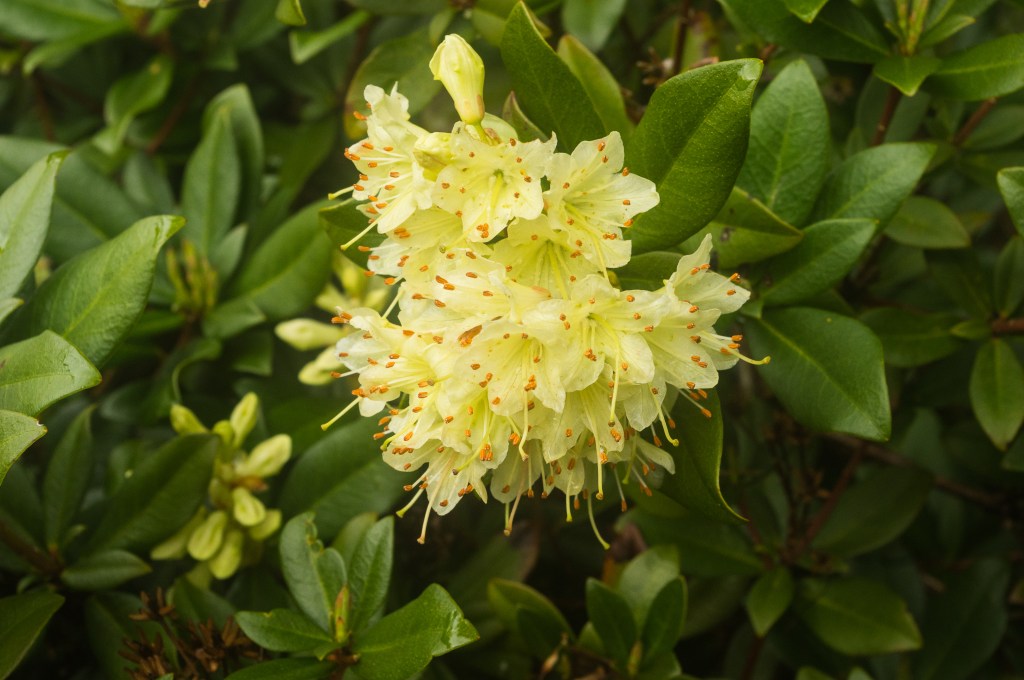
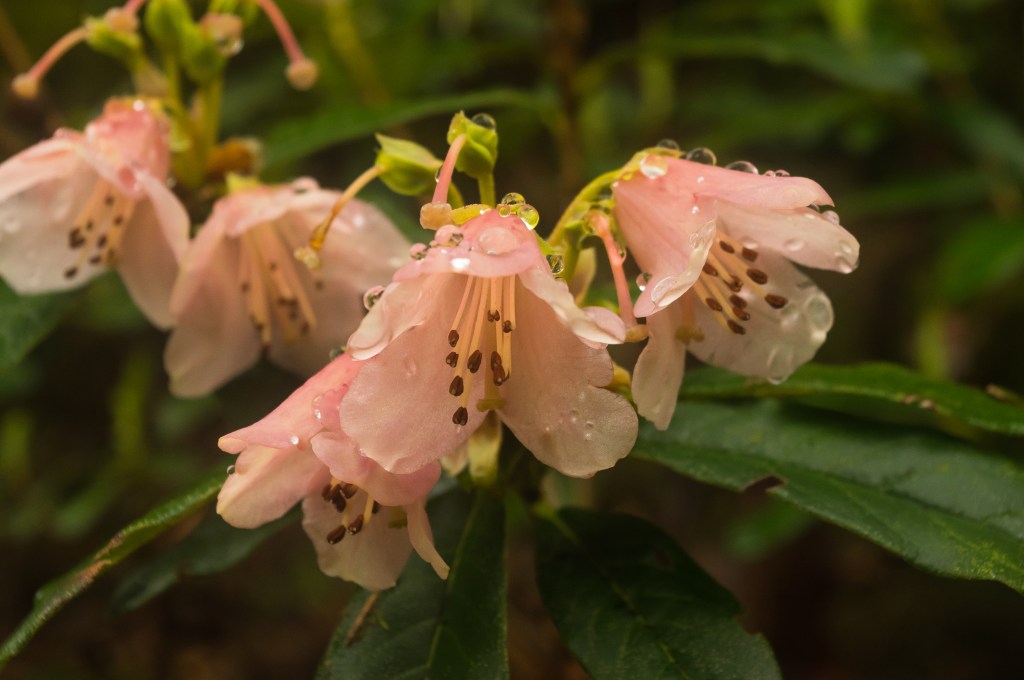
I have no Rhododendron expertise at all. I could find you a Rhododendron luteum with my eyes shut – the fragrance is intoxicating – but I’m struggling after that. I think this one is the Himalayan species R. barbatum.

I can read tags though – these are R. Avalanche and R. Brocade Plus, both real performers.

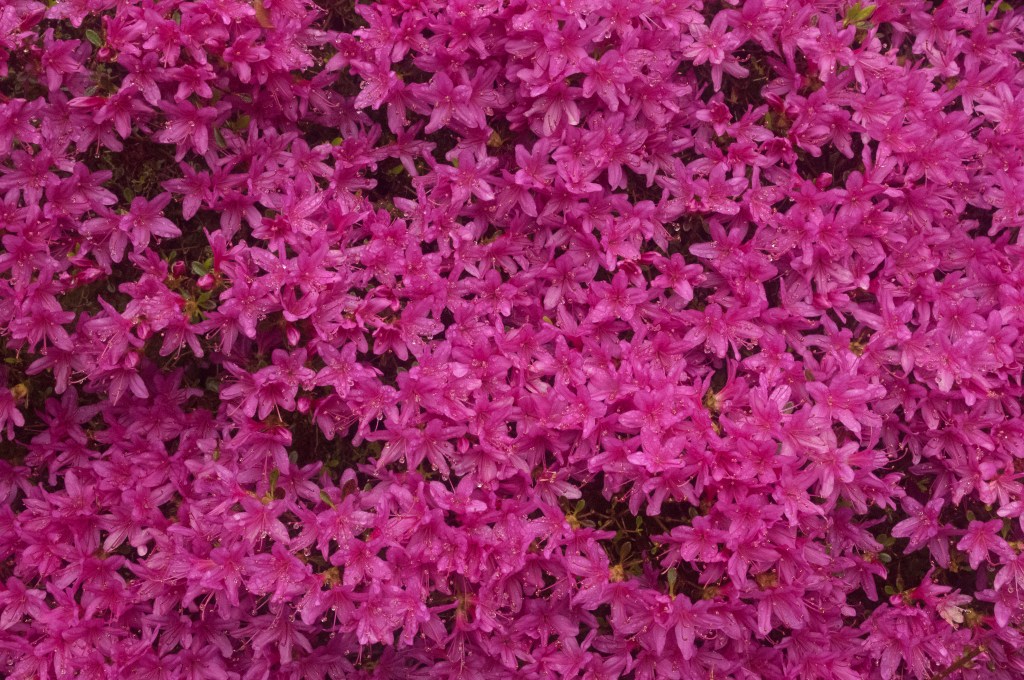
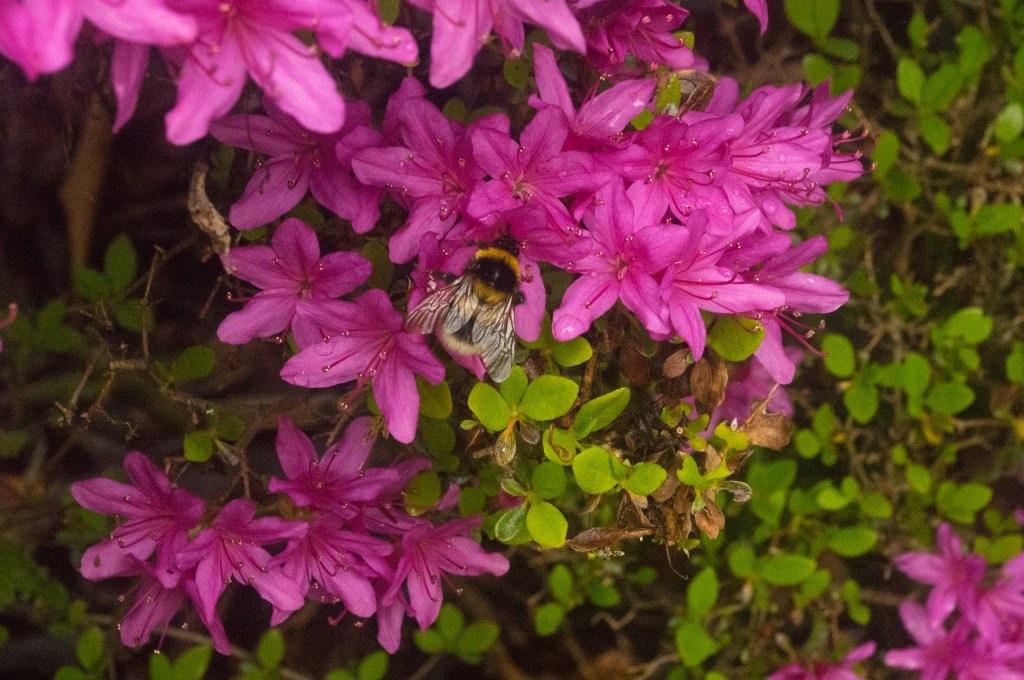
In the absence of identifications, this post looks a bit like a plant catalogue without the useful text pages but I hope you can enjoy the opulence and range of form and colour offered by these plants.

Scots featured prominently amongst the Victorian plant hunters and the estates of Argyll and Bute benefited from their searches. The Ardkinglass Woodland Garden near Cairndow boasts some champion trees (and Red Squirrels). The late Beatrice Colin set her final novel The Glass House on a local estate; the pursuit of the elusive Snow Tree (a Rhododendron, surely?) is woven through the narrative.

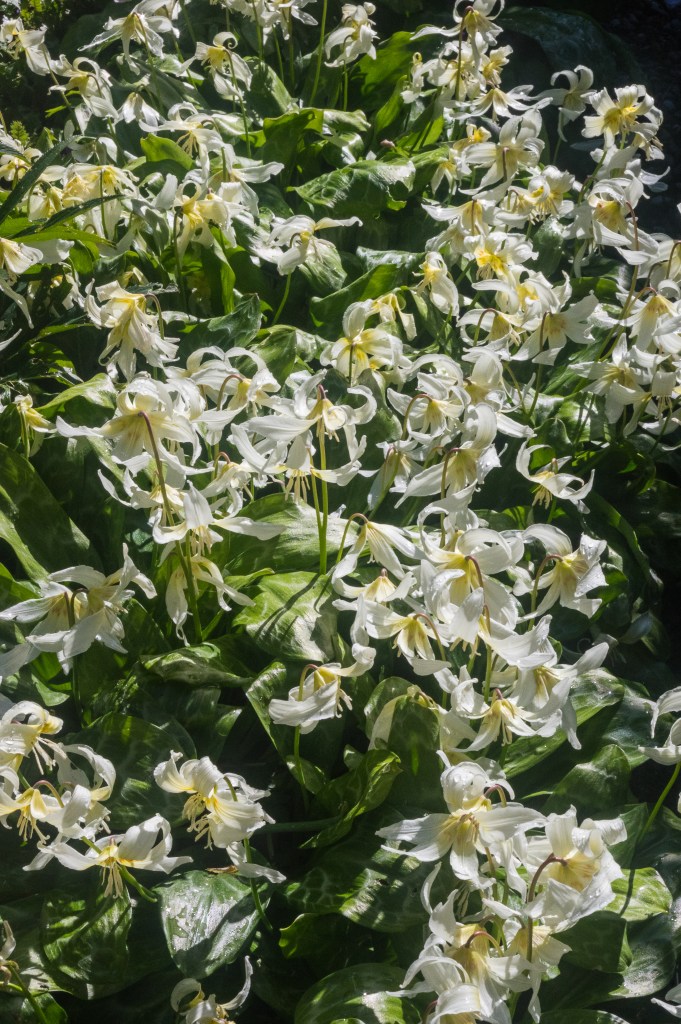
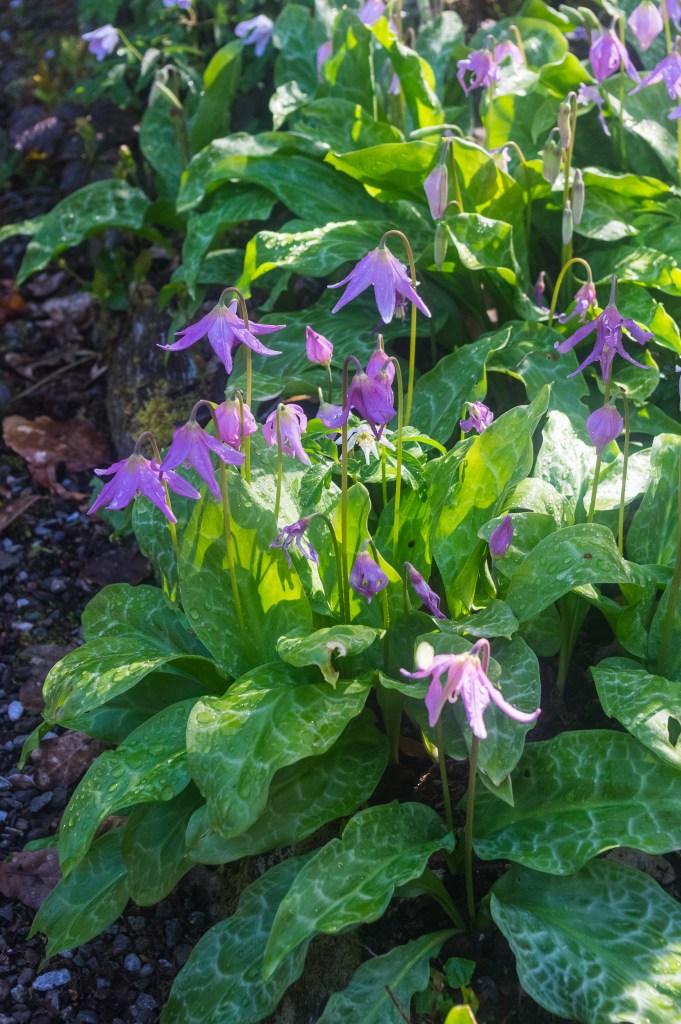
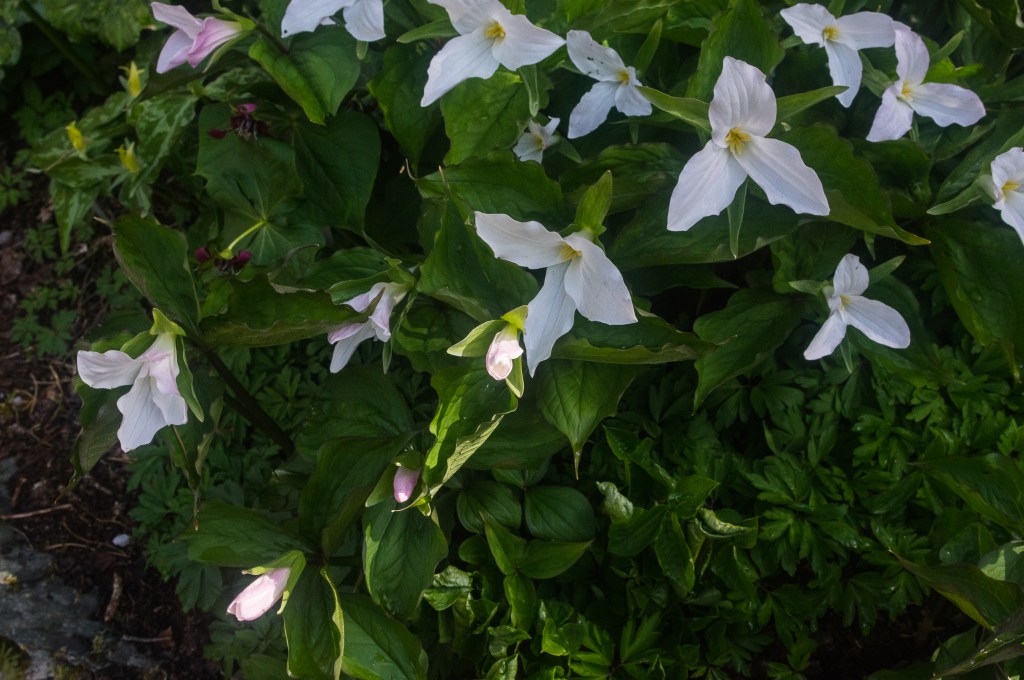
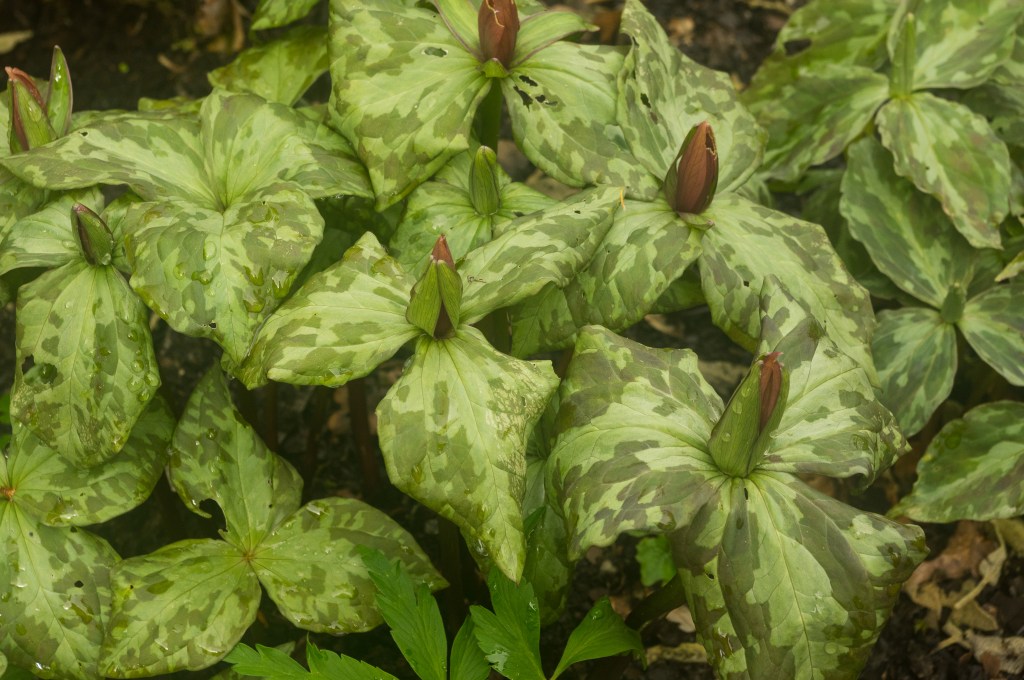
A set piece garden like Glenarn can offer quiet corners in which a different aesthetic prevails. The Erythroniums and Triliums (I’m very fond of both) are still a formal planting but mark a transition into a more modest range of colours and forms.

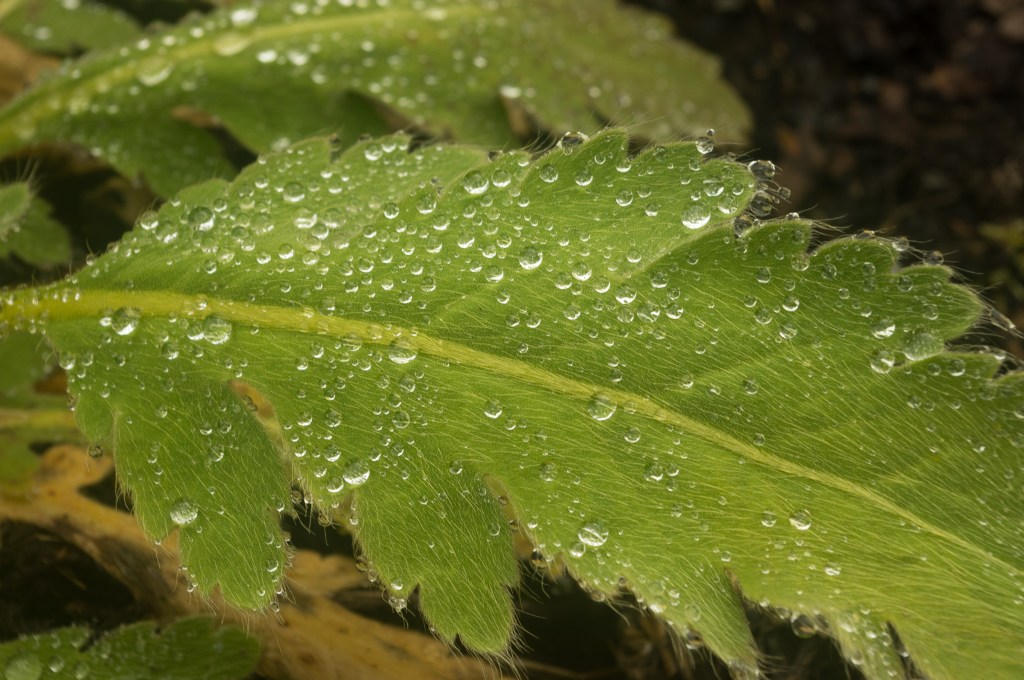
And then there are the serendipities where the gardener might be intending to clear some self-sets (but hasn’t got there yet) or has decided to let a wild thing prosper, or where a heavy dew or a shower has transformed a leaf into a bejewelled spectacle. I’ve seen a leaf like this before – I think it might be Meconopsis betonicifolia, a big favourite.

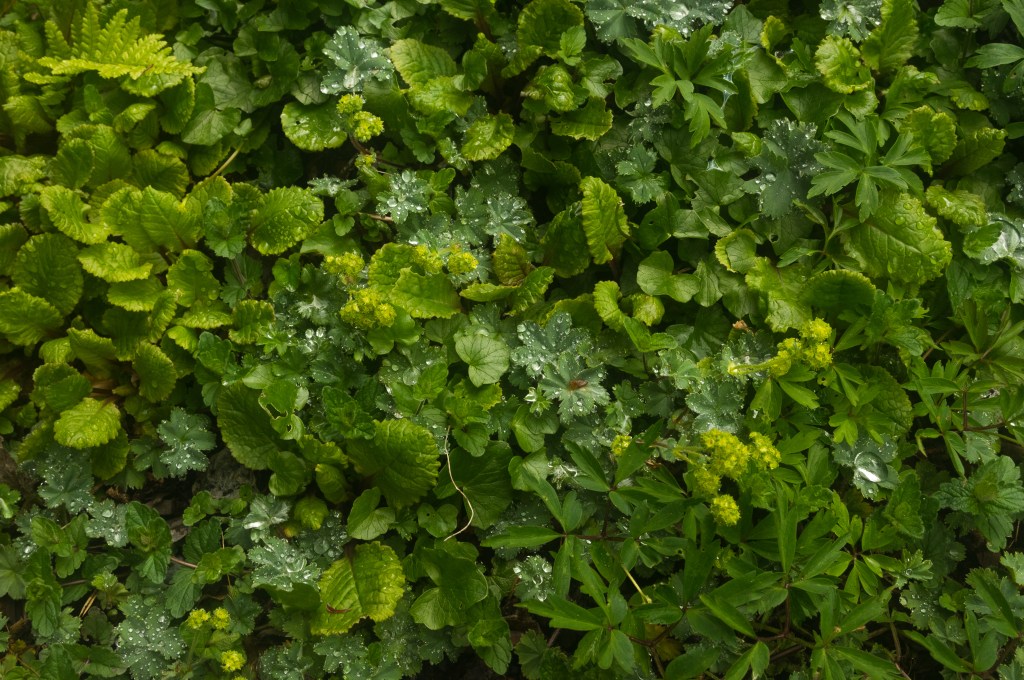
I like this “interplanting” of Alchemilla mollis and (an unknown) Primula –  I’m told that the former plant “is valued for the appearance of its leaves in wet weather. Water beads on the leaves due to their dewetting (the process of retraction of a fluid from a non-wettable surface it was forced to cover) properties. These beads of water were considered by alchemists to be the purest form of water. They used this water in their quest to turn base metal into gold, hence the name Alchemilla. The Latin specific epithet mollis means “soft”, referring to the hairs on the leaves.” Imagine being the alchemist’s lab assistant and collecting those beads of water by the litre.

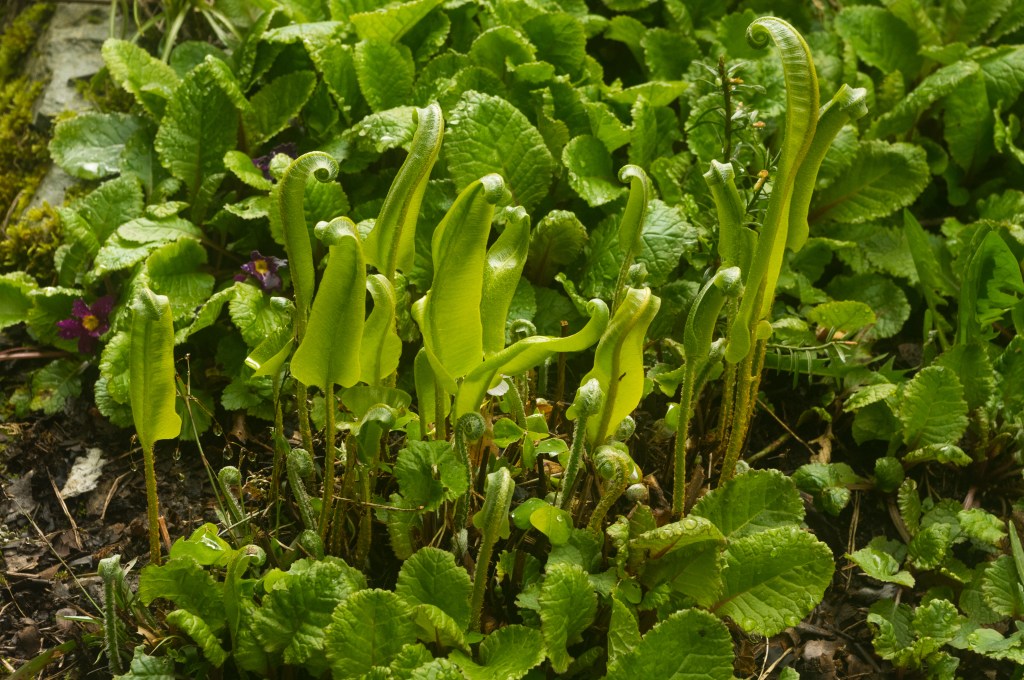
Nearby, I found this perfect hart’s-tongue fern reaching slowly for the light.

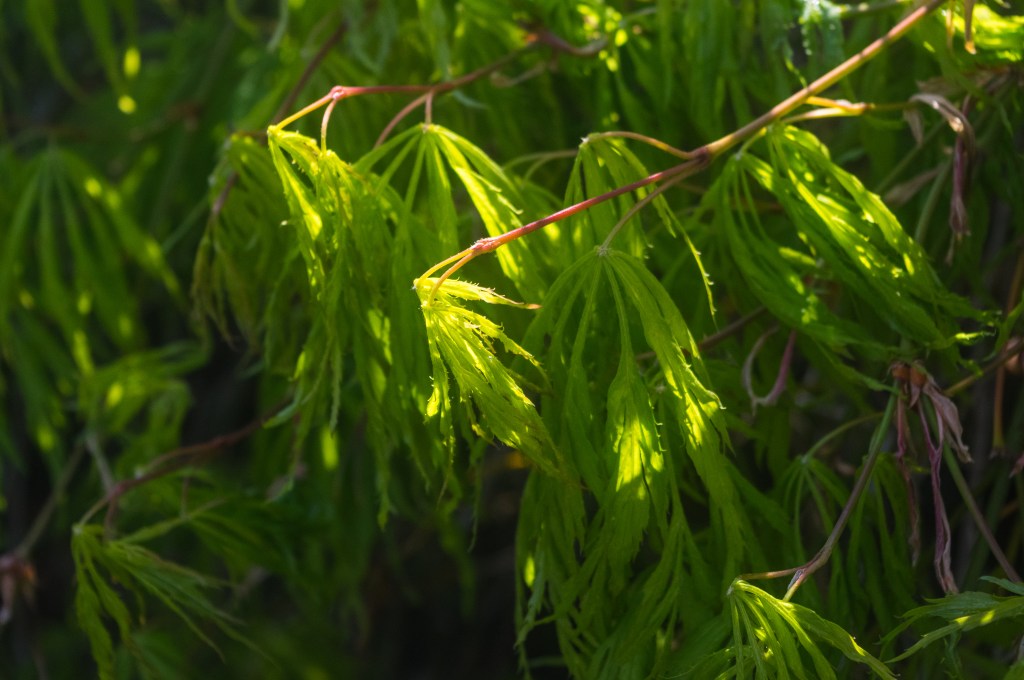
Glenarn has some excellent trees. I really enjoyed this Whitebeam starting to open its leaves, and the early Acer foliage.

I do have a name for this Acer – pensylvanicum, what a beauty.

We’ve seen few visitors on either of our visits and the main sounds have been of birdsong. I made this short recording while Faye fired up the Cornell Merlin Bird ID app. We’ve a Robin and a Blackcap according to the app and then, rather surprisingly, a Peregrine falcon (which did the decent thing and flew over our heads to put the matter beyond any doubt).

Glenarn Garden is a very special place – next year may be one for the really big Rhododendrons following their rest. I wish Mr and Mrs Thornley many more happy years of cultivation.

Black-headed Gulls

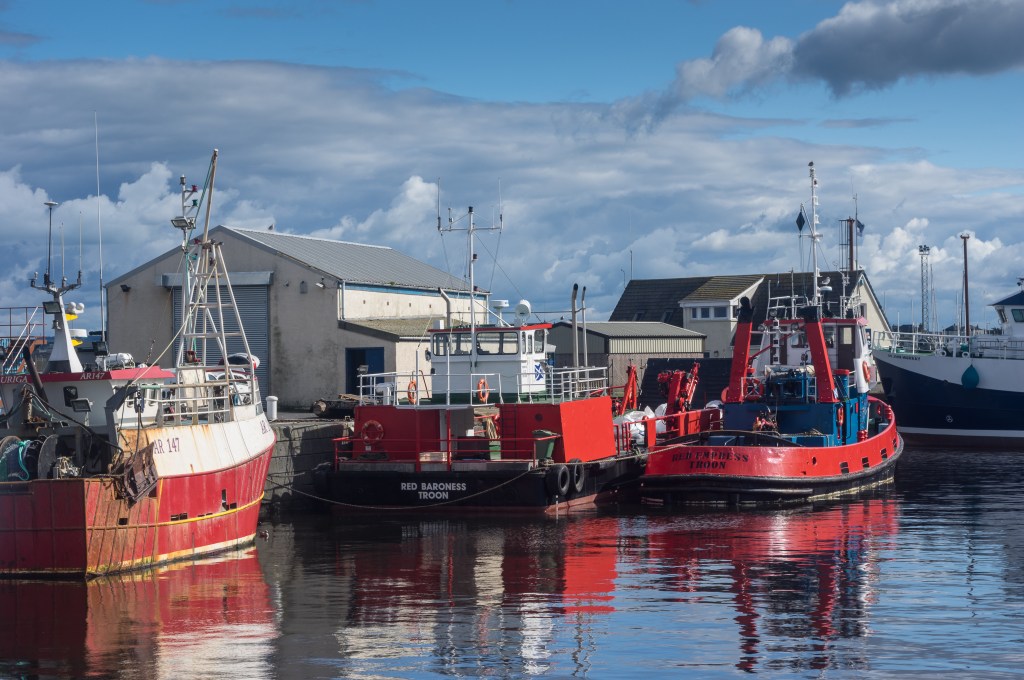
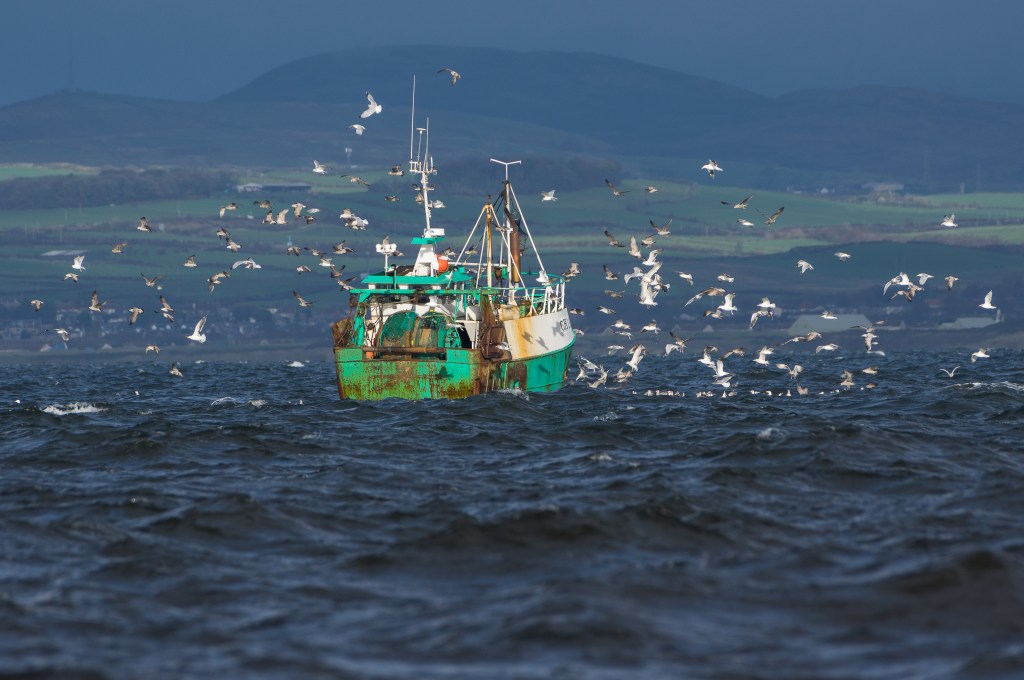
One of my images (the one of the Troon day boat) from the Ringed Plover post  got me thinking back to one of the most analysed utterances ever made by a professional footballer – one Eric Cantona – who said, in 1995, “When the seagulls follow the trawler, it’s because they think sardines will be thrown into the sea.” Cantona’s quip came at a 1995 press conference after a court appearance following his two-footed lunge at a spectator during a Manchester United match against Crystal Palace at Selhurst Park. In the years that followed a glittering career on the pitch, Cantona strode into the world of acting, decorating Shekhar Kapur’s 1998 film Elizabeth in his role as French Ambassador, unforgettable.

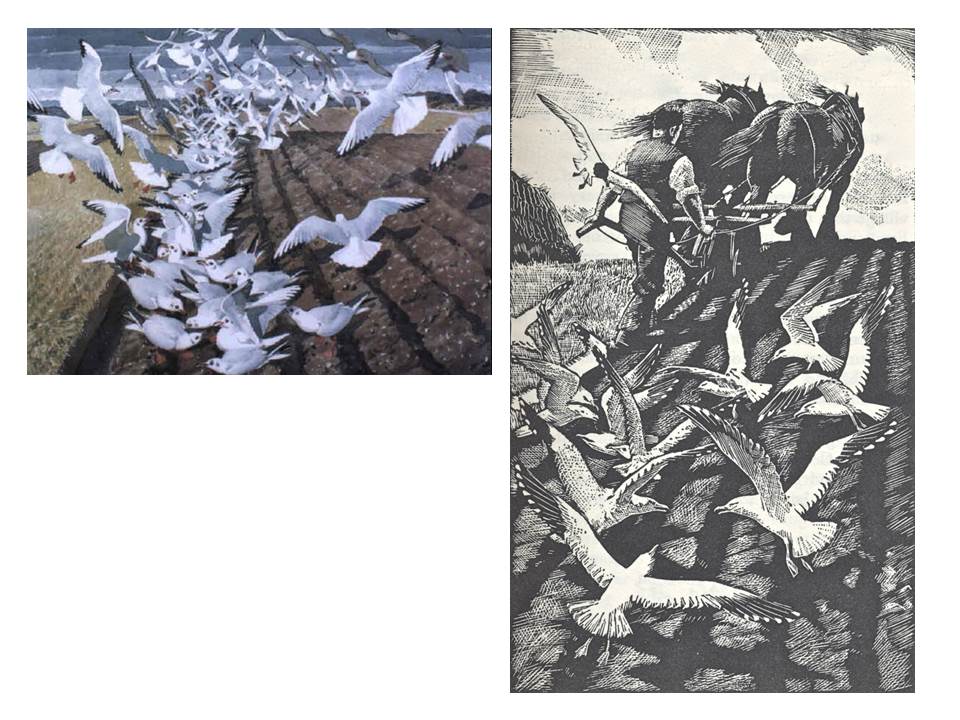
So Cantona’s bon mot got me thinking about gulls working around human activity, and back to childhood and seeing tractors climbing the local fields around Rainford with a clamour of Black-headed Gulls behind them. I would see clouds of Lapwings rise from these fields too, but that’s another story entirely. The BHGs were looking for nematodes and ground-dwelling beetles as the plough turned the land over.   Evidently the late C. F. Tunnicliffe RA had seen similar sights – his Black Headed Gulls Following The Plough sold at Christies in 1996.

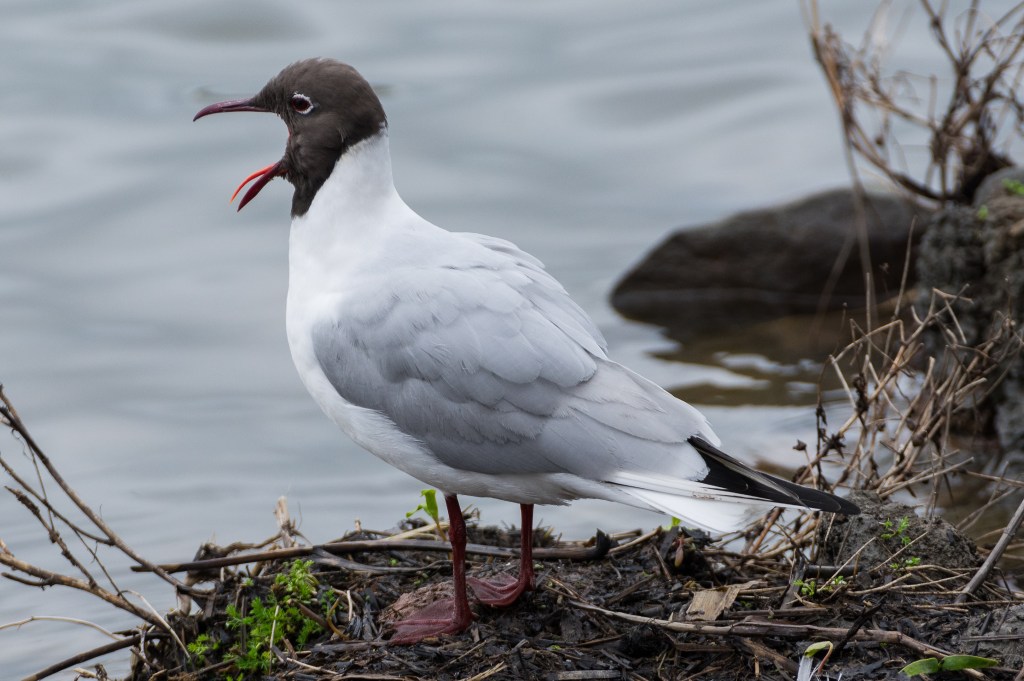
These BHGs have lost their breeding plumage, not unreasonably as this work cannot represent a summer scene. In Tunnicliffe’s woodcut on the same theme, there is a single distinctive black head to be seen amidst the throng of bigger birds.

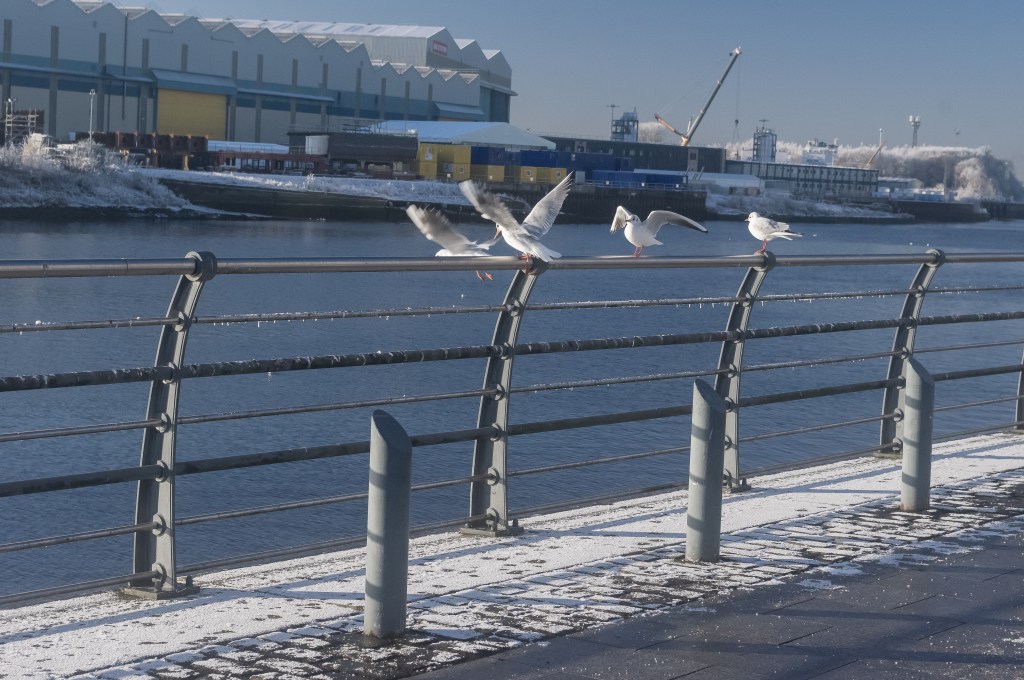
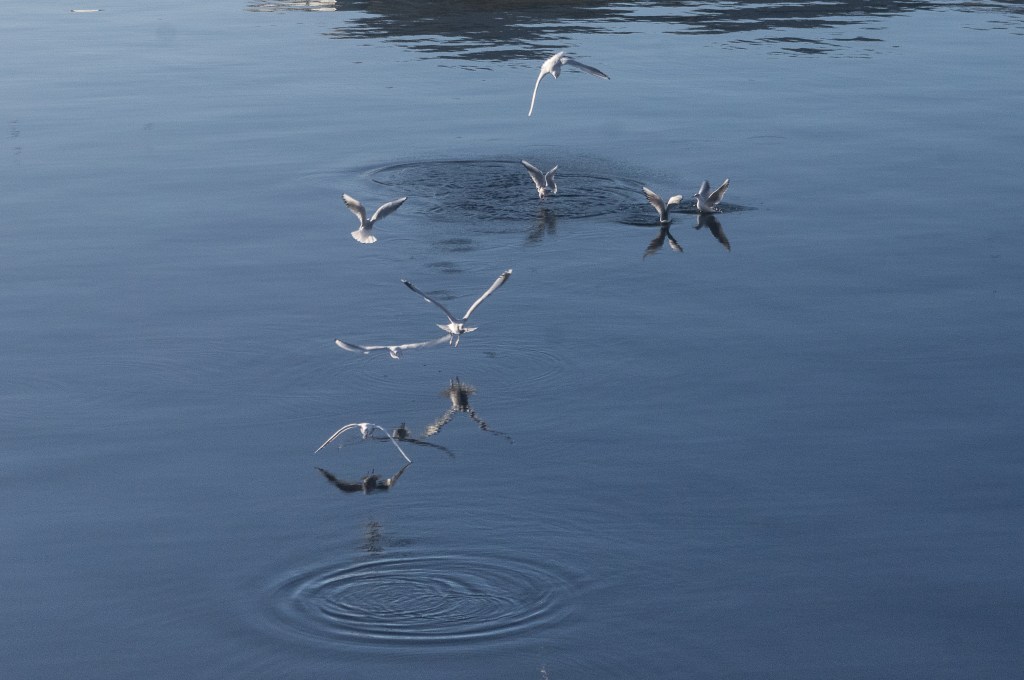
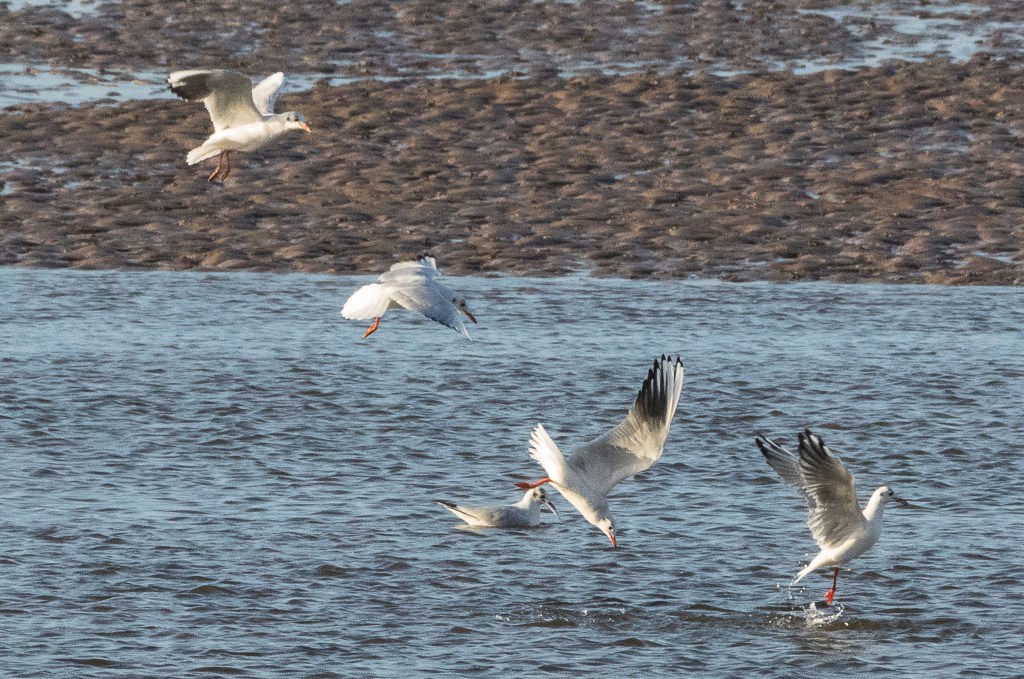
I always see BHGs when I run along the Clyde in winter; they are lively presences and they seem to glitter in certain lights.

The Clyde was partly frozen on this day and open water was at a premium.

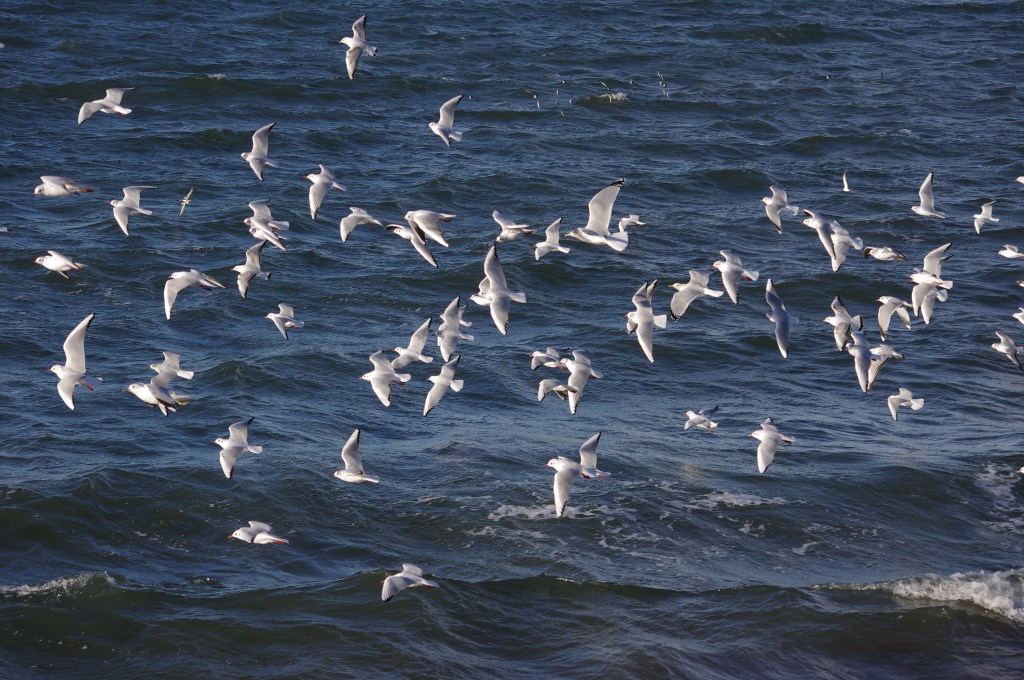
I remembered seeing a large group on the wing near North Berwick and went back a few years and found the image. I think there are a few plovers in the background – the image was taken just after a Merlin flew over the rim of the dunes towards some Sanderlings and I think all the birds were on high alert.

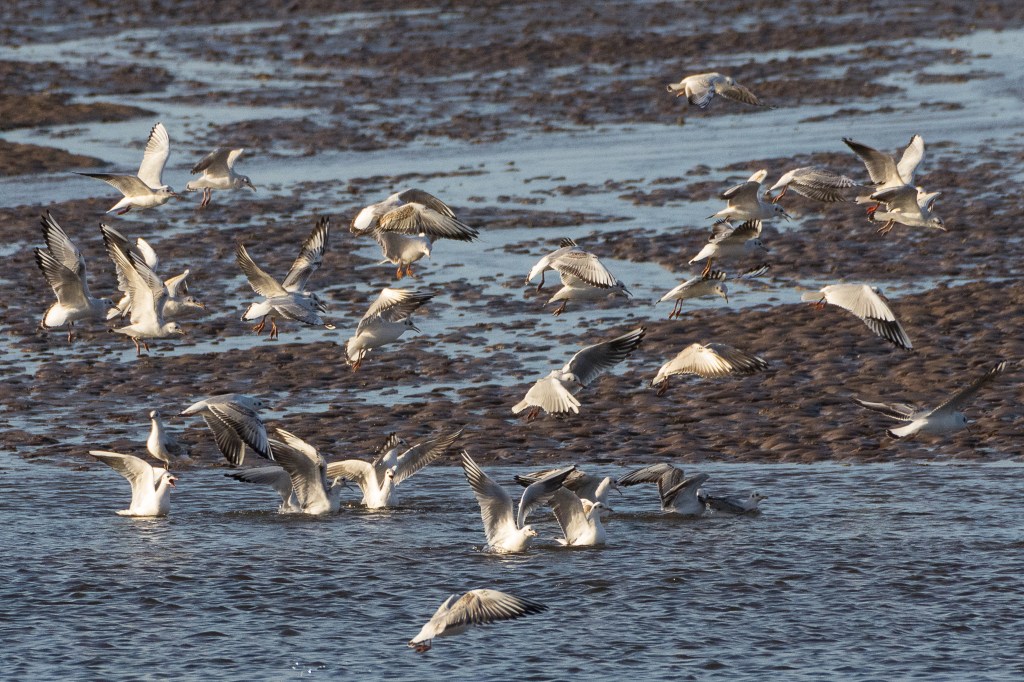
I had another group feeding near Aberlady.

I like the way that four birds seem to be queueing or following each other through a sequence in this image. It’s a crop out of something bigger so a little grainy, alas.

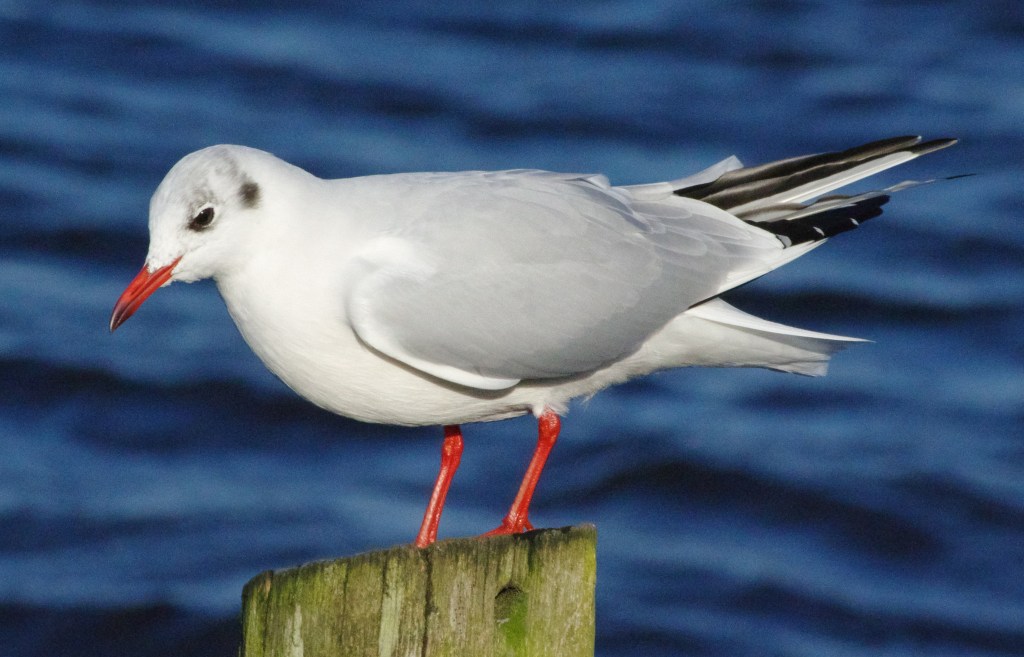
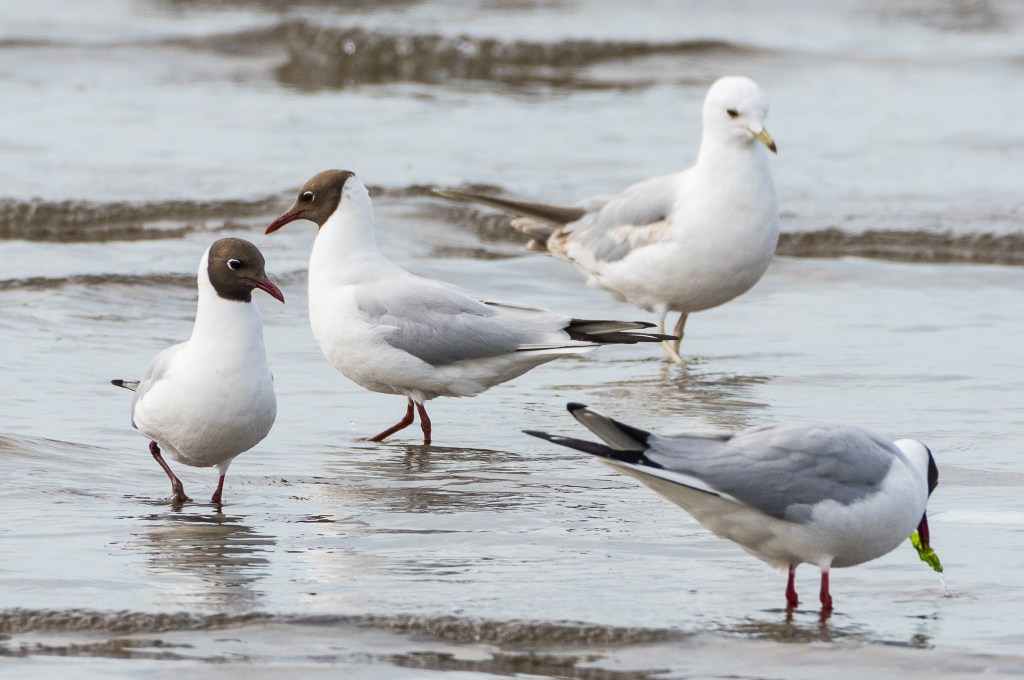
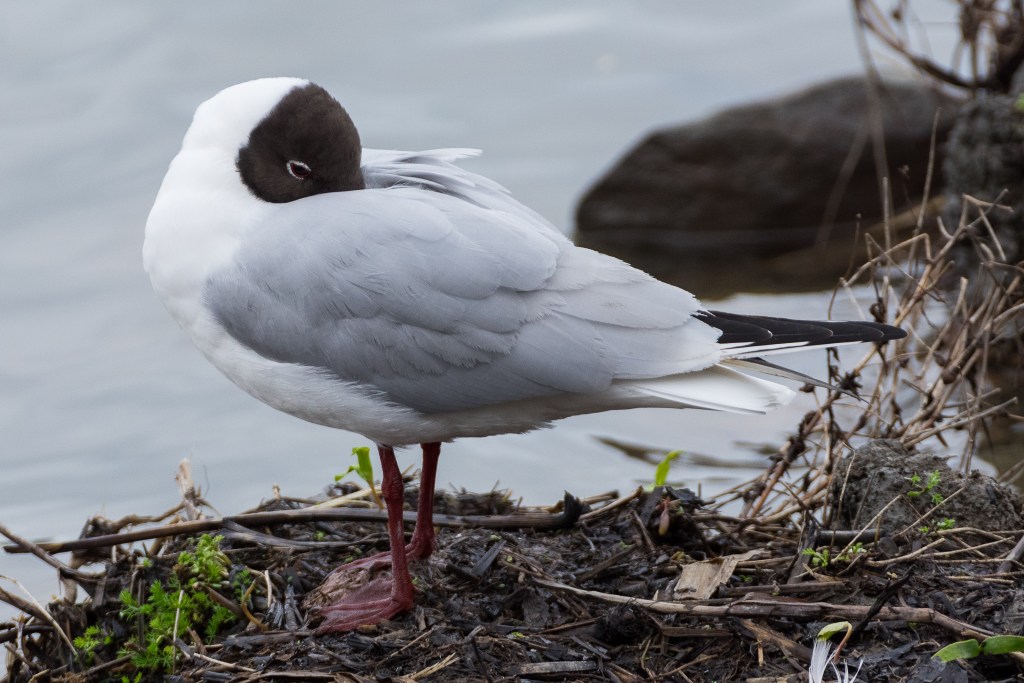
This is my best image of the non-breeding plumage, taken at Irvine Harbour in the winter.

I read Esther Wolfson’s Field Notes From a Hidden City some years ago. She’s quite keen on gulls, and generally speaking, I’m not. I remembered that she’d mostly written about Herring Gulls. Looking at her writing for August 11th again (it is mostly about Herring Gulls), I found that she had raised the ideas of philopatry (the tendency of an organism to stay in or habitually return to a particular area), nest site tenacity and mate fidelity. Far from being no more than urban anarchist shredders of bin bags, it seems that Herring Gulls are very socially organised.

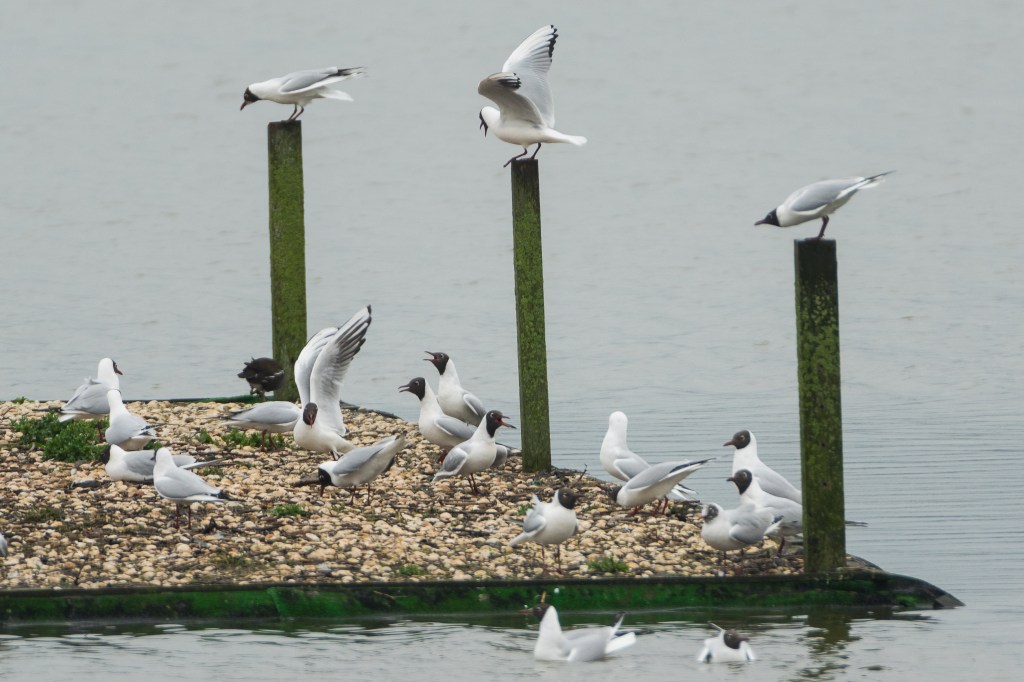
I hadn’t really thought about BHGs in this context until our visit to Belfast WOW. The reserve has large rafts which the BHGs use early in the season. Arctic and Common Terns follow them later in the year.

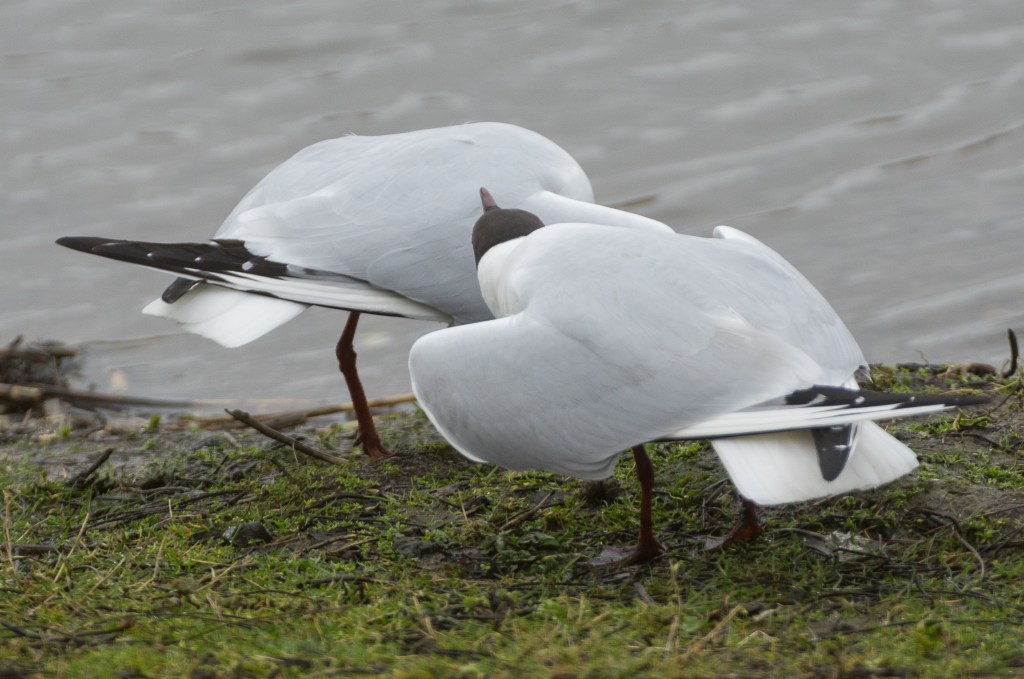
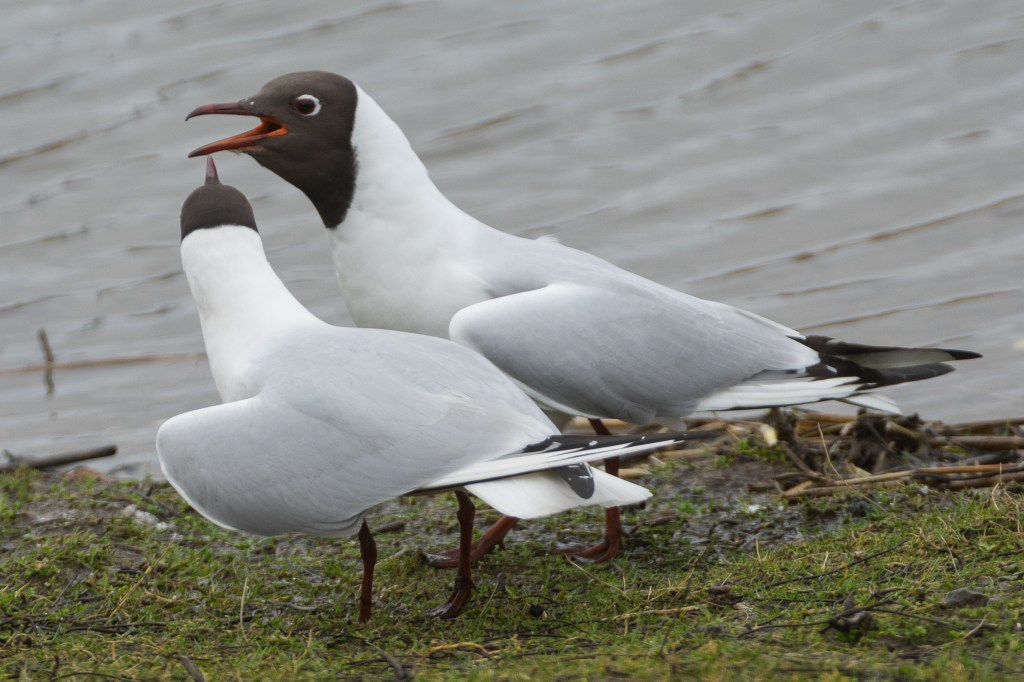
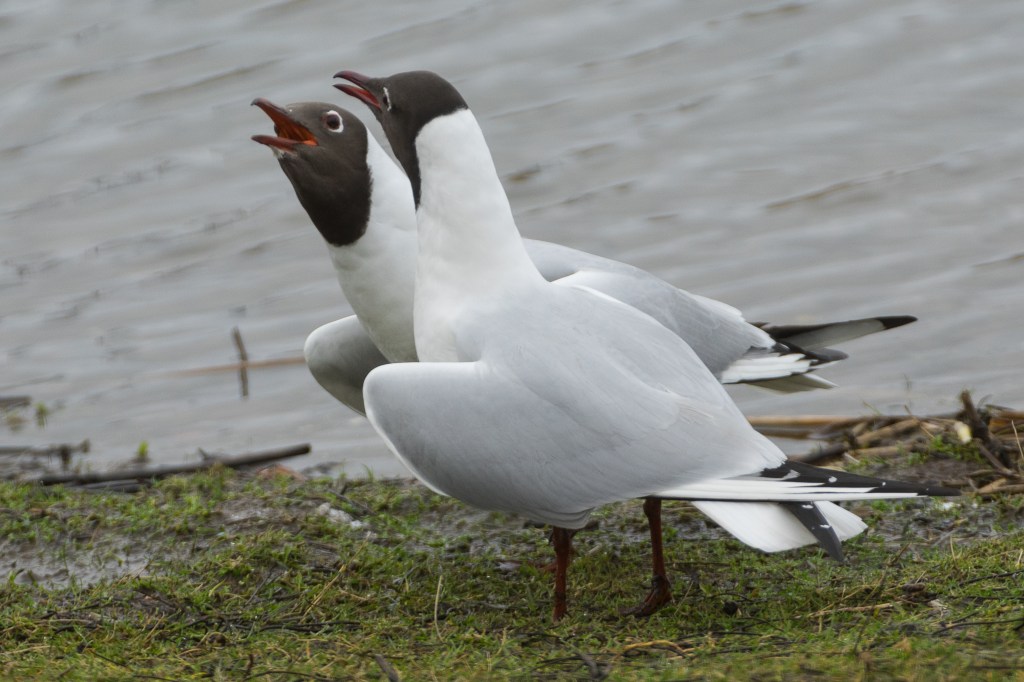
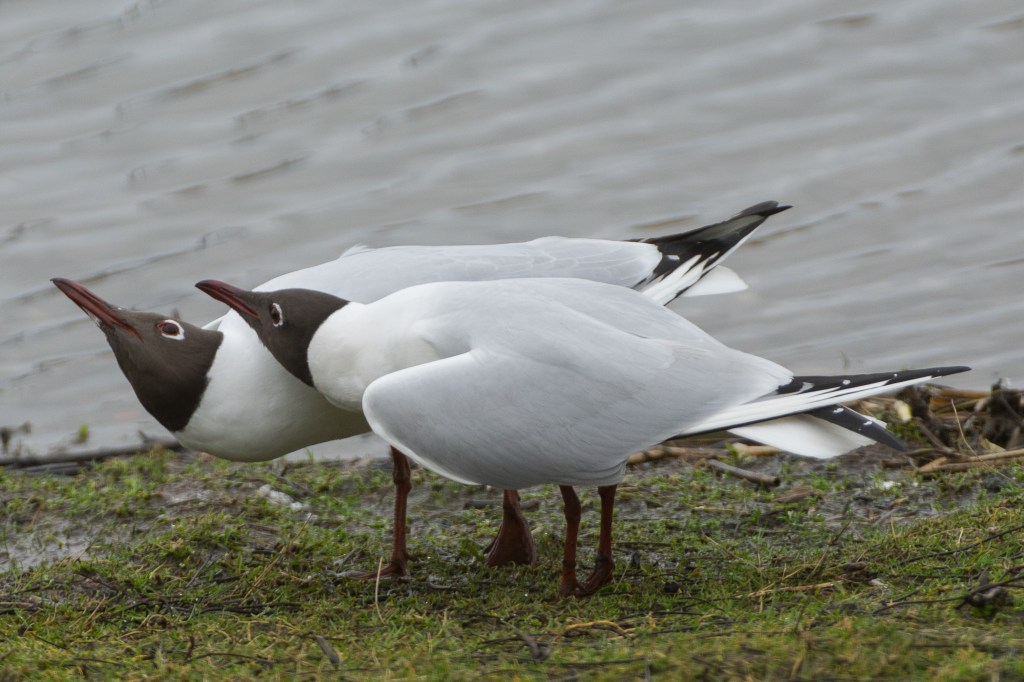
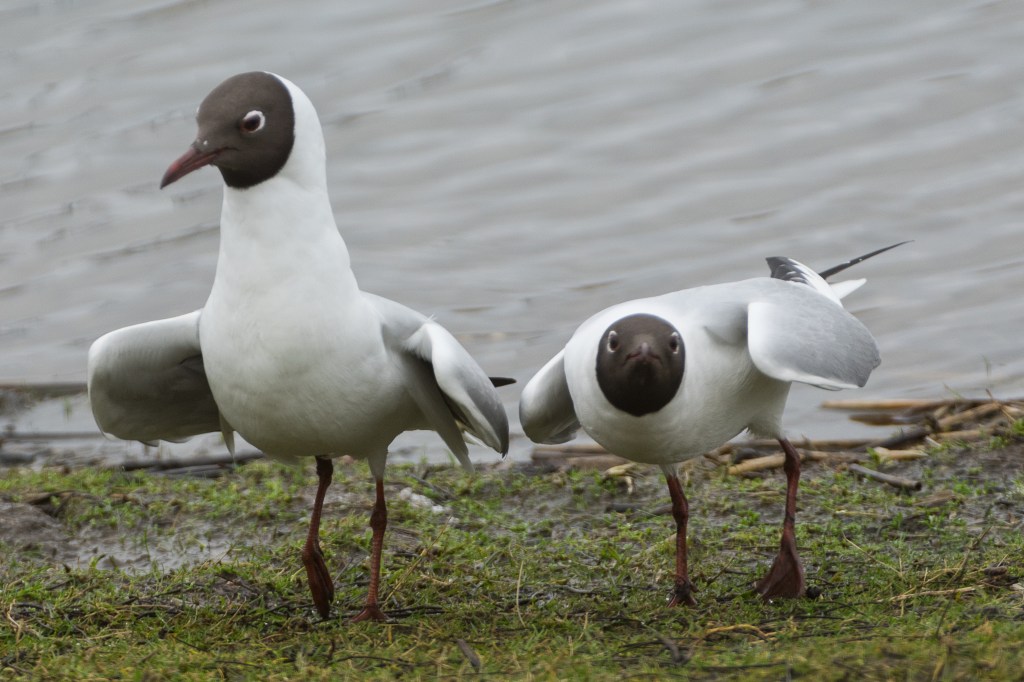
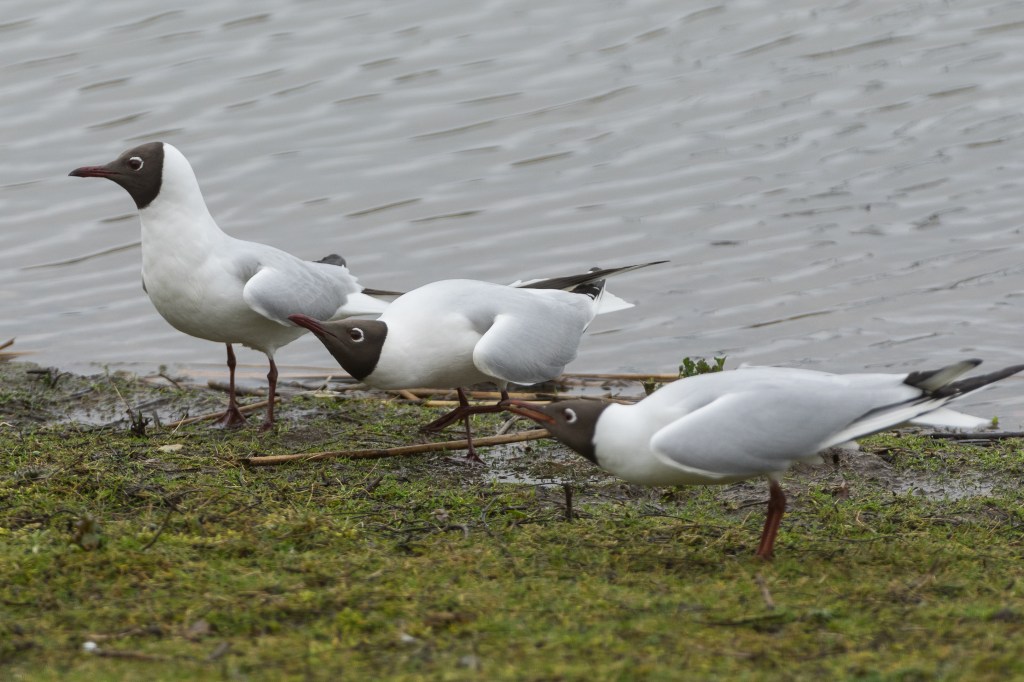
The rafts were a source of constant activity and clamour and it was very hard to follow individual behaviours. However, there were many pairs much closer to the hides and some of them were going through rather stately dances with remarkable posturing.

I haven’t been able been able to find much comment about this in the literature. I found a few moves in this YouTube video but not the whole business.

The posturing behaviour was widely reproduced, suggesting strongly that there was a degree of social organisation, and I found this article which discusses philopatry, nest site tenacity and mate fidelity. BHGs test high for all three. The study did report the odd breeding threesome.

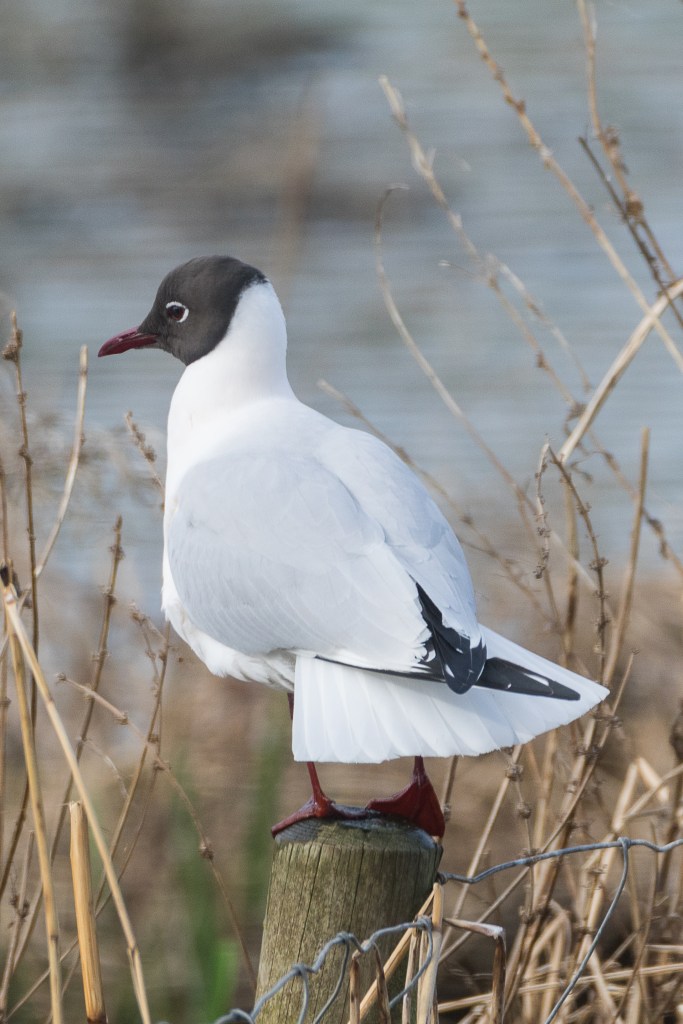
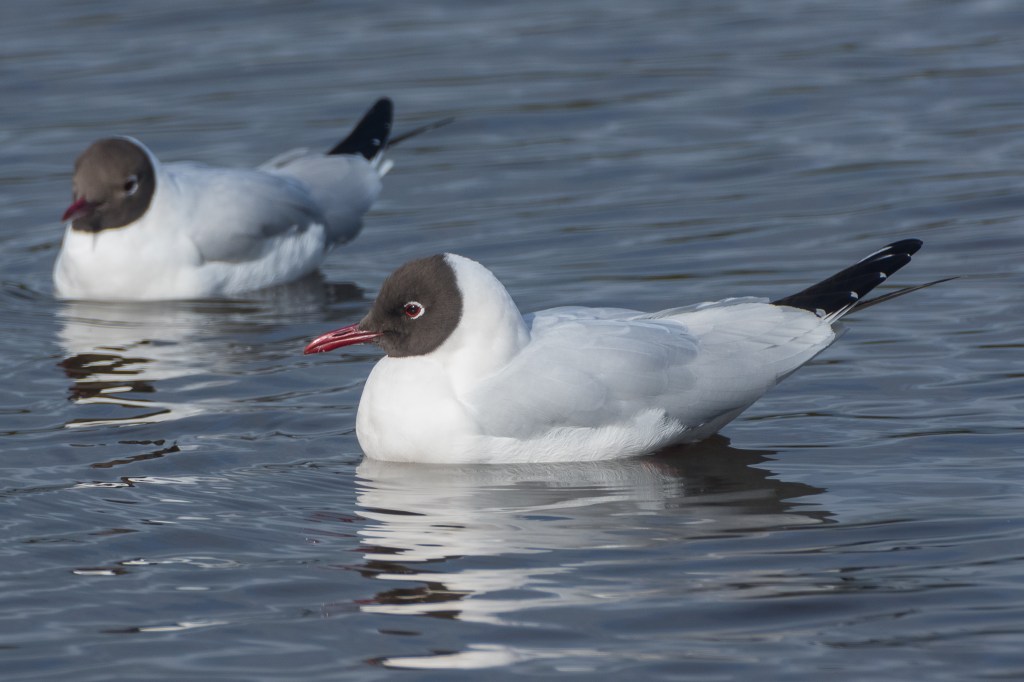
Our final visit of the Belfast trip took us to WWT Castle Espie in the sunshine and I was pleased to find some birds posing in excellent light. I love the crispness of the fanned tail, its whiteness emphasised by the blackness of the crossed wingtips. The lifted wings are so elegant and the five colours work beautifully together.

The typical lifespan of this numerous species is around 10 years, with the oldest individuals living for 30 years. Despite their breeding taking place in large colonies, their reproduction in Scotland seems to be slightly fraught. I quote from this article: “Productivity is affected by mammal predation, especially by American mink Neovison vison at west coast colonies. Comparisons of productivity at colonies where American mink were controlled against those with no control, or where control was unsuccessful, found that on average, between 1997 and 2011, American mink lowered success from 0.79 to 0.32 chicks fledged per pair – an estimated 59% reduction. However, from 2012 to 2014, success at colonies where American mink were controlled (0.06, 0.44 and 0.00 in each year, respectively) was actually lower than at colonies with no, or unsuccessful, control (0.44, 0.65 and 0.69 in each year, respectively), suggesting other factors (e.g. predation by large gulls, predation by otters Lutra lutra, or due to inclement weather) were impacting on productivity.” On the whole, anything approaching a gull colony on the ground gets a good slapping but I guess there are limits to the effectiveness of their communal defence.

I’ll be paying more attention to BHGs in future, whether they’re on the Clyde or at Stevenston.

Backwoodsman will post again on Saturday 13th May, all being well.

Shovelers

There is no specific seasonal trigger for me to post about this species; a couple of relatively recent opportunities to gather some images made me decide to commit.

Our first sight of Shovelers was at WWT Caerlaverock in Dumfries and Galloway. We took the train from Glasgow to Dumfries and eventually managed to summon a taxi to take us to Caerlaverock. It was a dark day and there wasn’t a huge amount about on the reserve. We were hoping for a goose spectacular – the reserve is on the Solway Firth which is an important wintering ground, particularly for Barnacle Geese from Svalbard. There were none to be seen which probably means that we’d picked the wrong season.Before a very fraught taxi pick up and ride back to the station against the clock, we did manage to see some Teal, followed by some Shovelers.

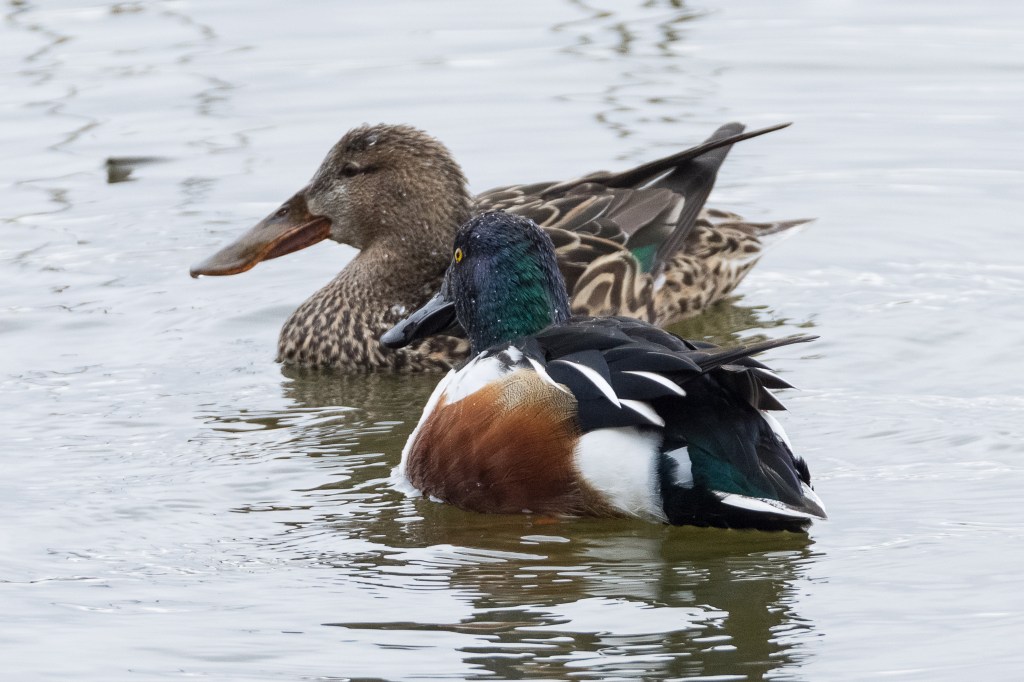
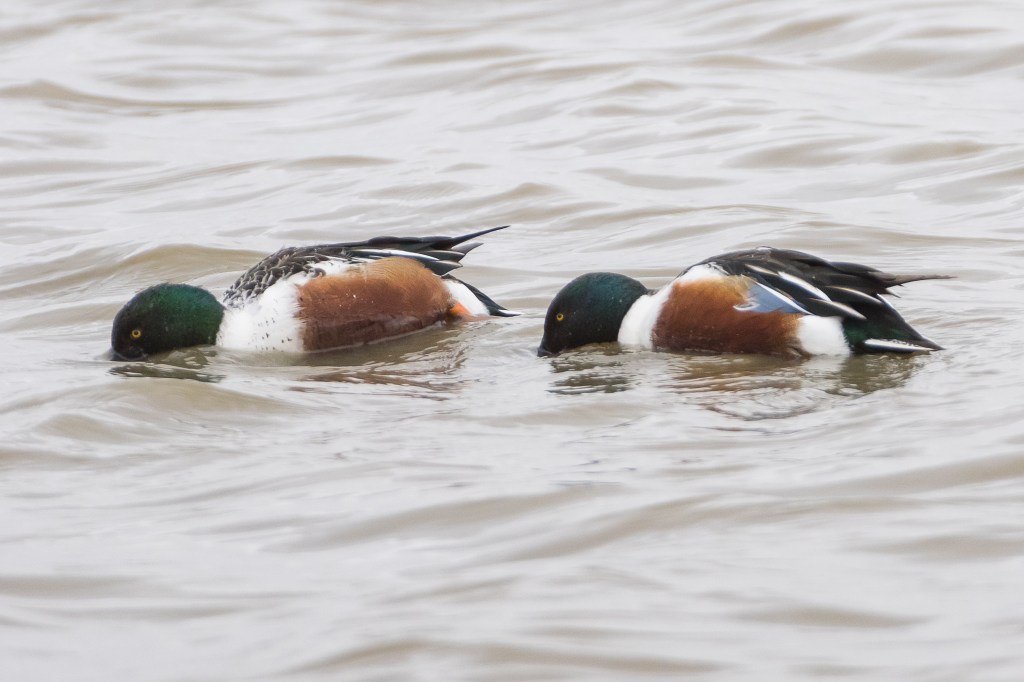
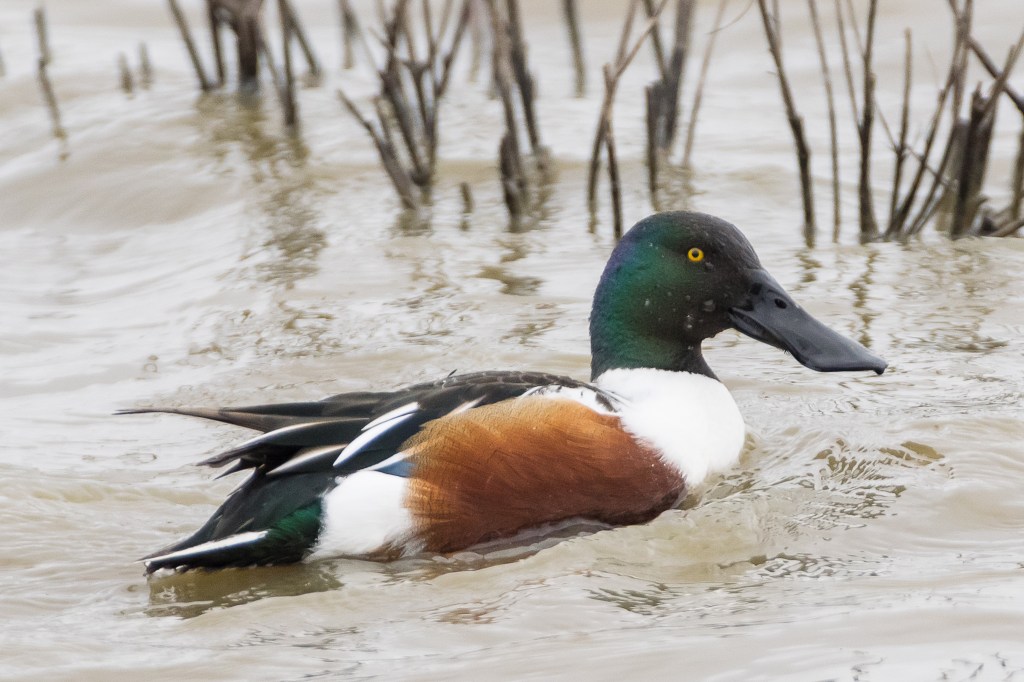
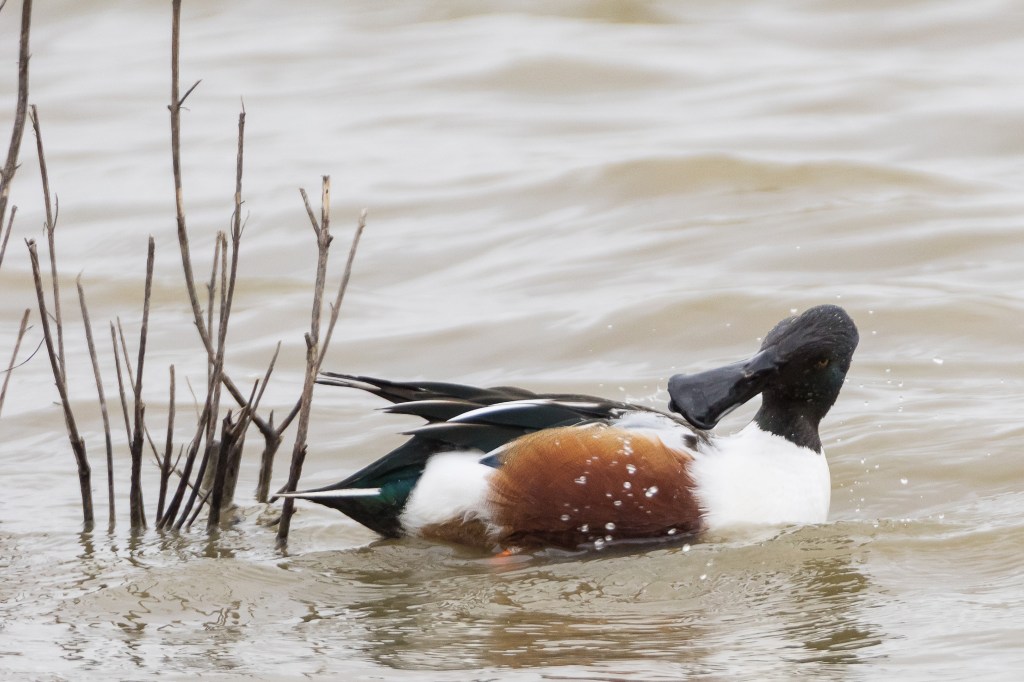
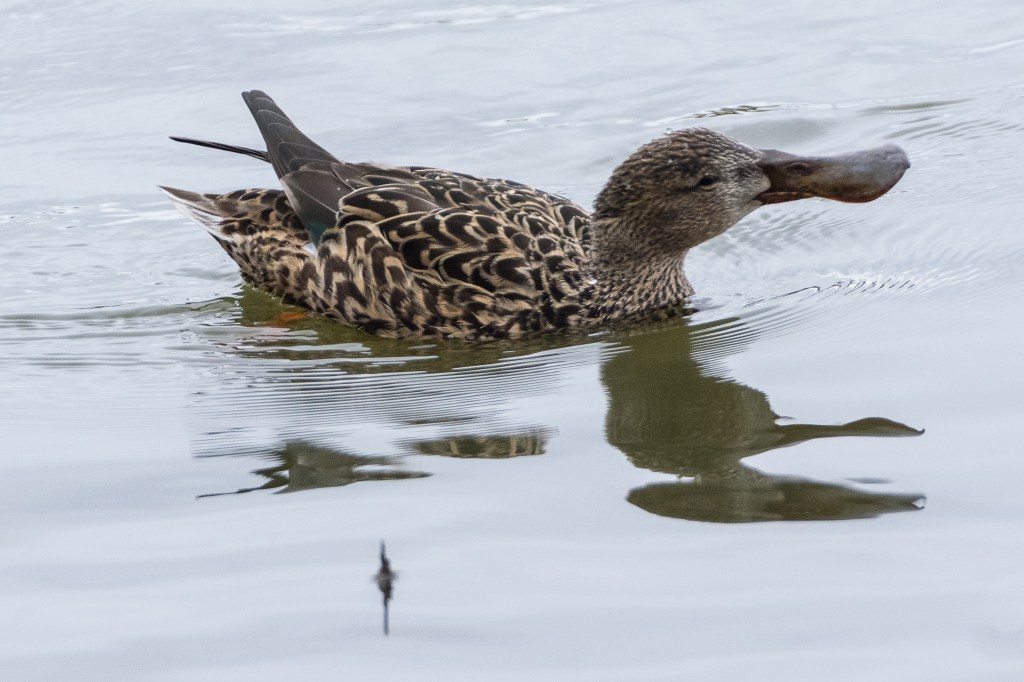
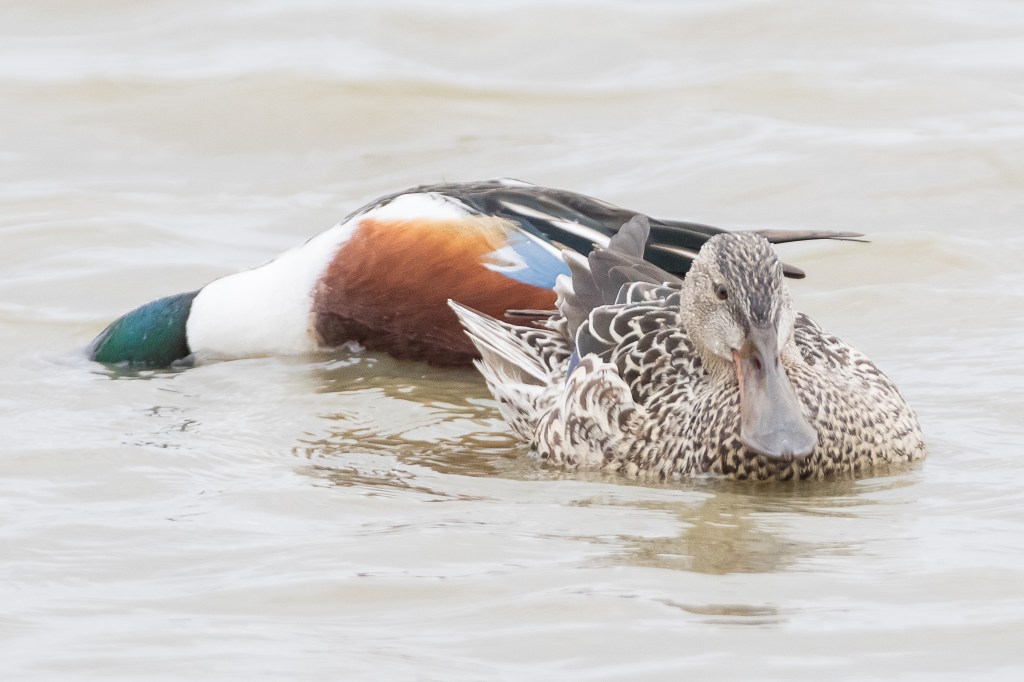
When you first set eyes on Shovelers, there really isn’t much else they can be, they are so well named. I have some rotten images from that day and I won’t trouble you with those. However, more recent visits to WWT Slimbridge and Belfast WOW delivered some better stuff, mostly due to our visits being made on brighter days (though there are still some sensitivity issues), and the availability of well-situated hides. At Caerlaverock, the Shovelers had simply cruised past into a reedbed but they went through some repertoire at Slimbridge and Belfast.

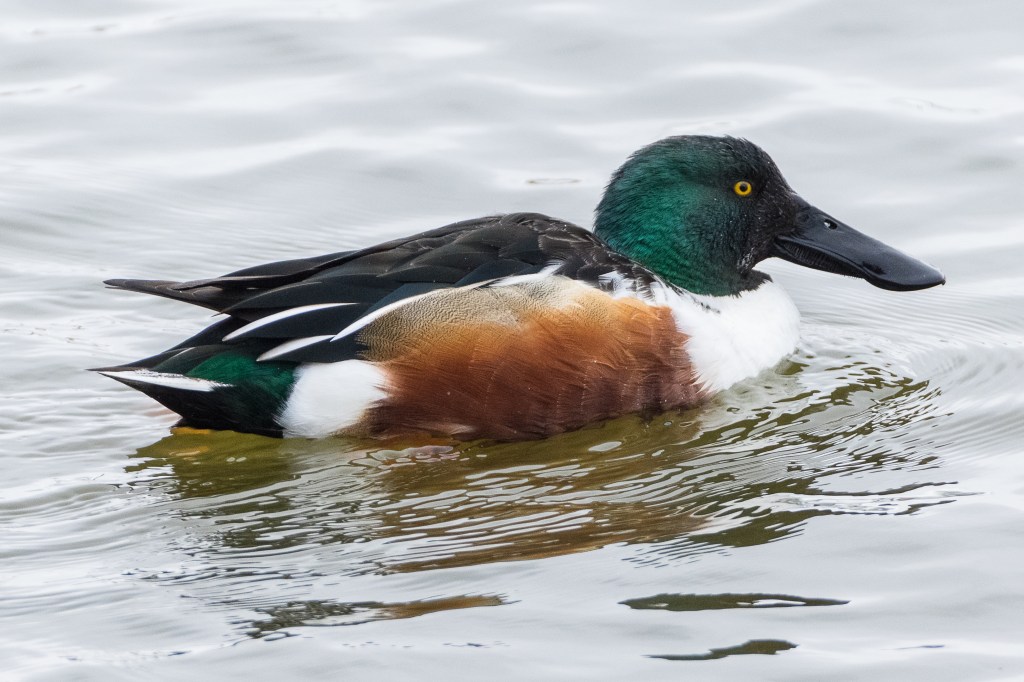
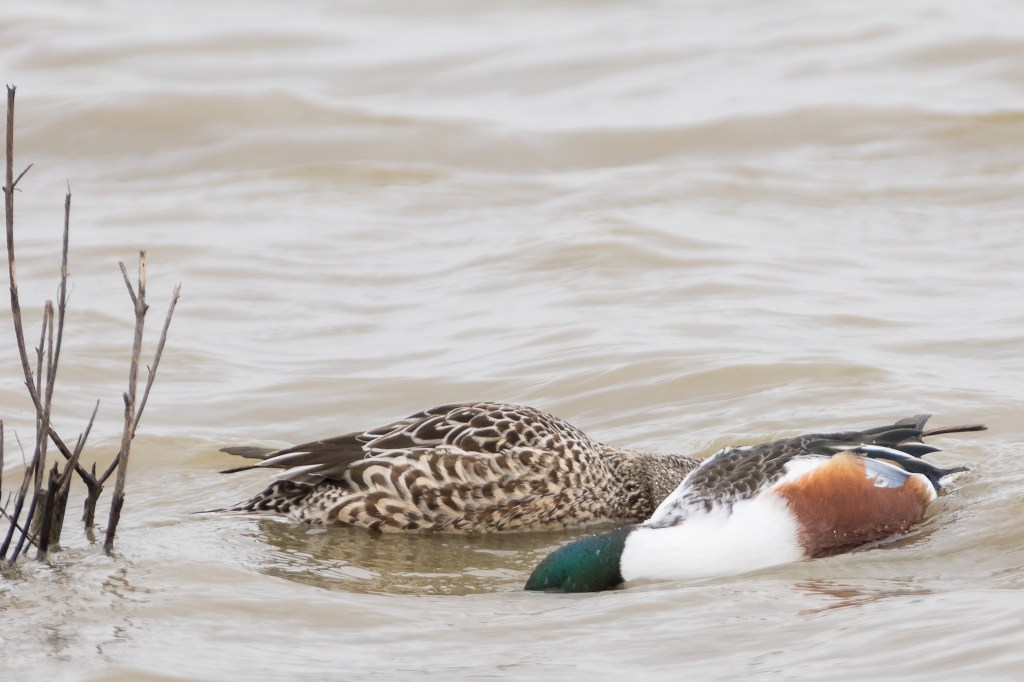
Apart from the glorious colour palette (which reminds me of Shelduck, another big favourite), it’s all about the bill with Shovelers. I had not found this ducks.org site before but it had some useful stuff – for example: “The Jimmy Durante of ducks, the northern shoveler, has perhaps the most unique bill of all waterfowl. Its wide, shovel-like bill with well-developed lamellae functions as a large scoop and sieve for skimming invertebrates and seeds from the water’s surface. It is not uncommon to see groups of shovelers foraging together like pelicans.” I’m thinking that Avocets and Spoonbills are pretty unusual too but we’ll let that drift with the tide. I saw males feeding in close mutual proximity – does this count as social feeding? This was February and most of the birds seemed to be paired up for mating.

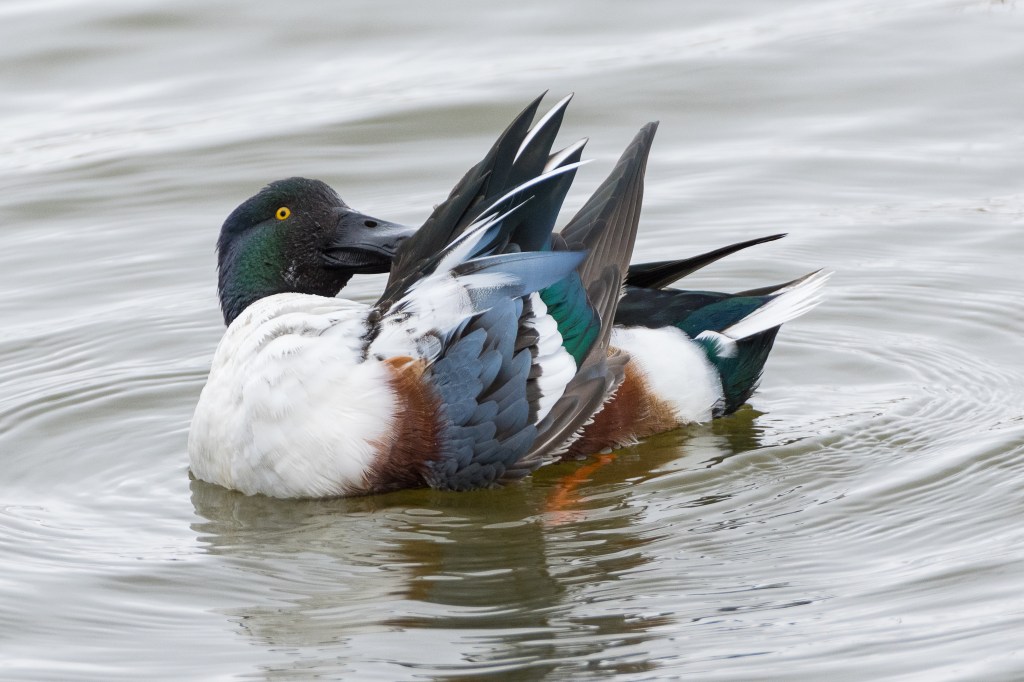
The same site also had: “Lamellae are another fascinating adaptation of the waterfowl bill. These small, comb-like structures along the inside of the bill act like sieves and look like teeth, even though ducks and geese don’t chew food. When ducks are searching for food, nonfood items such as mud and water can be expelled while seeds, bugs, or other food items are retained by the lamellae. The top part of the waterfowl bill is called the upper mandible, and the bottom part, the lower mandible. The upper mandible is affixed to the skull, but the lower mandible can move up and down… Shovelers have about 220 lamellae on their lower mandible and 180 lamellae on their upper mandible.”

I examined my photographs with more interest and found one (above) which shows the set quite well (but I’m going to struggle to count so many lamellae) – it’s a small piece of the image blown up quite big so there is a bit of grain. When I saw this cropped image, I thought of Baleen. I also include the uncropped image (below) which shows the glorious disarray of  feathers as the bird preens – so many colours and textures to enjoy here.

The BTO told me that: “The Shoveler is a rather specialized feeder, as its broad bill might suggest, feeding on zooplankton. One consequence of this is that Shoveler tend to favour more ephemeral waterbodies where potential competitors (e.g. fish) cannot survive.” I also found an image which shows (if you zoom up) the lamellae on the upper mandible giving an idea of the length of the individual structures.

I assume these are keratin bristles (as in Baleen). You may have heard Roma Agrawal on Radio 4’s Start the Week talking about the seven basic building blocks of everything in the built or made environment – string being one of the seven. I found her discussion of string, threads and cables engaging and it made me think of the structural proteins collagen and keratin – of course nature got there first, it always does.

Apart from the hardware, Shovelers have also evolved behaviour which involves agency, opportunism and cooperativity: “A Northern Shoveler feeds mainly by drawing water into its bill and then pumping it out through the sides with their tongue, filtering out minute food particles with long comb-like lamellae that line the edge of the bill. The particles mainly consist of tiny crustaceans, molluscs, insects, and their larvae as well as seeds and pieces of leaves and stems of plants. In addition to the food particles they also eat water beetles, small minnows, and snails. Social feeding is common. The shovelers are drawn to feeding areas by other birds feeding in an area. Shovelers take advantage of the food particles churned to the surface by the other birds swimming or wading in the area. Single birds may swim in a tight circle to create a whirlpool to cause food to come to the surface.” [My italics]

At Slimbridge, I watched a pair making a tight clockwise circle for long time. The wind was ripping in over the Severn and the hides facing into the wind weren’t too popular, funnily enough. I was pleased to see the head shaking movements which emphasised the scale of the bill.

This video shows some of the  feeding and courtship behaviour. I’m rotten at photographing birds in flight but I found a very nice image of a pair on the wing at a site called Saltlane. I haven’t seen this site before – I think they have some really high quality images, generally better than mine. Credit where credit’s due.

I feel a bit sorry for Shovelers. I don’t think that they are either sufficiently well known or ubiquitous for authors to seize upon them as motifs for aspects of human aspiration or suffering (The Wild Duck, Wild Geese, etc.)  so I’m not even looking for poetry or other forms of artistic writing about them. Where is the innate poetry in having a huge bill and shaking your head about a lot? I imagine they get shot quite often too – the females are coloured like Mallard and the green head of the drake might look perilously familiar and potentially tasty across a gun sight. I tend to shoot first (with the camera) and worry about it later – mind you, a lot of the people I worked with would probably say that summed up my professional life too. Anyway, let’s celebrate these rather marvellously adapted creatures, ninety percent duck, ten percent whale.

Ringed Plovers

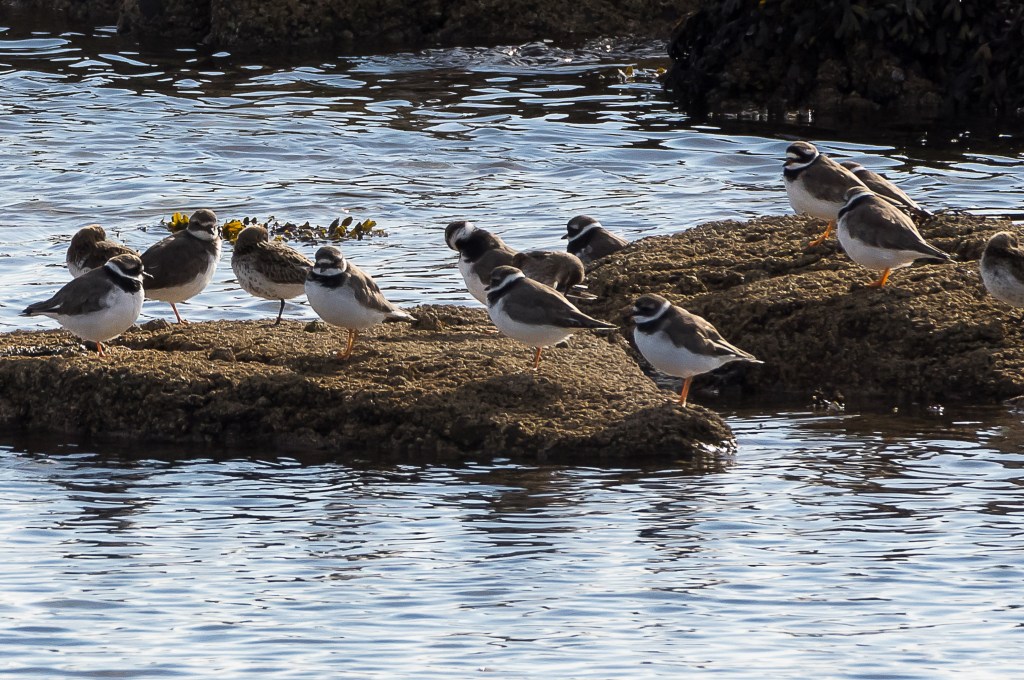
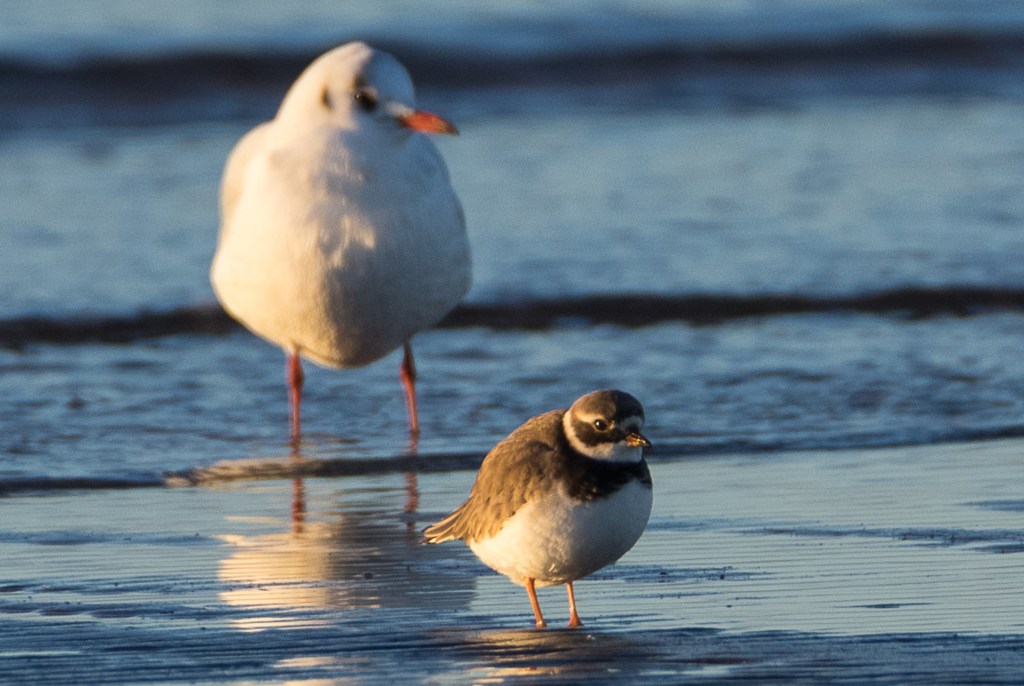
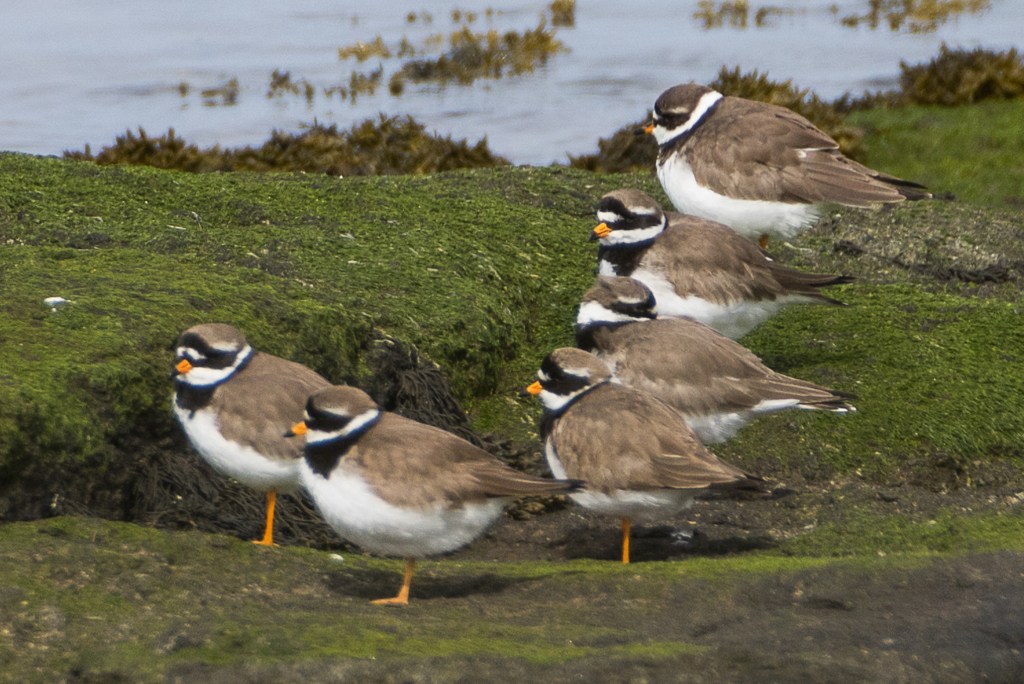
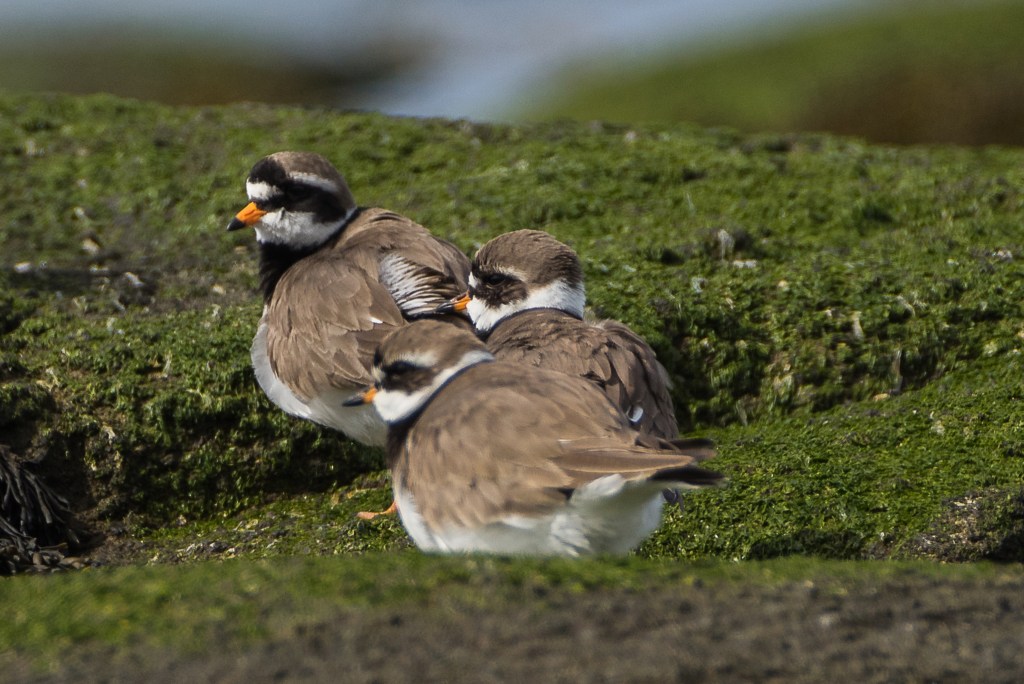
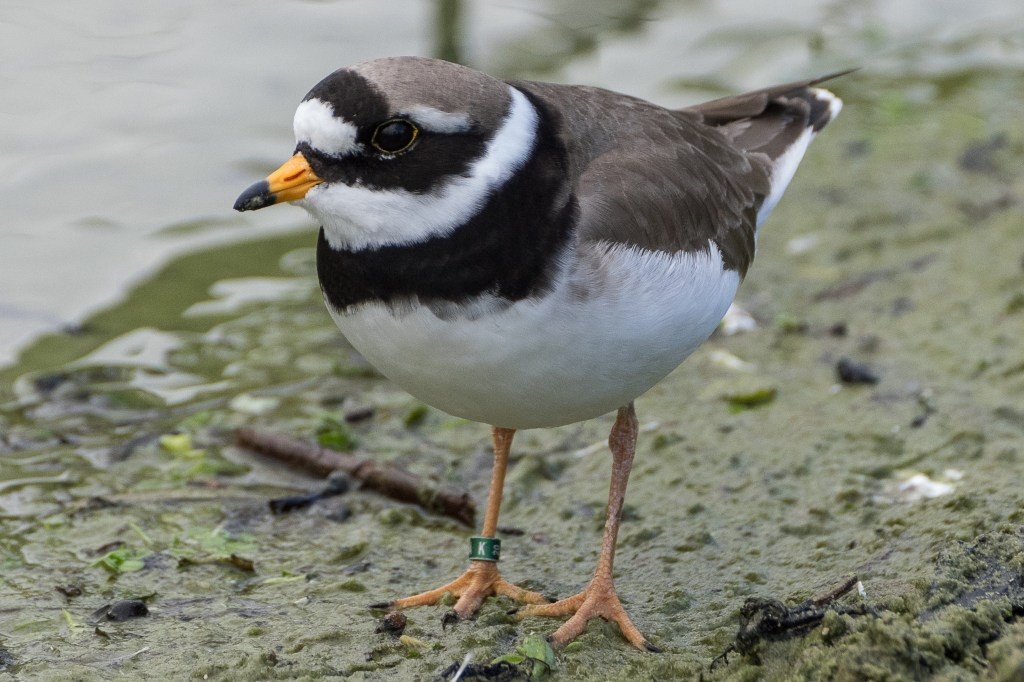
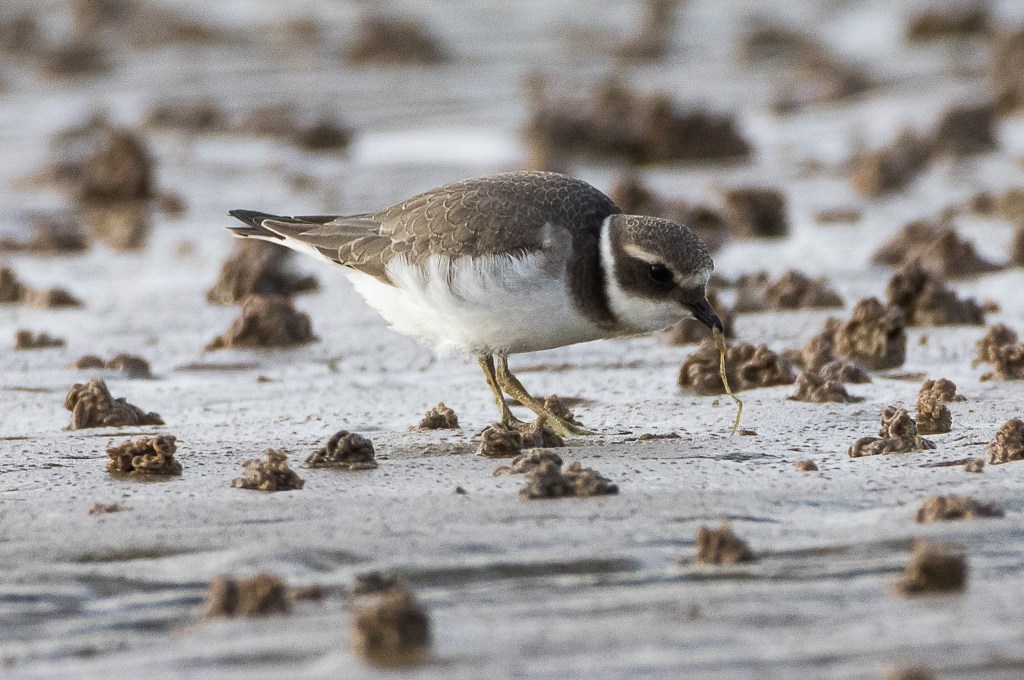
Time for buckets and spades again because the North Ayrshire coast is our place for Ringed Plovers. I’m very fond of this species. They’re such an endearing shape, with great colours, and the wing feathers have that wonderful scaly quality which is (to me) one of the most appealing features of waders. They turn up along the usual Troon-Stevenston-Saltcoats stretch. One cold day several winters ago, we saw hundreds standing on the remains of the Lido at Saltcoats, waiting out the high tide. No camera, alas. I often see them with Sanderlings but what a contrast in terms of general level of animation. They usually seem to be standing about and not doing too much of anything.

The Lido was quite a thing back in the day attracting thousands of visitors daily. This piece in The Scotsman (as it carries The Court Circular, I assume it is the Torygraph in disguise) speculates on a possible future refurbishment, given the current enthusiasm for Wild Swimming (or swimming outside as it used to be known). The wind fair rips across that stretch of Firth of Clyde and I do associate being in Saltcoats with being quite cold (while being quite happy). I imagine generations of Scottish children gradually turning blue in that water before being dragged in a frenzy of reluctance back to boarding house or caravan.

In Troon, there is a stretch of shingle in the shadow of the Harbour Master’s Portakabin. On one visit, we’d looked around the harbour and I’d taken a picture or two; we were met by the Harbour Master who was clearly wondering why someone was taking pictures of his boats. Our local fish man gets most of his stuff from the Troon day boats.

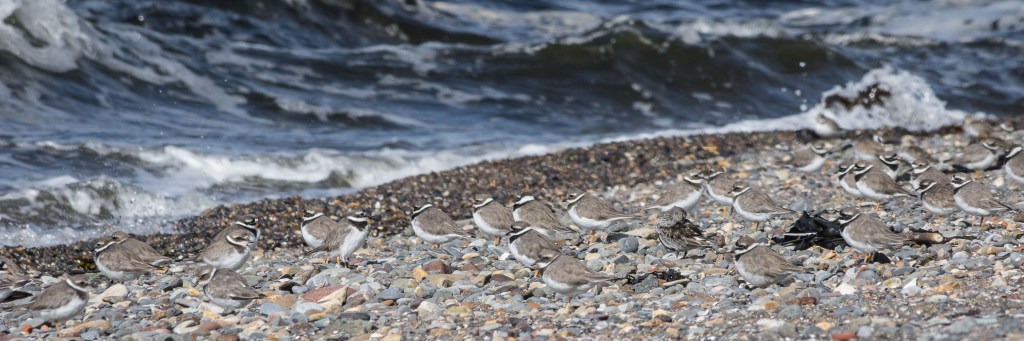
 I imagine there used to be some sensitivity about comings and goings (of shady characters, money, guns, and drugs) to the smaller west coast Scottish harbours before the Good Friday Agreement. Anyway, I indicated our interest in birds and the Harbour Master invited us up to his office to get the view down onto some Ringed Plovers. I guess he decided we were harmless. This isn’t a great image but it shows that it’s quite easy to lose birds in repose against the shingle.

I’m interested in how the eye is confused in a situation like this. The distinctive white collars seem to help the birds to blend in better rather than making them stand out. I remember watching a BBC documentary (which I cannot now find) which said that Peregrine Falcons have about an order of magnitude more digital resolution than humans. It seems that there is a complex interplay of factors which determine how well raptors can see. It might be that raptors are going to struggle in a situation like this where there is a very complex pattern of pixellation and little colour contrast, unless they flush the birds and can then hit them in flight.

How do birds work out where to stand? We’ve noticed a similar thing with Golden Plovers and their choice of rocks (I hope to post about this beautiful species in the future). A crawl along the shingle afforded some slightly better images in profile without disturbing the birds, but my best natural habitat stuff comes from The Ballast Bank, slightly to the south. Against a green background, these birds look much more vulnerable

I also have one zoo picture from the Waterscapes Aviary at WWT Slimbridge. This is a such a useful space for image capture; the birds are relatively used to people and cannot escape across the Severn. They don’t even seem to notice old blokes looming with large cameras. There was one Ringed Plover in the collection and I hope it wasn’t lonely. There were Redshanks, Ruff and Avocets for it to roost with so fingers crossed.

The BTO has its usual very useful pages on the species, including this: “When nesting, individuals will feign a broken-wing to draw predators away from the chicks. The chicks are perfectly camouflaged against their sandy substrate, so will sit and ‘hide’ if they can as they are near impossible to spot.” I found a short video on YouTube showing this distraction behaviour beautifully.

I don’t imagine this feigned broken-wing jazz gets them anywhere with the Hedgehogs introduced (rewilded? Hmm) to the  Outer Hebrides, which are apparently eating plover eggs and having a big impact on breeding success. Doesn’t Mummy have some plover’s eggs sent to the young Sebastian in Brideshead Revisited? Bless. I’d rather a Hedgehog had them any day.

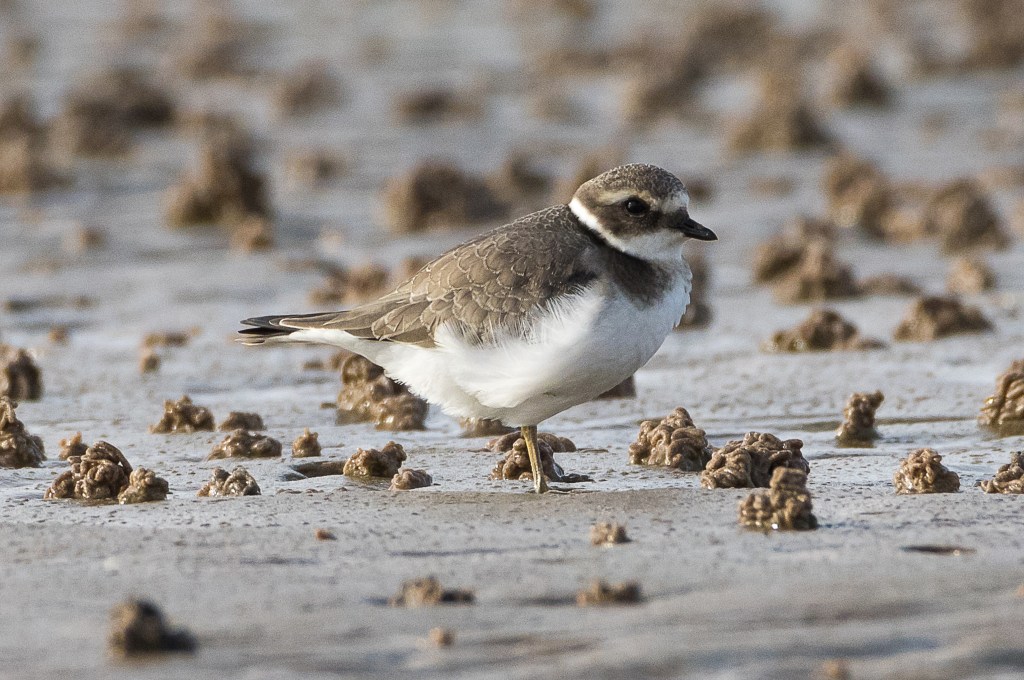
The breeding population seems to be quite small (ca. 5000 pairs) with of the order of 40000 pairs visiting in winter. The species is now red listed. The Troon group higher up the post which was shot in September clearly contains a mixture of young (paler) and mature (more coloured) birds, so either they are managing to breed on this coast, or they are incoming for the winter. I think my favourite images are of this young bird on the shore at Aberlady Bay.  I am getting wet in the sand for this one and the bird is pottering towards me and feeding.

Which brings me to the Scottish Seabird Centre just along the coast from Aberlady in North Berwick – they are involved in a drive to raise funds under a matching scheme with Aviva. If anyone is interested in supporting their work, you can find the details here.

I will also mention the Flamingo Land Mark III proposal at Balloch – some of you may have seen the earlier versions of the proposal. Scottish Greens are taking the lead in opposing this very large intrusion on the Trossachs National Park.

There is a confusion species – the Little Ringed Plover – and they’re gradually spreading north. I see nothing in my images to lead me to think that I’m seeing them but I live in hope that some will turn up in Ayrshire and in front of the camera.

Urban Spring

Spring is our favourite season. Recently Faye asked me when I thought it began and at first, I wasn’t sure how to respond, so I thought about it. The blooming of the Snowdrops is a prelude but the beginning of the main movement is marked (for me) by the arrival of a couple of species from their winter quarters, and the flowering of the trees. A run early last week revealed that the Sand Martins and Chiffchaffs were back and a Good Friday walk around North Glasgow in bright sunshine provided an opportunity to photograph the former species and record the latter. The Sand Martins use an old wall at the end of Speirs Wharf as a nesting site. I think that the wall is made of blonde sandstone blocks and there must be soft sandy material between some of the blocks which has eroded and washed out, providing the Martins with tunnels and nesting chambers.

I find photographing Martins hard because of their speed and agility on the wing. My strategy is simple; find a place to stand where I won’t upset them, then find a hole they seem to be using. Stay tight on that and blast away when I think birds are coming and going and I might get an outcome. My location in cover is behind a massive steel link fence – I’m resting the camera on that and hoping that the separation between the plane of the fence and the focal plane is sufficient for my image not to be affected. I was lucky in that a bird spent a lot of time perching at a tunnel entrance. I’m sure it’s watching me looming behind my fence but I am a long way from it and my outline must be masked by my cover.

From time to time other birds would approach and there would be an opportunity to see beautiful wing shapes. I’d need much better images to do a Sand Martin post but these are a good symbol of the season and the optimism which it brings.

The Chiffchaff was calling in the Claypits, or to give it the full title The Hamiltonhill Claypits LNR. The website says “Hamiltonhill Claypits is a local nature reserve located on rewilded post-industrial site close to the city centre along the Forth and Clyde Canal” which is partly true. The Claypits site was a wild area of mature trees and scrub close to the city centre along the Forth and Clyde Canal. It now has large cleared areas, an artist-in-residence (a dog warden would be more use), and a lot of recently planted whips, some of which are doing quite well. There are some gravel paths which are great for running; therefore, it is considerably less wild than it was. Some of the older trees remain, as do the industrial legacy pigeon lofts which are still in use.  There is a team of people working hard to keep the litter down on the site, which is great. I’ve been surprised by Roe deer there on winter mornings and I can usually find Long-tailed tits and Bullfinches. I think there were at least two Chiffchaffs calling on Friday –  you may also hear the calls of Easter egg hunters.

We found Bird Cherry just coming into bud and Norway Maple and Rowans coming out.

As we left the Claypits, Faye noticed some activity around the eaves of the Scottish Canals building by Applecross Basin and we stopped to look closely. There were Long-tailed tits flying under and back out from under the eaves, not foraging but collecting insulating material to add to a growing nest. You can see the cup shape of the nest, into which the bird’s tail really will not fit. The top layer of moss is starting to disappear under insulating material and it’s looking a bit of a mess but I hope that it will be warm for the incubation and that they succeed in fledging some young. Because of the difficult angle, my camera lens is on Faye’s shoulder at this point – “A good tripod!” as a passer-by interjected.

After the Claypits, we had a cup of tea from a Thermos by The Whisky Bond while admiring Frodrik’s piece. It’s been there for ages and no-one has ever tagged it, clearly a sign of respect from the youth. The Council were out recently cleaning lesser works off the flanking walls but maybe they just though better of removing this work. The Marsh Marigold was in full bloom on the canal.

We left the canal, moving towards Glasgow Angling Centre at Saracen Point down Applecross Street, hoping to admire the European Plum tree but we’d pretty much missed it – it seems very early this year.

We headed on towards Pinkston Basin which lies below the North Bridge development on the site of what used to be Sighthill Park, now flattened and gone. The site is enormous, stretching east towards Springburn, with nothing to break the horizon bar the top of a huge Tesco sign. The bit they’ve finished boasts the Sighthill Community Campus and the new bridge over the M8, both featuring attractive deployments of COR-Ten steel, so beloved of Grand Designs. What glorious colours in this spring light! I’ve been watching the bridge take shape for ages now and I am pleased to see the rather sinuous end product. There are plantings of white-barked Birches on the site.

At the canal edge, we found Goat Willow, Grey Alder and Wild Pear. I used to fish under the Pears.

On the way home, there was Flowering Quince, Alder and Blackthorn.

A short detour was made through the Park to take in the emerging Horse Chestnut and the double cherries up by the house (a panoramic image, hence the curvature).

The Chestnut buds are a photographic challenge because of their size – this image has been made using Zerene Stacker software (the good bit is the cluster in the middle of the frame – I’m sorry there isn’t a natural crop to do on this image).

It’s tripod work. You start out-of-focus in front of the object and use the focus ring to step through the image emerging out of the back, or vice versa. The images which contain something in focus are then “stacked” in the software using some sort of miraculous minimisation routine to prioritise sharpness over fuzz and beat the depth-of-field problem.

We were treated to a marvellous St Matthew Passion by the Dundedin Consort on Friday evening, enjoyed a walk up the Stoneymollan Road on Saturday and I’m now trying not to eat chocolate in a wanton manner. If you’ve read Chocolat by Joanne Harris – in Chapter 38 (5.55 am onwards), the  wee troubled curate voices my natural instincts rather well. I wish you a Happy Easter.