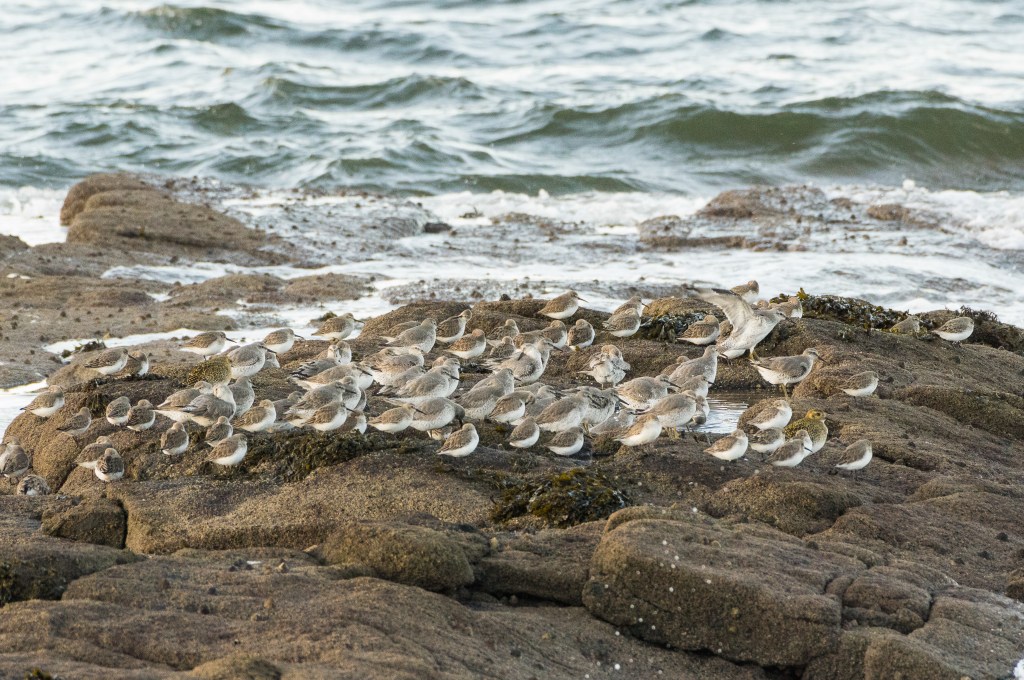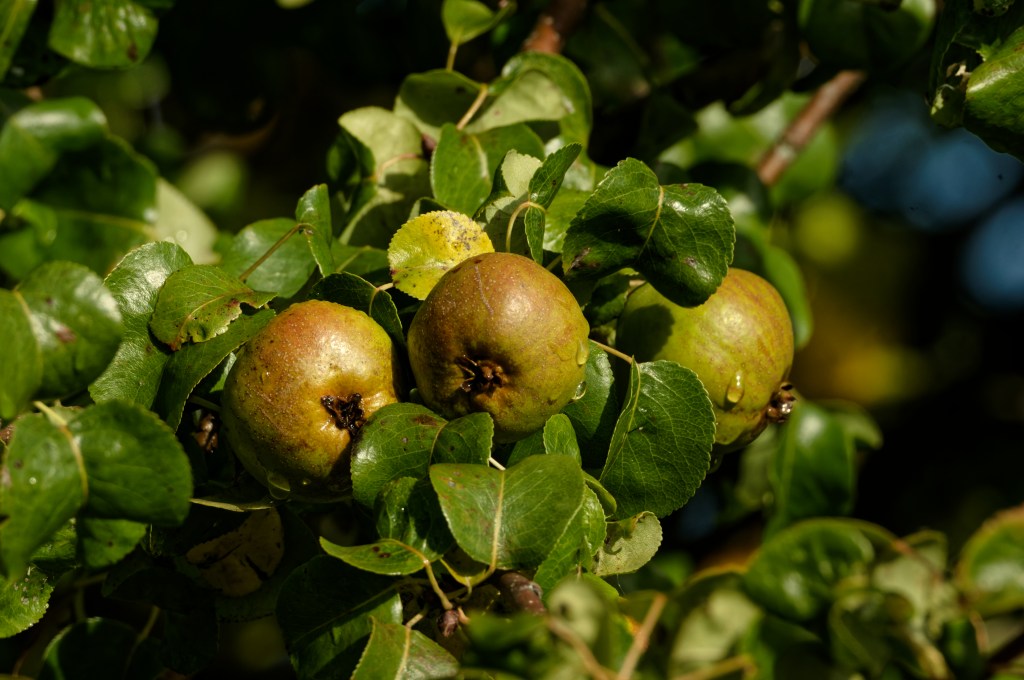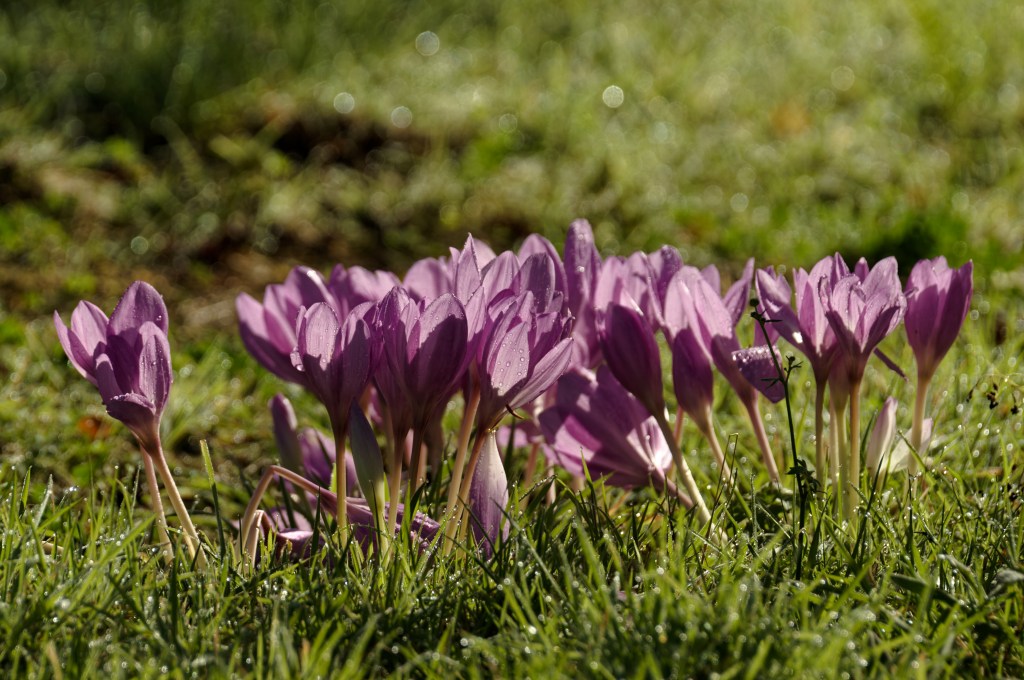
On a midweek run, Backwoodsman was surprised to see a stand of Autumn Crocus just by the Pinkston Road in the little parcel of land planted up by the developers of the NorthBridge estate, right at the edge of the new Sighthill Park. Wet weather came over the following days so Backwoodsman was pessimistic that there would be anything to see by the weekend; Autumn Crocus are usually flattened by the rain. Sunday morning was brilliant with blue skies, so we went to look, taking in the ripening Pear crop by the canal at Pinkston, and the Water Lilies in the SUDS ponds on the way.
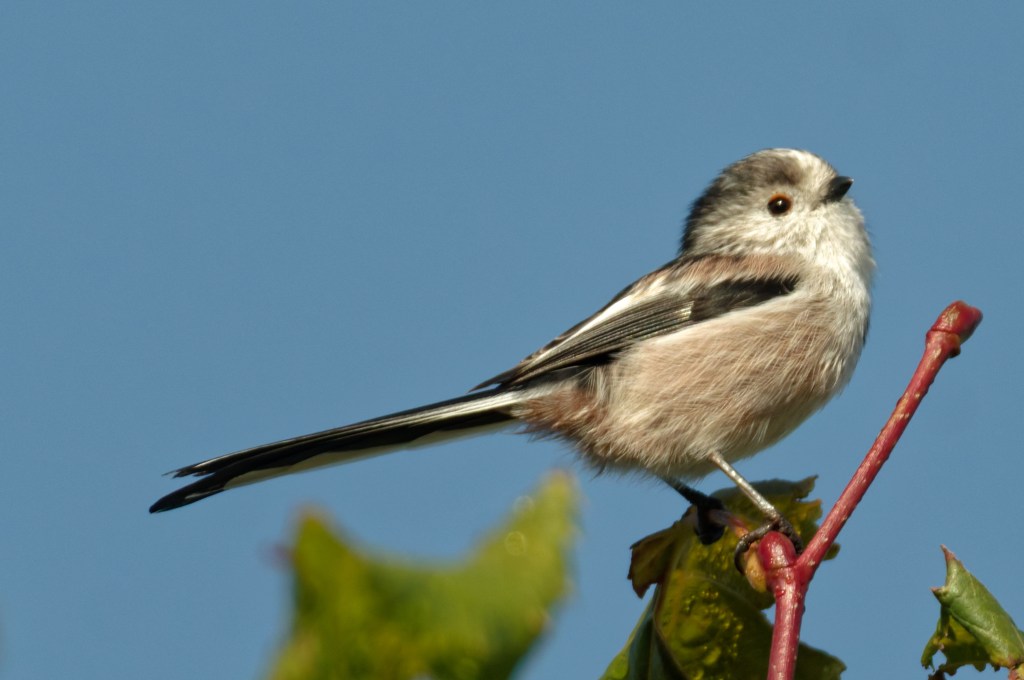
A small flock of Long-tailed Tits was enjoying the sunshine. They were unusually still in the tops of the Lime saplings; perhaps they were warming their tiny bones after a cold night.
The Autumn Crocus were doing very nicely despite the weather; more flowers had emerged, enlarging the groups and brightening the display, which was really pleasing.
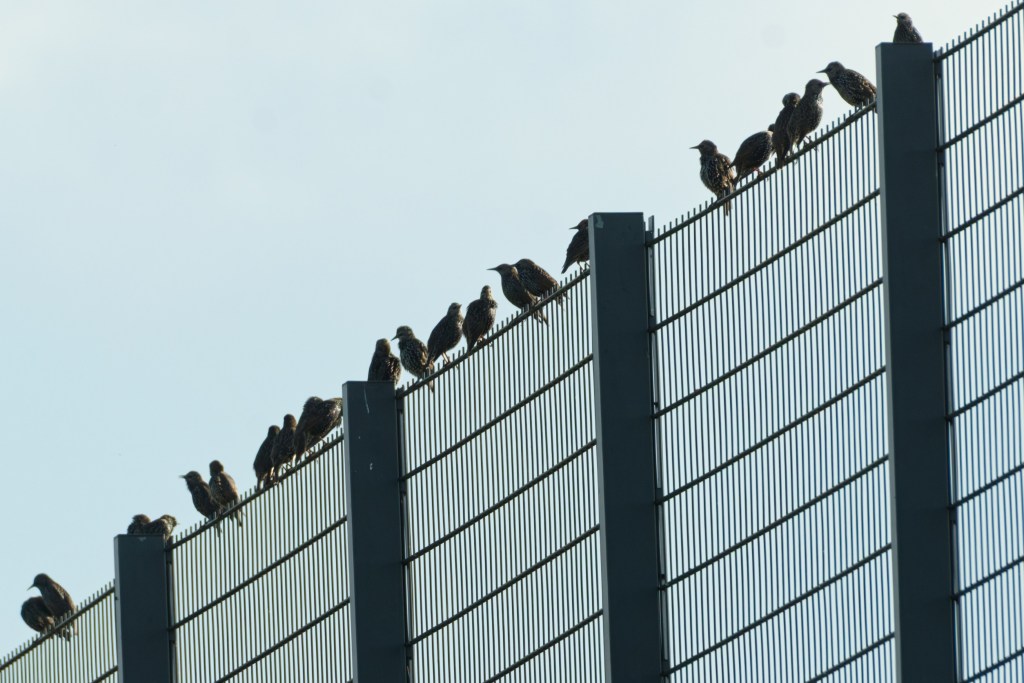
Our eyes were drawn to a striking gallery of Starlings, mostly young birds.
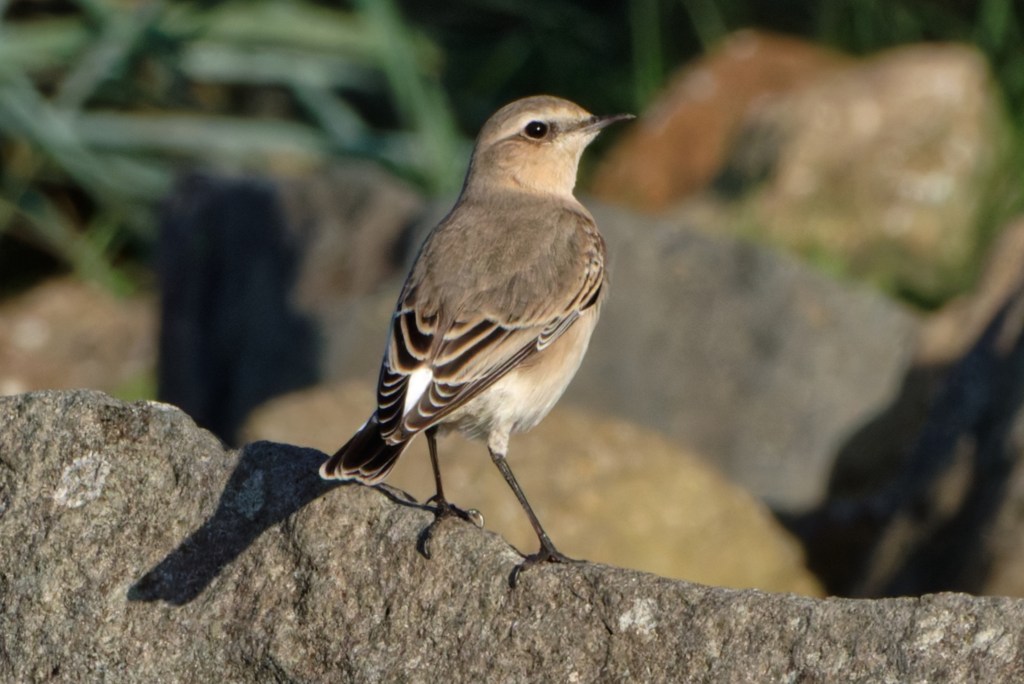
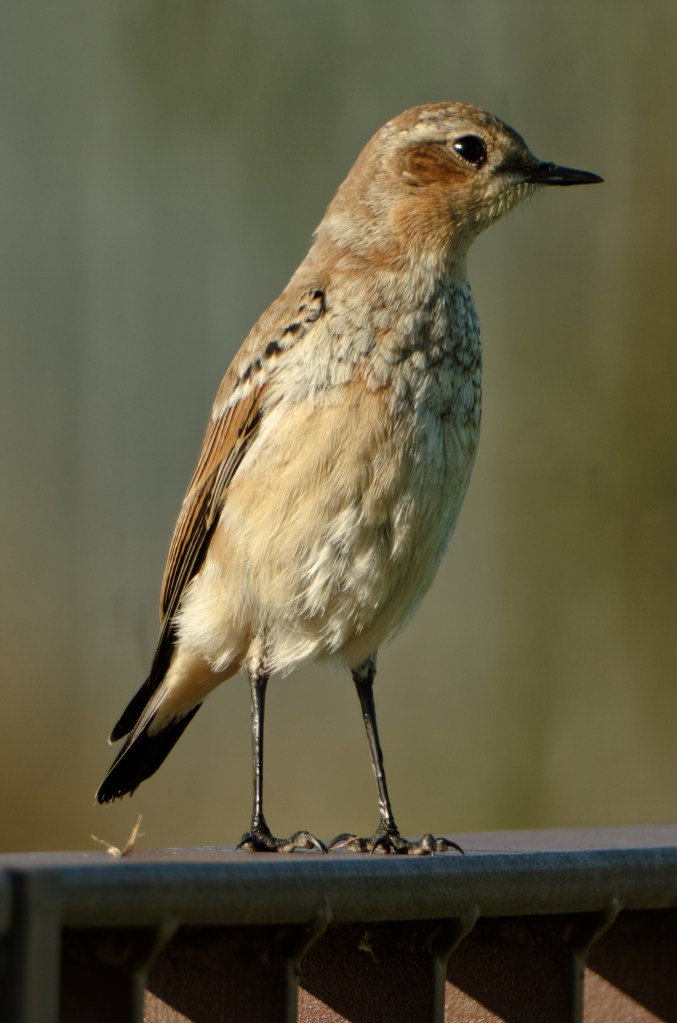
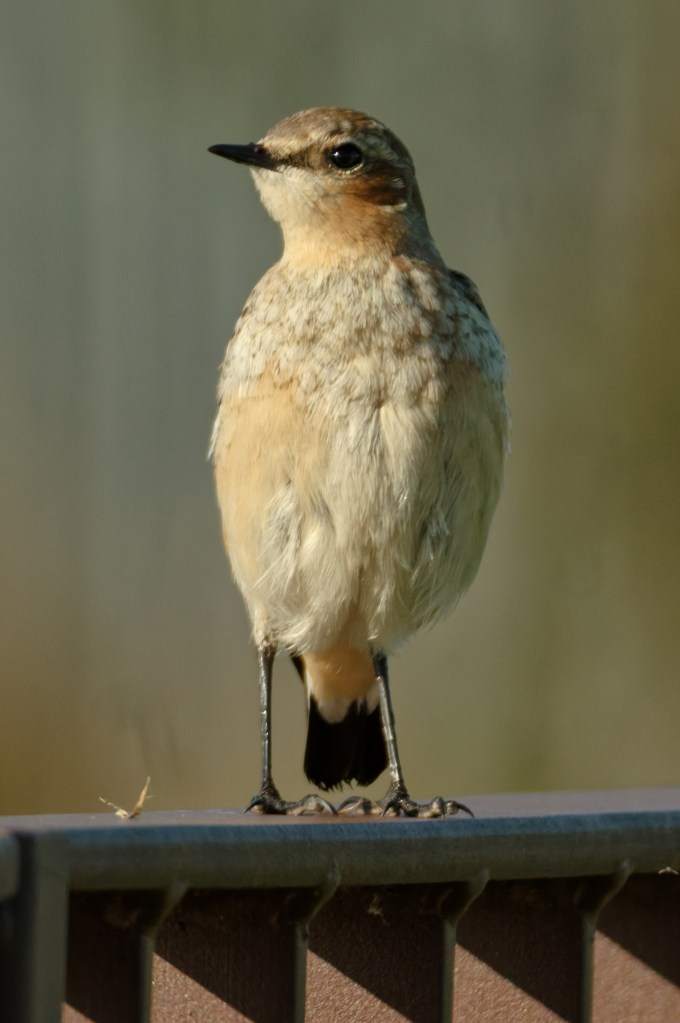
Starlings like this part of North Glasgow – it offers feeding opportunities on grassland and also on the Borron Street tip. As we walked away from the Starlings, an upright and pale bird hopped into view and perched on the iron rail beside a SUDS pond metres in front of us.
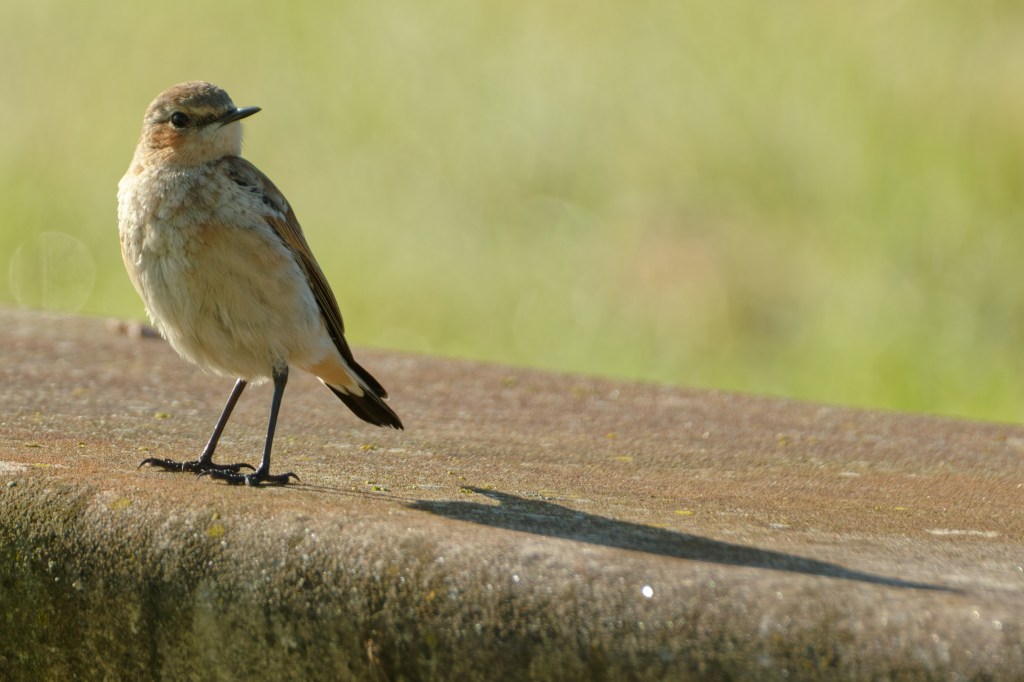
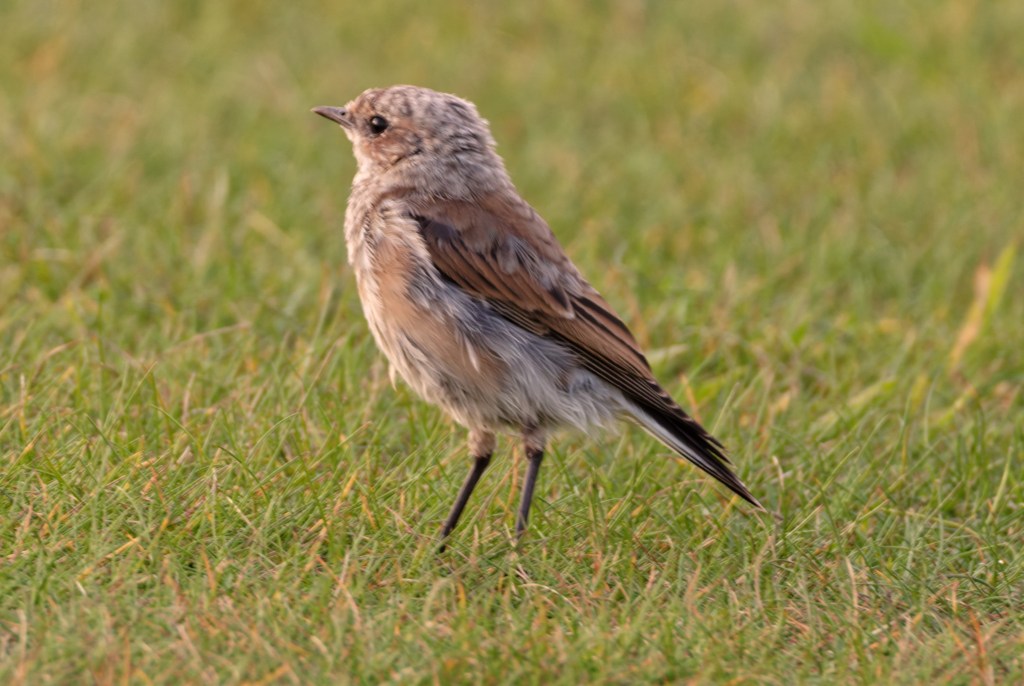
We caught a flash of a white rump as it flew to the rail – Wheatear, we thought. The posture looked right, and the perching habit. We sat down for a cup of tea and watched. There were plenty of places (concrete benches, guard rails, waste bins) for the bird to perch on, and it took full advantage, moving around us and trying out the possibilities. It was happy to let Backwoodsman approach it with the camera, suggesting that it was a young bird. Adult Wheatears usually flee from the approaching photographer or walker.
This was a one-off sighting; Backwoodsman runs through this area regularly and would have noticed the bird had it remained. It would not seem unreasonable that this young bird had fledged on the rough grassland to the north and was beginning to range south as a prelude to migration.
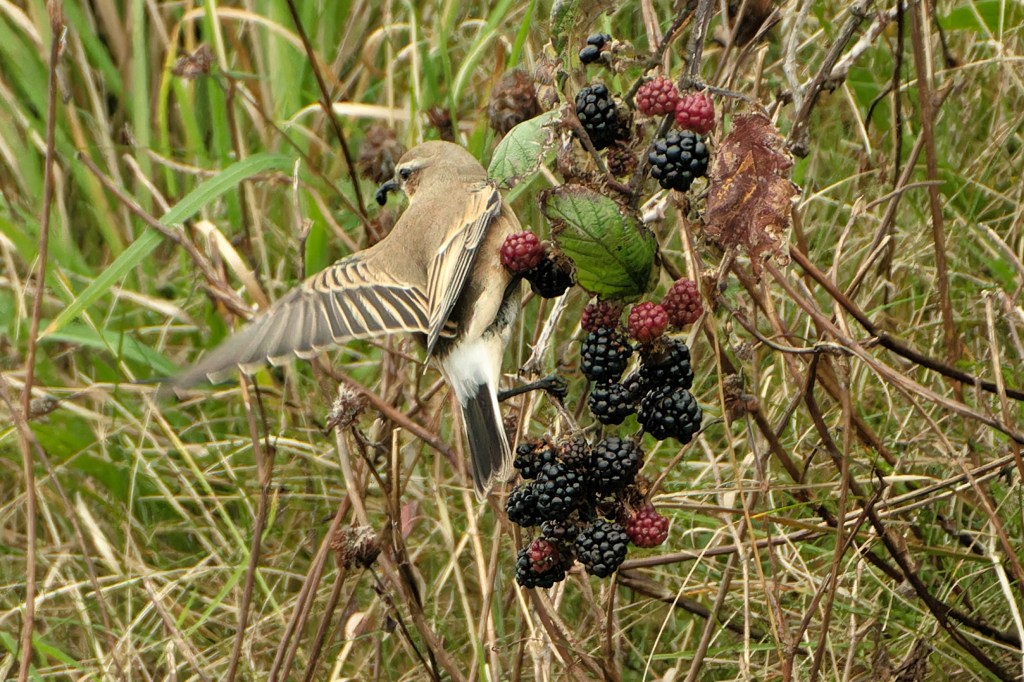
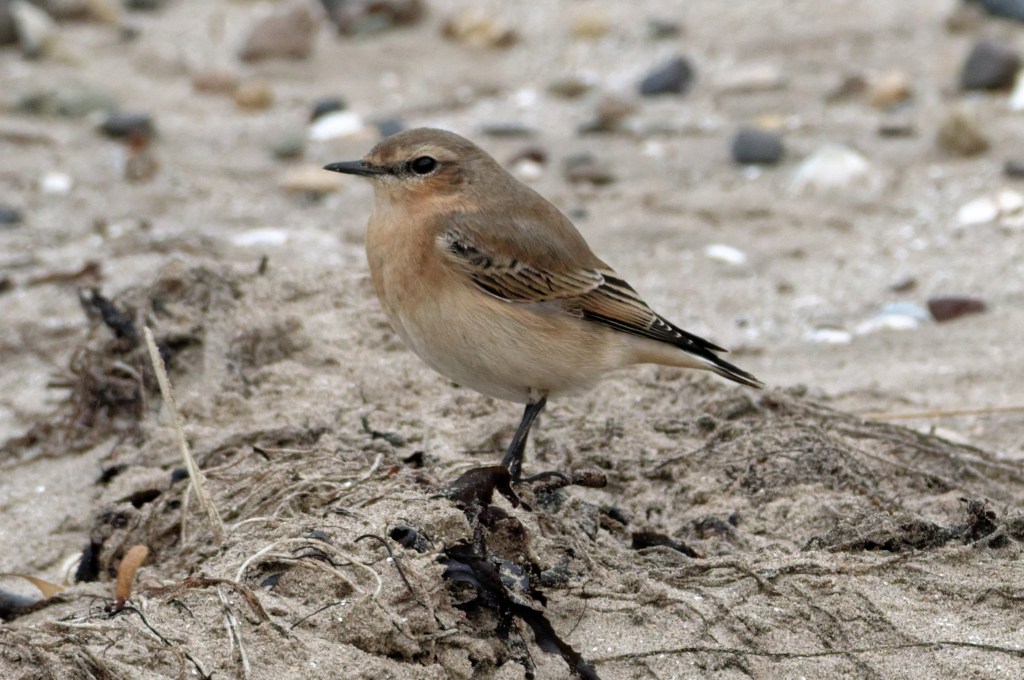
Backwoodsman looked back through the archives for other possible Wheatears and arrived at a folder of images taken at Cardross on September 21st in 2024. An adult bird, definitely a female, was feeding in the brambles.
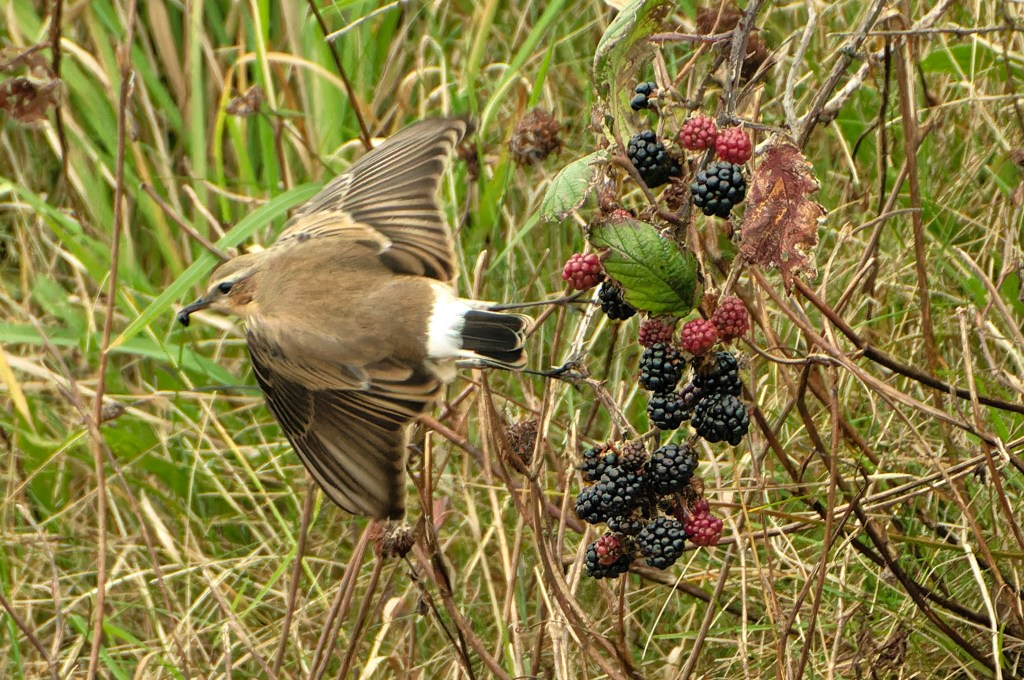
When she took off, the distinctive white rump was even more obvious.
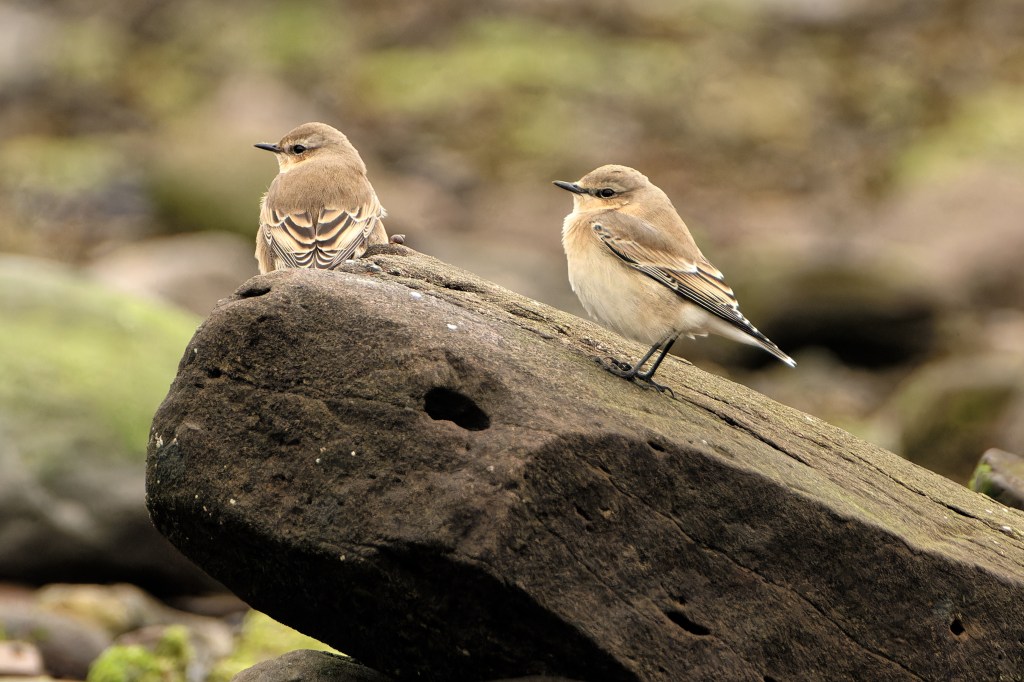
Further down the foreshore, she visited a pair of young birds, identifying them unambiguously in the process.
We might have struggled with these birds – they could be juvenile or female Stonechats, or Whinchats. Their posture makes them look quite rotund, whereas one of the key descriptors of the Wheatear is “sleek”. The adult plumage is clearly developing; there is a strong hint of the eye stripe and the white rump is clear to see.
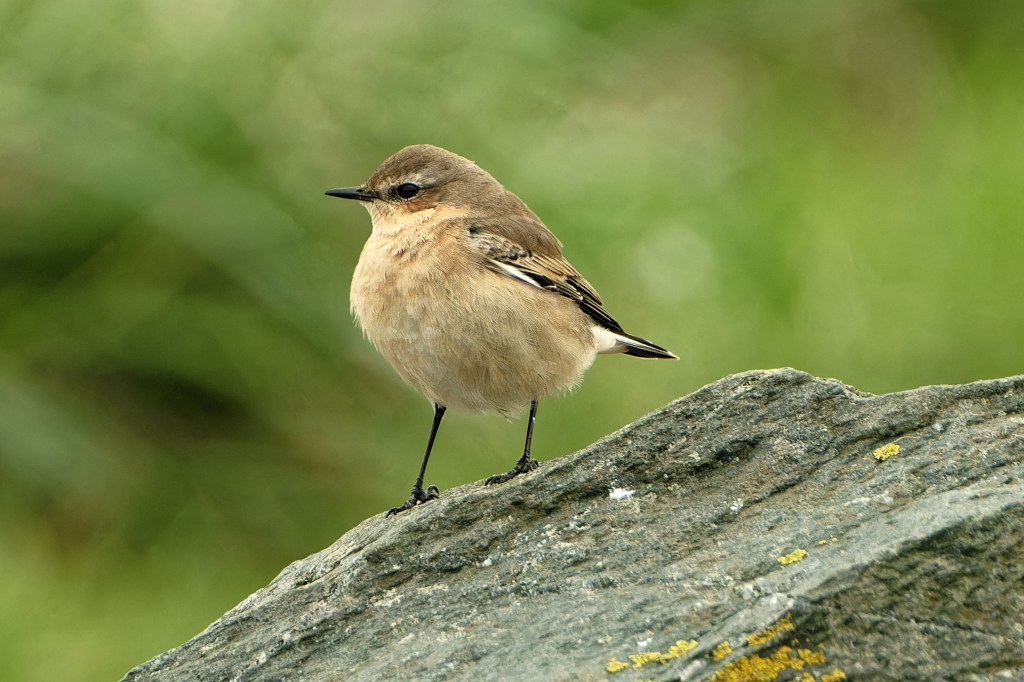
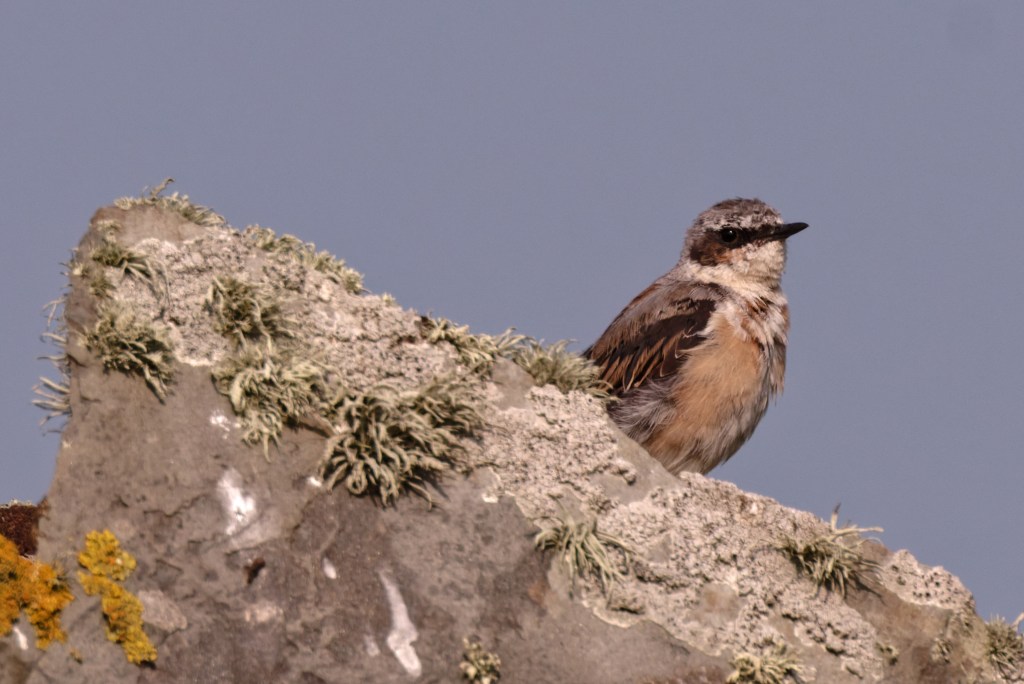
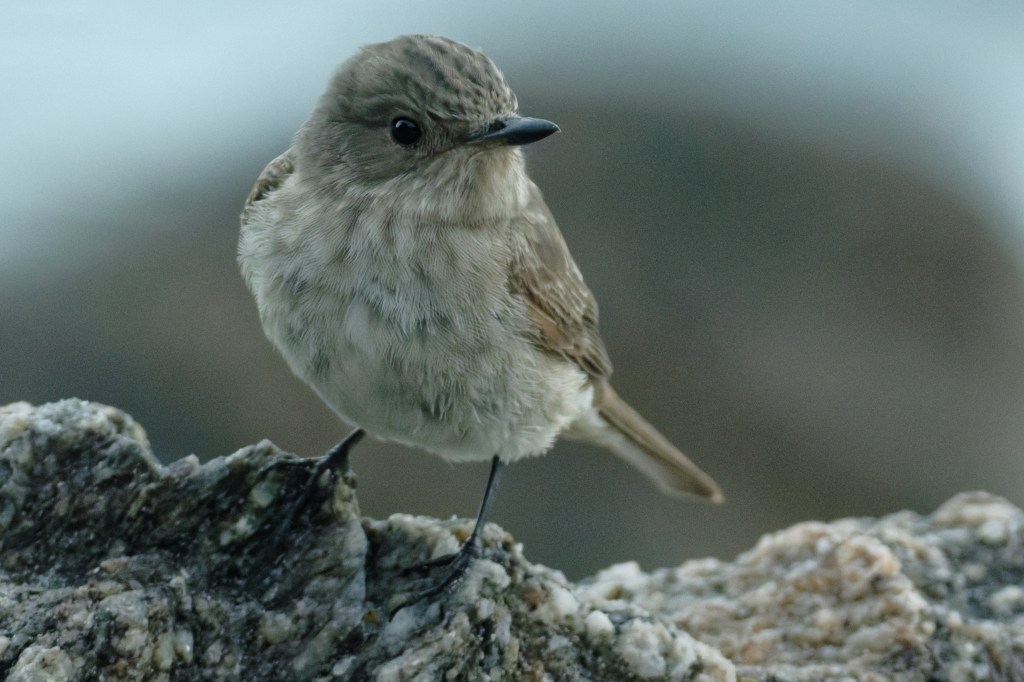
One Shetland sighting was particularly confusing. Backwoodsman spotted this individual some years ago on Sumburgh Head and was thinking Flycatcher, but it is probably a young Wheatear.
We spotted this bird not too far away; it may be in moult but it has some of the lovely grey colour which all the books give to adult Wheatears. It could be that this moulting adult was keeping an eye on the young bird as the latter learned its trade of foraging in the coastal grassland.
Any regular readers of these posts who track our movements will be ticking off the regular haunts, like North Glasgow and the Clyde at Cardross, and will be expecting to go to the Ayrshire coast any time soon. Stevenston has offered transient sightings of Wheatears, usually in the early autumn. We found this bird between Barassie Rocks and Irvine in mid-August.
Wheatears have a huge breeding range in the northern hemisphere and head south into Africa for the winter. There is an excellent account of this to be read, and of other behaviours and habits, courtesy of a PhD student carrying out research at the the Fair Isle Bird Observatory.
By now and with any luck, all our Wheatears will be a long way south. We’ll look forward to their return, and will hope to catch some in the striking grey breeding plumage.
It’s that time of year again. The little students are back, shuffling along University Avenue at quarter-speed and rendering it all but impassable. In the subject villages, apprehensive staff ask each other about holidays, putting off the evil moment when teaching timetables must be contemplated and the questions from wonks about REF outputs, answered, or possibly deflected. So, we went to Golfo di Aranci in Sardinia and it was great, thank you. Faye took the appropriate Lawrence book and Backwoodsman took his camera kit, hoping to see all manner of Mediterranean exotica on the wing. Faye finished and enjoyed the Lawrence, regaling Backwoodsman with tales of the privations endured by Dave and Frieda. Backwoodsman stumped about with the camera, getting hot, but not seeing many birds. Hmmm.
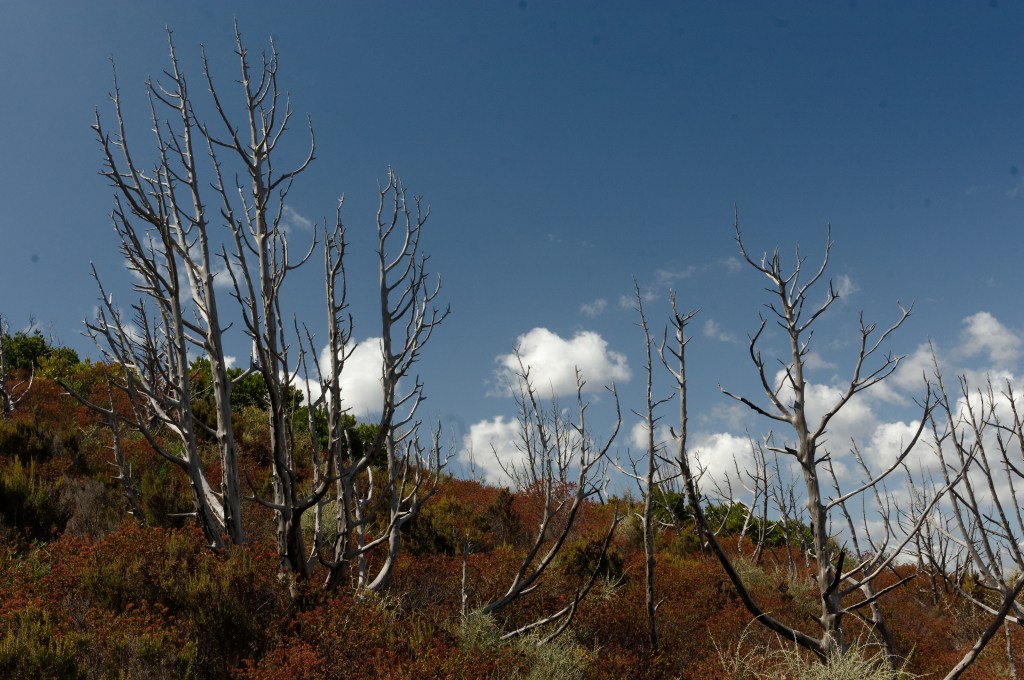
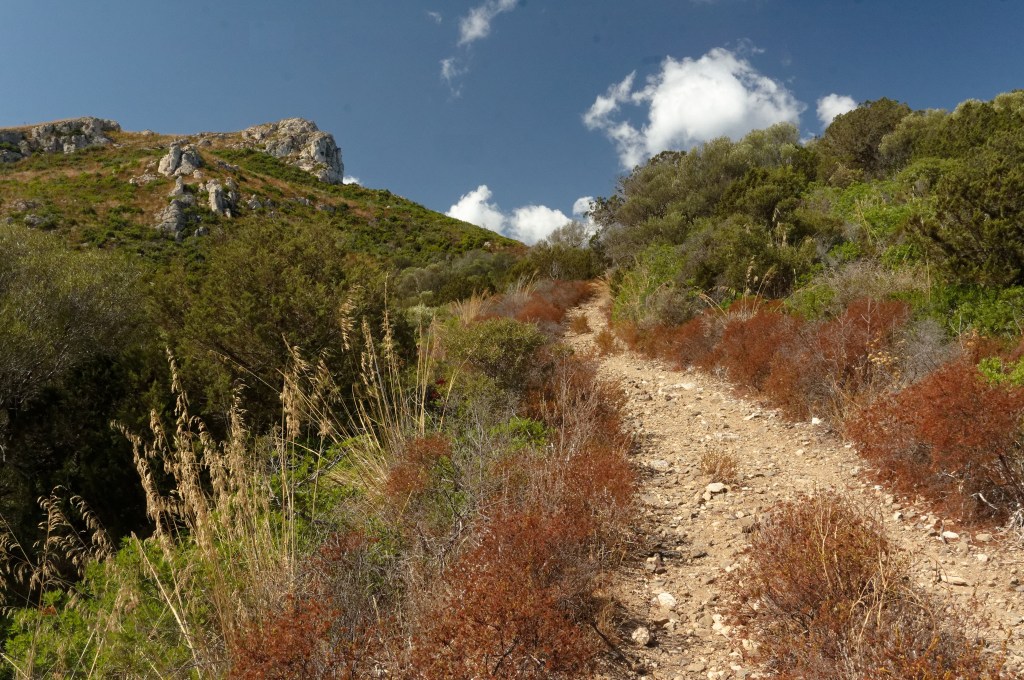
The landscape had a burnt look; under still conditions, even short walks would have proved difficult, but we had the benefit of a very strong breeze on several days. On such days, we could explore the Capo Figari, a headland made principally of Limestone (much of Sardinia is Granite). Several walking trails were available, including one (Sentiero dei Carbonai) which took us up towards the outcrop of Rocca Ruja (just left of centre in the image).
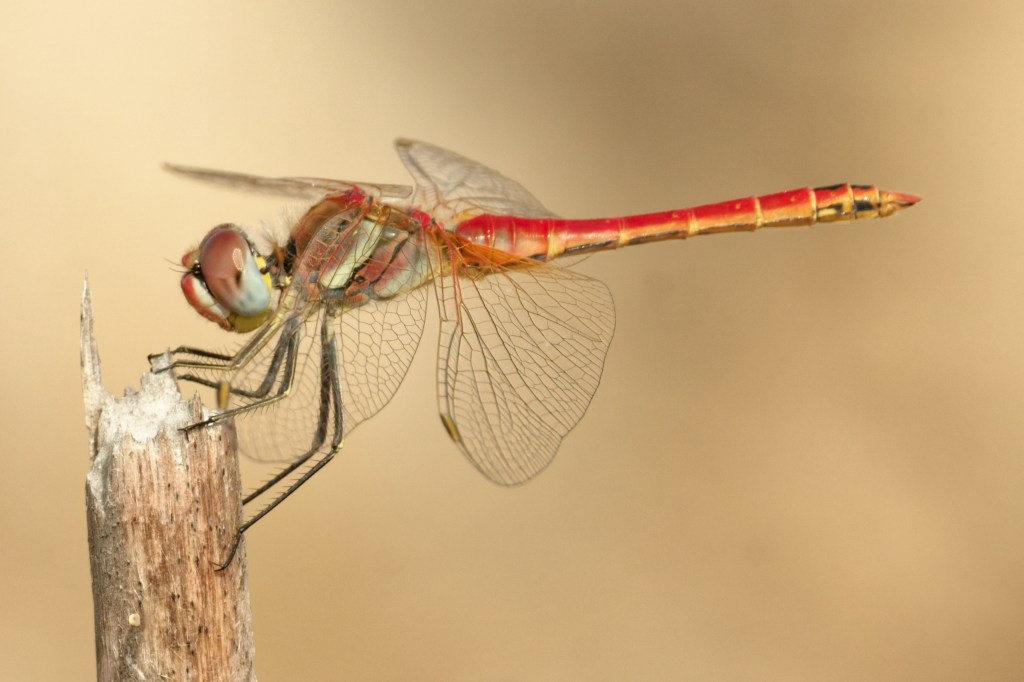
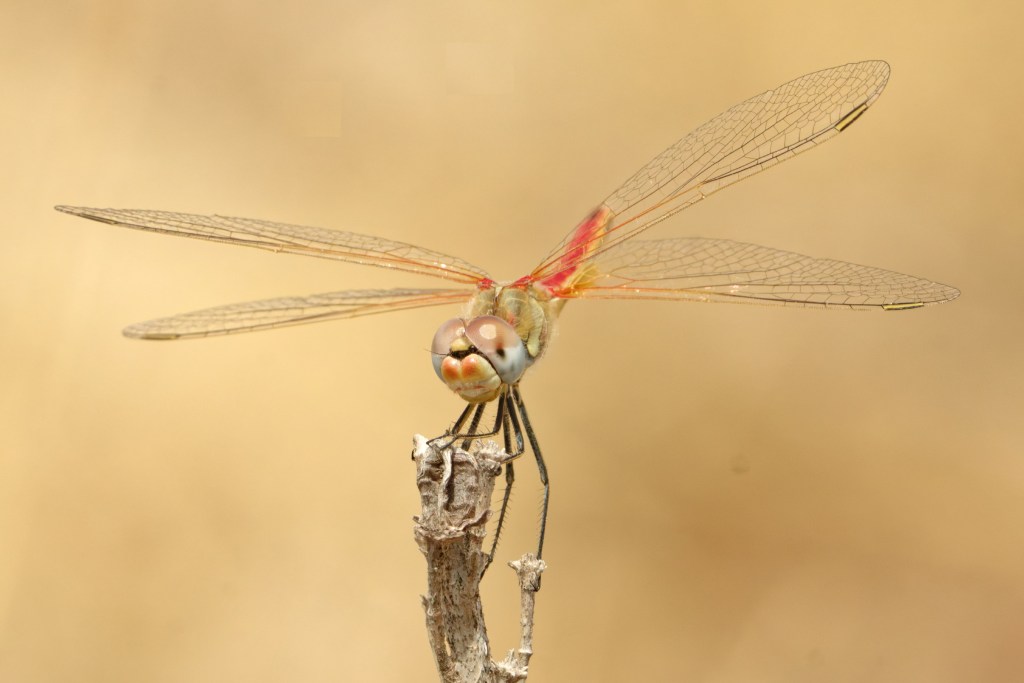
The track went over a shoulder at 83m and there we found Red-veined Darters.
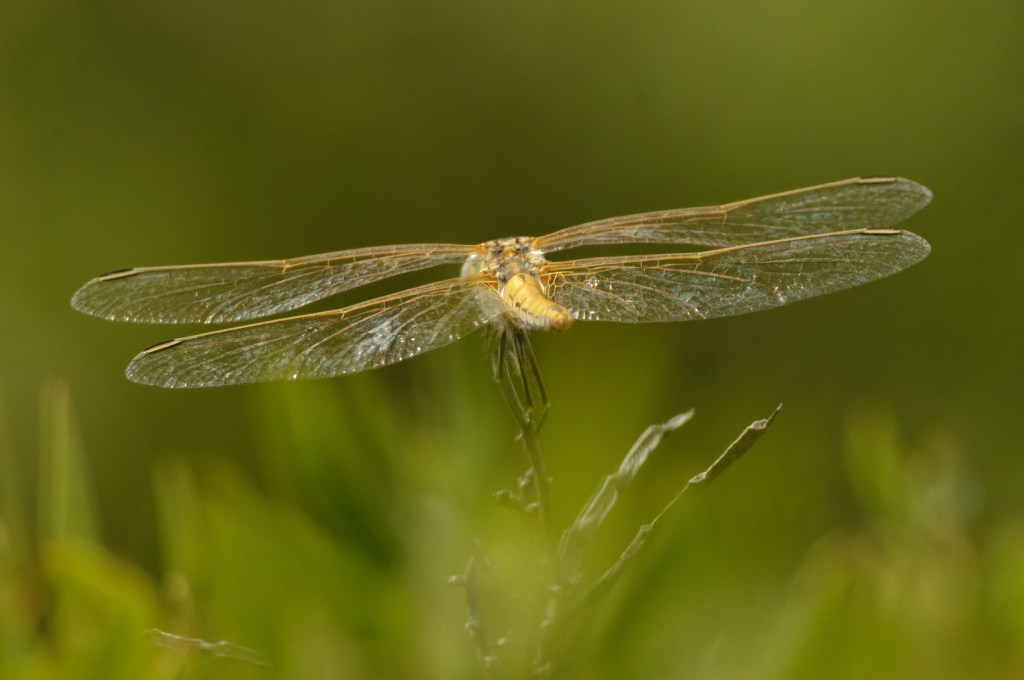
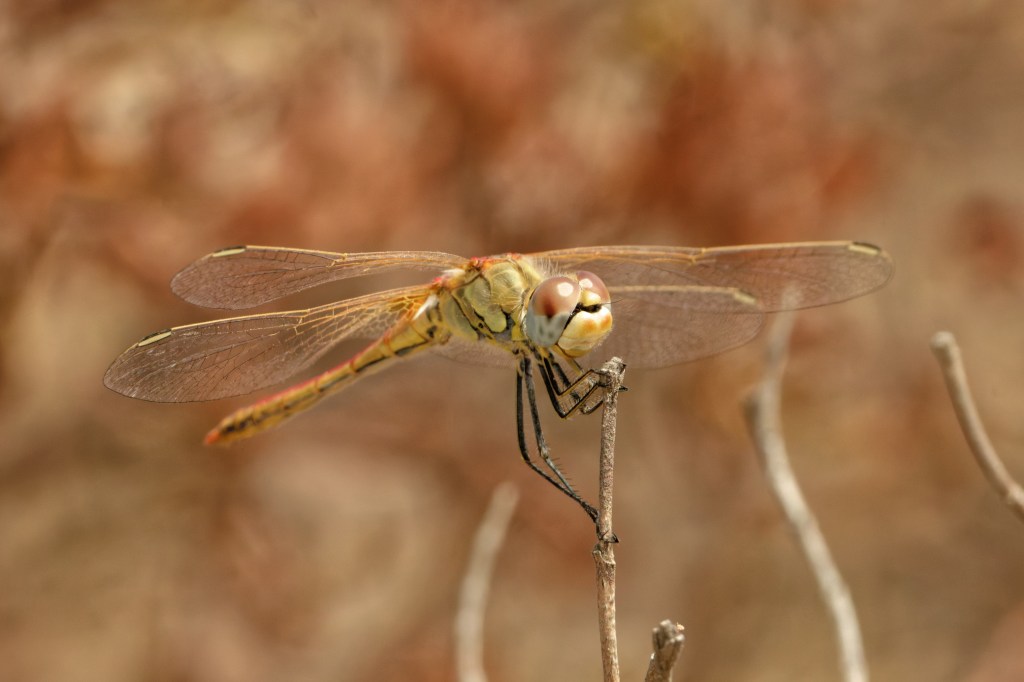
The superb light allowed quite a fast shutter speed to be used, which was important as the photographer was being blown about and the camera was doing its best to swing around on the monopod. The dragonfly was vibrating in the wind but between gusts, some decent images could be had. Backwoodsman is standing away and using full zoom to get a decent dataset without looming and disturbing the insect. The resolution of small parts of the insect like the bristles on the legs and the tufts behind the head is really quite pleasing. And don’t the colours sing?
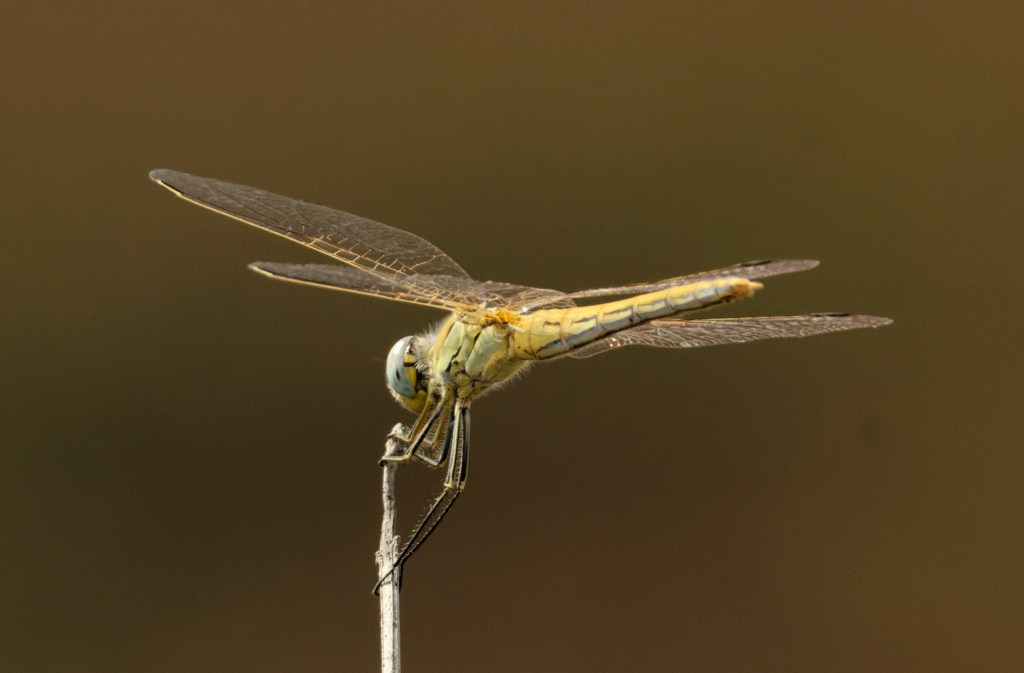
The Red-veined Darter can be distinguished by the blue eyes, pale pterostigma (wing spots) outlined in black, and the coloured wing veins (red in males, yellow in females).
From Wikipedia, it seems that “the pterostigma, a heavier section of the wing than nearby sections, assists in gliding. Without the pterostigmata, self-exciting vibrations known as flutter would set in on the wing above a certain critical speed, making gliding impossible.”
The insects had favoured perching posts which they returned to frequently, and from one day to another. This female perched nicely, showing the yellow wing veins really clearly.
The blue eyes are shown well in this image.
It would have been great to see a Darter take another insect on the wing and return to the post to eat its prey but Backwoodsman was pleased to see the Darters defy the gale and hang on to their perches for some good images to be had.
Backwoodsman did not know much about Dragonflies before starting to think about this post. Groups based in Australia and Sweden carried out original work to reveal some of the neuroscience upon which Dragonflies rely in their hunting. A commentator wrote in Nature that “Dragonflies are reported to successfully catch up to 97% of their targets, using clever interception paths that predict prey’s future location. Undaunted by swarms of potential distraction, they hunt within visually cluttered environments like the riverbanks they call home.”
The groups implanted miniaturised electrodes in the optic lobe of dragonfly brains to monitor electrical activity associated with the pursuit of prey. Processes of prediction, attention, and filtering were identified, located in a neuron named ‘Centrifugal Small-Target Motion Detector 1’, or ‘CSTMD1′
From the commentary: “When a prey-like target zips across the dragonfly’s visual field, some neurons encode the area ahead of the target, exhibiting an enhanced sensitivity in this region and suppression elsewhere. This likely prepares the dragonfly to respond to an imminent target and forms a prediction of the prey’s trajectory, even if it becomes obstructed (such as when it flies behind the leafy branch of a tree). The second property is ‘Selective Attention.’ When presented with a pair of rival targets moving on different trajectories, a dragonfly must choose only one for lunch, or risk missing both. In a winner-takes-all manner, CSTMD1 responds to just one of the rival pair, encoding the target’s trajectory in a train of electrical impulses, ‘spikes’, unperturbed by the presence of the rival distractor.”
The dragonfly can even strike “a balance between attention to one target and flexibility, allowing the world’s most successful predator to ignore other forms of visual distraction and keep its eyes on the prize.” The original (open access) paper can be found here. Figure 6 on page 9 represents the processes of target selection and the suppression of distracting signals graphically.
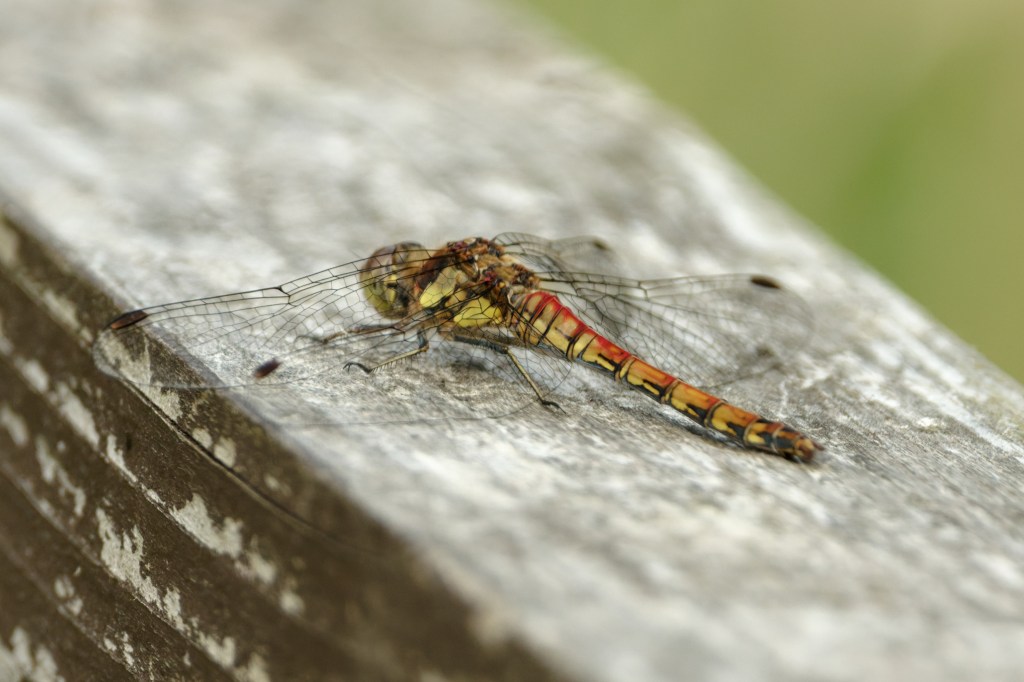
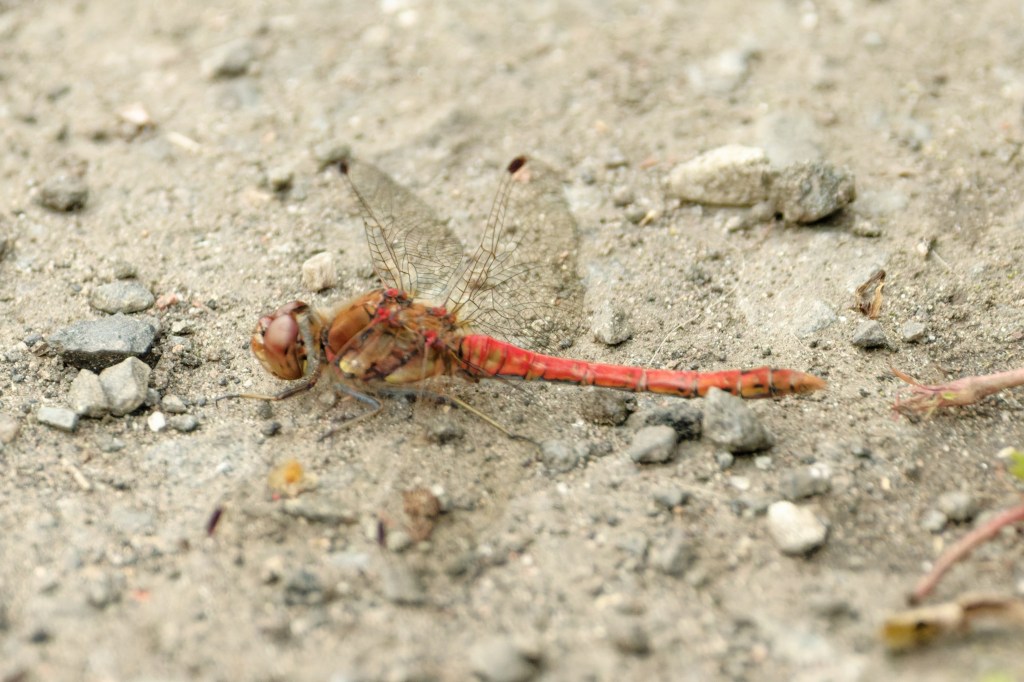
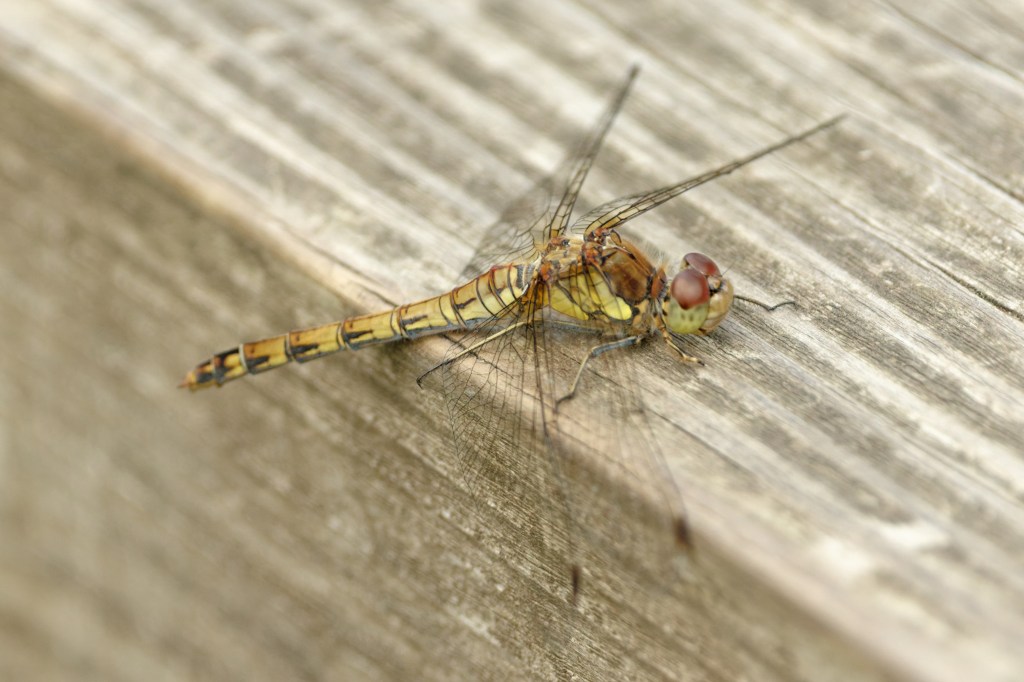
A search of Backwoodsman’s archives revealed images of Common Darters, a species native to the UK. Red-veined Darters are visitors – better to call them this rather than migrants, in case some yobs with flags show up and try to burn down the places in which they stay.
We came across these insects between Hogganfield Loch and Cardowan Moss. What a difference the strong sunshine makes to an image!
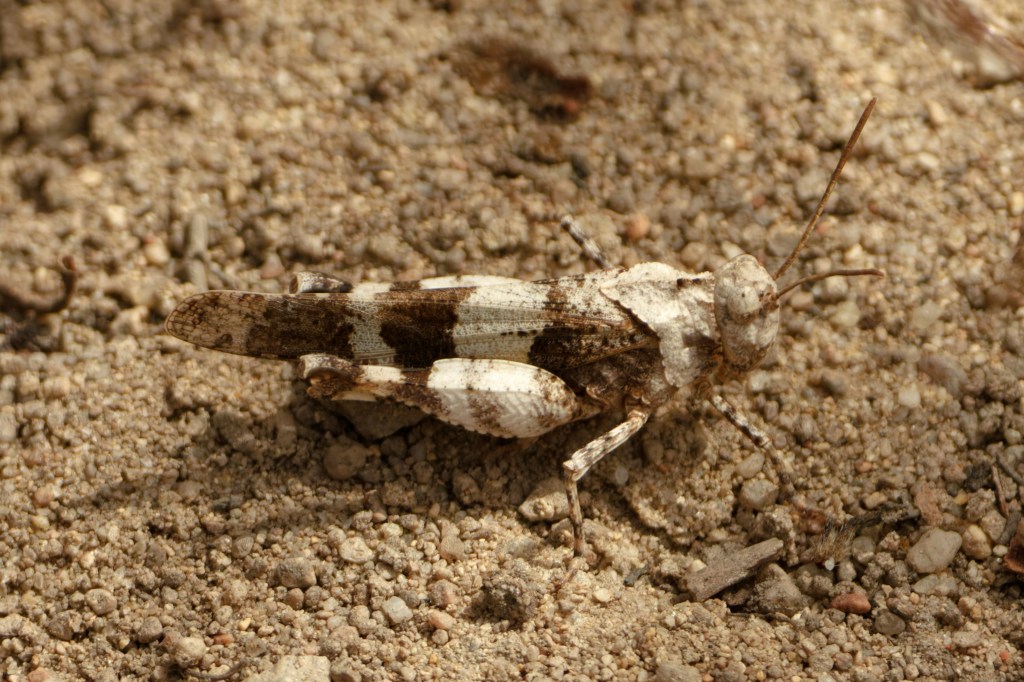
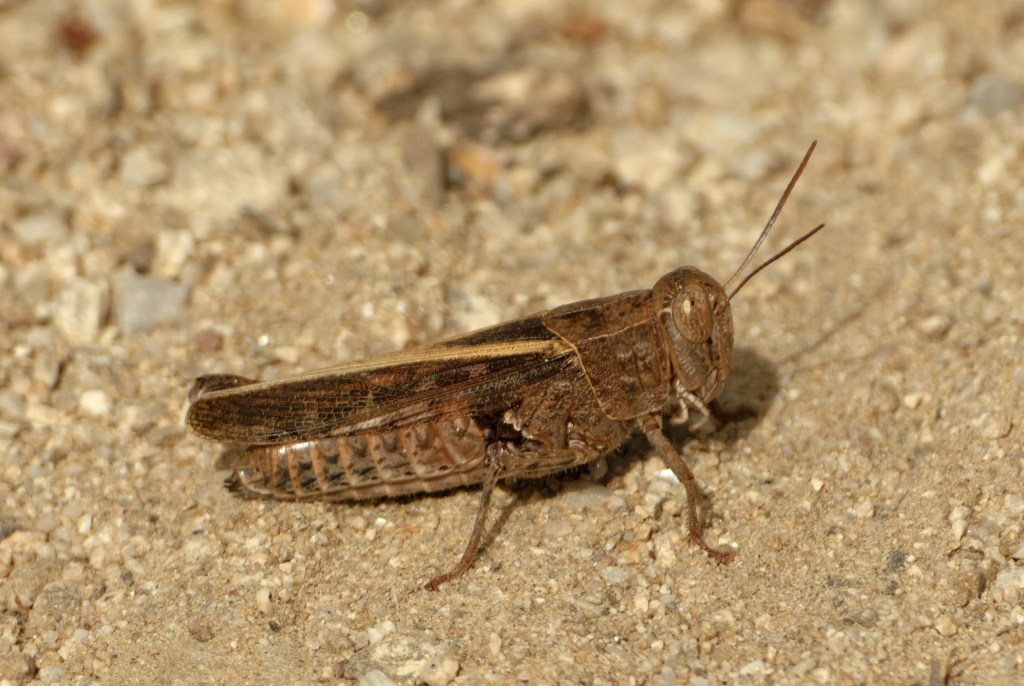
Other insects were to be seen in Sardinia and Backwoodsman used the Picture Insect app to begin their identification – Backwoodsman is a beginner when it comes to insects. Pale grasshoppers would ping skyward with a flash from beneath our feet as we walked. One stayed long enough for this image to be acquired.
Picture Insect says this is Oedipoda caerulescens, the Blue-winged grasshopper. We did not manage to see the rather striking underwings clearly, but a flash of this delicate colour in strong light would explain the sudden brightness as the insects took to the wing.
The App identifies this species as an Italian locustCalliptamus italicu. Locusts have been a bit of a problem on Sardinia in previous years with a serious irruption relatively recently.
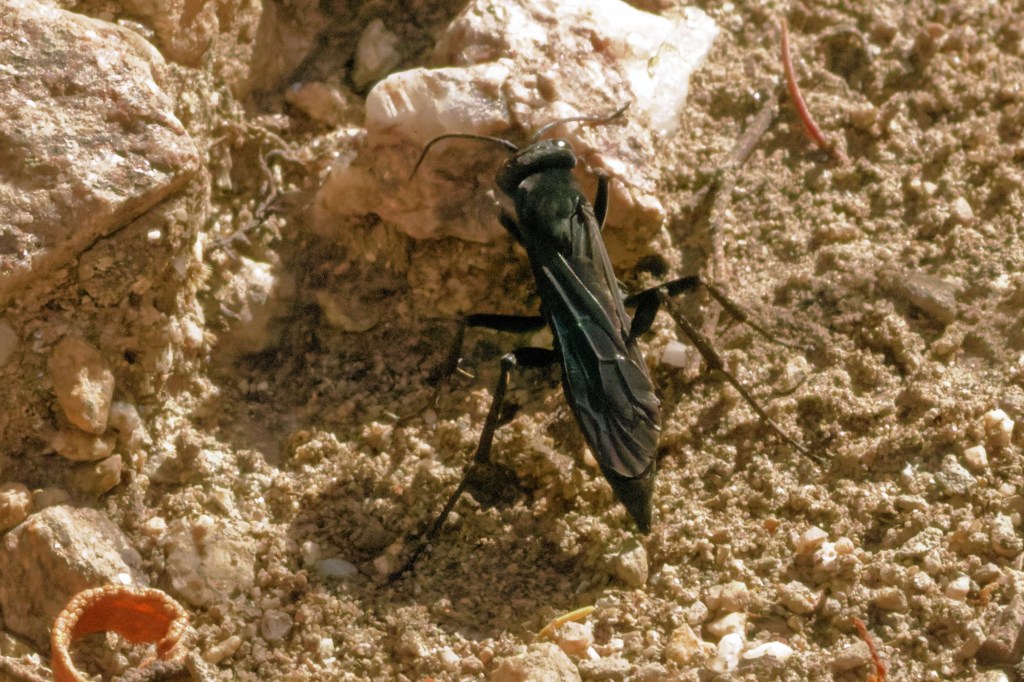
Picture Insect identifies this as a Blue mud-dauber wasp Chalybion californicum, a native of North America but known to have been introduced to Croatia. It is a spider hunter and our specimen was running on the ground, looking under stones and into crevices. There are a lot of different Chalybion wasps; see this link for a list of species. It may be that the training set (of only 4000 species) for Picture Insect has a North American bias, or the Blue mud-dauber may be on the march.
In this strong light and wing-folded posture, neither the blue colour nor the extremely narrow connection between abdomen and thorax are visible. This image has a similar overall appearance to our specimen.
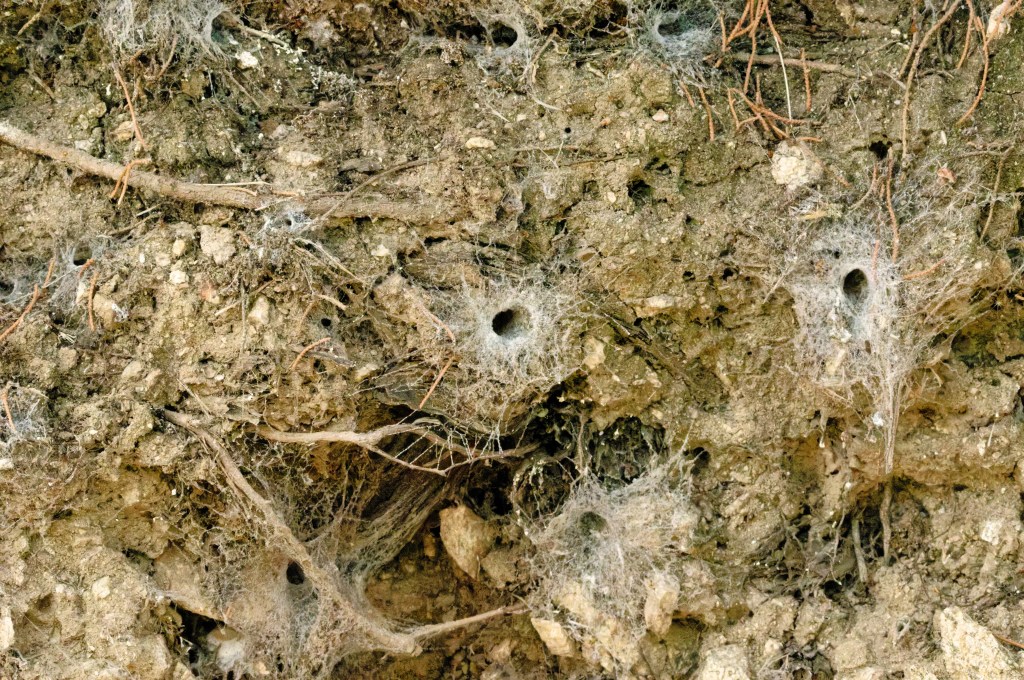
We also noted many silk-lined tunnels in the area where we found the wasp – it looks like the odd spider might be around for the wasps to munch.
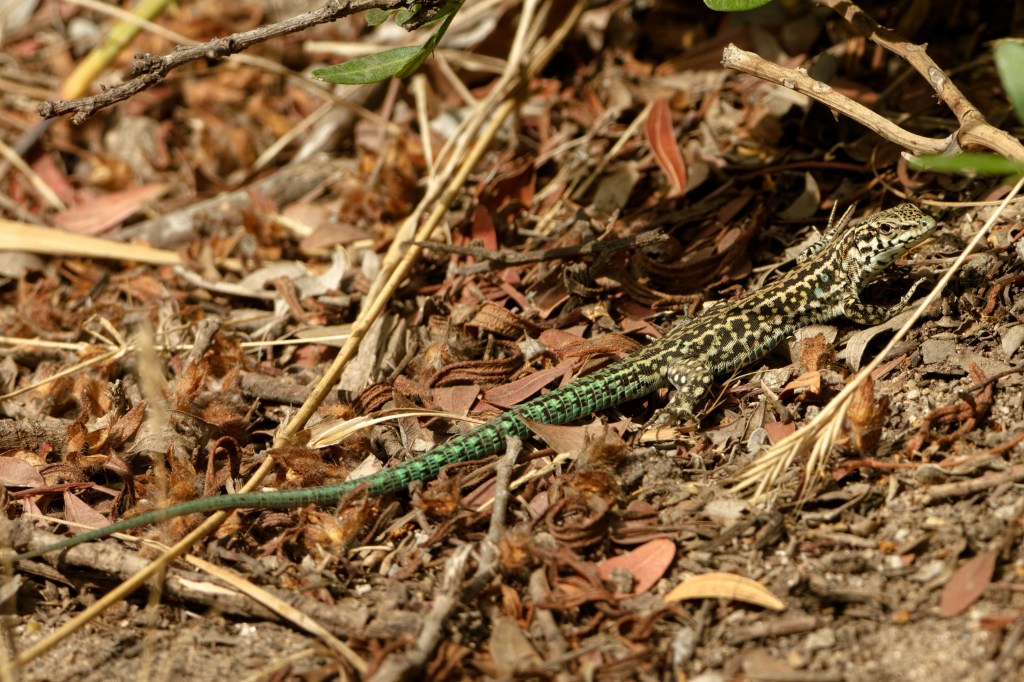
No doubt about this chap though – a Tyrrhenian wall lizard, handsome with his malachite-green tail.
We saw many of these, usually just heading into the undergrowth, but occasionally pausing long enough to show just how splendid they are.
Of birds, we saw few. A flock of Green Parakeets sped from the undergrowth as we climbed towards Rocca Ruja. We saw an elegant falcon soar across the hillside then vanish, and hirundines (House Martins and Swifts) swept over our heads out on the Capo and at the hotel. We heard warbler-like clickings and scratchings from the undergrowth but found that the Merlin App was usually defeated by the strong wind or the lack of an internet connection. The songbirds behaved like they were hunted regularly, or predated in some other way.
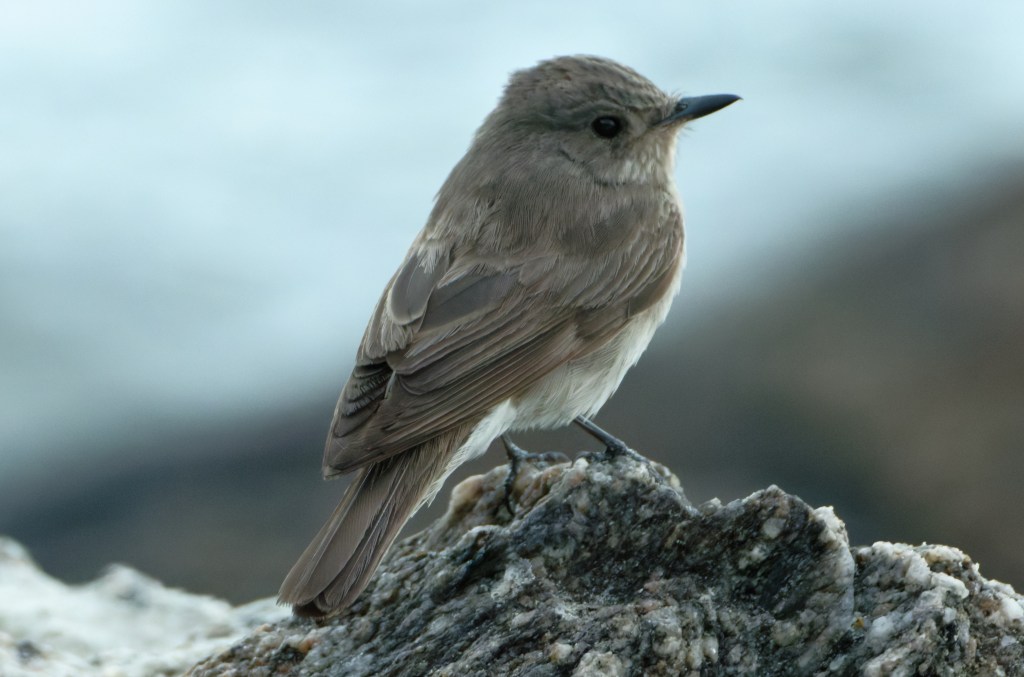
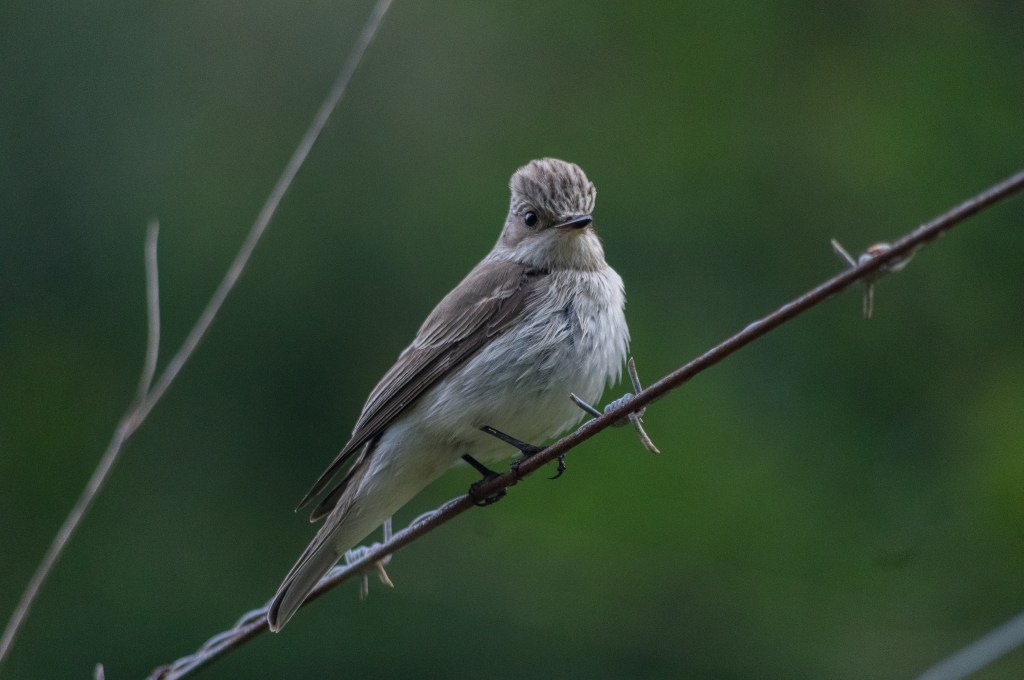
It was really only at the hotel where we came across a bird which would show itself. We developed an aperitivo habit and were visited on the terrace by a small chat-shaped bird which would perch, and fly out and down before returning to a vantage point. We were delighted to have the company of a Spotted Flycatcher. As the British Trust for Ornithology say “More streaked than spotted, this small grey-brown, long-winged flycatcher is a dashing bird of woodland, parks and gardens. Spotted Flycatchers spend the winter months in Africa and BTO research has shown that some head as far south as Namibia, around 7,000 km from their breeding location. A host of summer migrants are experiencing declines in their breeding populations and the Spotted Flycatcher is one of these. It has been on the UK Red List since 1996.”
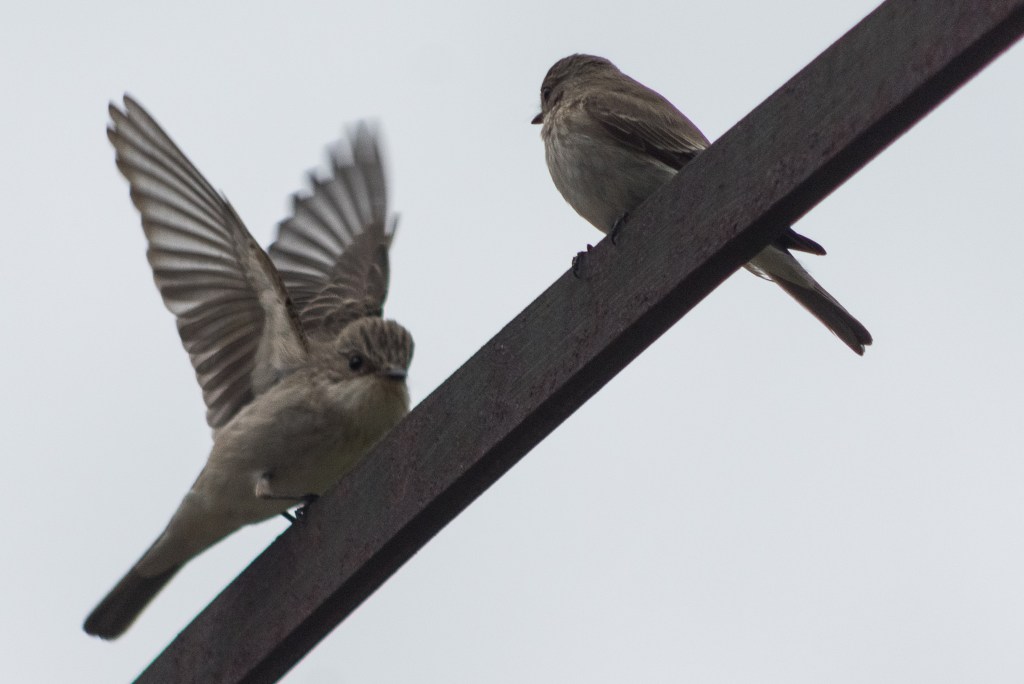
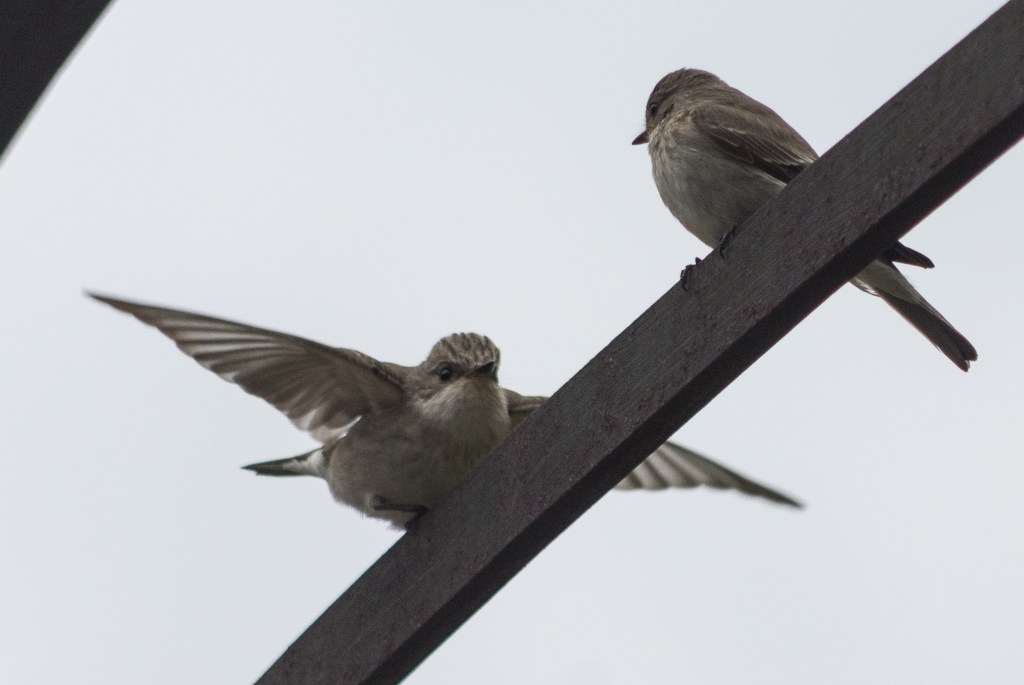
Our bird seemed to have a territory bounded at one end by a thicket beside the hotel pool, and at the other by some rocks on the beach near the lifeguard’s chair and ladder. During the middle of the day, the bird could be heard moving about in the thicket; at the hour of the aperitivo, the bird would emerge and perch on the terrace rail, making very short flights to seize insects. But in the early morning when we visited the sea before breakfast, there were two birds, standing on the rocks for extended periods. Backwoodsman’s only real shots at anything with feathers! We were all in the shade, alas, but the image quality is not too bad.
They really didn’t seem to mind us, coming very close then darting away for fresh insects emerging from the piles of broken eel grass on the shore.
We had seen this species in Mallorca some years before – this bird has selected a good background. We also found a pair of birds making some wonderful shapes on that trip, and wondered if we were seeing a breeding pair, or an adult and a fledgling.
So that’s that. Bucket and spade packed away for another year but much to look forward to on the fresher shores of Ayrshire and the Clyde as the waders return for the winter. Our little part of Sardinia was vivid and beautiful and we certainly ate much better than Dave and Frieda, especially when we dined at La Spigola. Backwoodsman can imagine the hillsides ablaze with flowers and bouncing with birds in the spring.
Backwoodsman was fortunate to be booked on a boat trip to the Isle of May, organised by the Scottish Seabird Centre. The trip was a birthday present – thank you, Faye!
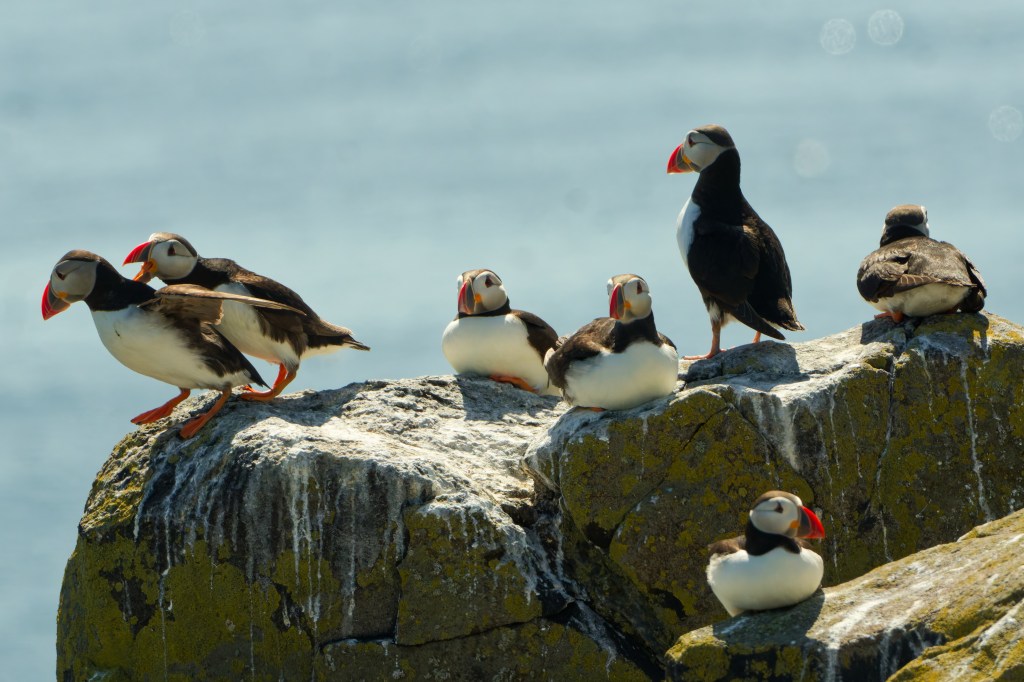
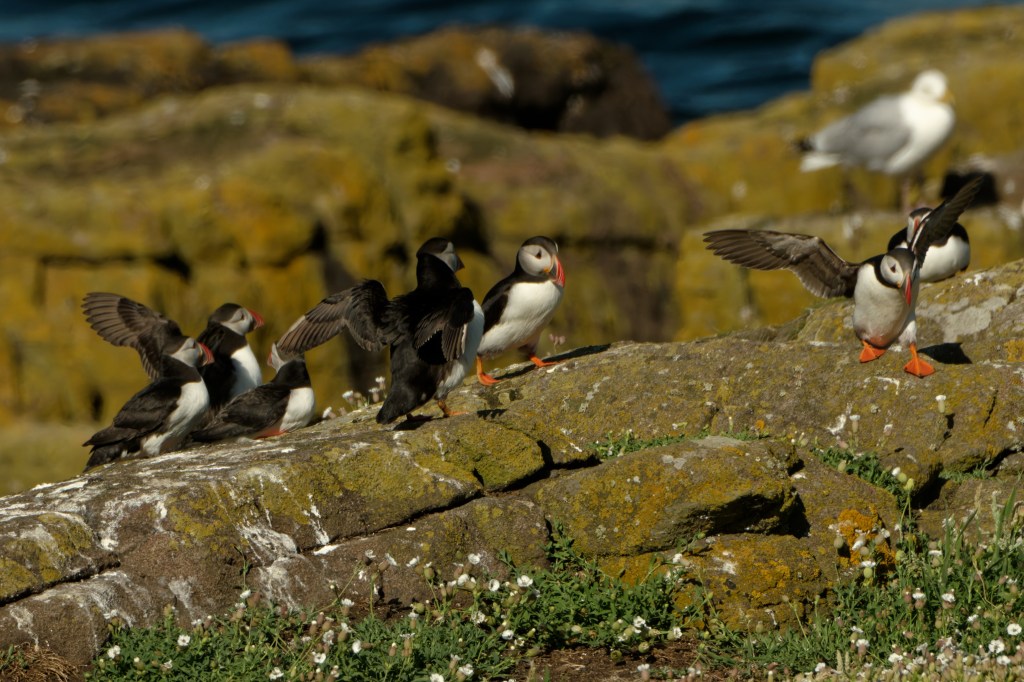
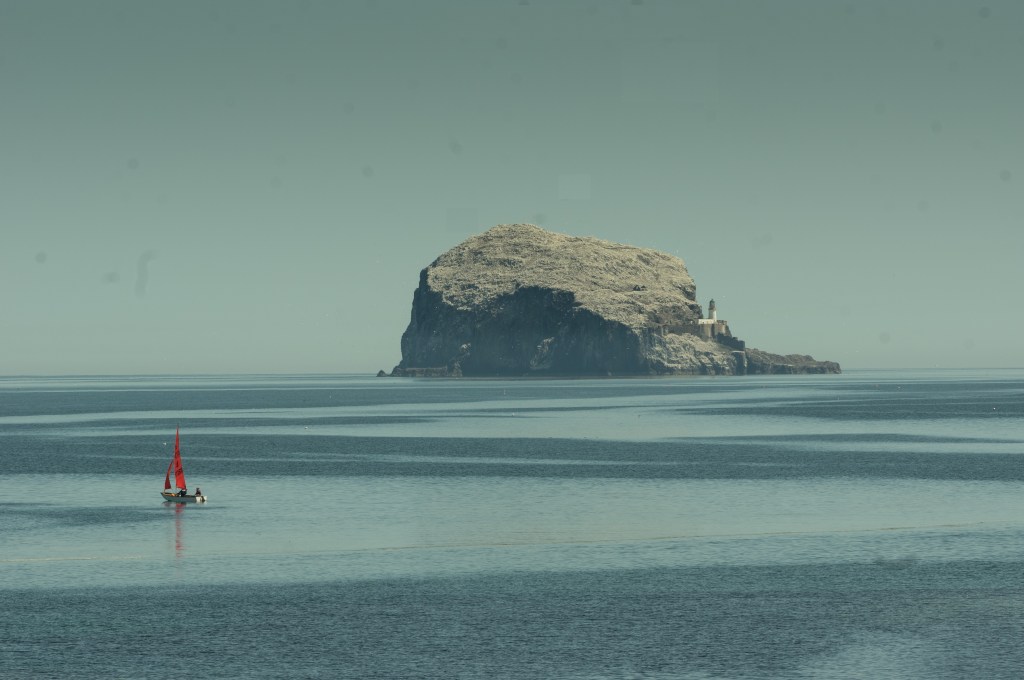
The trip took place on a day of brilliant light and across a flat calm sea. We passed by Bass Rock on the way, so it took a while to reach the Isle. Once we arrived at the Isle, we were free to wander, though the importance of staying to the clear paths was stressed by the warden from our boat. And with good reason – almost every part of the grassland seemed to contain a Puffin burrow. Puffins were everywhere, sitting in small groups, or setting off to fish.
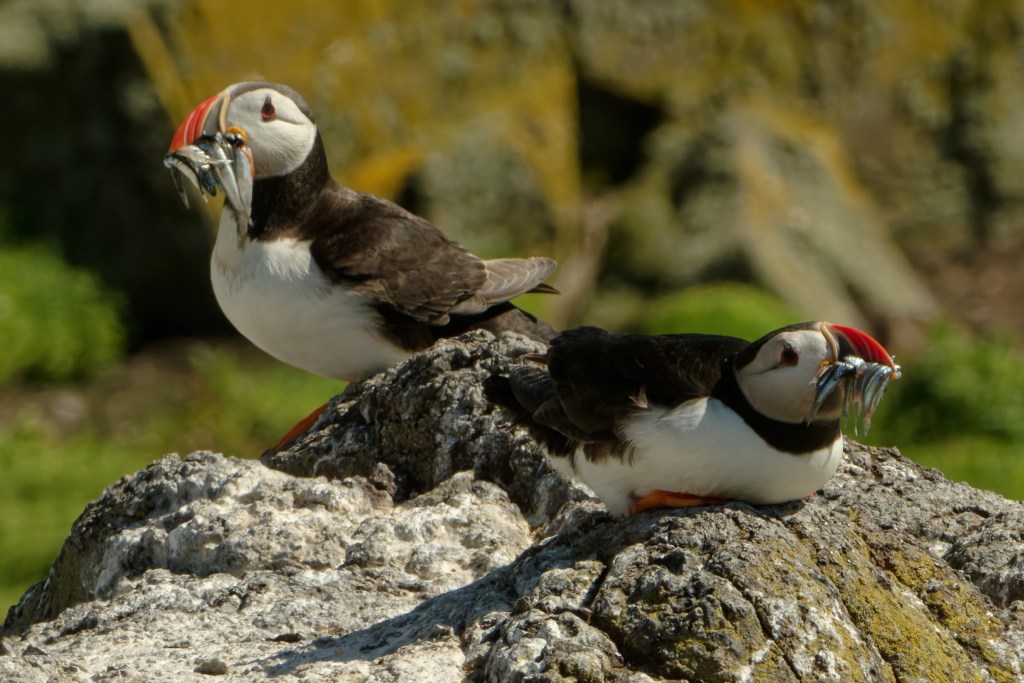
There were even Puffins holding Sandeels in their bills, something we had not seen on any of our visits to Sumburgh Head in Shetland.
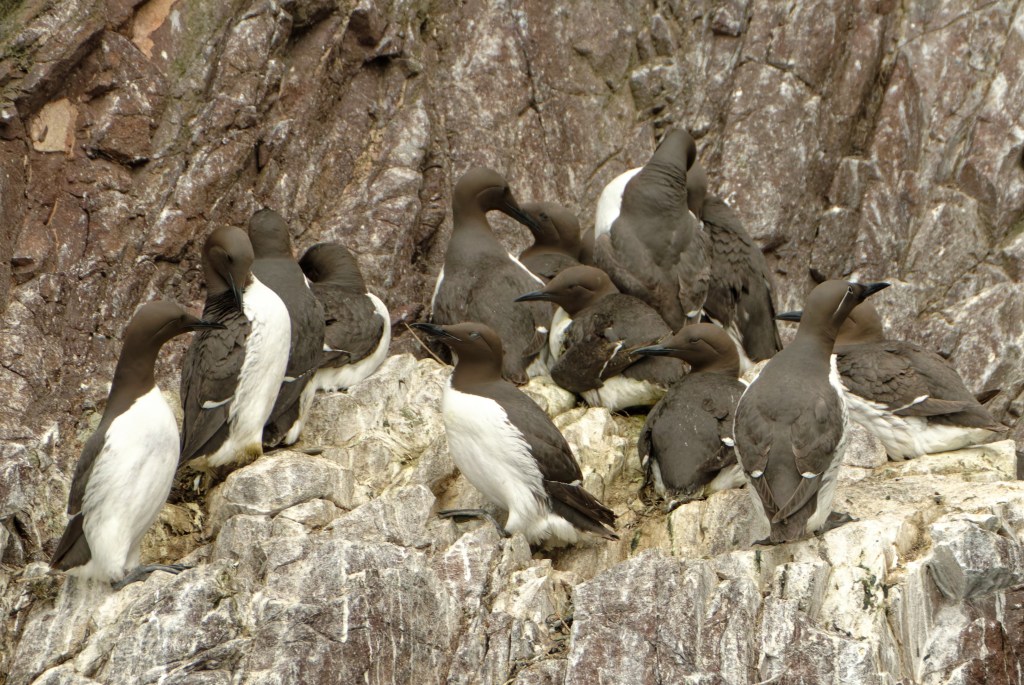
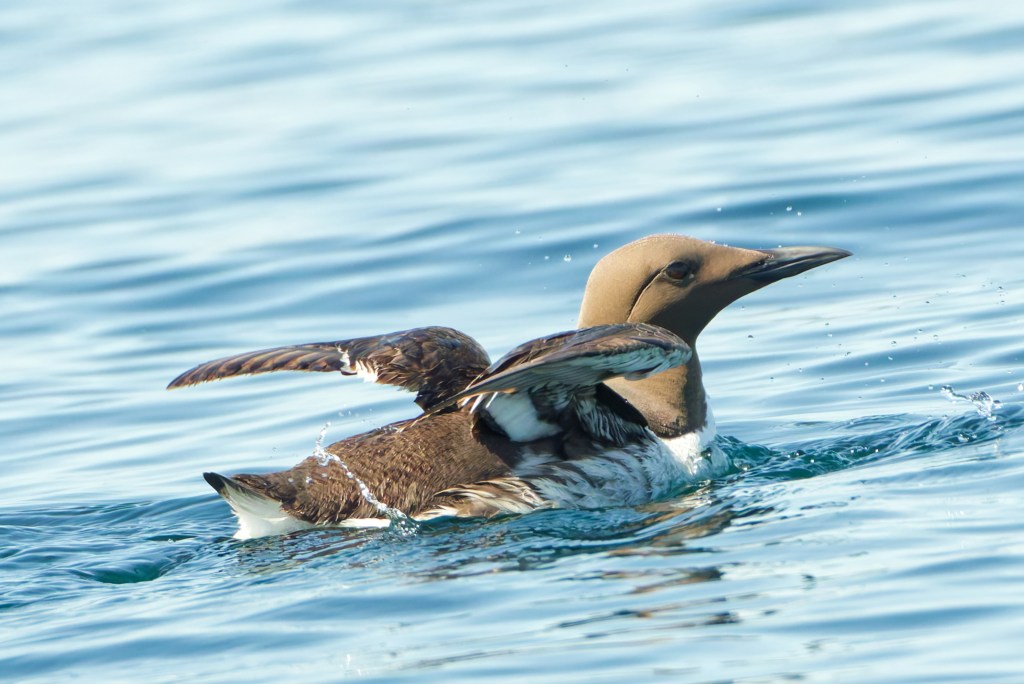
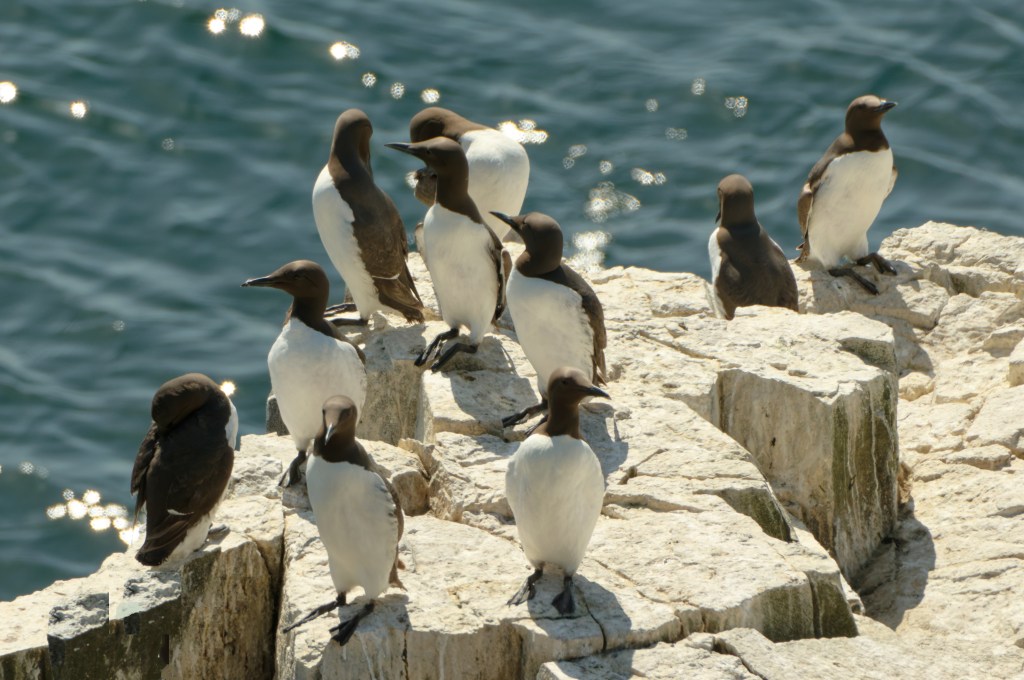
We headed to the edge of the Isle hoping for some good views down onto cliffs and opportunities to photograph nesting birds. The path took us to some good viewpoints and there, below us, were Kittiwakes and Guillemots in abundance.
Photographing Guillemots can be a bit frustrating, particularly if they are standing on a ledge and incubating eggs – one each, that is. Most birds will be facing the cliff, bill upturned; this group may contain some birds on eggs, though there are no eggs to be seen.
It is worth looking at the rocks on which the birds are standing; “ledge” might overstate the amount of space and stability on offer to some of these birds. As the Scottish Wildlife Trust says:
“Guillemots are fiercely territorial, defending what can be tiny nesting areas. They can show aggressive behaviour towards neighbours and the female may reside on the nest site for several weeks after the male takes the chick out to sea in order to protect the nest site from competitors. In some areas, such as the Isle of May, guillemots have been recorded to return to the nest sites as early as October, most probably to defend high-quality nest sites.”
“A single egg is laid directly onto the bare rock – no nest is made. The mottled egg is pear-shaped (pyriform), and this is a special adaptation so that the egg rolls round in a circle when disturbed rather than off the ledge.”
The Guillemot’s pyriform egg is really quite interesting and is much studied. A recent (2020) PhD Thesis by Dr Jamie Edward Thompson from the University of Sheffield entitled “Egg Shape in Birds” discusses the Guillemot’s egg in detail. Thompson points out that:
“[The] Guillemot’s pyriform egg is inherently stable, especially on a sloping ledge, allowing the egg to be more safely manipulated by the parents during incubation and incubation change-overs.”
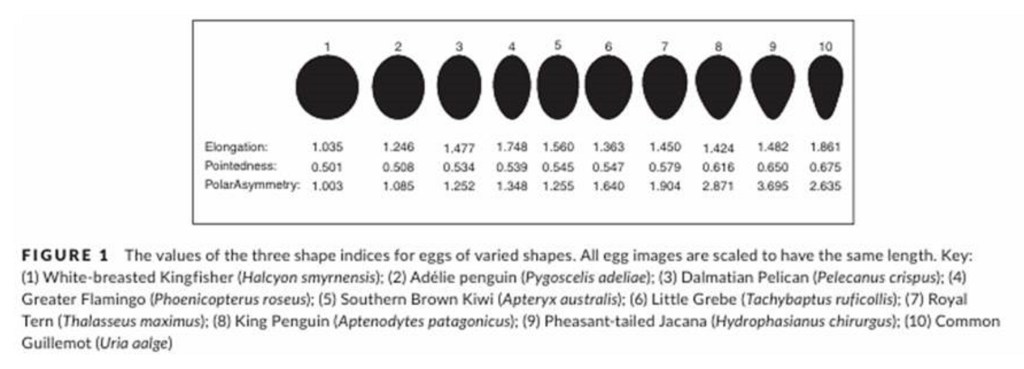
From photographs, he concludes that the majority of incubating birds are oriented with their heads directed upslope; birds incubating their single eggs, have the blunt end of the egg oriented away from the bird and up the slope. This natural resting position of the egg tends to lift the blunt end up and away from the guano which inevitably carpets the densely crowded breeding ledges. There are many fascinating things in the thesis; one of the publications upon which the thesis is based contains this graphic which shows a whole spectrum of egg shapes, with the pyriform egg at one extreme.
In Chapter 3 of his thesis, Dr Thompson (a student of Tim Birkhead, author of The Most Perfect Thing: the Inside (and Outside) of a Bird’s Egg) writes about Edward Walter Wade (1864–1937), author of The Birds of Bempton Cliffs (1903, 1907). Thompson’s discussion shows Wade to be both an insightful ornithologist and climber of considerable nerve. Unfortunately, he was also an egg collector; page 53 of the thesis shows a remarkable image of Wade, or a fellow nest robber, swinging from a precipitous cliff by a rope.
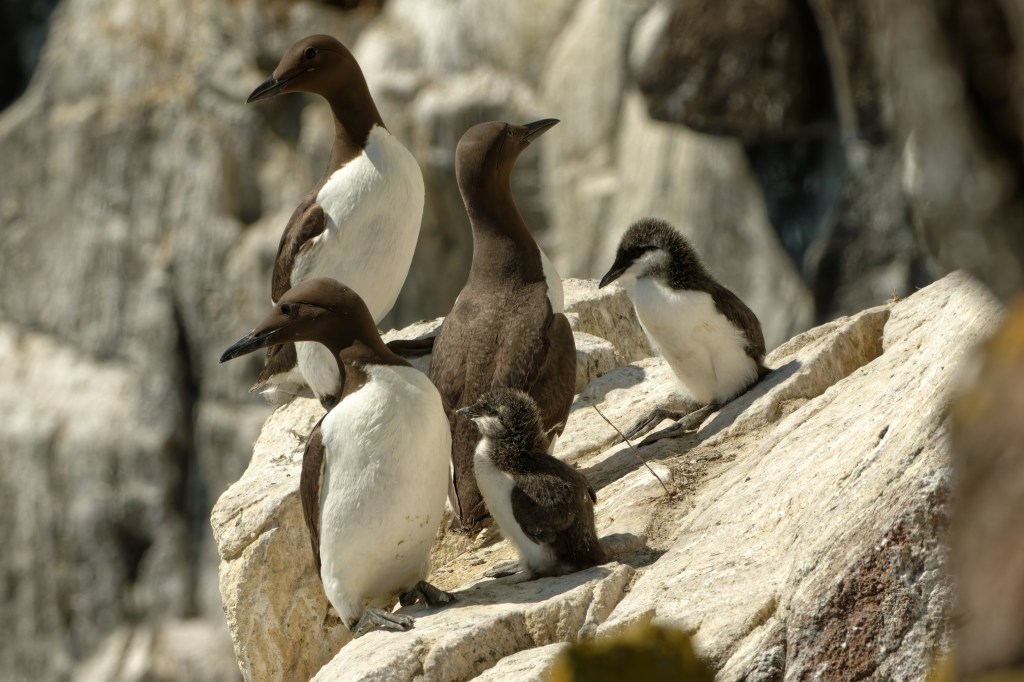
Once the eggs have hatched, there are chicks. We were able to observe this group from the path close to the cliff top; there was space enough for the birds to be relaxed, and for the photographer to be confident about his footing.
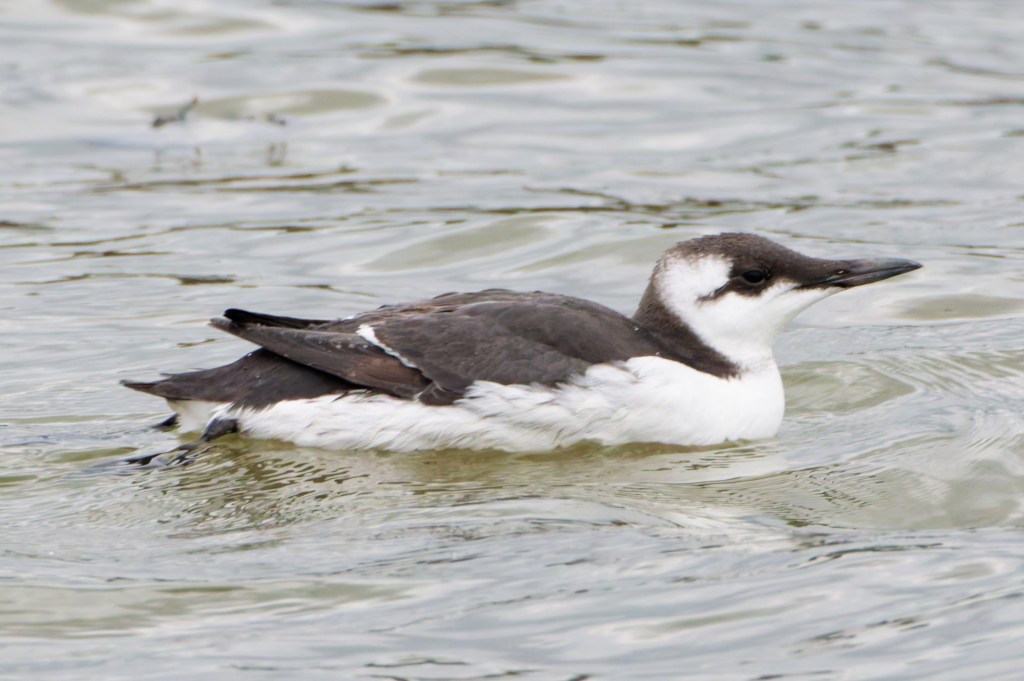
One of the wardens walked by and suggested that the chicks were not too far from launching themselves from the cliff to begin their seagoing lives. Backwoodsman photographed this young Guillemot in September at Aberlady some years earlier.
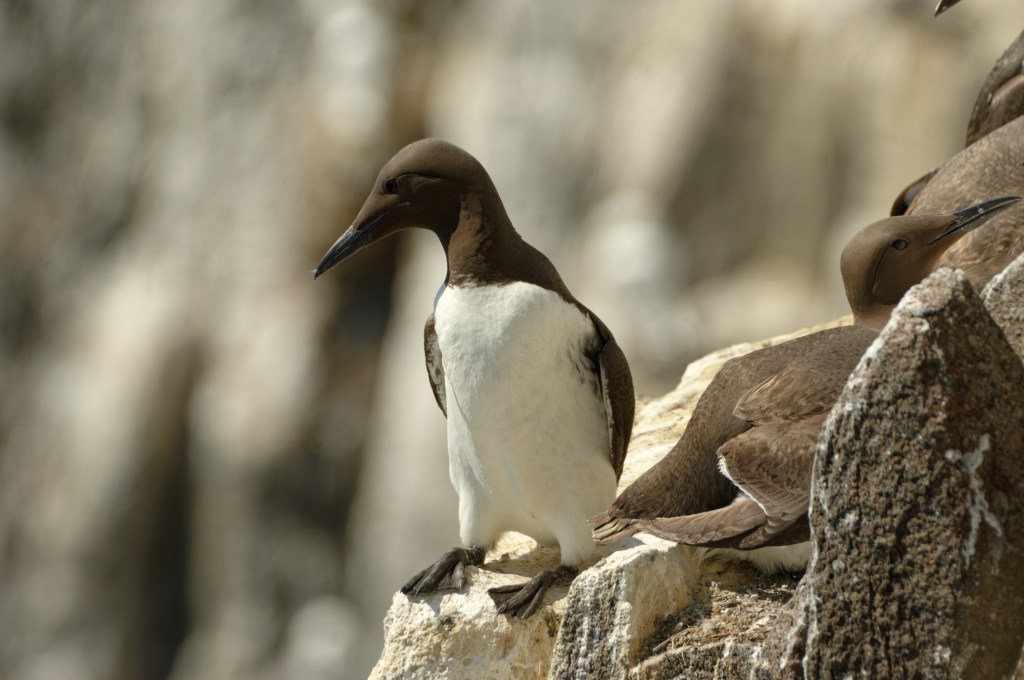
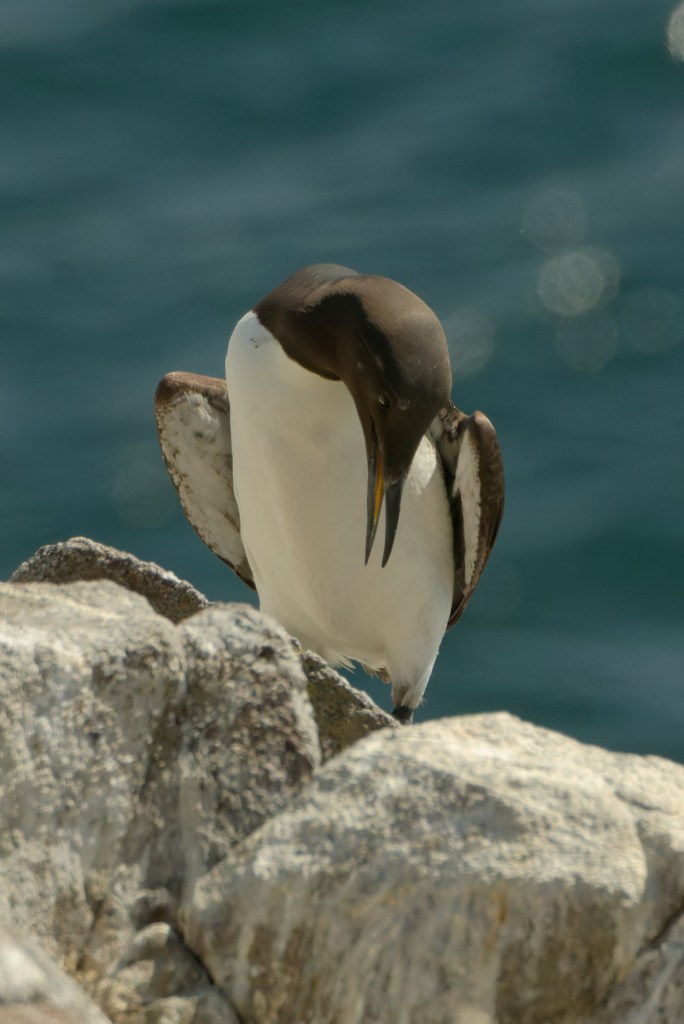
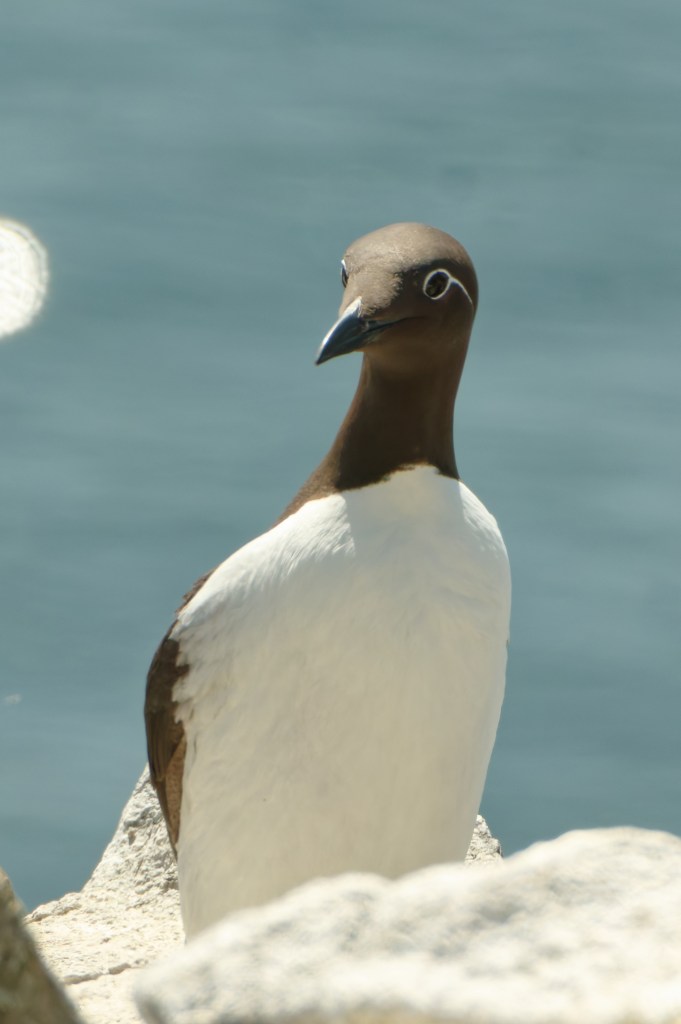
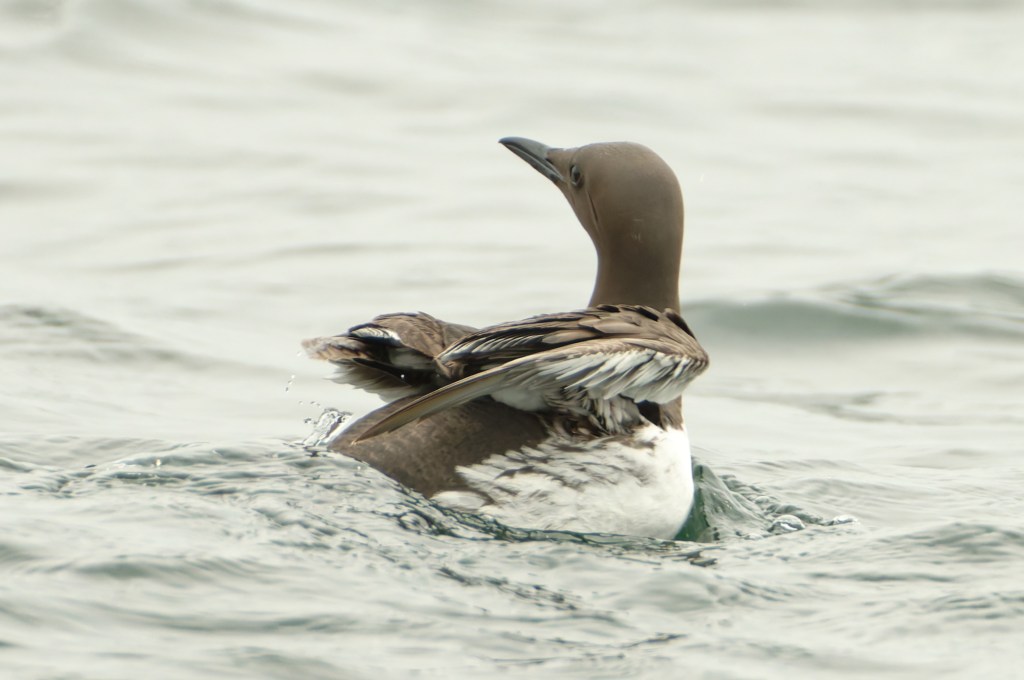
Birds which are not incubating, and are perhaps waiting to go out fishing, show a bit more of themselves: the chocolate brown head and the yellow inside of the bill respond to strong sunshine.
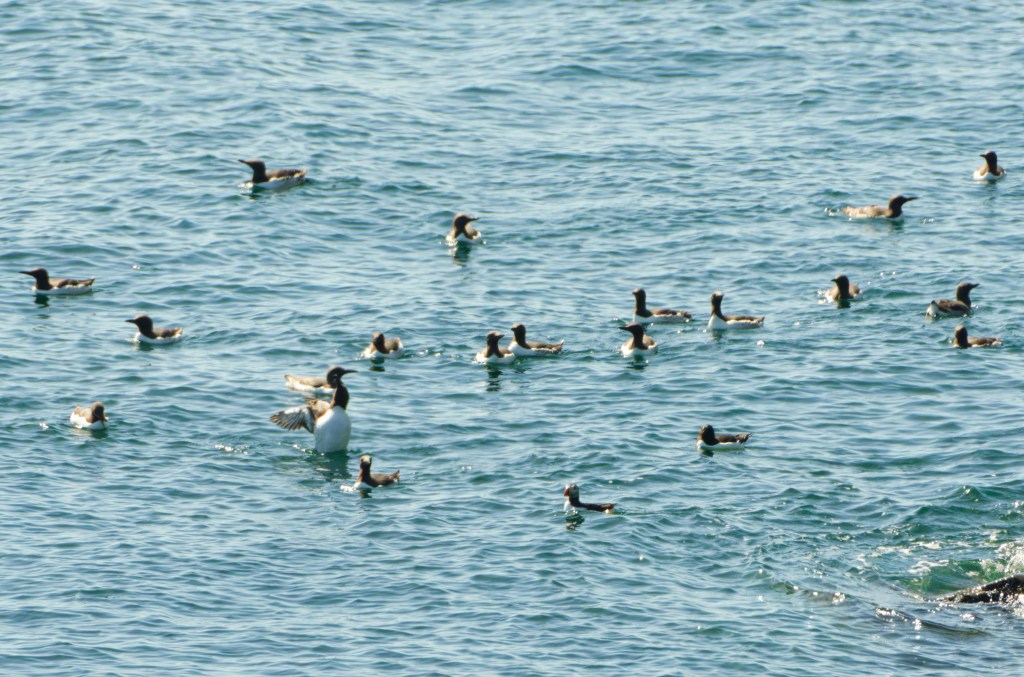
The birds form rafts on the sea, and individuals will sometimes be sufficiently relaxed to allow close approach by a vessel.
The SWT also comment:
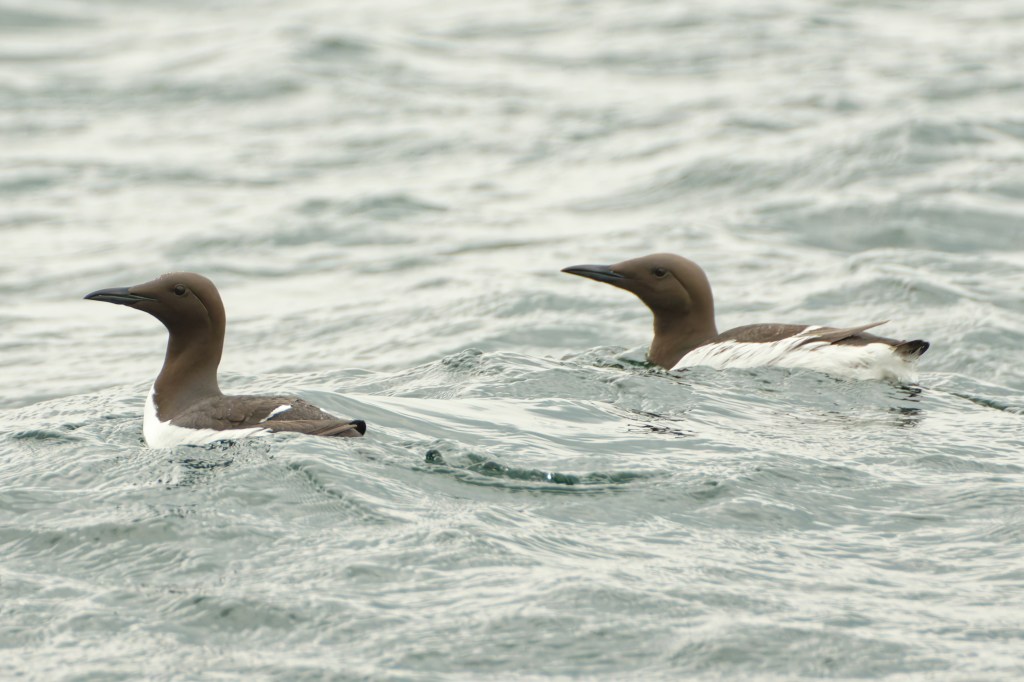
“Many North Atlantic and Arctic guillemots may display a variation in their summer plumage, displaying a striking narrow white spectacle around the eye and white line along the furrow behind the eye. This is not a distinct subspecies, but an alternate colouring that becomes more common the farther north the birds breed.”
It is estimated that approaching one million pairs breed in UK waters. The Forth Islands population is relatively modest in comparison with that based on other sites. Furthermore:
“…geolocation tracking data from common guillemots [was used] to show that they use fixed and individual-specific migration strategies, i.e. individuals go to the same wintering areas in successive years, showing fidelity to geographical sites. They point out that while this behaviour allows individual guillemots to become familiar with their chosen winter home, it represents a constraint in the context of rapidly changing environments. Guillemots may not be able to adjust their migration strategy as conditions change, for example as a consequence of depletion of forage fish stocks in their chosen wintering area, or impacts of climate change on forage fish distribution.”
It remains to be seen what impact the recently approved Berwick Bank development, potentially “the world’s largest offshore wind farm”, will have on the Forth Islands Guillemot population.
Backwoodsman will look forward to his next opportunity to visit the marvellous reserve that is the Isle of May.
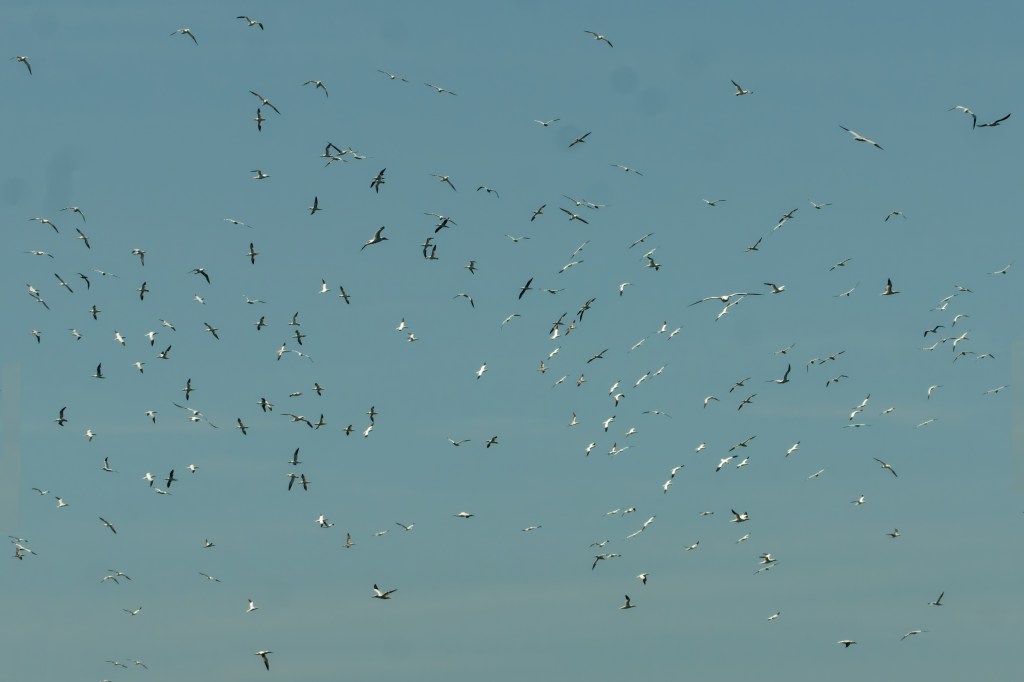
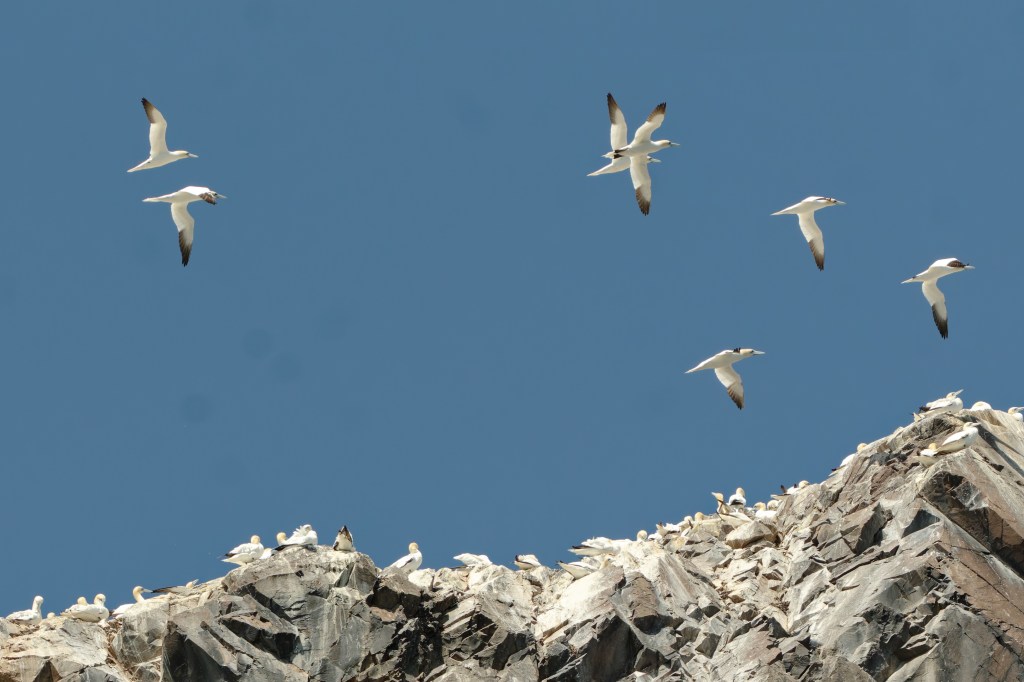
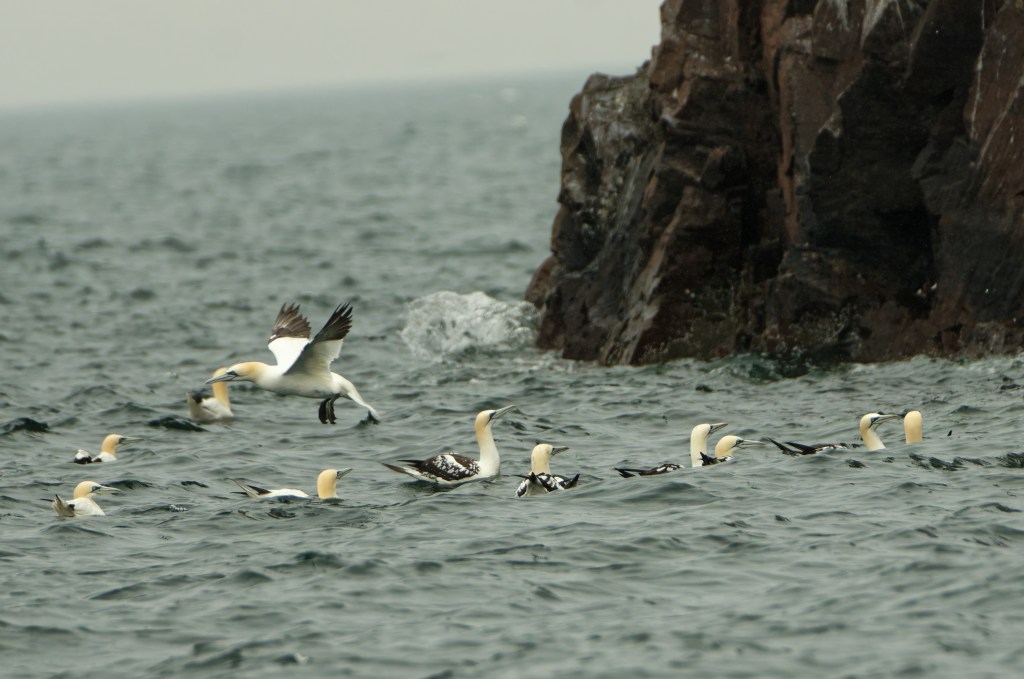
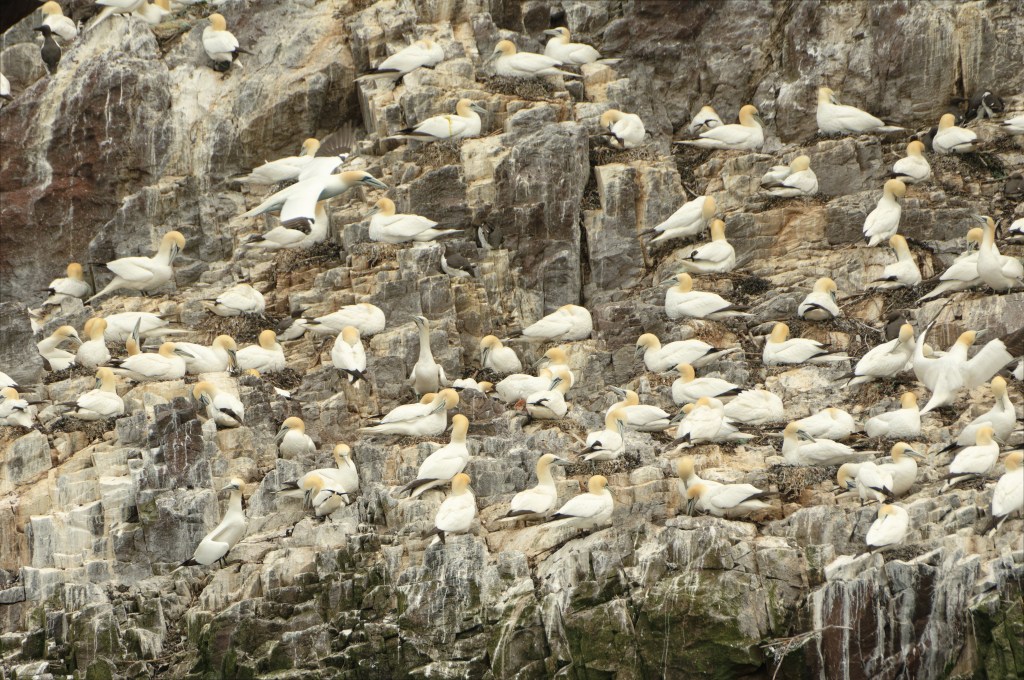
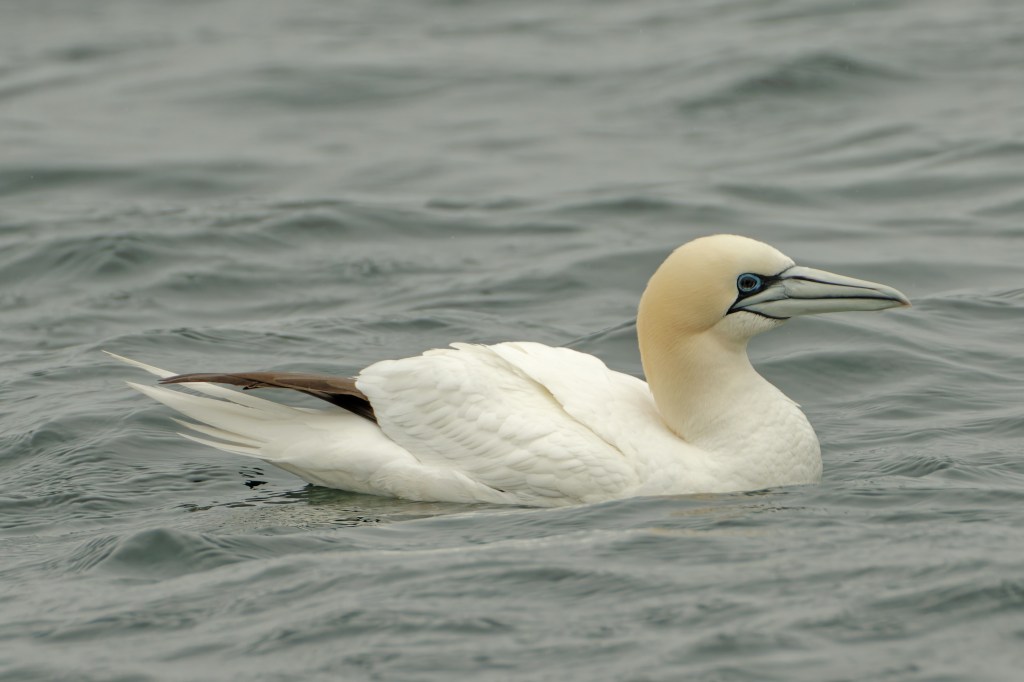
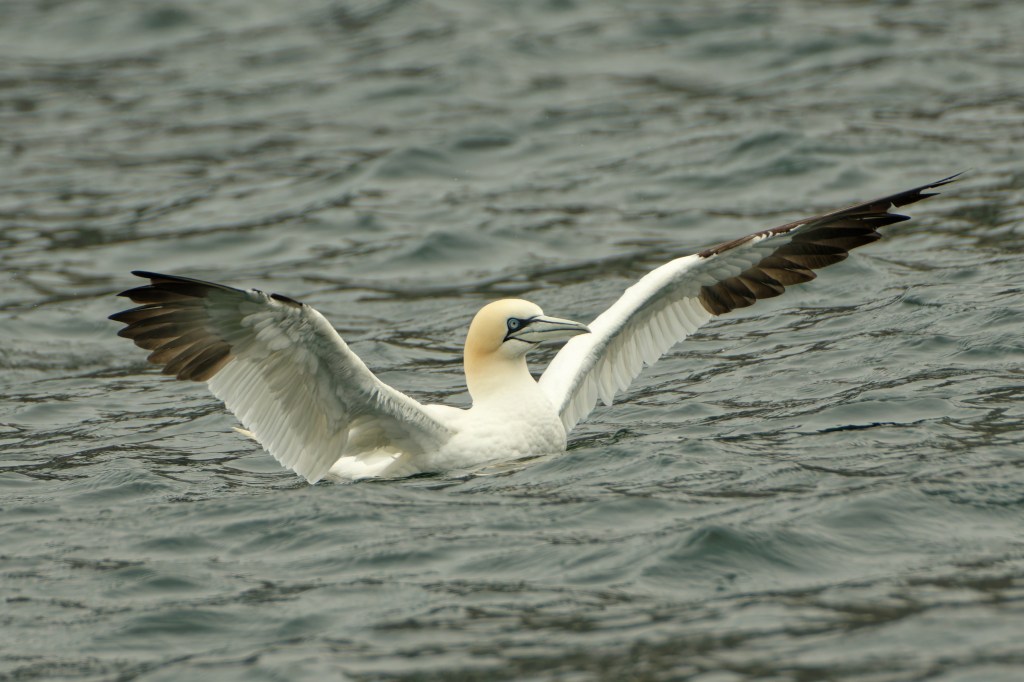
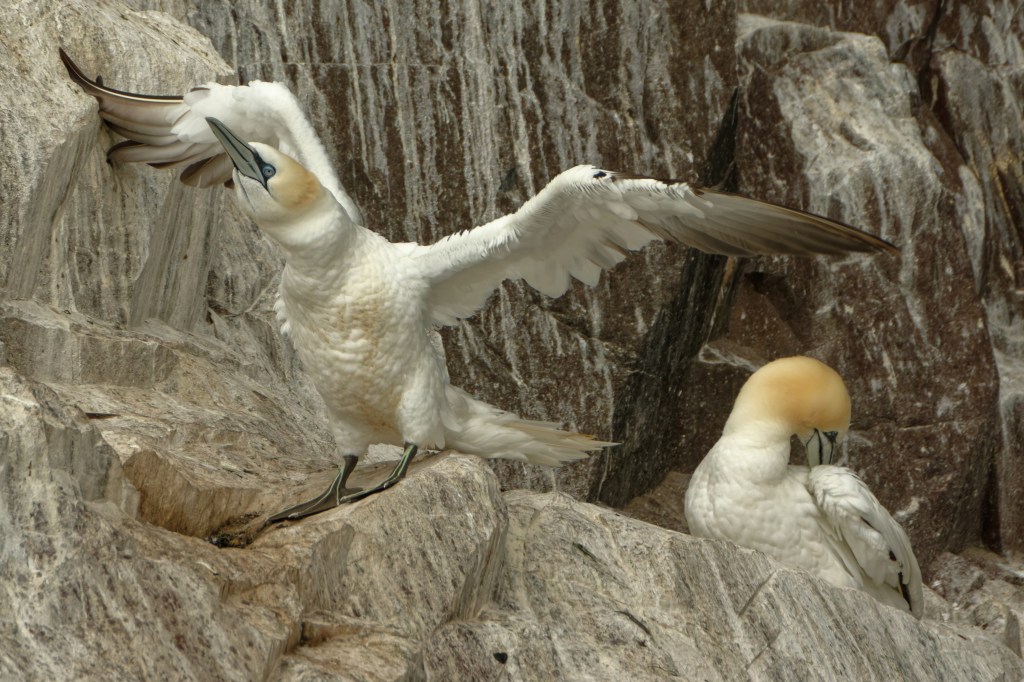
Backwoodsman has made not one but two visits to Bass Rock, “the world’s largest northern gannet colony”, recently. Both visits took place on trips organised through the Scottish Seabird Centre in North Berwick. We’ve been trying to get on one of these boats for a year or two; they are booked up well in advance and Faye made our bookings early in the new year. As the dates approached, we scrutinised weather forecasts, dreading the possibilities of gales and downpours. Neither arose; instead, we had two dry days, one grey and slightly gloomy and one blessed with brilliant light. The view of the rock through the window of the Scottish Seabird Centre on the much brighter day is at the top of the post. If you can scroll up on the image, you will see individual Gannets in the sky and sitting on the rock in the colony.
Distant views of these birds were fairly common from our visits to the Ayrshire coast, with the stretch from Stevenston Point to Saltcoats usually the best bet. The Ayshire Gannets could well be from Ailsa Craig, one of the major gannetries in the west of the UK. The birds would stay well offshore and fish, and photography would be unproductive. We were about to have a very different experience.
As we approached the Bass, we saw a sky full of Gannets. They were not fishing, but soaring on stiff wings and glittering in the bright sunlight. In Sightlines, Kathleen Jamie describes a visit to a Gannetry beautifully. Indeed Gannets grace the cover of her book. She writes, of her approach to the colony: “It was exciting, like a fun fair; the closer we got to the cliff edge the more we could hear the racket, the more the breeze brought us the smell.”
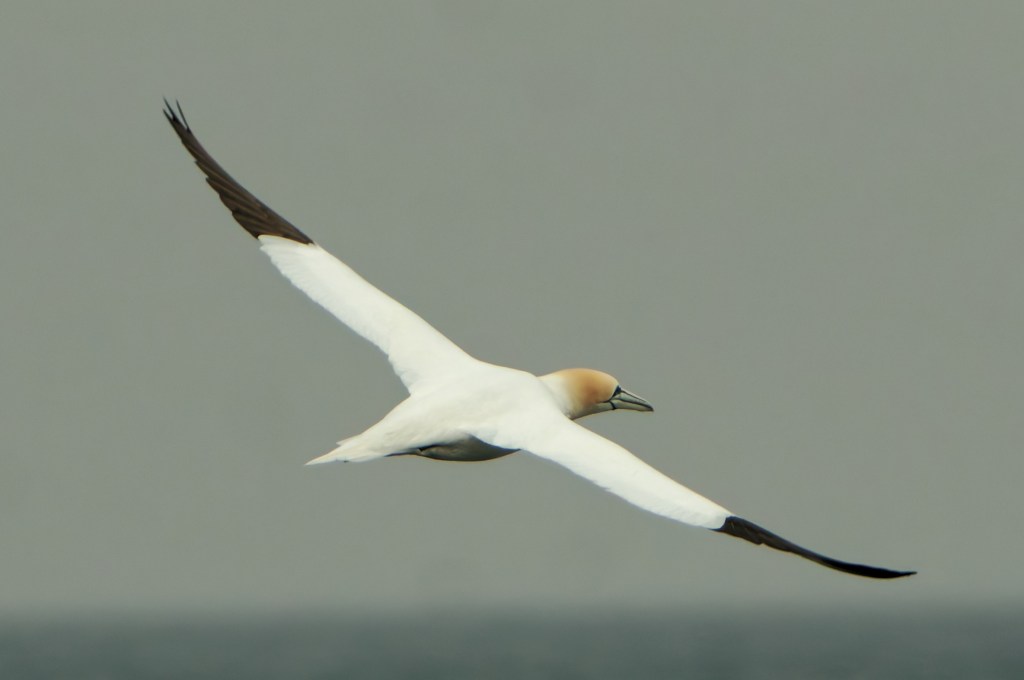
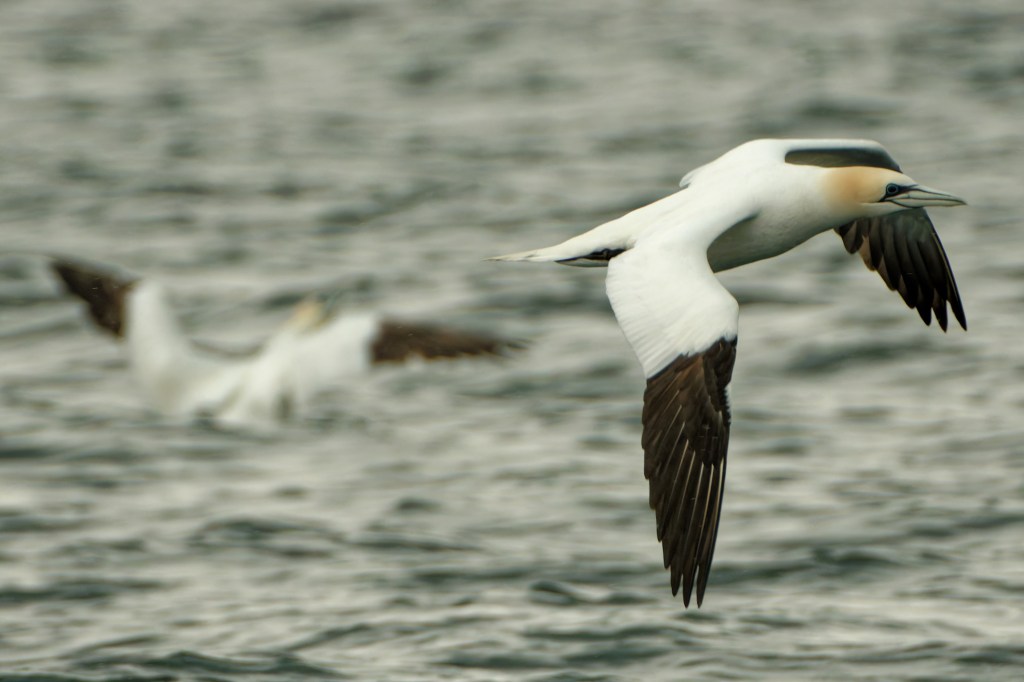
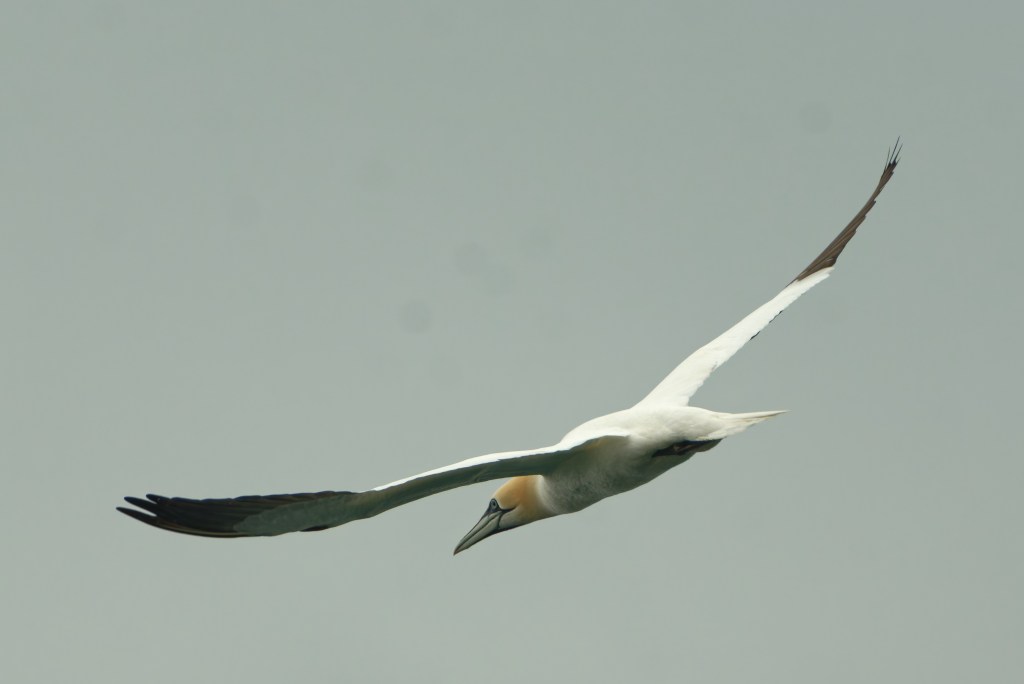
Sensory impacts all round! As we grew closer to the rock, birds crossed our path and the two metre wingspan made its considerable visual impact.
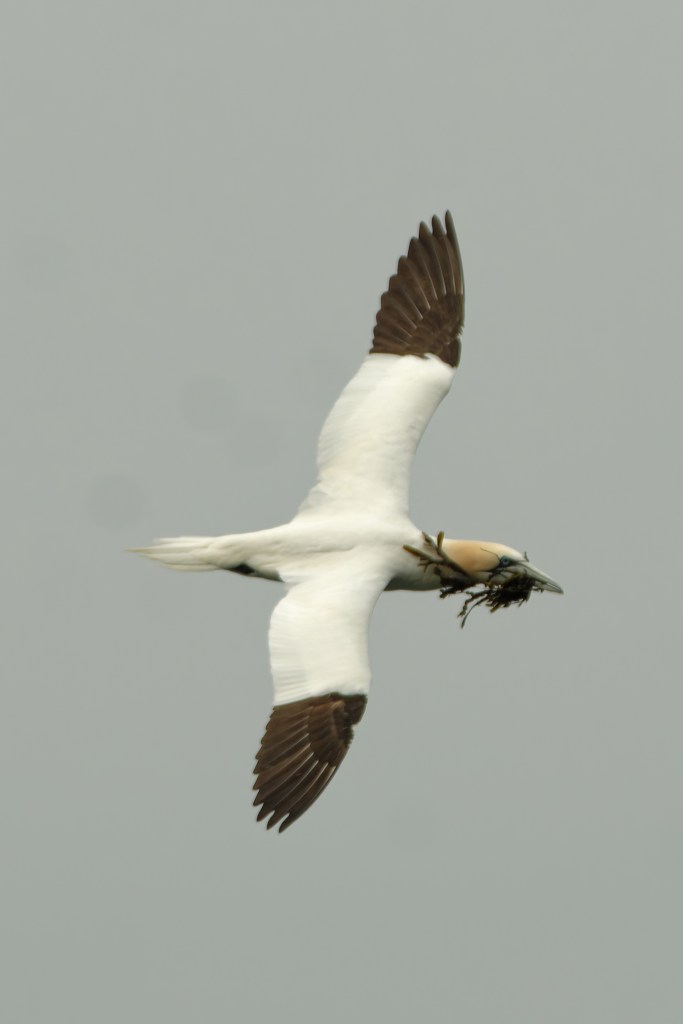
Birds approached bearing feathers and seaweed for nesting material.
The smell and clamour grew and we began to see birds sailing by.
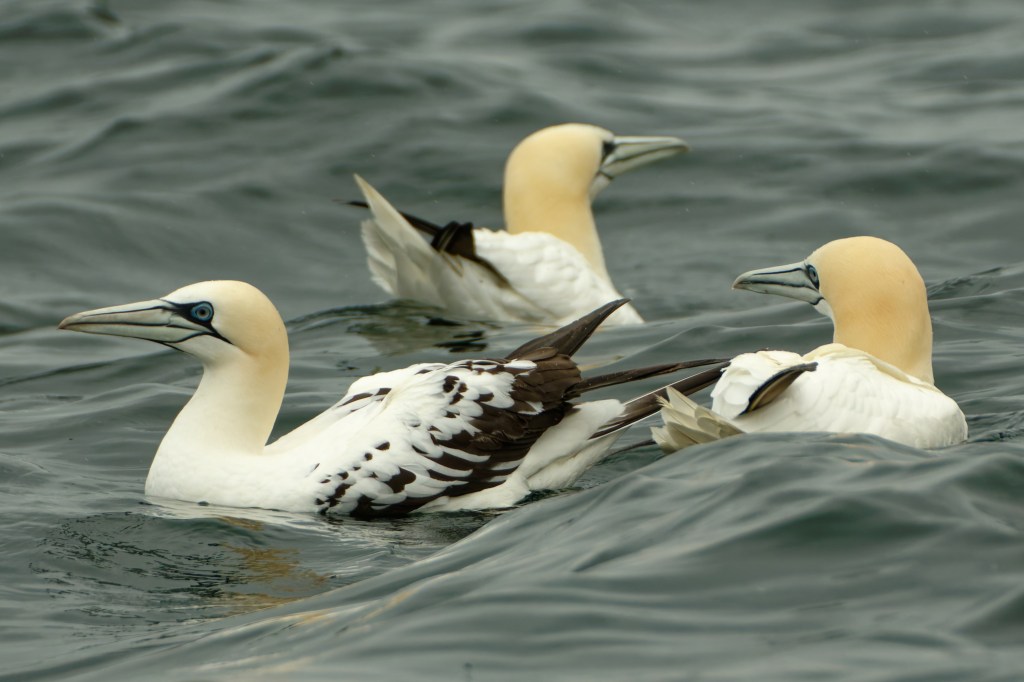
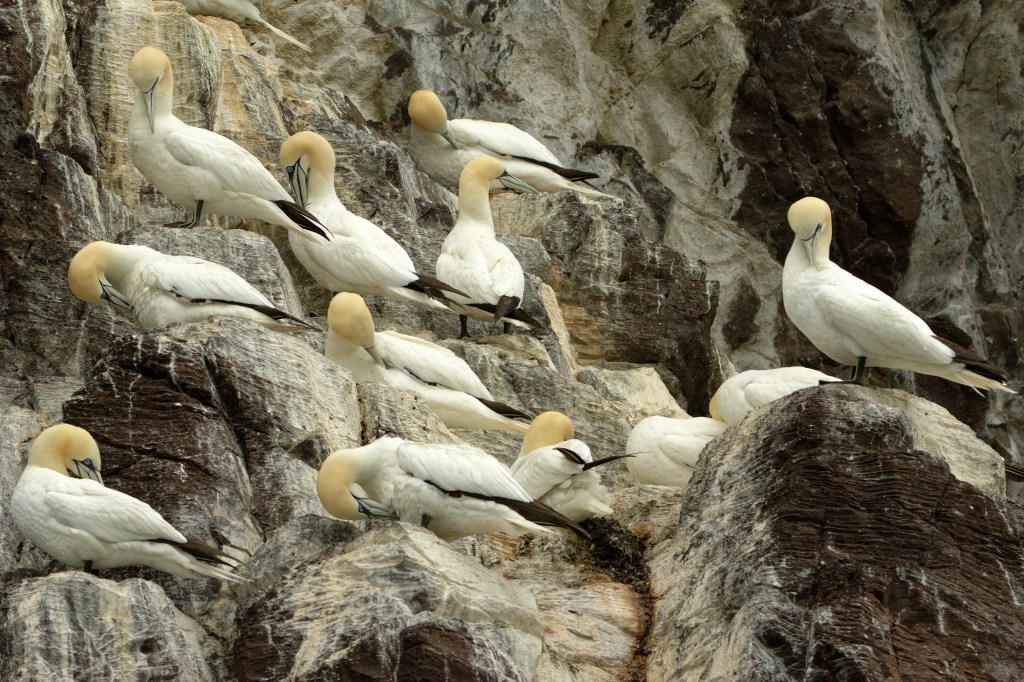
You’ll notice birds with quite a lot of black feathers; these are sub-adult birds. Gannets attain their adult plumage after four to five years.
The view (and the smell and the sound) at the foot of the rock was overwhelming. The nature programmes often explain how a raptor attacking a flock of birds will be confused by all the movement and may fail to catch anything. Backwoodsman felt somewhat bewildered by the sheer range of targets. Time to focus (ho ho).
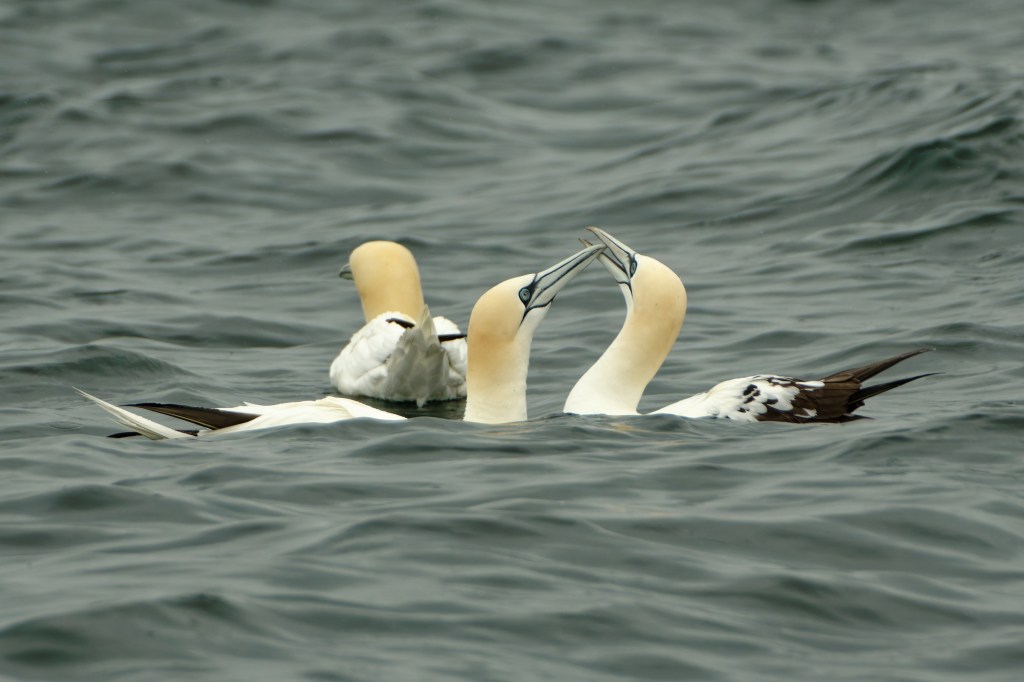
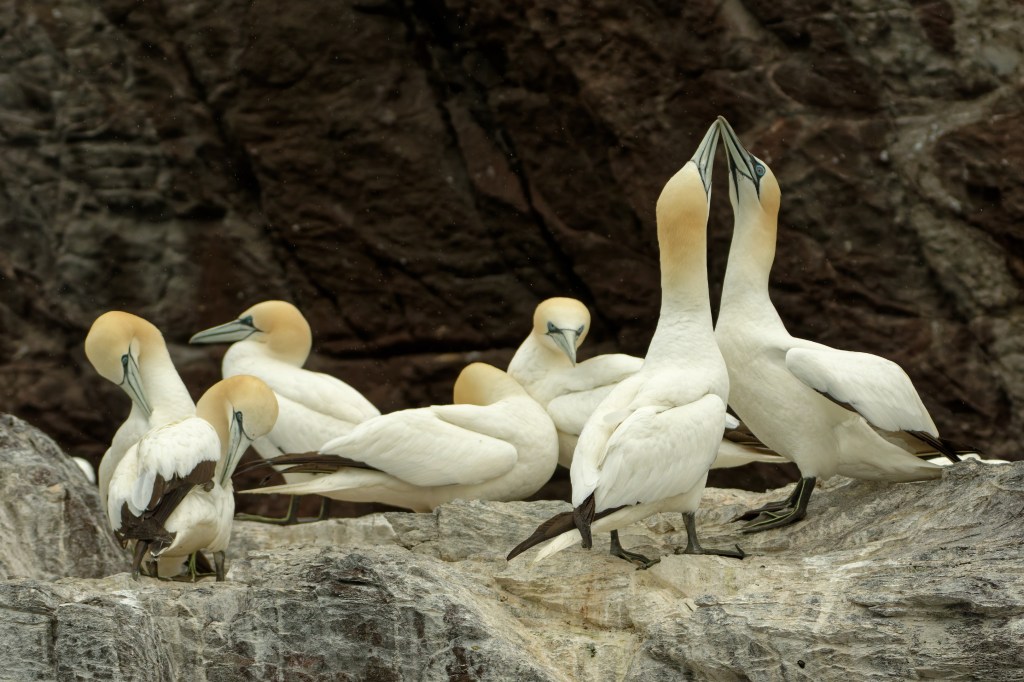
The Gannets are bonding in the top photograph; this seems to be only part of their ritual life, described in this review.
Gannets boast some remarkable adaptations (air sacs, binocular vision, lens shape changes) which help them to survive their extreme dives, and locate and home in on fish from the air and below the surface. The original publication of the vision study has a very nice graphic describing Gannet dives (it refers to a related species).
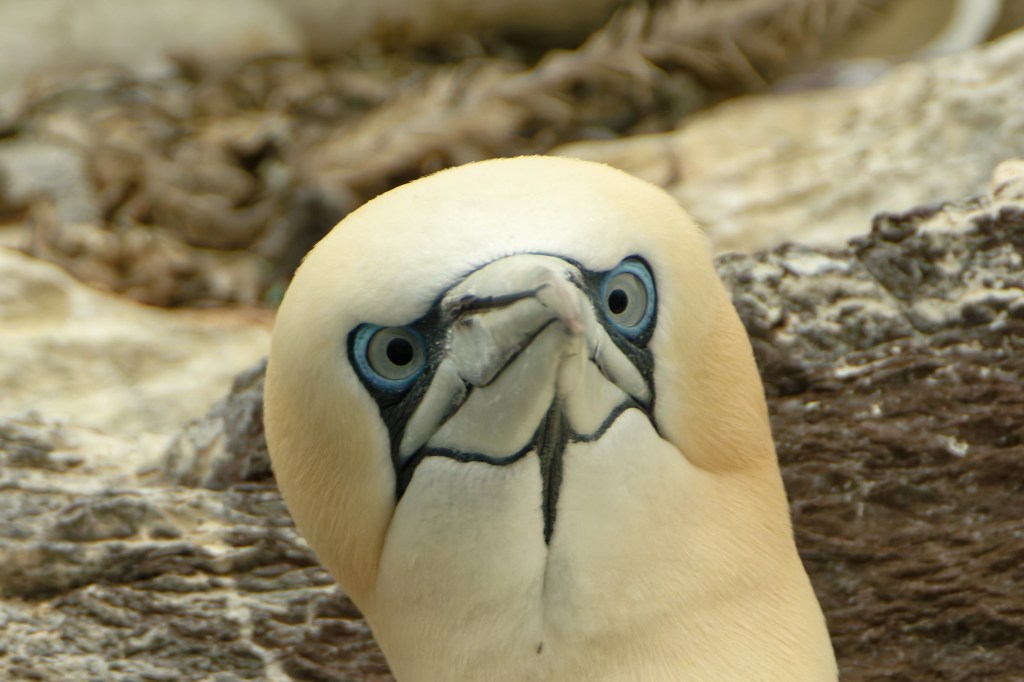
Being looked at by a Gannet is a slightly disconcerting experience.
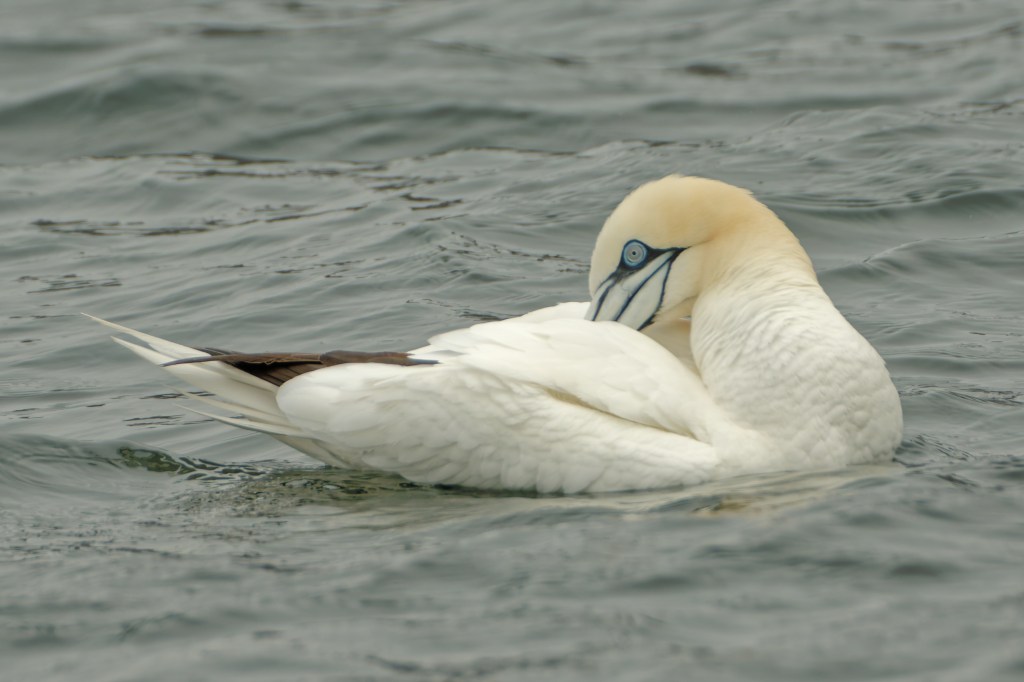
The eye colour also reveals a bird’s history of Avian ‘Flu; in the first image below with the blue rings, the bird has not been infected with the virus, but the bird with the black eye in the second image is a survivor.
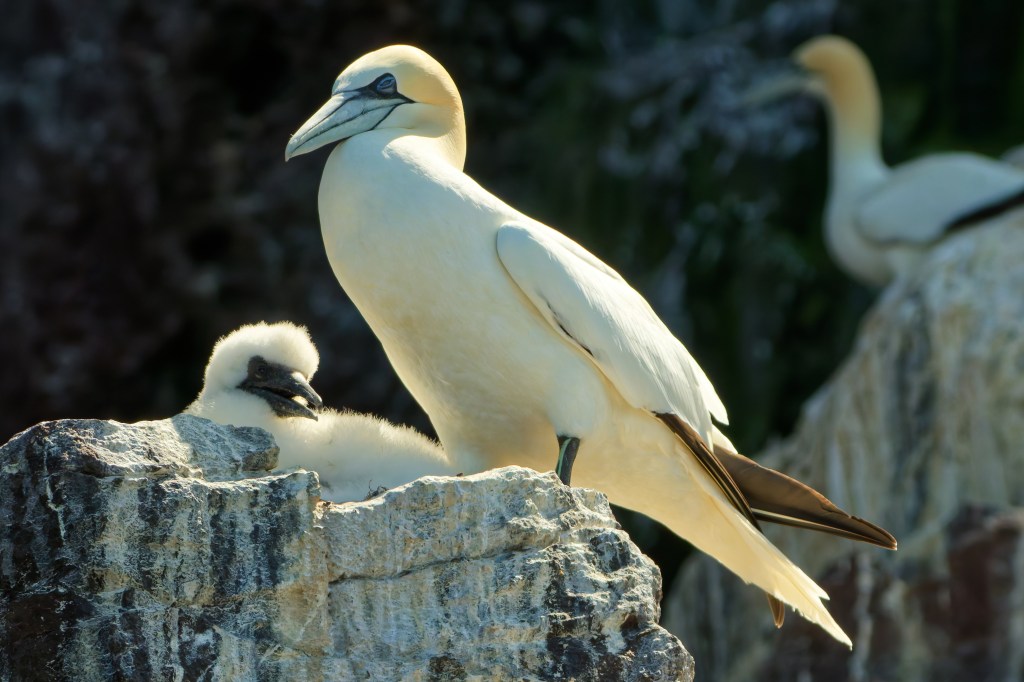
A pair of Gannets will attempt to raise a single chick – some were visible when we visited on the bright day. As it grows, this bird will take on the dark plumage of the juvenile.
As we left the Seabird Centre, we passed a table upon which some campaign material had been set out – it referred to the Berwick Bank Project proposed by SSE Renewables. The company say that “We have conducted comprehensive aerial bird surveys during the development of Berwick Bank. The enormous amount of data we have collected has enabled us to refine our proposals and put forward a more environmentally friendly design.” In a recent post (15th June 2025), the company revealed that it was reducing the area of the project by 20% as it prepared for consent submission.
Glasgow-based environmental consultants MacArthur Green (now part of the multinational SLR Group) wrote an opinion on Gannets and windfarms in 2021, which includes this:
“A case might be made that there should not be a requirement for compensation for offshore wind farm impacts on gannets because the UK SPA suite for gannet is certainly overall in Favourable conservation status, with breeding numbers on the suite as a whole about 90,000 pairs above the population level at designation of these sites, and with every SPA in Favourable conservation status for breeding gannets. Furthermore, it could be argued that there is over-provision of SPA protection of this species, with more than 95% of the UK population of gannets breeding within sites where they are a designated feature. However, Britain and Ireland hold most of the breeding population of gannets, so this species is particularly important for us in a global context.”
Quite a lot is known about Gannet migration: “The Gannet Morus bassanus is one of the seabirds considered most at risk from collision mortality at offshore wind farms in UK waters, so a better understanding of migration routes informs assessments of risk for different populations. Deployment of geolocators on breeding adults at the Bass Rock, Scotland, and Skrúður, Iceland, showed that the timing of migrations differed between populations, birds from Bass Rock passing south through UK waters mostly in October and back in February while birds from Skrúður passed south through UK waters mostly later, in November, but returned north earlier, in January. Many birds from both colonies made a clockwise loop migration around Britain and Ireland. Only a minority of birds from the Bass Rock returned northwards to the colony through the southern North Sea. A counter-intuitive consequence is that many Gannets moving northwards through waters to the west of Britain and Ireland in spring may be birds from North Sea colonies. Although Gannets normally remain over the sea, one tracked bird appears to have made a short overland passage in spring from the west of Scotland through central Scotland to the Bass Rock, whereas most returned around the north of Scotland.”
The case against the project is based more on the presence of the installation in an area which the birds will use to feed, rather than it being a hazard flung across a migration route: “A globally important area for seabirds will be severely at risk if a proposed offshore wind development, Berwick Bank, is approved. The proposed development is immediately next to the Outer Firth of Forth and St Andrews Bay Complex Special Protection Area. This is designated for its globally-important seabird populations. The proposal is for a 4.1 GW project with 307 turbines, each one 355 metres high to blade tip. If it is built, it will be one of the largest in the world. Berwick Bank, in its current form, would be more destructive to seabirds that [sic] any other proposed offshore wind farm in Scottish waters. It has the potential to kill tens of thousands of seabirds and to displace tens of thousands more over its lifetime. This area is used extensively for Kittiwakes, Puffins and Gannets. What’s more, shallow waters near the shore are the most important for many seabirds to find food for their young.”
It remains to be seen how the Scottish Government will handle this. There is more about the campaign here and a link to a petition.
Would it be trivial to end by saying that one of Backwoodsman’s favourite restaurants is named for this most impressive seabird – The Gannet in Finnieston! Backwoodsman hopes not, and likes how a diving bird is celebrated in the logo.
So, wild mammals again; we had a local canal walk last Sunday. On our way out, we skirted the compound where Amey are based for their repairs to the Woodside viaducts. There was a chap in full camo holding a large cigar in his left hand and a lead in his right. When the creature at the end of the lead emerged from the long grass, it turned out to be a Polecat. A Dundas Hill billy !
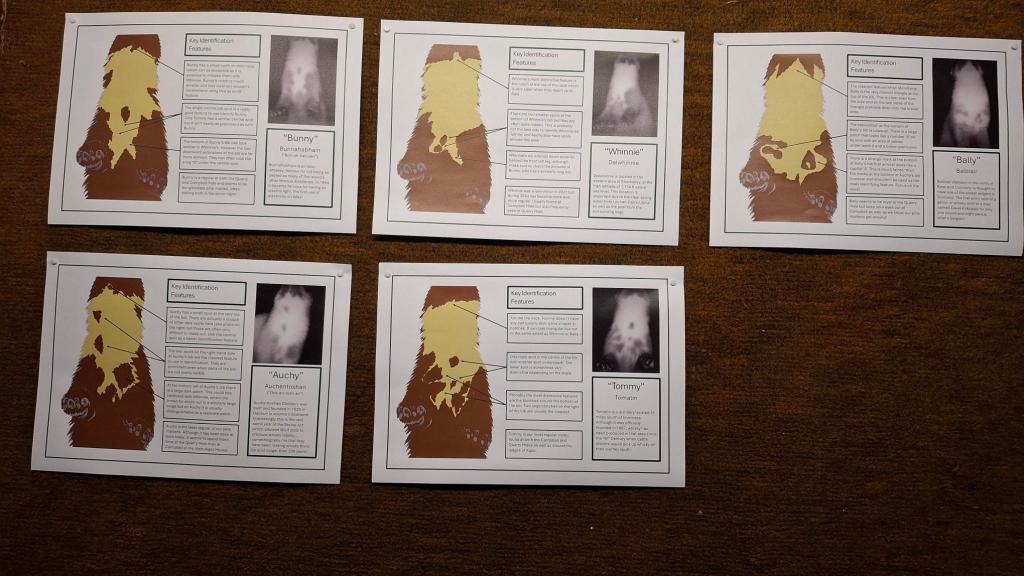
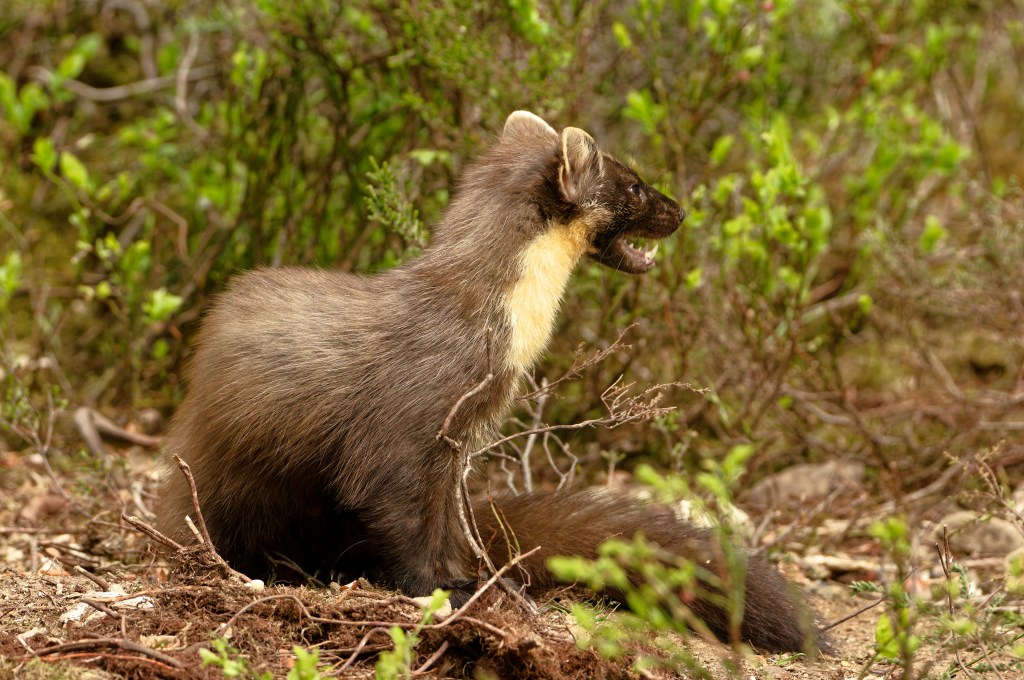
If you read the Red Squirrels post, you should know that the Aigas offer also included Pine Martens. Backwoodsman had never set eyes on one of these creatures before our May trip and was keen to get some pictures. We were offered an after-dinner private trip to the Quarry Hide with one of the wardens, and took up the opportunity with great enthusiasm. Bait was placed, lights were turned on and we took our places in the comfortable hide and waited in stillness and silence. The light fell, various creatures rustled in the grass but of Pine Martens, there were none. After a couple of hours, the vigil was called off and everyone exhaled. When the lights went back on in the hide, we were able to read about the role bib patterns play in identifying individual animals, and the cunning way in which images had been obtained.
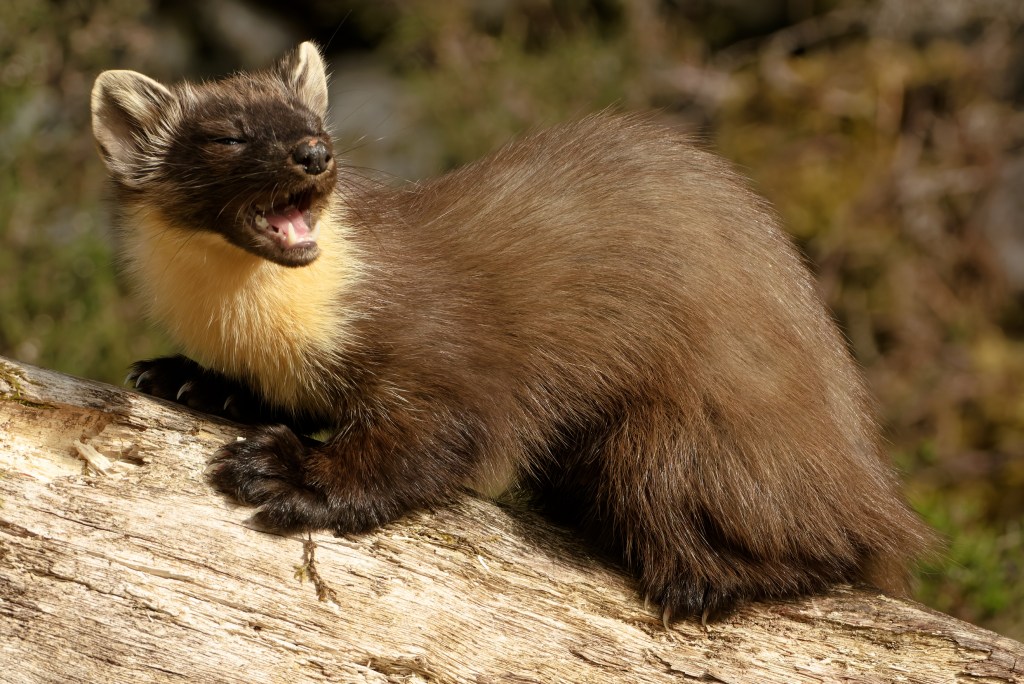
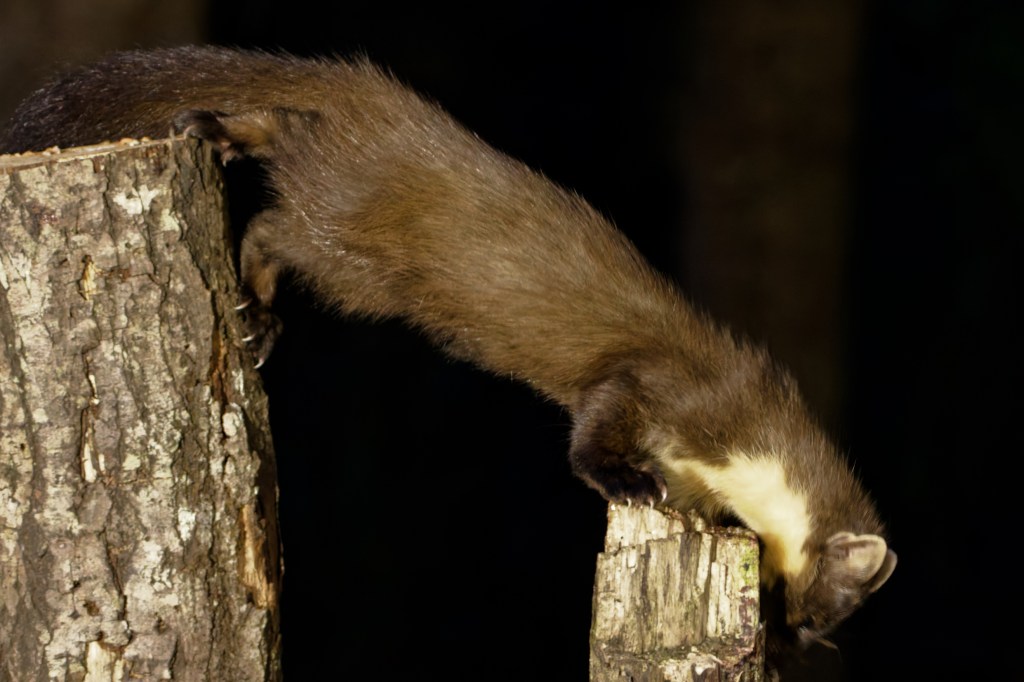
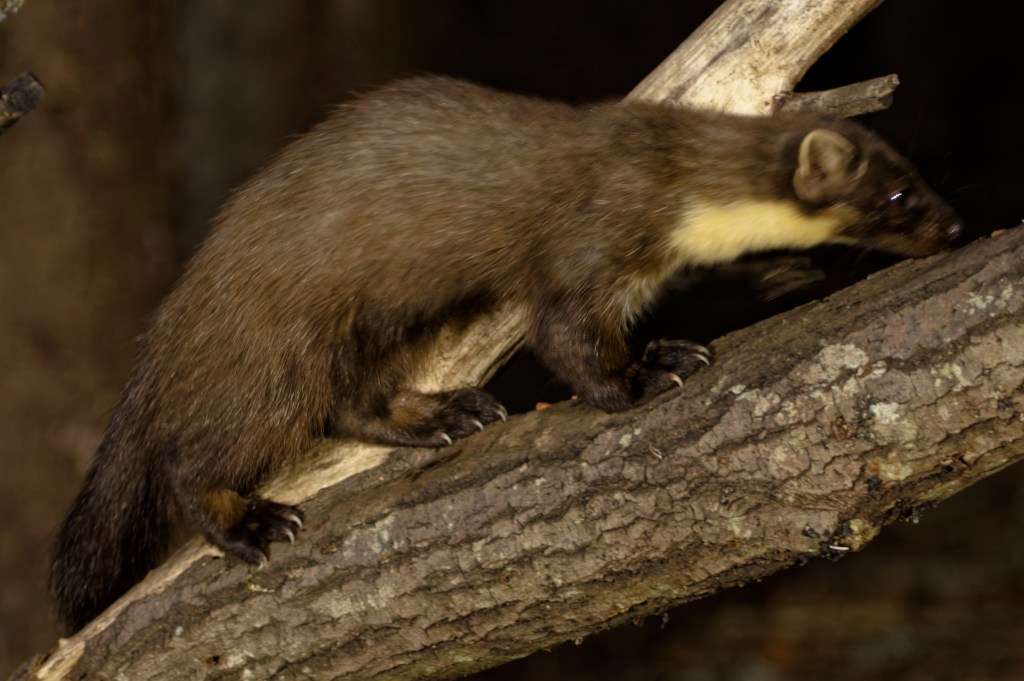
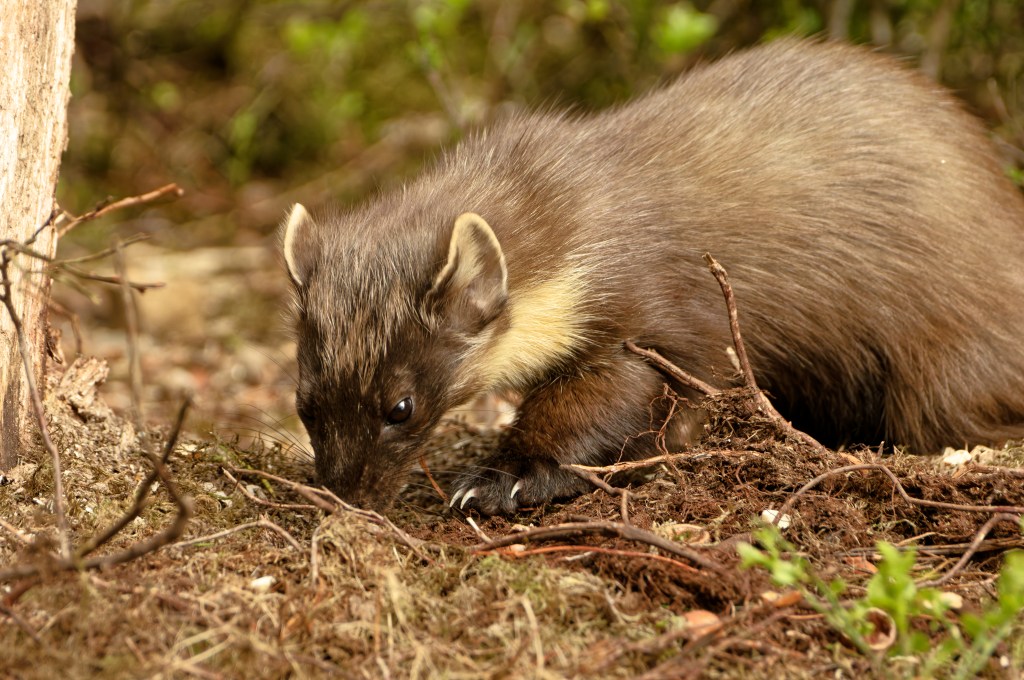
The Pinewood Hide had delivered some excellent views of Red Squirrels and we visited it again a couple of days later with the intention of improving Backwoodsman’s stock of Woodpecker images. We baited up and as we scanned the edge of the woodland, something that could only have been a Pine Marten bounded away from the hide and into the bracken in front of us. The mammal book says that the species is “Mainly nocturnal but in summer may forage after dawn and before sunset.” We had not hoped to see one in the bright light of a May lunchtime, and yet…
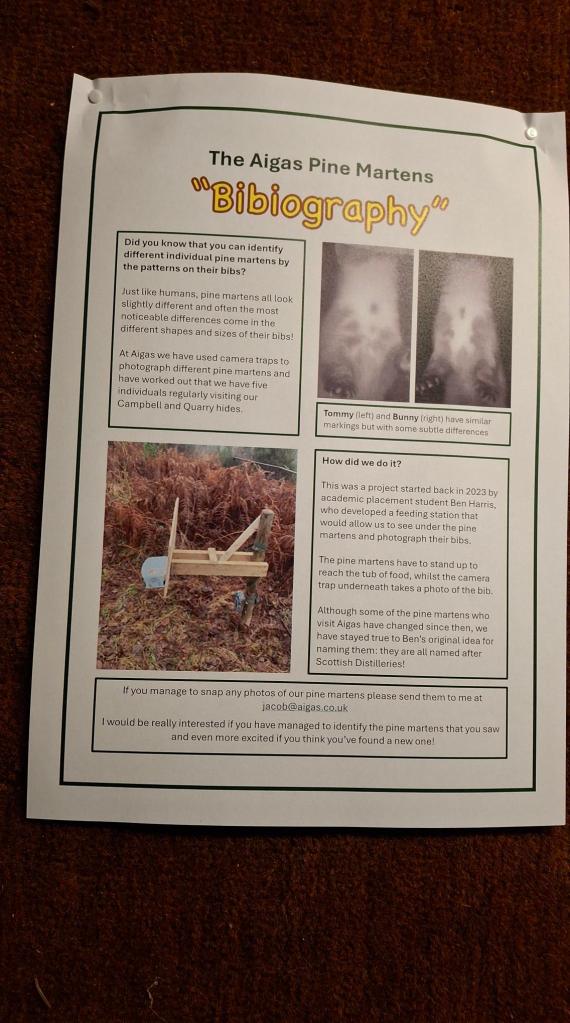
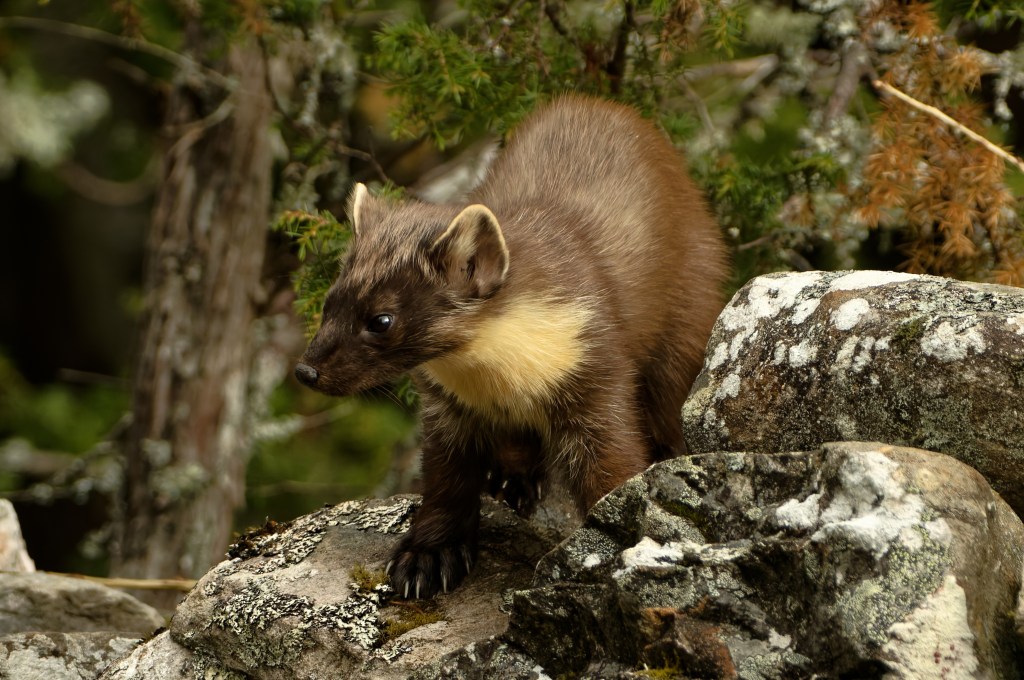
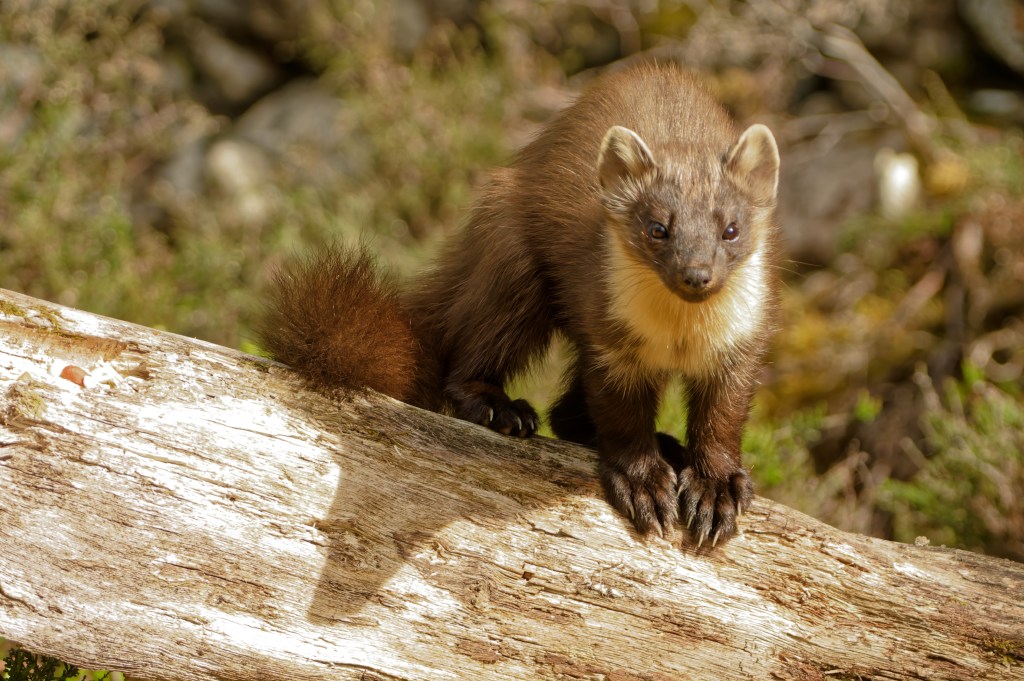
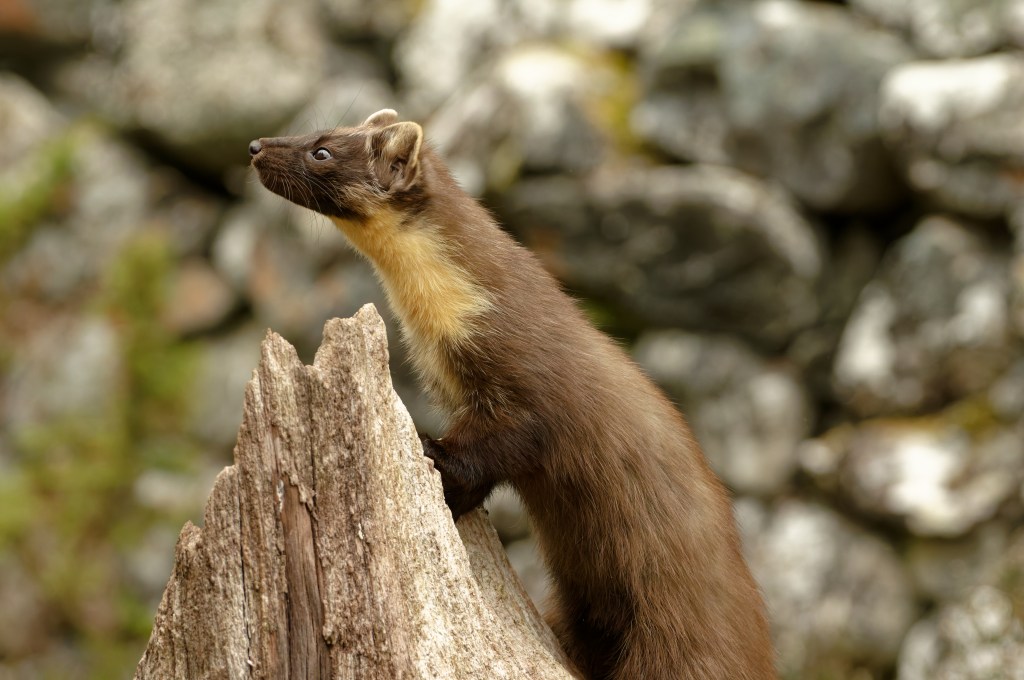
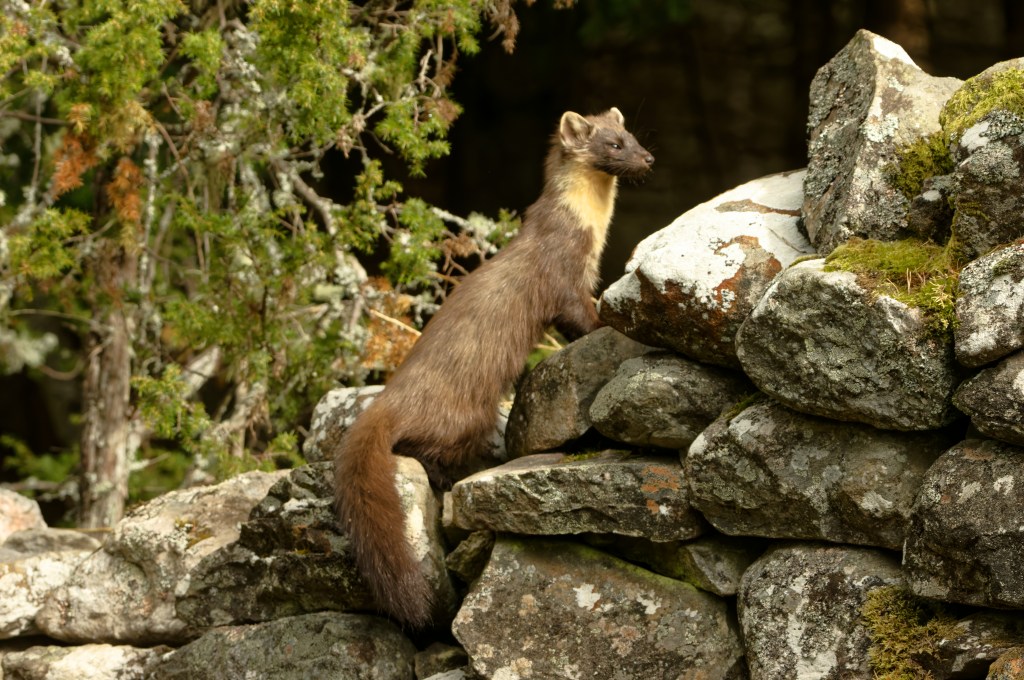
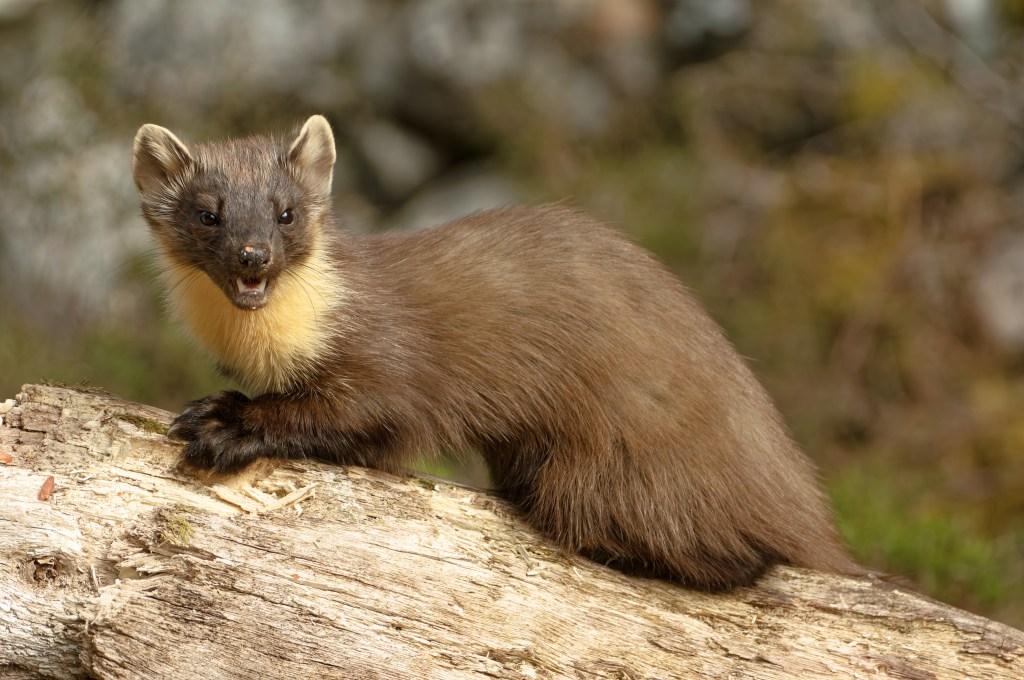
A small head appeared atop the wall against the dark background of the woodland, viewed the food offer, assessed the level of threat we posed back in the hide, and made its way in for the peanuts.
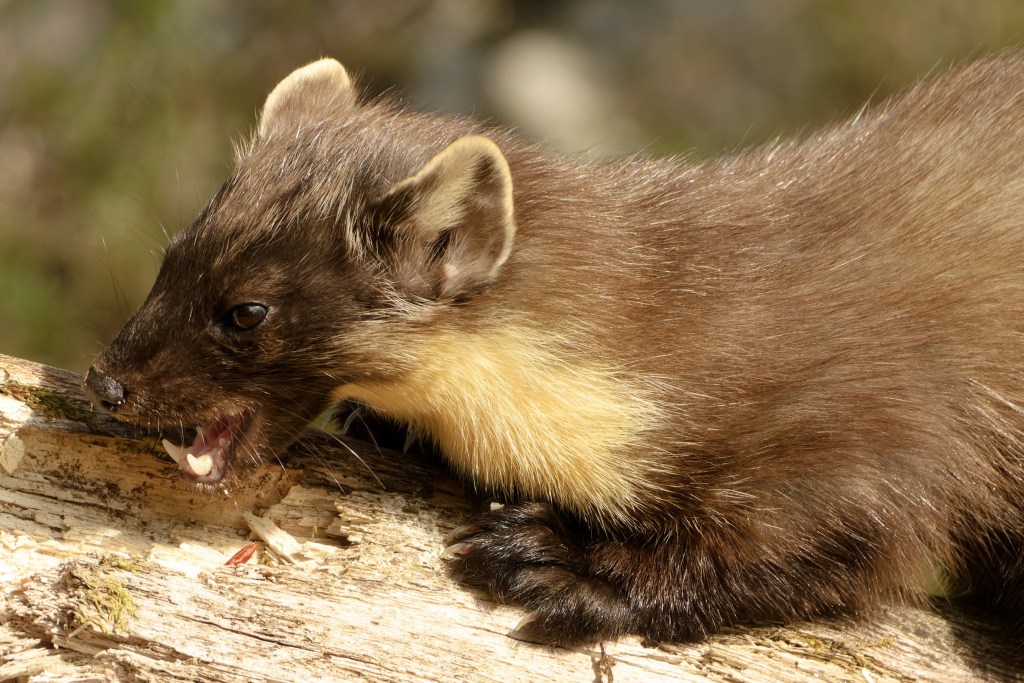
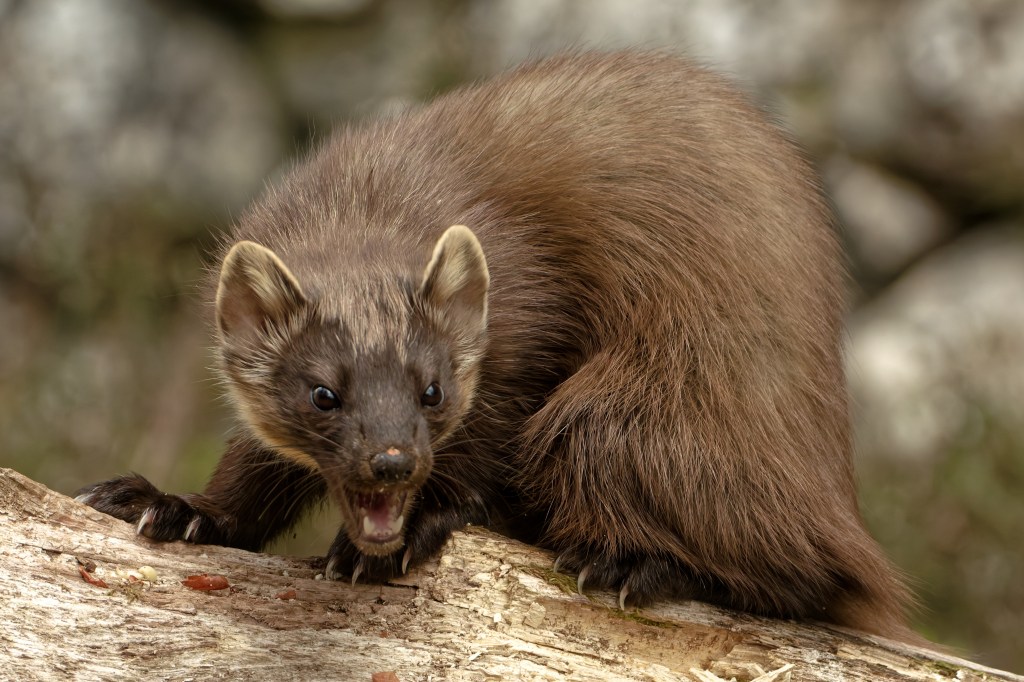
The animal looked quite relaxed – the camera was clicking away all the time but the Marten neither flinched at the sound, nor looked towards it. The teeth were bared from time to time but it looked more like a reflex associated with chewing or swallowing than a threat.
Once however, the animal seemed to look past our hide and strike a more aggressive posture – could another animal have looked in at this point?
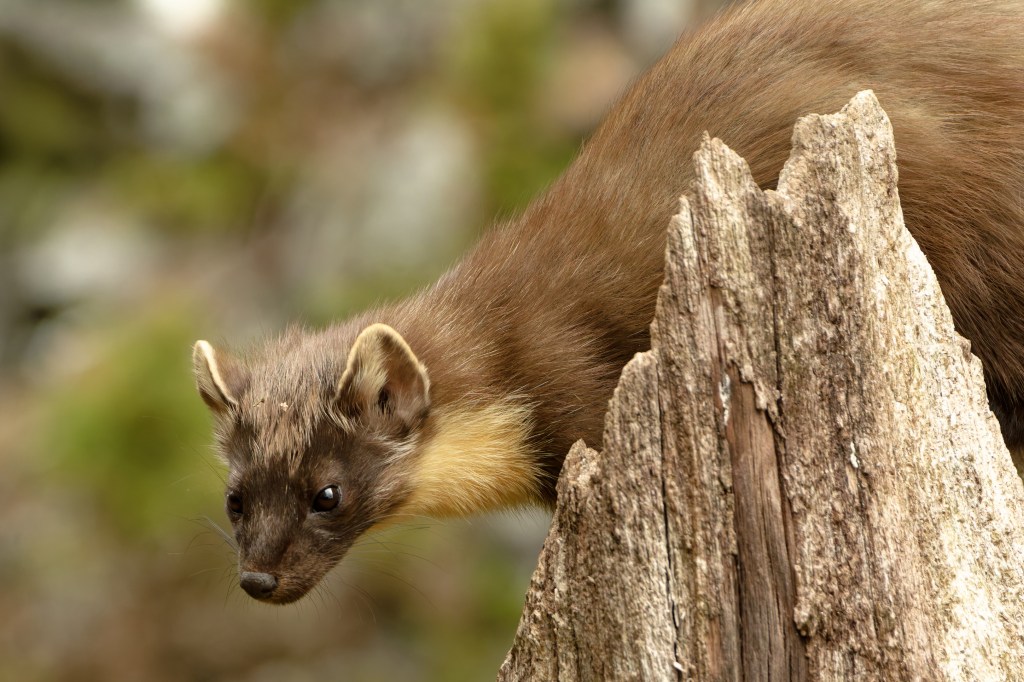
Crisis over and it was time for a look around the area before the trip back to the wall and an exit into the darkness beyond.
We were stunned by what we had just experienced. The images are time-stamped so we know that the Marten had spent twenty-four minutes in our company.
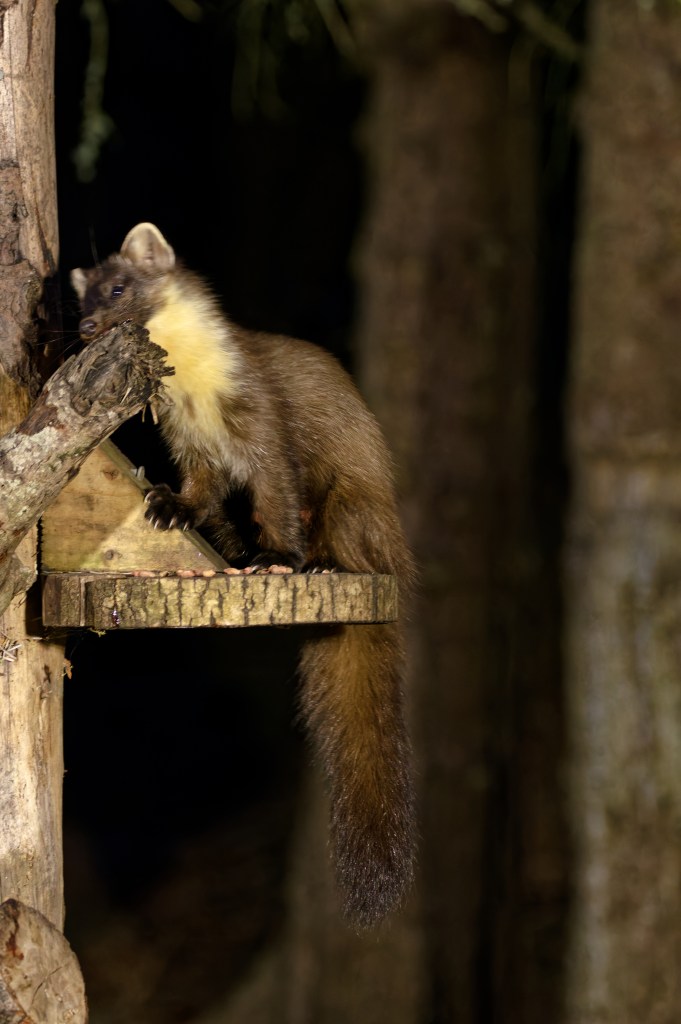
It might be thought vainglorious to say that this set of images was unlikely to be improved upon unless the opportunity arose to photograph two Pine Martens, or an adult and some little ones. However, when offered another after-dinner guided hide visit, we took it up. Our host, Sir John Lister-Kaye, had used one of his short after-dinner speeches to express his displeasure at the selfish actions of a photographer on one of these night-time hide visits, so Backwoodsman was committed to available light and single frame shooting only when we sat waiting in the Campbell Hide. Suddenly, a Pine Marten was with us, crunching peanuts and licking jam from the adventure playground.
So job done, Pine Martens spotted and documented, and what a wonderful opportunity.
Backwoodsman found this in a Natural England blog:
“The pine marten was once widespread and common across Britain but is now rare and recovering. Pine martens are generalist omnivores, eating a wide range of different food species. They predominantly prey on small mammals such as field voles, and this usually consists of up to 50% of their diet. Their diet preference is determined by what is locally most abundant. Predators are a crucial part of a functioning ecosystem. A diverse predator community is expected to naturally limit populations of abundant prey populations. However, pine martens by themselves generally live at low density; a population of one per km2 is considered a high density, and a pair of martens generally need at least 200 ha of suitable woodland.”
So, areas; 200 hectares is 2 km2, which is quite a small area. The Aigas Estate covers 600 acres according to a source (another bewildering unit: an acre is one chain by one furlong, the likes of Mr Rees-Mogg love units like this because no-one can work out how much land his lot actually own!), so that’s 2.4 km2 in sensible units. Five Pine Martens on the property seems quite crowded, but perhaps multiple territories overlap on the Aigas Estate, with individuals making feeding raids and then retreating to somewhere a bit more spacious.
There is a Pine Marten recovery plan which seeks to reintroduce viable populations of these animals into England and Wales without affecting the recovering population in Scotland.
An interesting point from the document: “Recent studies in Ireland…suggested that pine martens may have a negative impact on grey squirrels, with a benefit to red squirrels where they are present and as a result, many organisations and partnerships in Britain are particularly interested in pine marten reintroduction projects for grey squirrel control. However, these are often locally designed initiatives, motivated by local conservation targets, without consideration of how they fit within the wider context of pine marten conservation and of other, similar projects. Reintroductions can offer a powerful conservation tool but when they are motivated and planned at a local scale this may hamper their ability to contribute to the long-term recovery of a species at the larger scale. This is particularly important for species such as the pine marten, which occupy large (ca. 2-30 km2 per individual) home ranges and which, therefore, require suitable landscapes, rather than sites, [Backwoodsman’s italics] in which to establish sufficient territories for a viable population.”
The Aigas Estate has a small but established population of Beavers and breeds Wildcats to support reintroduction projects. Backwoodsman is less excited about these species, or by the others which various rewilding agendas seek to reintroduce, particularly Lynx and Wolves. Some of you may remember the illegal release of Lynx in the Cairngorms earlier this year?
One of the Aigas rangers was enthusing about Lynx: “do you see the reintroduction of Lynx as being an unambiguously good thing?” Backwoodsman asked her. Her answer referred to a “landscape of fear”, in which deer would smell large predators as they forage, and move on smartly without overgrazing, allowing trees to grow back. Deer fencing is no good because Grouse fly into it and maim themselves, so the deer get to roam unchallenged, proliferating far beyond sustainable population densities and grazing everything to extinction. Presumably Wolves would also provide a landscape of fear. They certainly would if they develop a taste for walkers on the West Highland Way. Backwoodsman wonders if pheromone spraying at strategic locations might not be a potential control strategy, as the semiochemicals used by Lynx, for example, seem to be quite well characterised.
According to the BBC story, Lynx became extinct from Britain five hundred to one thousand years ago. Backwoodsman wonders if conserving what we have now should be top priority, rather than reaching back into a past in which people lived and farmed very differently. The rewilding movement is having none of that:
“Nature knows best when it comes to survival and self-governance.
We can give it a helping hand by creating the right conditions – by removing dykes and dams to free up rivers, by reducing active management of wildlife populations, by allowing natural forest regeneration, and by reintroducing species that have disappeared as a result of man’s actions. Then we should step back and let nature manage itself.”
There are four action points in the second paragraph; the first three seem rooted in a practical approach but the fourth is completely unqualified and almost appears an end in itself. Rewilding Britain is the local branch and one of the rewilders celebrated on its website (Dorette Engi) was actually present at Aigas during our visit.
“If Dorette Engi hadn’t read Isabella Tree’s Wilding, which recounts ‘the return of nature to a British farm’, Dayshul Brake [a rewilding cluster] might never have come into being.
With retirement looming, the briskly outspoken psychoanalytic child psychotherapist who grew up in Switzerland, was keen to put her strong Buddhist principles into practice for the planet. Inspired by Wilding, “I thought, perhaps a bit presumptively, ‘OK, I’m going to do that’.” Her presumptuousness extended to booking herself on a rewilding course for landowners at Tree’s Knepp Estate. Presumptuous because, as yet, Dorette didn’t own a single acre. That changed in 2019 when she and her daughter, Eti Meacock, fresh from a permaculture course, and architect son Anthony, bought Broadridge Farm, having scoured the county for suitable sites. “It just felt ideal… It hadn’t been over-fertilised and ‘pesticided’… And it had water. We wanted water”.
Dorette again: “Wilding is experimental. That’s what I like about it. I love the idea of creating a space, and seeing what it needs. Moving forward without following a strict guideline. I really wanted to play.” And “I’m doing a lot by not farming here”, explains Dorette. “The water stays on the land [helping prevent] floods.”
In the area around the Beaver lodge at Aigas, many small trees had been felled, their stumps showing that unmistakable sharpened pencil finish left by Beavers. Quite a bit of chicken wire had been deployed to protect the remaining trees. Backwoodsman overheard a conversation Dorette was holding with another guest. When challenged with the view that the Beavers tended to make quite a mess, Dorette came back with “Well, nature is messy.”
Backwoodsman would contend that nature abounds with symmetries, precision and refinement of adaptation of purpose, in which species of many different types interlock to the benefit of all – if you look at nature and see a mess, maybe you missed the patterns? Perhaps that is a low blow. Nevertheless, where we position ourselves on the continuum from rewilding (anarchic, individual, possibly small scale) to planned large-scale conservation (slow-moving, bureaucratic) will be critical, as governments look hard at big infrastructure projects and planning laws. Public opinion may start to turn against well intentioned conservation efforts, driven away by projects which have slightly slipped their moorings, like the HS2 bat shed.
And of course, big capital is on the way in. Backwoodsman came across this item about wild goats recently.
“A campaign has been launched to protect an ancient herd of wild goats on a moor in the south of Scotland amid an outcry about a cull.The goats roam across Langholm Moor including 11,000 acres (4,450 ha) recently purchased by rewilding company Oxygen Conservation.”
Goats eat trees so their numbers have to fall (it’s the same argument as in deer versus landscape of fear).
Oxygen Conservation say:
“We are growing natural capital at scale
Natural capital is the parts of nature such as forests, water, soils, and oceans that provide benefits to us, from providing food, water, and energy, to removing carbon from the atmosphere, and creating opportunities for recreation. Sadly, despite the importance of natural capital to every part of our society, it is facing a long term and catastrophic decline. Governments have tried and failed to halt this decline, and we believe that it is time for the private sector to start making a positive impact.”
The Langholme Moor site would be a 9 km x 5 km parcel, which must have cost money. Backwoodsman doesn’t have the right sort of vocabulary to understand how purchases on this scale are funded but logically, carbon credits have to be sold to generate, or justify the advancement of, capital, and make a profit for the next round of acquisitions. And of course, there are eco-activities which can generate income – for example, the website shows a group of chumps in wetsuits about to jump into somewhere chilly. No doubt their employer paid handsomely to help them navigate their leadership skills journey going forward.
On April 1st 2025, The Wilderness Society put up a post called “Wolf pack released in the Scottish Highlands”, which was quite funny. There are quite a few green lairds in Scotland now and they’d probably like to play too (pace Dorette). Is this a good future for conservation – rich men, big fences behind which lurk species which were around centuries ago and are now gone? With less favoured species (but possibly quite interesting ones) being tidied away? Backwoodsman feels that the whole rewilding agenda needs much more scrutiny than it is getting just now.
Nevertheless, we were hugely impressed by the Pine Martens and will look forward to seeing them making their way into the West End of Glasgow (ho ho). Though two of our friends did spot one just up the road near Milngavie quite recently. Watch this space!
Backwoodsman had the huge good fortune to be taken to the Aigas Field Centre recently. The trip was a twenty-fifth wedding anniversary present, and what a good one it turned out to be. We took the train from Glasgow Queen Street to Inverness and were collected at the station for the ride towards Beauly and into Strathglass where House of Aigas sits. The area supports a very large HEP Scheme (Affric-Beauly hydro-electric power scheme) with power stations at Aigas and Kilmorack, a significant amount of local infrastructure and a contentious history, which makes for a most amusing read in this Wikipedia entry.
SSE proposes to build new lines in the area including a big one running from Spittal in Aberdeenshire, to Beauly. New substations will also be required, with one of these planned near Beauly. We started seeing protest banners as we hit the A831 heading in the Cannich direction. Backwoodsman was forearmed having watched the BBC Panorama programme “Rewiring Britain: The Race to Go Green” in which “Justin Rowlatt meets the people taking sides in the battle over rewiring Britain”. It was an interesting watch, what with Rowlatt skipping in and out of helicopters like an excited puppy.
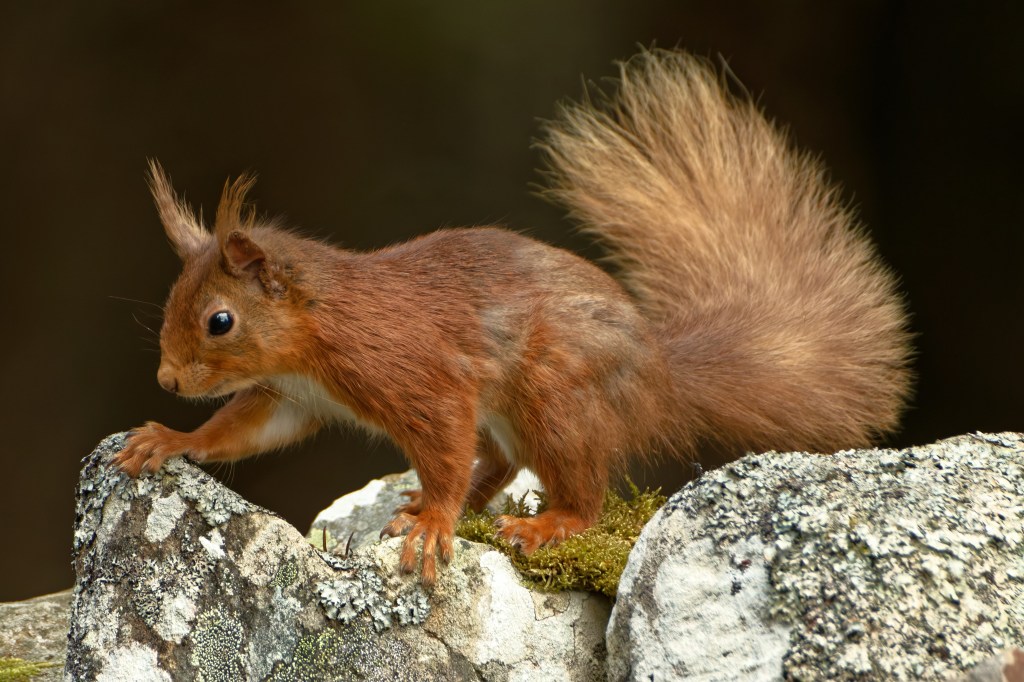
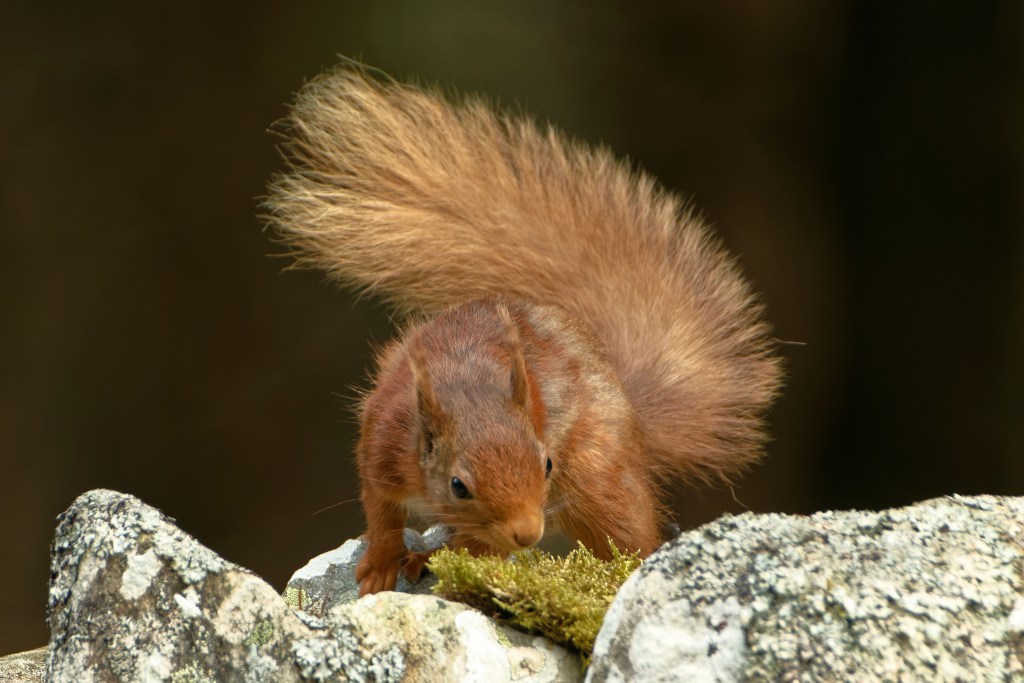
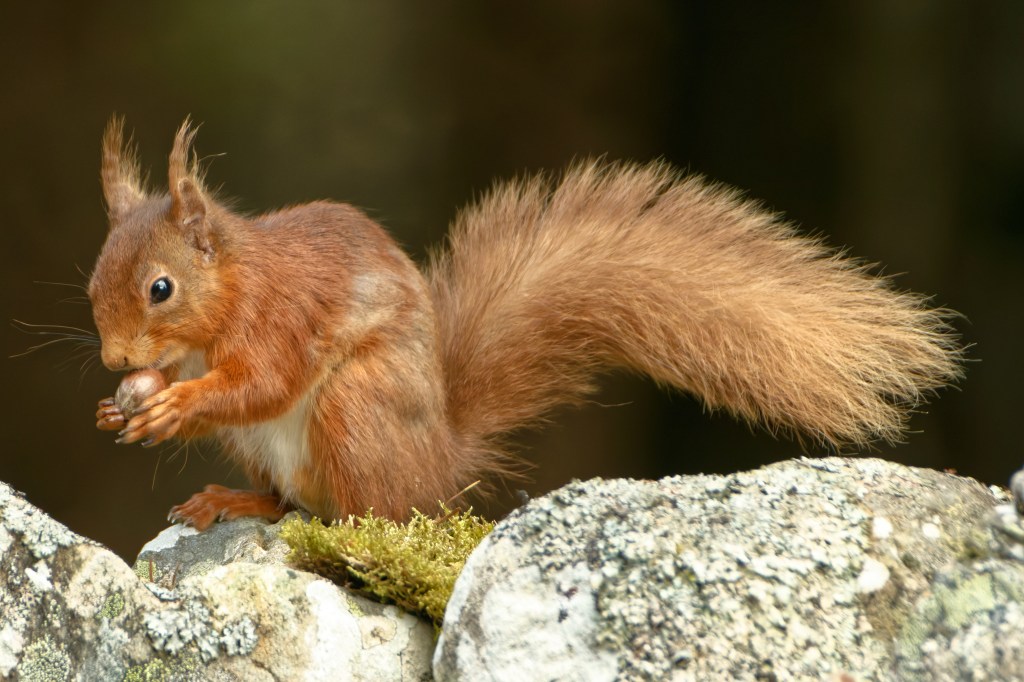
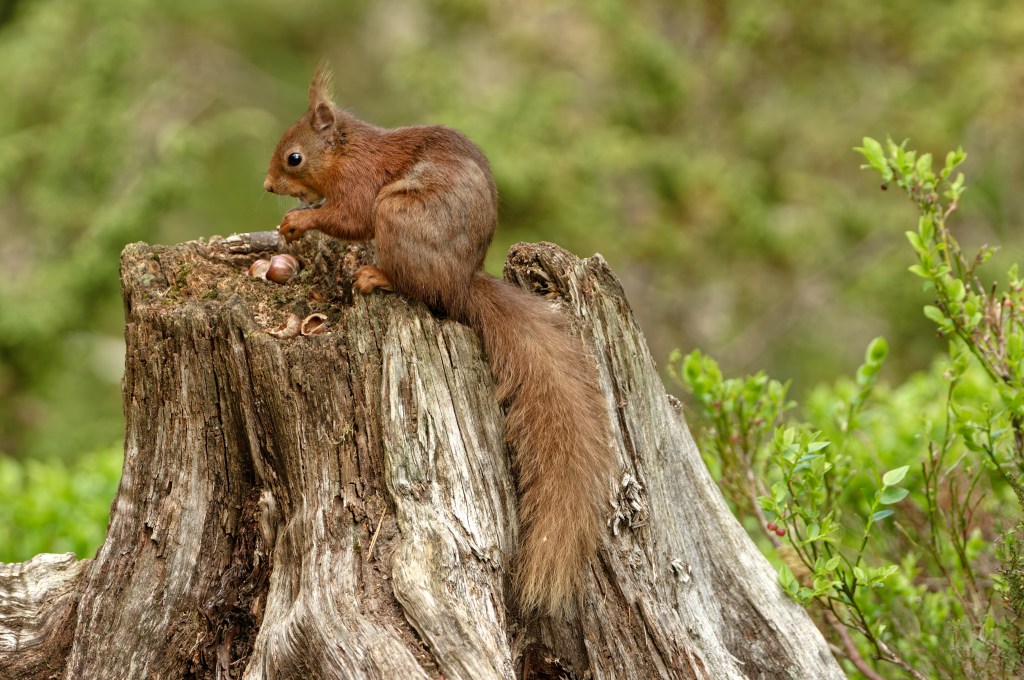
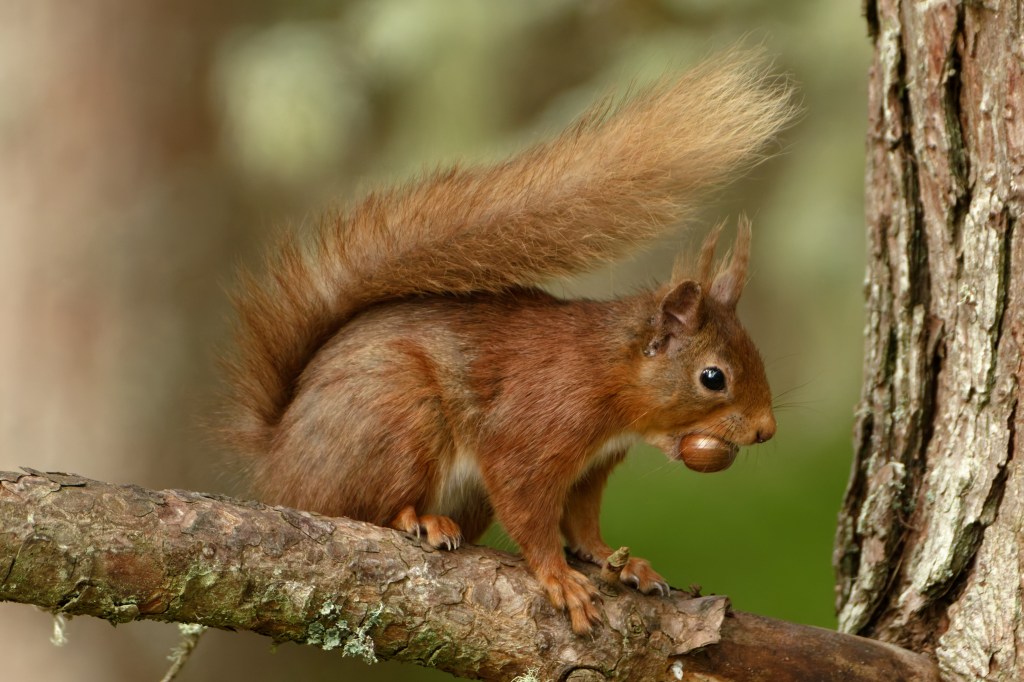
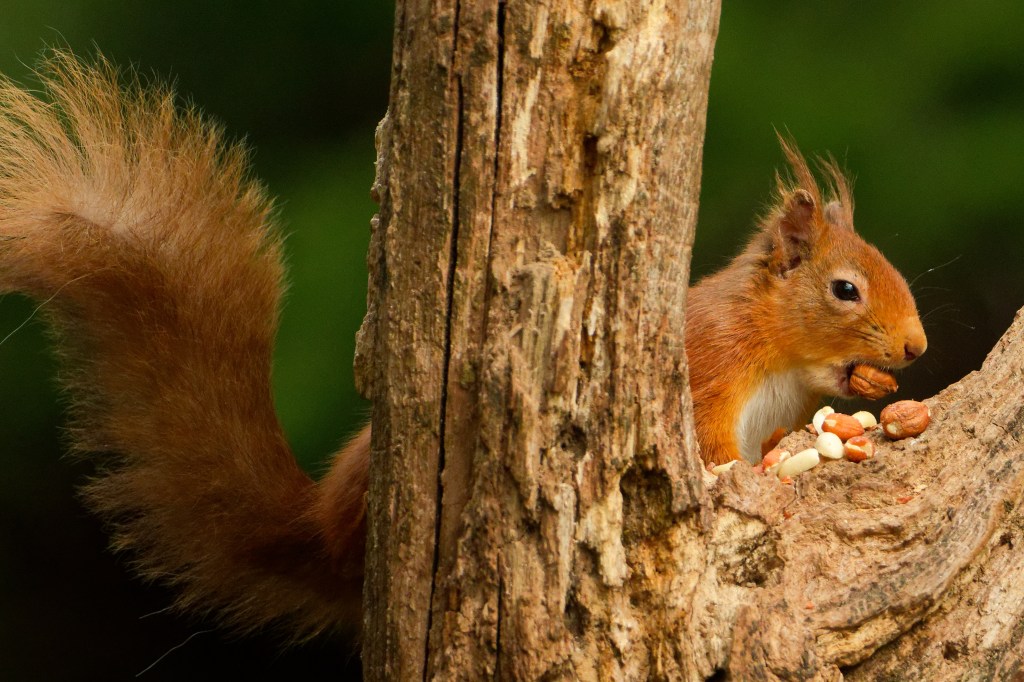
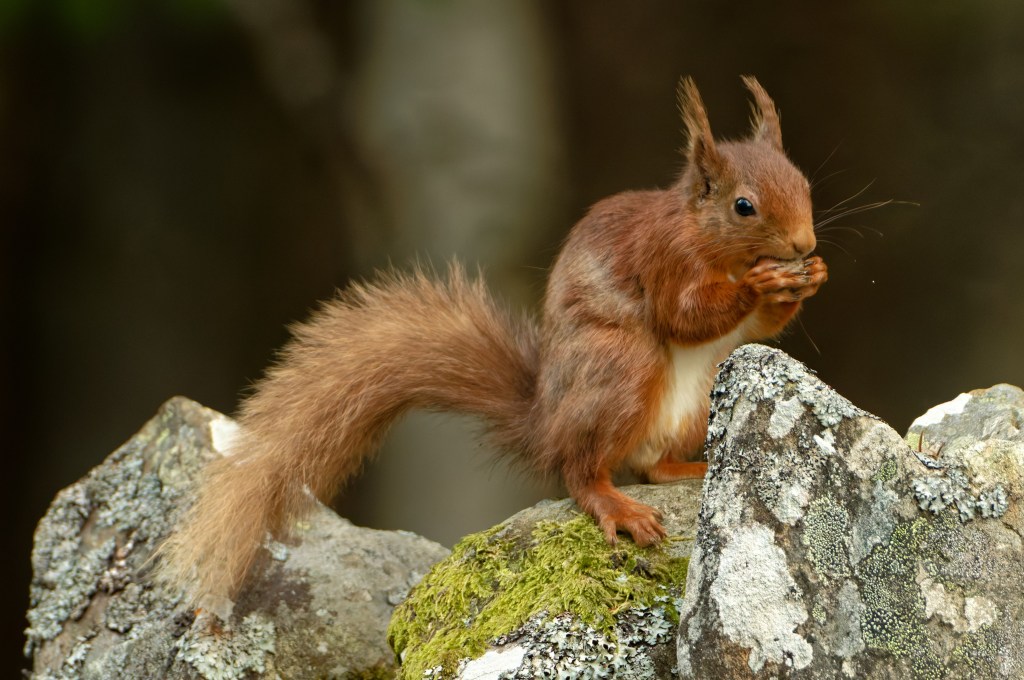
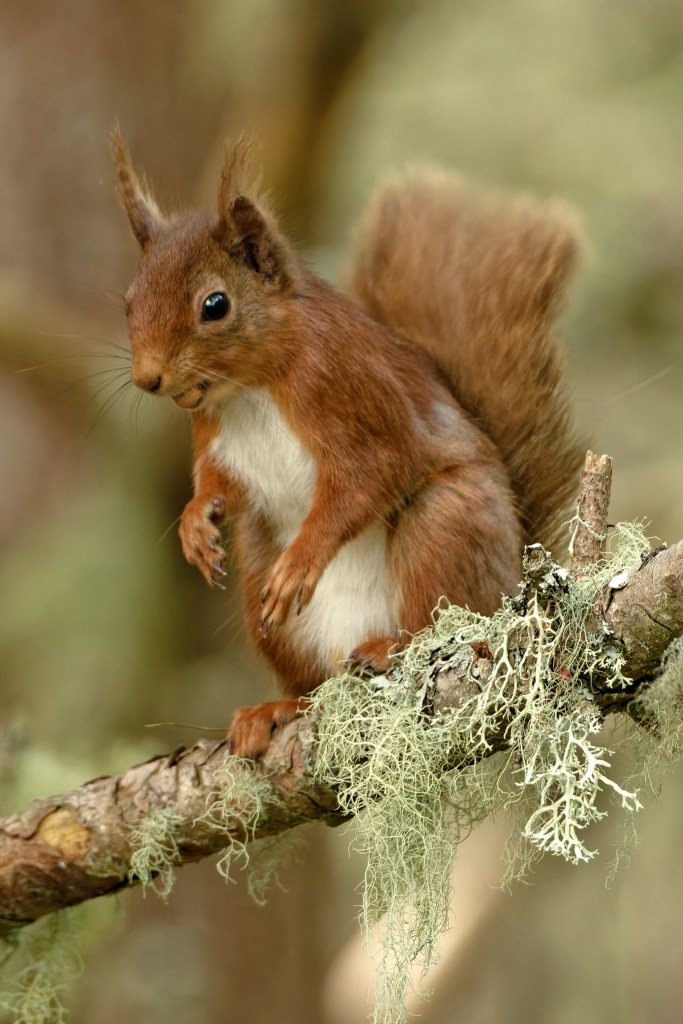
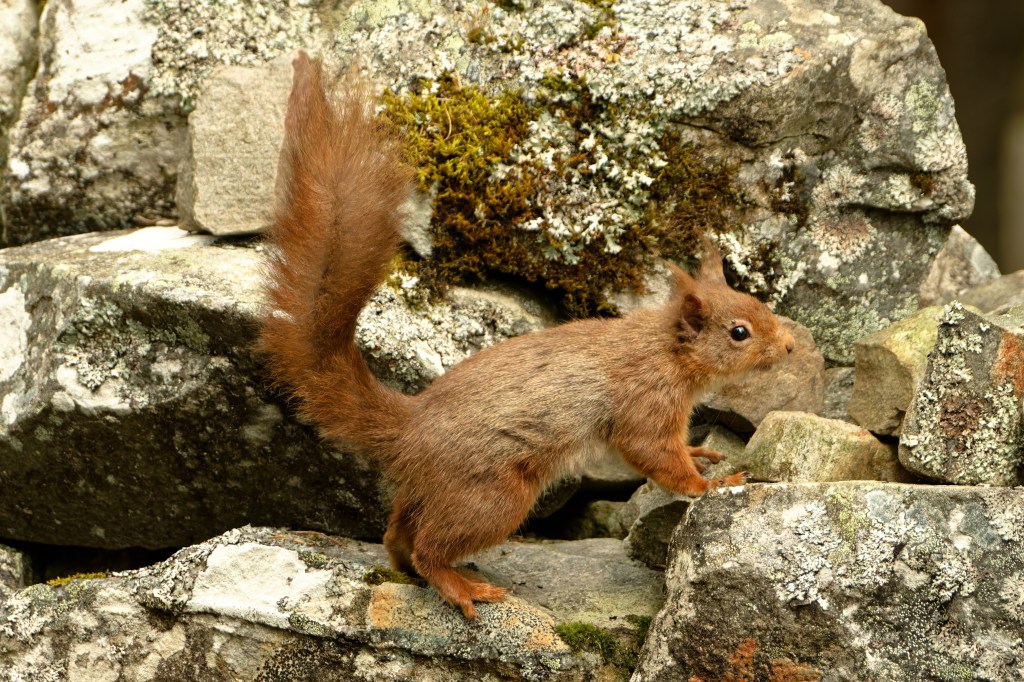
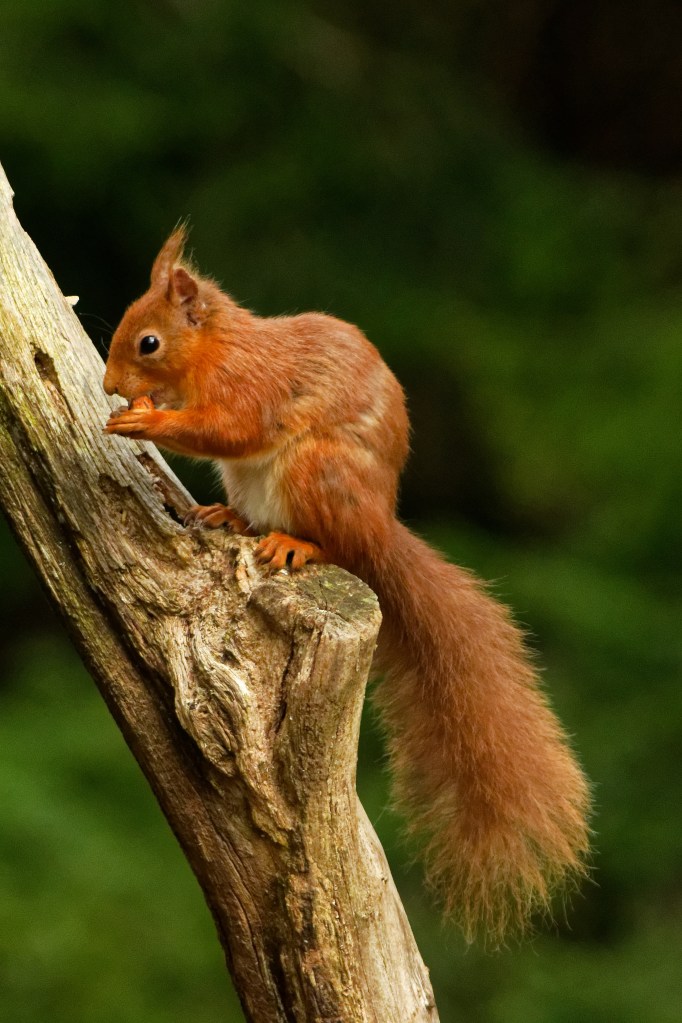
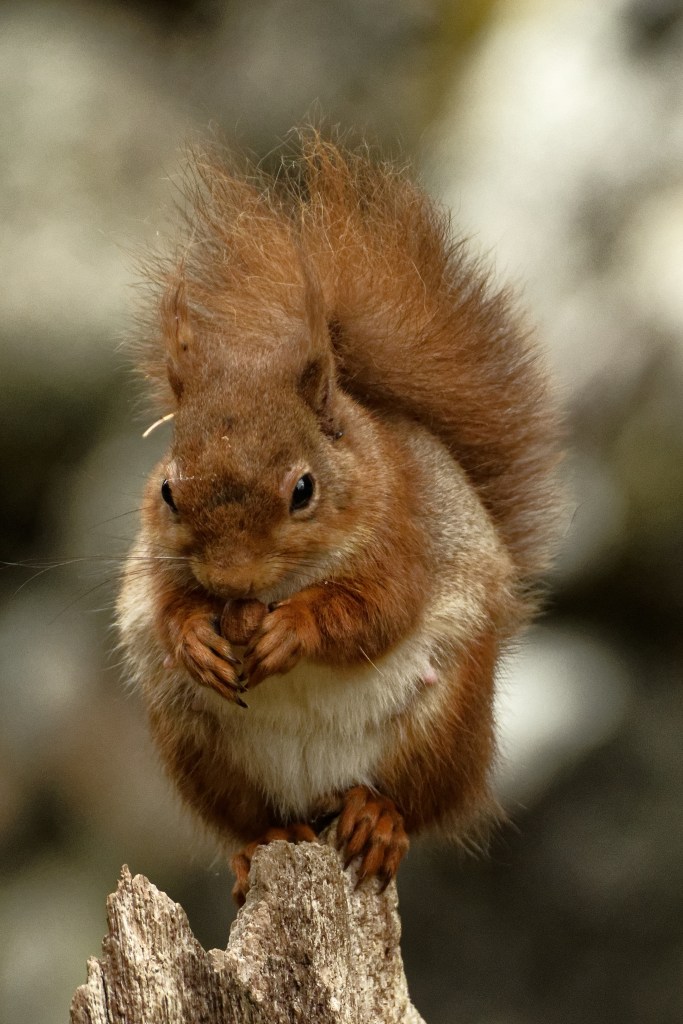
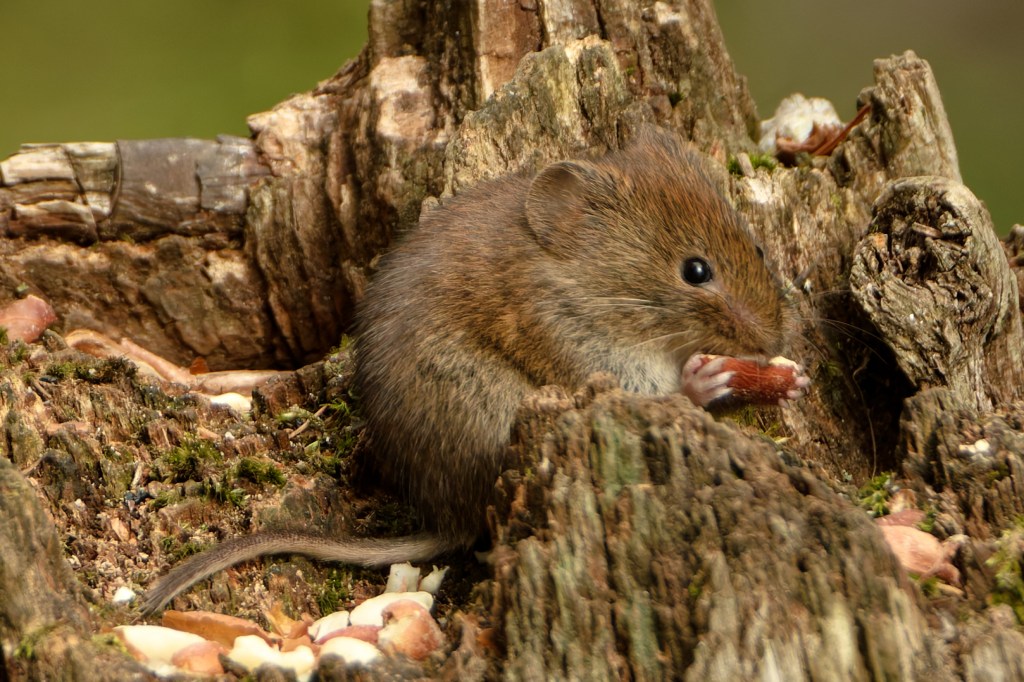
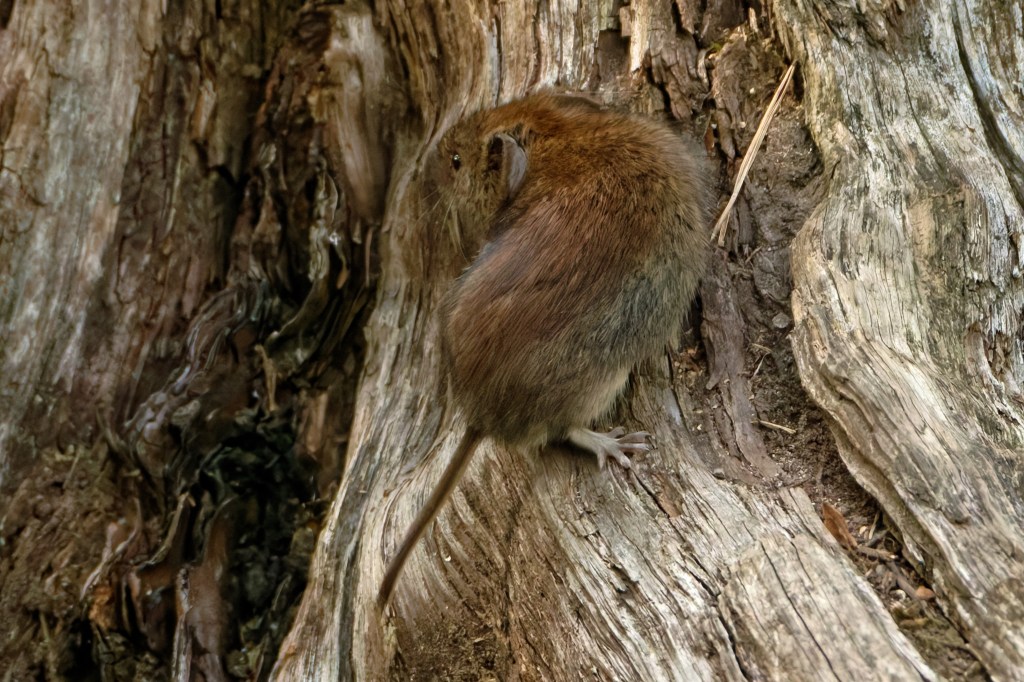
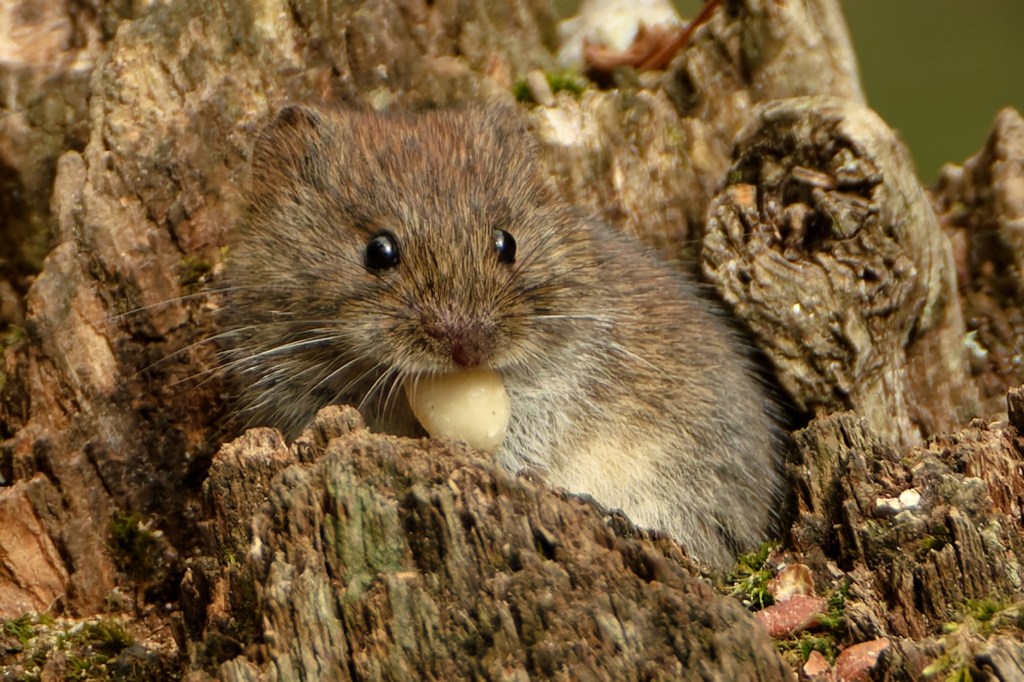
Backwoodsman will return to the vexed question of “Rewiring Britain” later on but before that, here is what we went for. The Aigas Estate is managed for wildlife and many Red Squirrels live on the property. While these rodents abound in Scotland, they are usually far too quick for Backwoodsman’s camera but not this time. The Pinewood Hide at Aigas offered the opportunity to lay traps; a bin in the corner of the hide contained shelled peanuts and whole hazelnuts. The latter could be shelled and served (fast food) or presented whole in their shells. A squirrel would take longer to scoff a nut in its shell, and might do some cute stuff with its little hands while it ate. Backwoodsman is an angler and spends a lot of time thinking about multiple lines and how to feed them to attract fish in different ways (usually unsuccessfully), so off we went with some peanuts here and hazelnuts there and there. A Vole was clearly watching this caper – they are very fast but like eating. Even wild animals are not daft – they know where the food is going to go in and they watch those lines. Perhaps you would argue that these animals are becoming, or have become, semi-domesticated?
A poster in the hide identified this tiny rodent as a Field Vole. Backwoodsman’s copy of the book Britain’s Mammals (p. 72 of the updated 2021 edition) suggests that Field Voles and Bank voles can be distinguished by tail length and degree of hirsuteness of their ears. In this image, the tail is half the length of the body, spot on for a Field Vole, but in all these images, the ears seem quite prominent and really not hidden in the fur. Backwoodsman will defer to the local expertise.
So here is a gratuitously cute image.
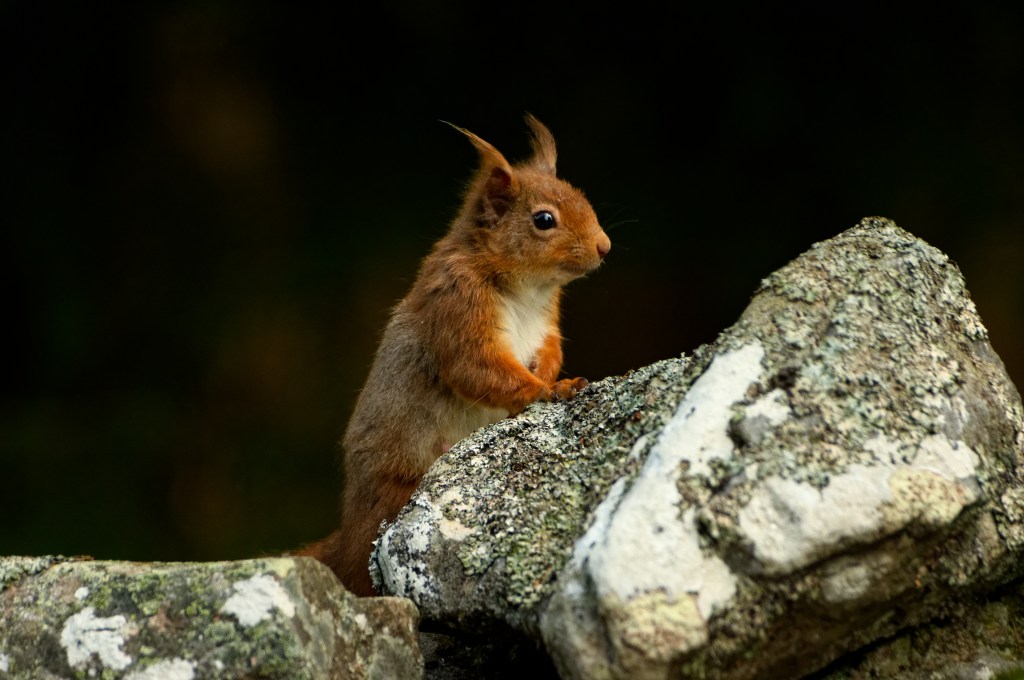
Anyway, then the squirrels came. We saw several animals, mostly very pretty but there was a somewhat thuggish looking animal and we watched it destroy a flimsy bird feeder, just like the Grey Squirrels do at home. If you are struggling with this issue, fit a Squirrel Buster feeder, they work so well.
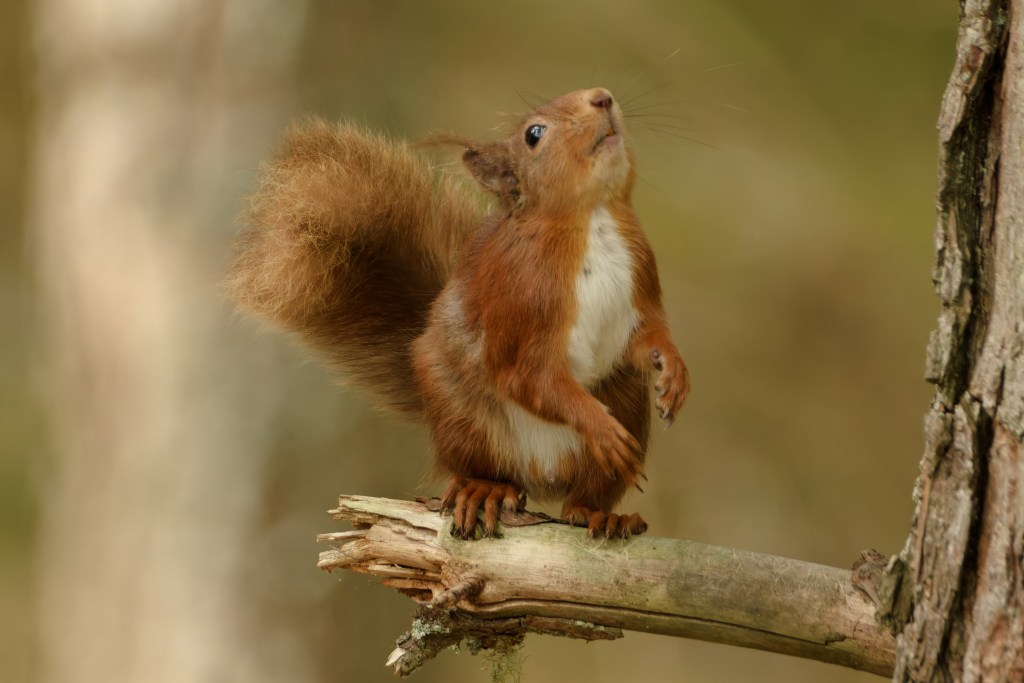
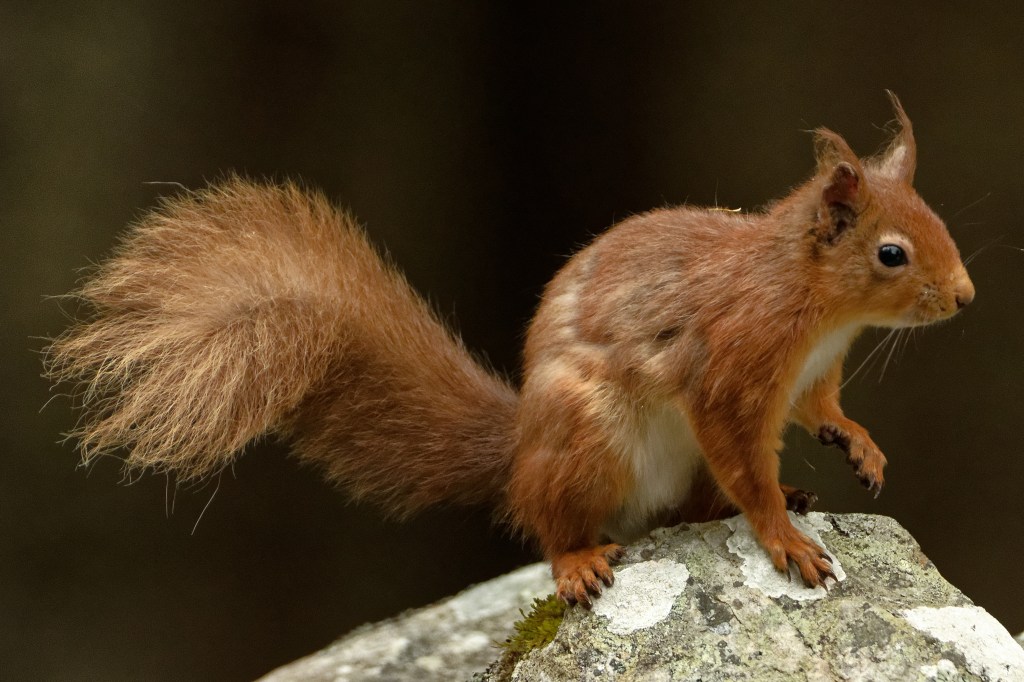
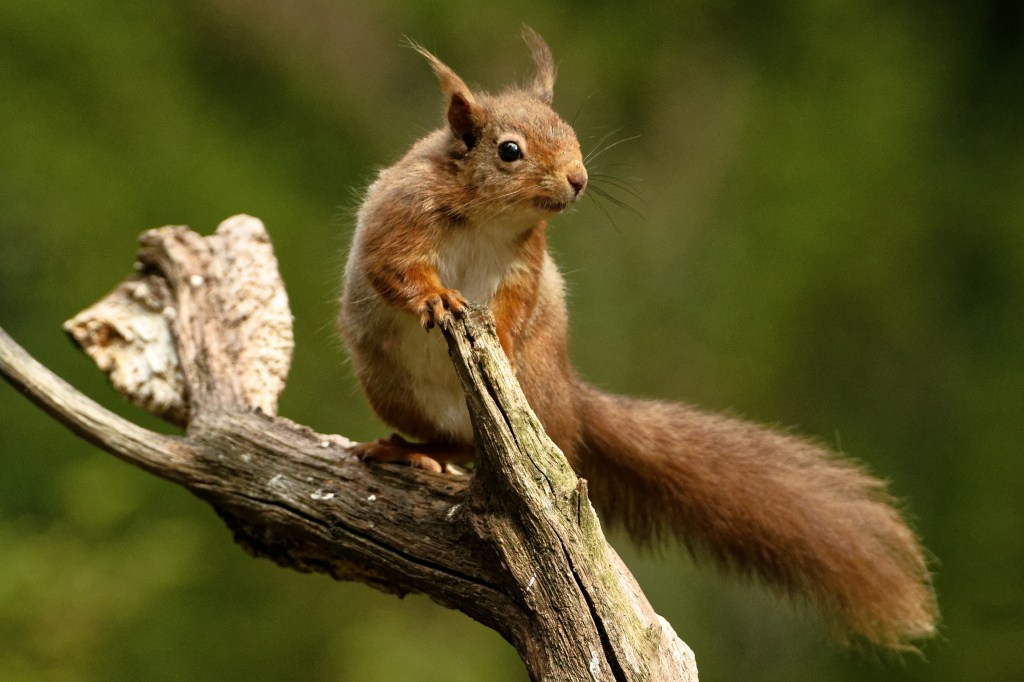
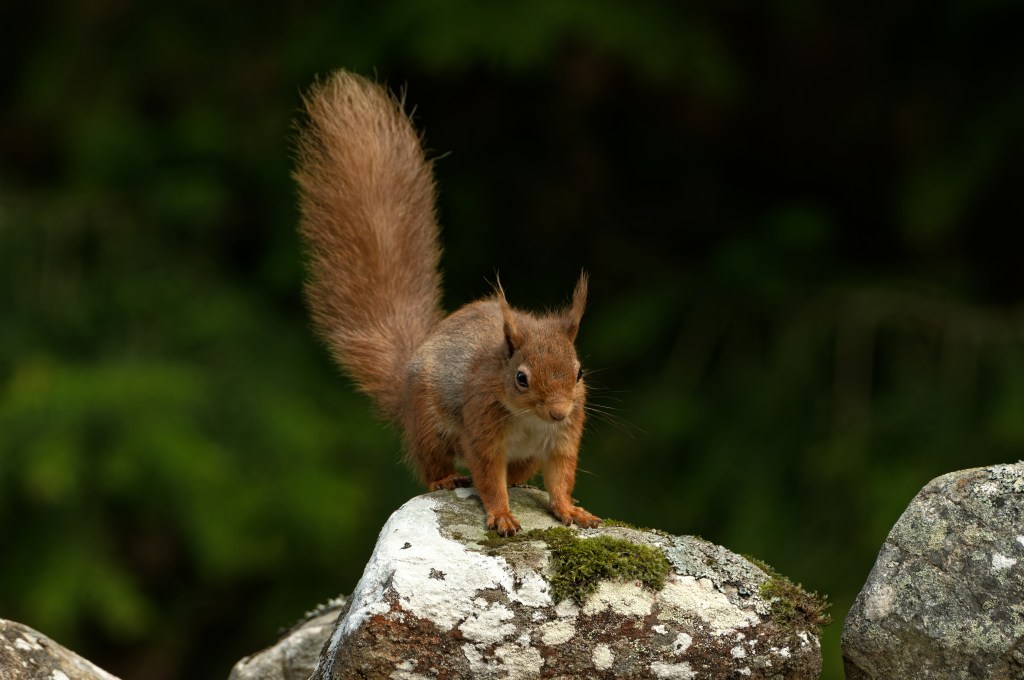
Anyway, the Red Squirrels ran through quite a lot of repertoire and delighted us. There are a few Squirrel Nutkin poses in this set of images!
Backwoodsman confesses that he is not entirely immune to the charms of Grey Squirrels – they have a way about them. There is a place in Kelvingrove Park where students from East Asia go to feed Grey Squirrels and take photographs; the squirrels attending this site know how to put a best paw forward. The whole narrative of invasive species versus native species is a slippery one, but it is disagreeable to think of Red Squirrels being driven entirely from large swathes of territory and infected with viral disease. Fortunately, Reds are being looked after and may be said to be on the march (or possibly bound); one even turned up in Bishopbriggs, just a few miles from where we stay, last summer.
So “Rewiring Britain”…”Do you have to??” bellows Backwoodsman’s limited readership. Well, some quite interesting things came up in the programme and Backwoodsman has looked into some of them. Opponents of the Beauly pylon line were very keen on buried cables and Backwoodsman wondered about the merits of overhead versus underground. Much of the following content seems consistent with Emma Pinchbeck’s comments on the issue:
“Although underground cables may be less prone to faults, they take longer to repair on average than overhead lines, since repair involves locating the fault, excavating the cable, completing the repair and reinstating the cover. The difference in repair times increases with the voltage such that, at 132 kV and above, overhead lines are out of service for a far shorter time than underground cables. At times of low demand, underground cables are also prone to brief overvoltages and system instability which may constrain the operating flexibility of the transmission system.”
And:
“At higher voltages, the disadvantages of underground cables in terms of higher capital cost, greater down time due to faults, the potential for greater environmental damage and loss of useful land have precluded their widespread use. High voltage underground cables tend to be reserved for circumstances where overhead lines are impracticable, such as in dense urban areas or sea crossings. In exceptional circumstances, where it has not been possible to avoid routeing lines through areas of designated landscape value, there have been occasions when lengths of underground cable have been installed to preserve the visual amenity. “
And:
“Care is taken to minimise damage to farmland, which with underground cables could be significant and take a long time to recover, with possible disruption to drainage and water courses. When in service, both overhead lines and underground cables which cross agricultural land impose constraints on farming operations.”
Punters just don’t want pylons and neither do their MPs – this from John Lamont, Conservative MP for Berwickshire, Roxburgh and Selkirk.
“Our countryside could be scarred, which would damage tourism, leave businesses out of pocket, and risk the environment. Agricultural land could suffer, which could affect farms and reduce the amount of produce made here in the Borders. I believe there is another solution – instead of so many overhead wires, underground cabling should be considered.”
There’s a few votes in that from the chaps in purple corduroy trousers and waxed jackets. Is a cable buried in your farmland, which you might plough up at any time, so much better than one in the sky, which you can drive underneath safely? Backwoodsman has no view.
Pylons are not attractive but it would seem to be necessary to have some to maintain the National Grid. Will it come down to a judgement based on aesthetic concerns? If so, we might be in for some trouble: just check out the dwelling and outfit of the lady leading the anti-pylon campaign on Deeside in the Panorama programme (05:05 onwards). The Rivers Glass and Farrar are both lined with pylons and HEP stations currently. Neither are exactly virgin lanscapes so does it matter if some taller pylons go in here too for the greater good? One of the young Aigas wardens made a good point while we were out in his van; the construction of the new infrastructure will push volumes of heavy traffic down small roads which are not really made for this purpose. This will clearly be problematic and it is hoped that every effort will be made to mitigate the impacts.
There are ways of looking at energy development which seek to benefit the communities which host the infrastructure. Becky Ford in the Spring/Summer issue of ReSource, the house journal of the Royal Society of Edinburgh, and representing Community Energy Scotland, writes that the need for communities and industries to work together for collective good “…allows for care for people and place – not as assets or resources to exploit but as intrinsically valuable ecosystems which can sustain life for all.”
The Suffolk objectors were very focussed on offshore infrastructure as well as buried cables and keen to cite efforts in the Low Countries. It is possible that they were talking about Belgium’s energy island (and video), a huge offshore infrastructure build which will collate cables and outputs from a major array of wind turbines. “As the world’s first artificial energy island, the Princess Elisabeth Island is our flagship project. Located off the Belgian coast in the North Sea, the island will serve as an electricity hub that will bundle together the cables leading to wind farms in Belgium’s second offshore wind zone, helping to bring the electricity they generate back to shore. It will also act as an intermediate landing point for interconnectors that link Belgium to other European countries.”
Belgium is still doing overhead cables though, despite what the SEAS people said. For example: “Lamifil supplied 260 km of AAAC UHC (Ultra-High Conductivity) overhead conductors for a vital and unique backbone upgrade of Belgium’s national grid. Belgium’s national grid operator Elia is continuously developing its high-voltage grid system or ‘backbone’ to support the energy transition and increase interconnectivity within the European grid network.” Other Low Countries are at it too.
The UK hasn’t been too great at major infrastructure projects over the last couple of decades; three characters will convey the scale of the problem – HS2. We’ve been busy getting on with the important stuff of delivering austerity and securing our Brexit freedoms. Backwoodsman has the merest suspicion about how all the objectors in the Panorama programme might have voted on the inglorious day. He does not see them as supporters of the current policy of the Labour Party under any leadership and wonders how they feel about any approach to Net Zero on any timescale?
There is so much to understand about the energy industry but it does seem clear that our demand for electricity will only rise, unfortunately, particularly as more and more data centres are built and electric cars plugged in. It would seem better to avoid building the data centres, find ways of moving people around that don’t require the proliferation of EVs and generally attempt to moderate our use of energy resource, but that isn’t how things are done now. Renewable energy resource will be generated far away from the main points of consumption and it will need to be connected into the grid. Growth is all, even if it’s growth of dumb sht we really don’t need. Or possibly even want, given an either/or/choice, like, shall I have pylons in my back yard, or shall I not lease that new electric SUV? Ideally, I get the new tank and someone else gets the infrastructure. Result! Backwoodsman opts for a live-in Red Squirrel, thank you.
PS Backwoodsman has just been asked “Do you mean that petrol cars are better than electric cars?”. No, just that fewer cars, whatever their fuel, should be our goal, especially for us city folk.
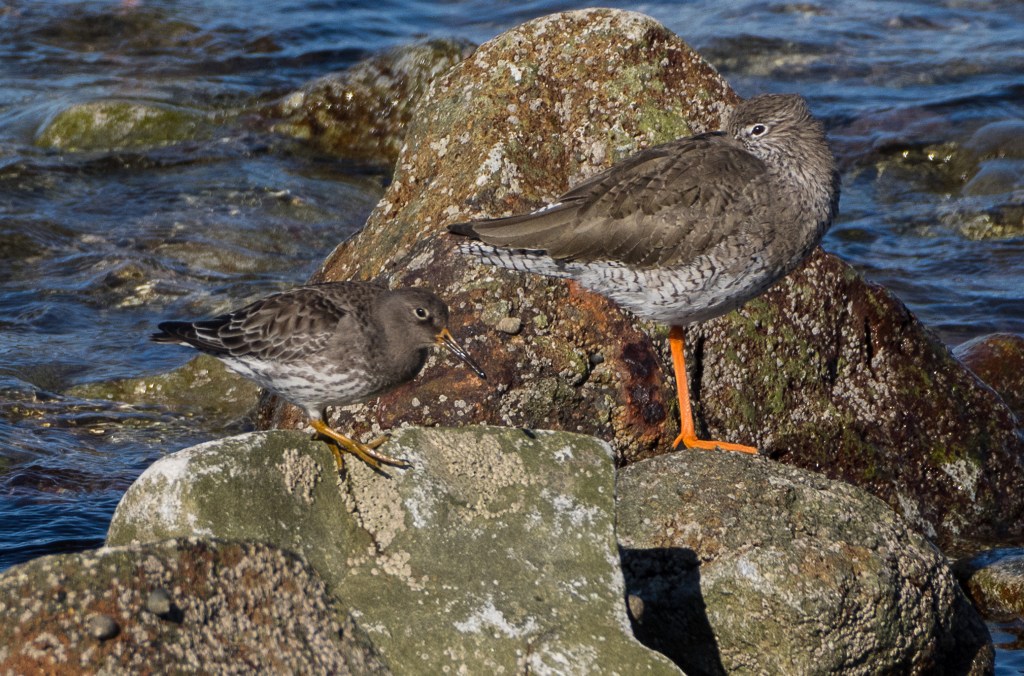
We used to see Purple Sandpipers regularly at Troon on the Ballast Bank, our main place for the species, back in the day before the invasion by the Troon Tadpoles. Backwoodsman had taken a few pictures there but was stranded short of enough material for a post, and had begun to despair of seeing these pretty little waders again. The odd bird would turn up at Stevenston or Saltcoats but they were always distant. For example, this shot is a long range effort taken at Stevenston Point; the size contrast with the Redshank is quite striking.
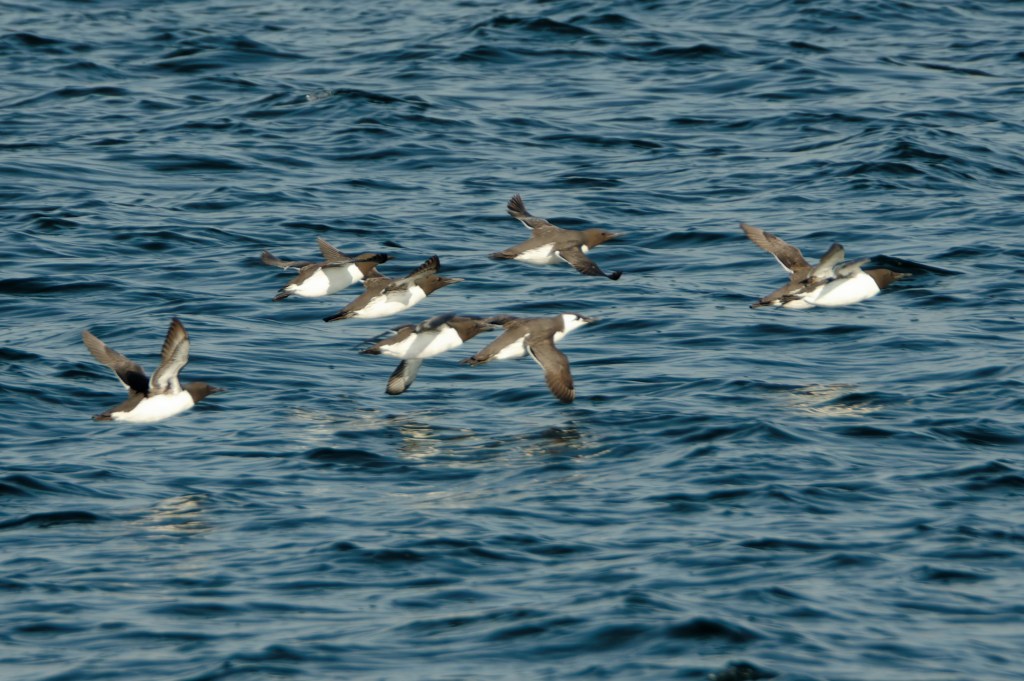
A recent trip solved the problem. On a Saturday in mid-April, we had taken an early train from Glasgow Central to Gourock and boarded the ferry to Dunoon. It was a brilliant morning, and flat calm. The crew member collecting fares took note of the camera and spoke of dolphins on the inbound voyage. Backwoodsman scanned the middle distance; there were no cetaceans to be seen but small groups of Guillemots were flying low across the water, heading east and further into the mouth of the Clyde. This is a long-range shot made more difficult by the speed of the vessel in one direction and the birds in the other.
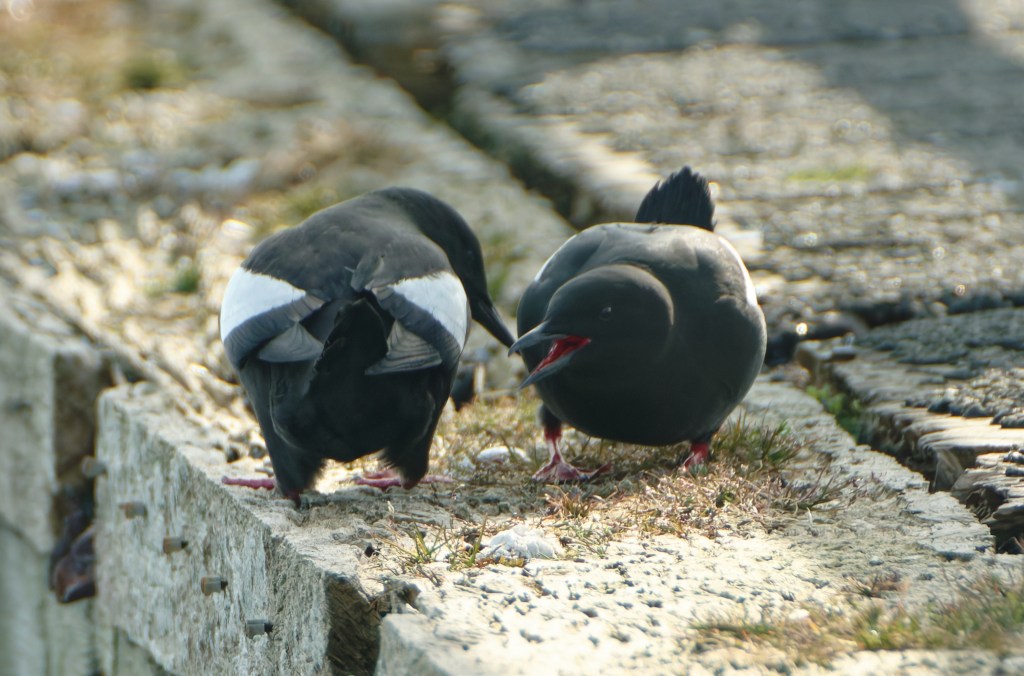
The vessel docked, the handful of passengers disembarked, and a larger group of gaudily-clad racegoers heading for the Scottish Grand National in Ayr boarded the empty vessel. We looked around the pier, initially hearing, and then seeing Black Guillemots courting.
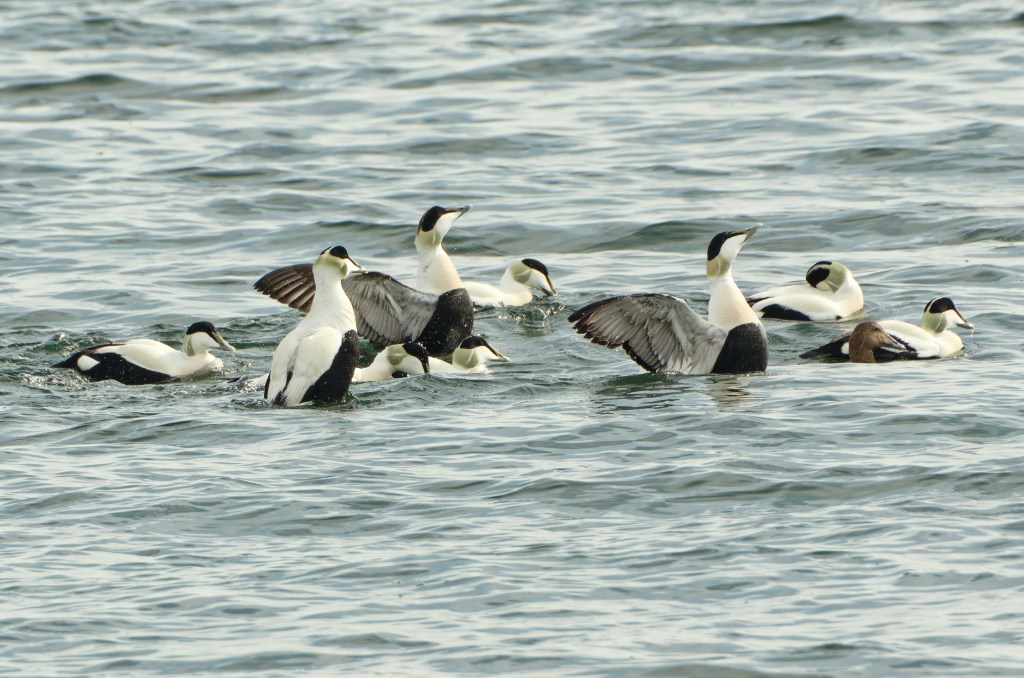
We enjoyed watching the birds for a while before heading north east along the Esplanade into Kirn. Familiar sounds made their way to us across the water, the “yah-roo!”calls of displaying Eiders. We usual hear this call from a distance but it is even more pleasing at close quarters. Backwoodsman had recorded this video at WWT Martin Mere on the recent visit and was wondering if it would ever be useful for anything – here are some loud Eider calls.
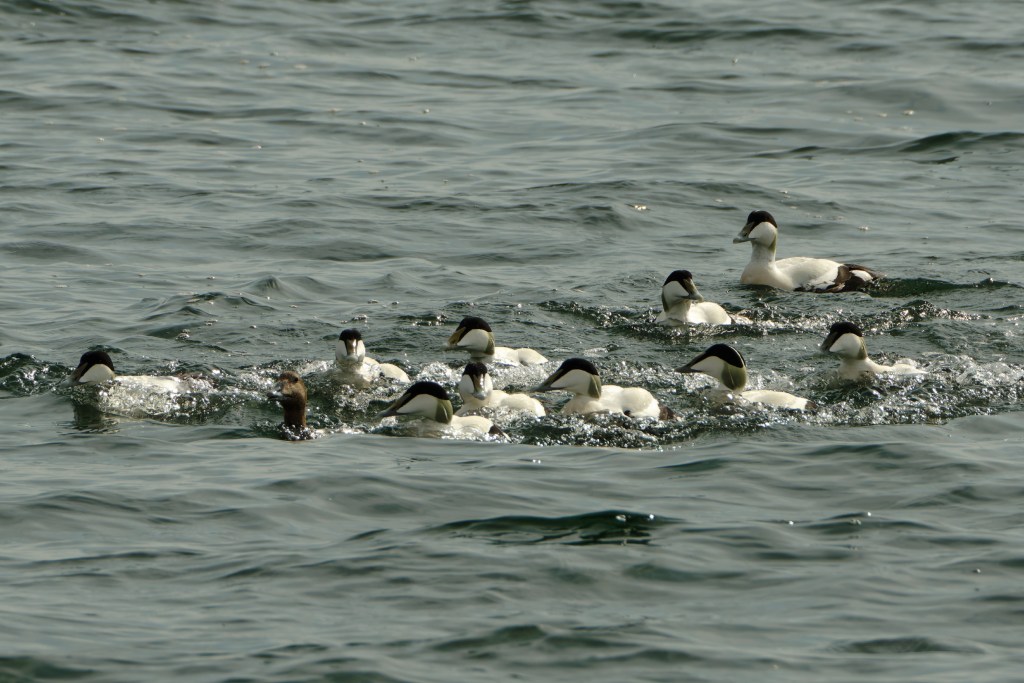
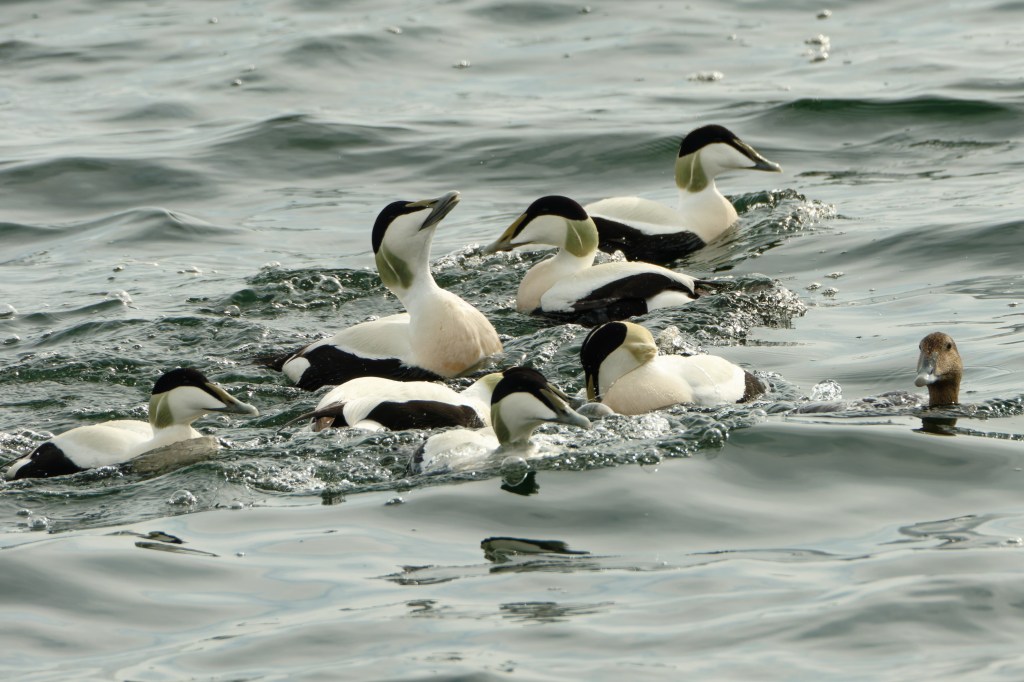
The group of Dunoon birds came in quite close – they were too busy courting to be upset by figures on the shore.
We could see up to ten drakes and one duck at a time; they would sail about and call, and then the whole group would dive. The colours looked vibrant in the excellent light, particularly that incongruous botanical green on the back of the neck.
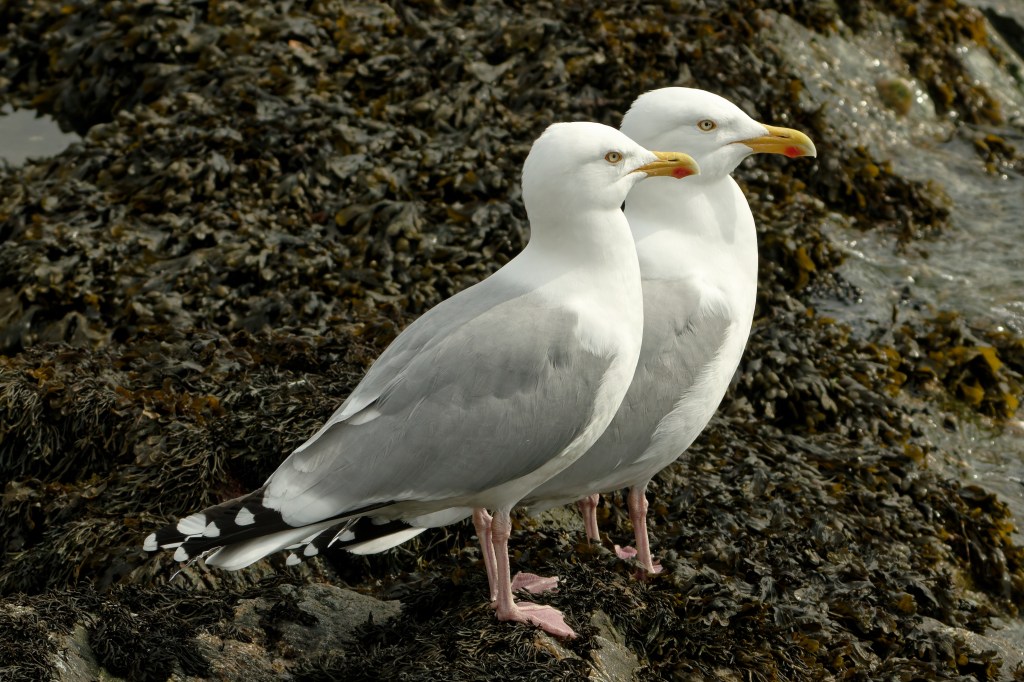
Herring Gulls watched them too.
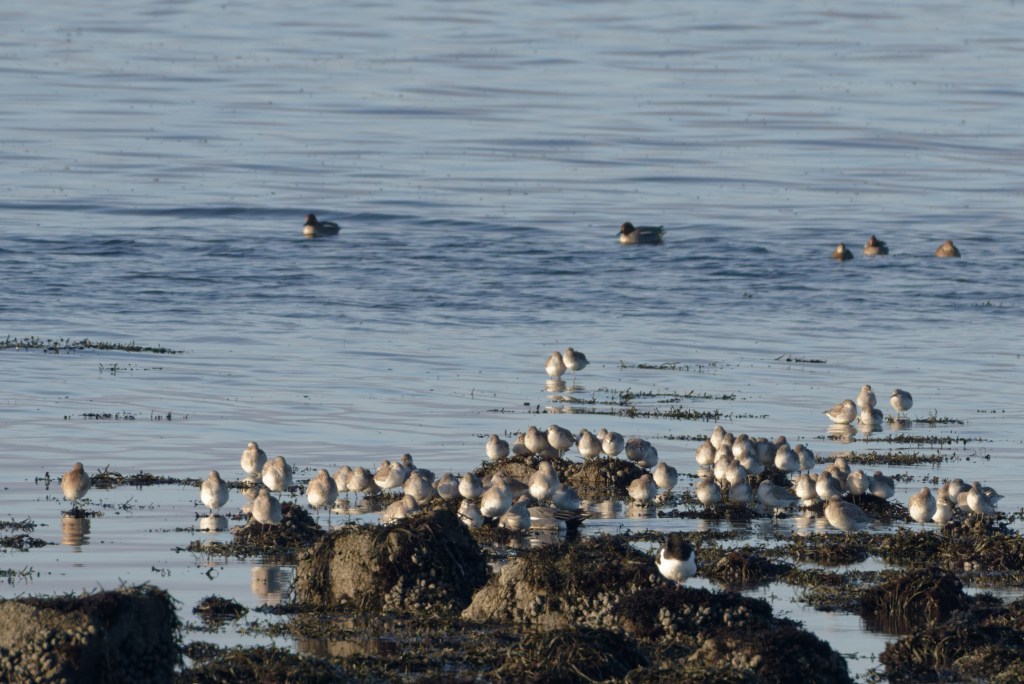
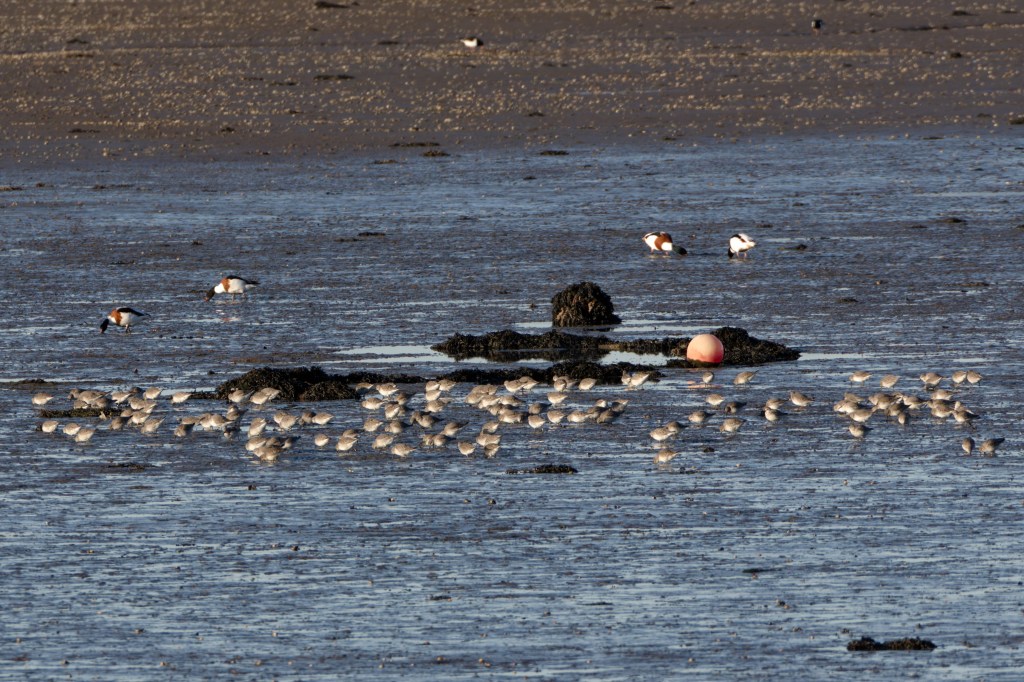
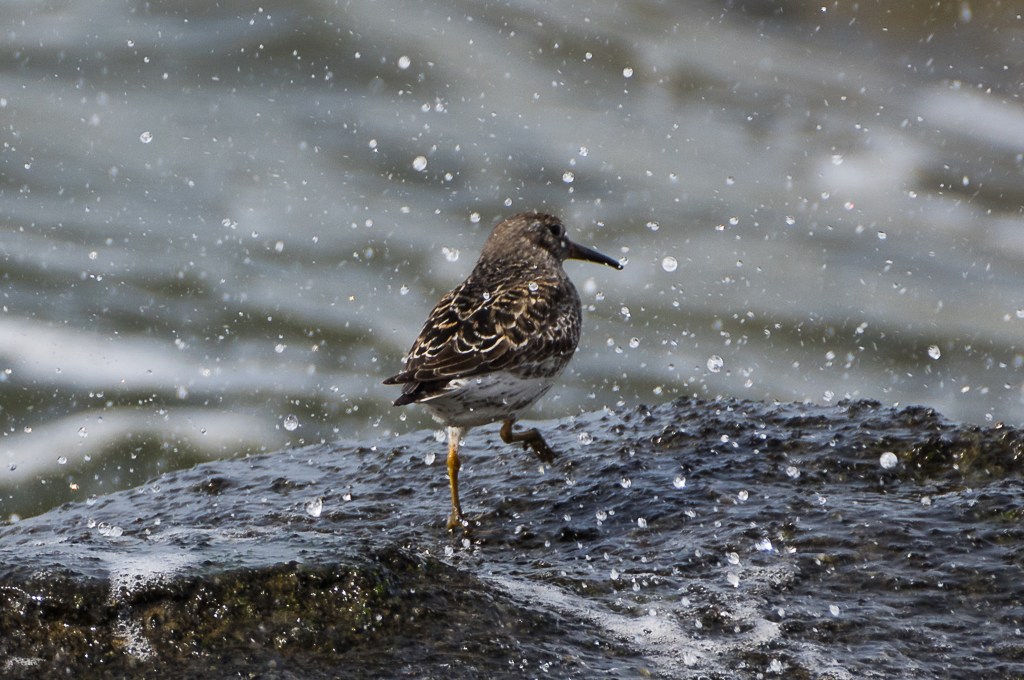
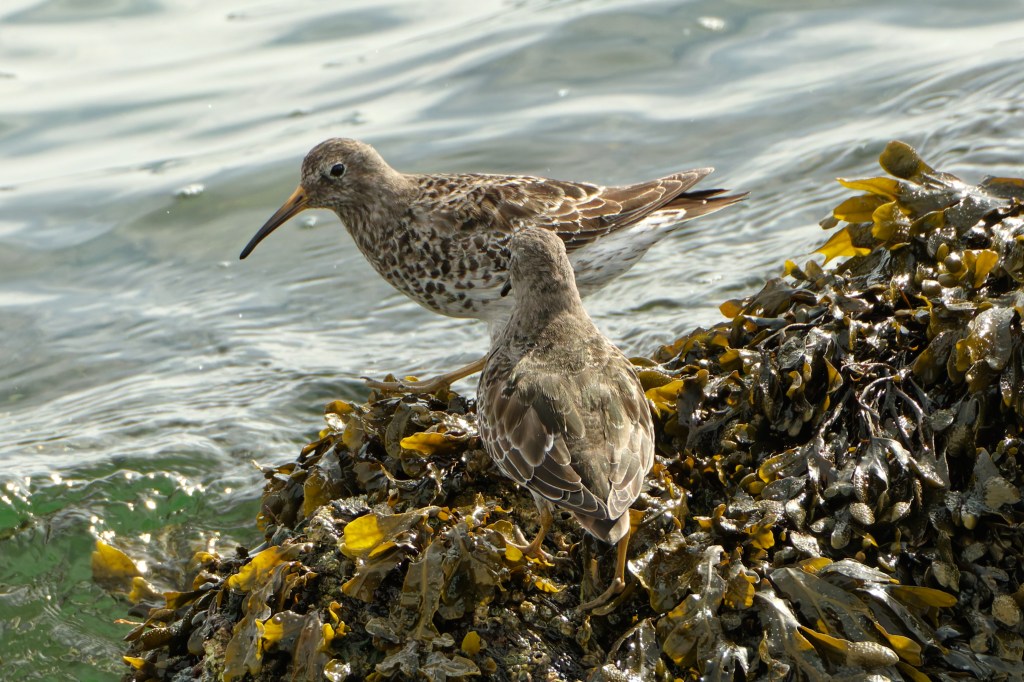
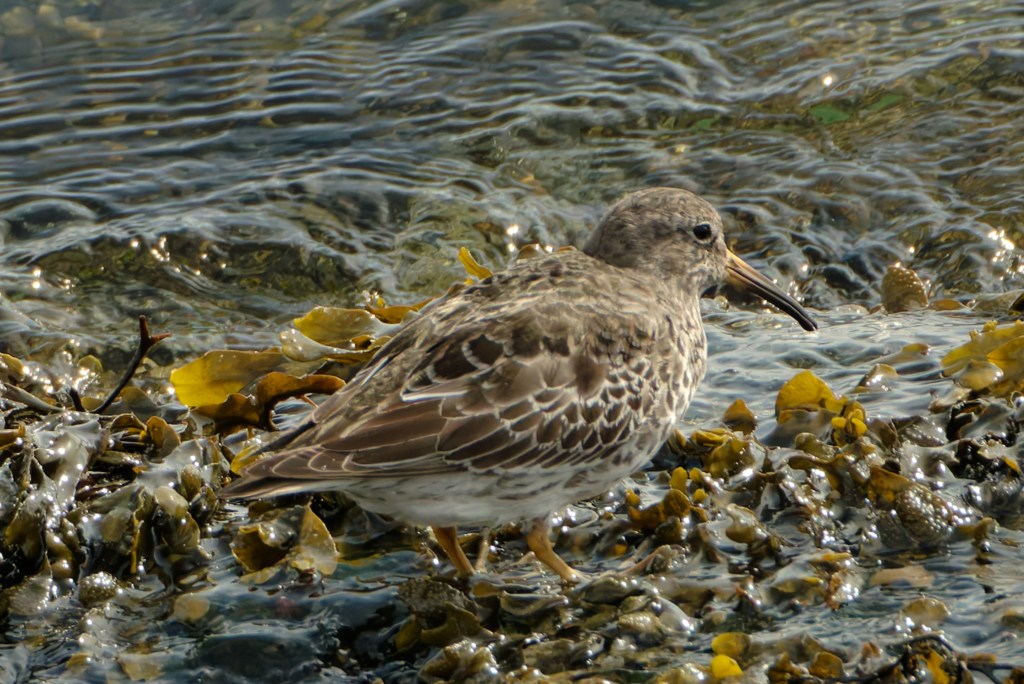
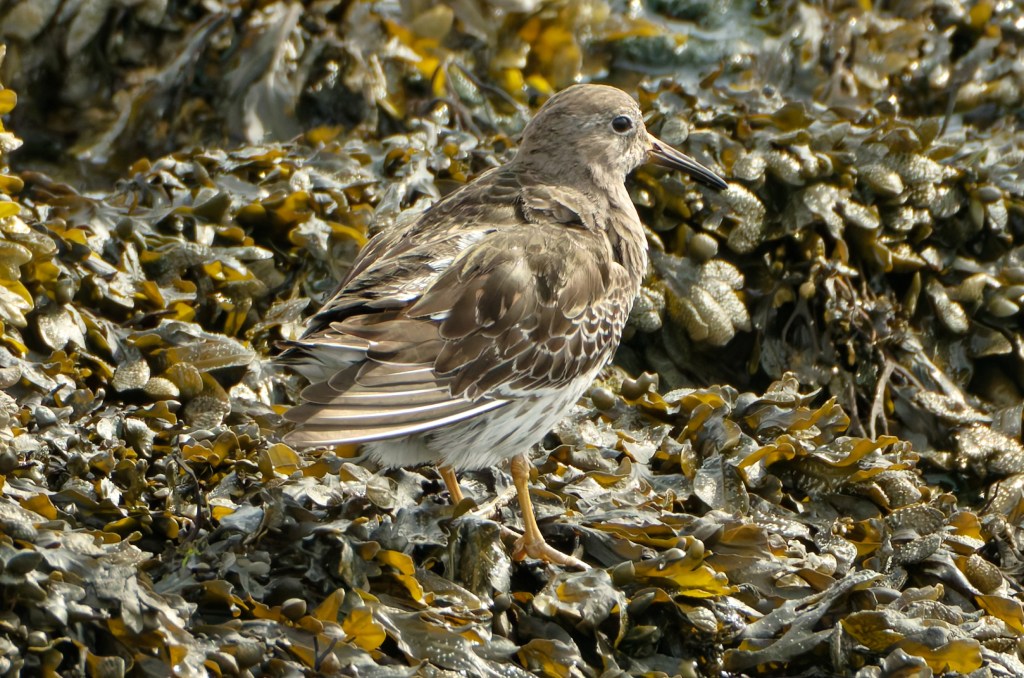
We moved along, finding Turnstones, and then, oh joy, Purple Sandpipers. It was almost high tide by now but the Purple Sands were still foraging.
Summers et al. investigated the diet of these birds. At high tide, they feed on Kelp Fly up in banks of drying weed, and eat small shellfish when the water is lower and more of the shore accessible. Females have longer bills which allow them to take larger shellfish, Summers et al. referring to this as sexual size dimorphism.
According to the BTO, Purple Sandpipers do not breed regularly in the UK; their data for 2013-2017 has one pair breeding in northern Scotland, with of the order of ten thousand birds spending the winter with us.
Summers et al. also studied Purple Sandpiper migration making use of tracking devices. This seemed interesting:
“Purple Sandpipers winter at relatively high latitudes compared to other waders. It is suspected that the majority that winter in Britain and Ireland originate from Canada, but there is no primary evidence of their breeding grounds and migratory routes. These birds, characterised by their long bills, start to arrive in Britain and Ireland in late October/early November, after completing their post-nuptial moult at an unknown location. Fifty geolocators were attached to Purple Sandpipers in northern Scotland and southwest Ireland and we established for the first time their Canadian origin (Baffin Island and Devon Island), migration routes and post-nuptial moulting areas. Spring departure from Scotland and Ireland took place mainly in late May, followed by staging in Iceland and/or southwest Greenland before reaching the breeding grounds. Those that staged in Iceland departed earlier than those that flew directly to Greenland. Post-nuptial moulting areas were in southern Baffin Island, northern Quebec/Labrador (the Hudson Strait), and southwest Greenland. Migration from Baffin Island and Labrador took place during late October – early November, and during mid to late December from Greenland, usually in a single trans-Atlantic flight. Therefore, this migration was scheduled at a time when most other wader species are already on their wintering grounds. No birds staged in Iceland on the return trip. The flight from Baffin Island to Scotland and Ireland was accomplished in about 2.5 days at an average speed of about 1400 km per day. Freezing of coastal waters may be the reason for the eventual departure from the Hudson Strait. The more northerly route via Iceland, taken in spring by most birds, and the more southerly route in early winter were associated with seasonal shifts in the Atlantic low pressure systems (depressions) whose anti-clockwise wind-flows would have assisted flights.”
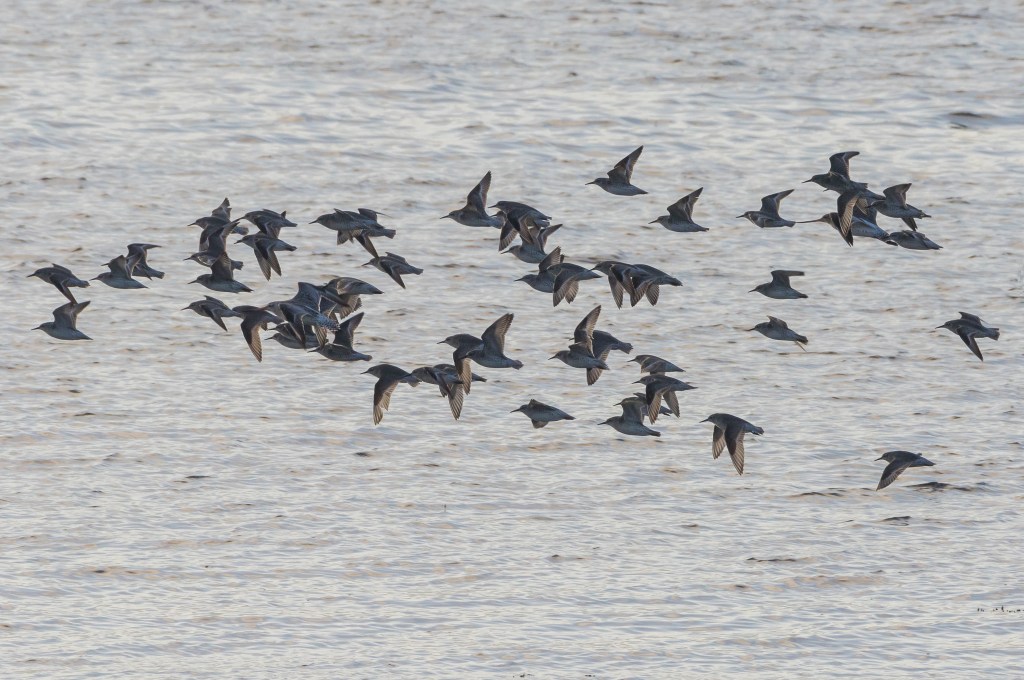
This material comes from an open access journal and the title page features a charming pencil sketch of Purple Sandpipers on the wing.
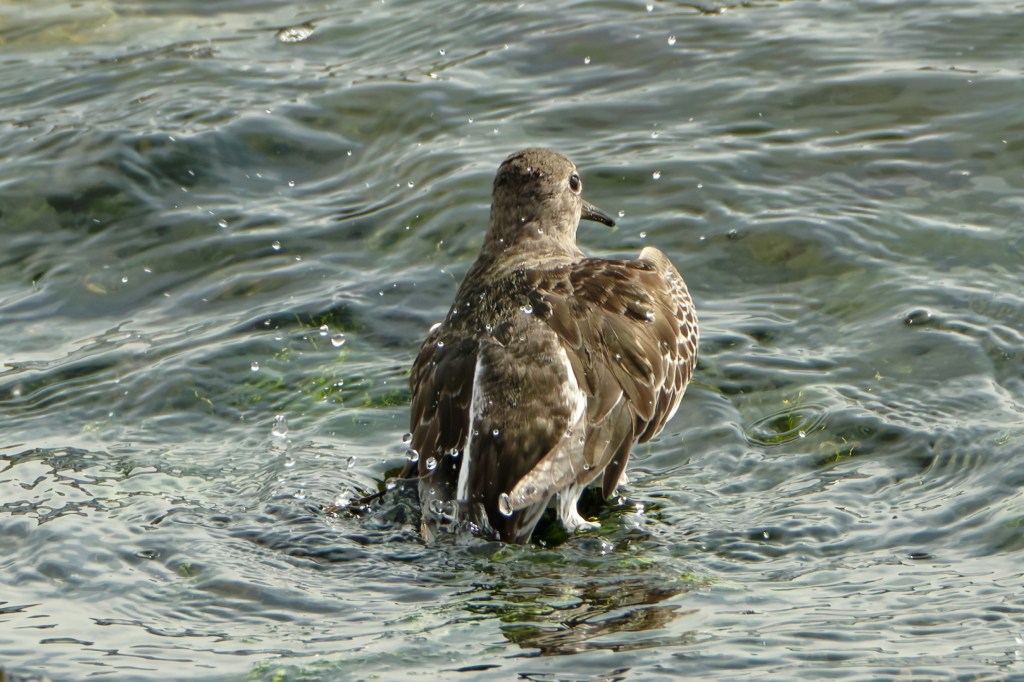
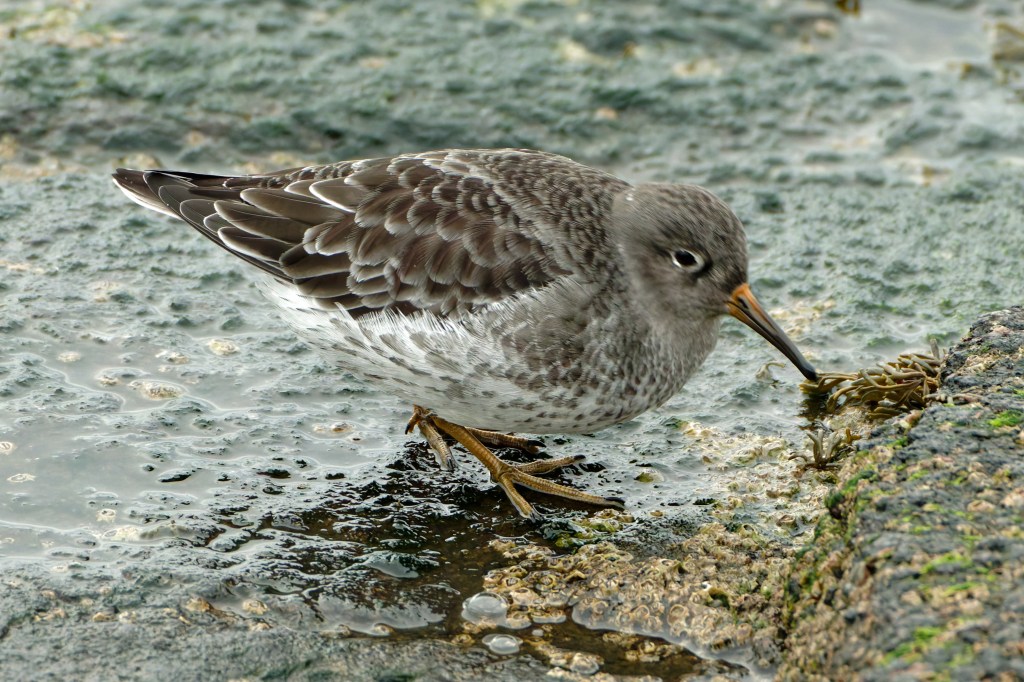
The birds do not look remotely purple in the strong morning light but a greyer sky and lower colour temperature bring out the effect for which they are named.
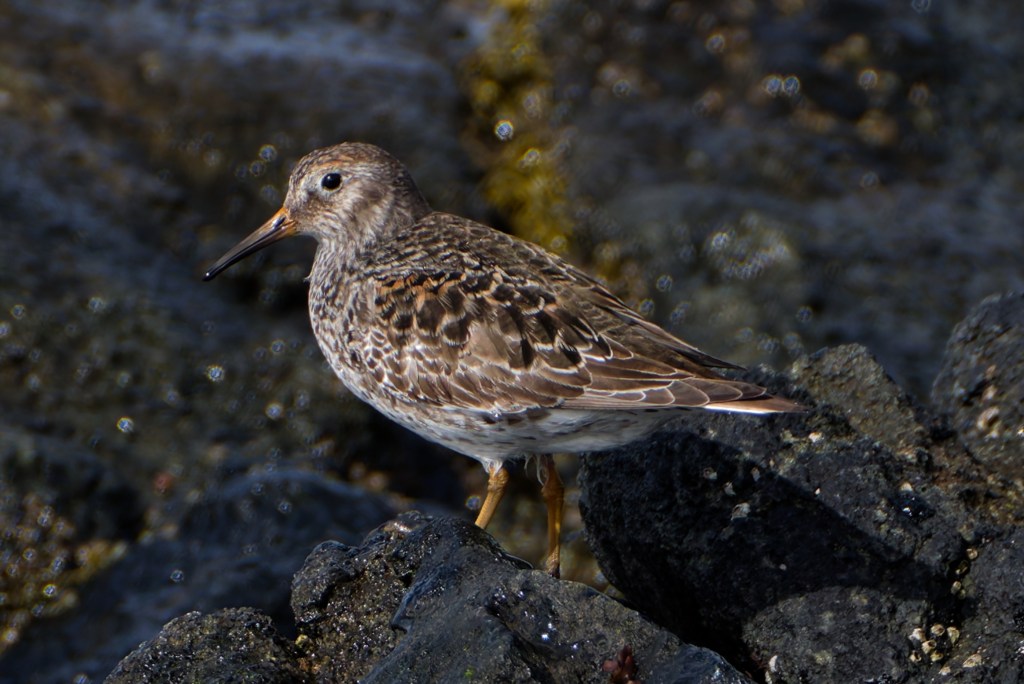
This image from Troon in early May shows a bird starting to develop some chestnut colour in the plumage below the neck in preparation for the long flight north and breeding.
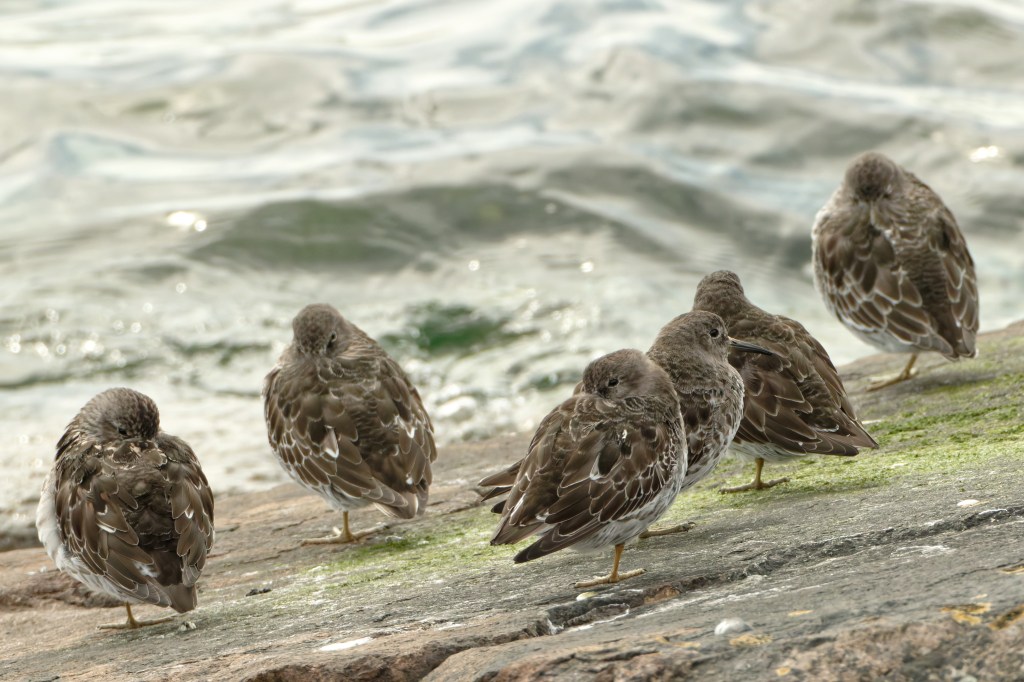
At the highest point in the tide in Dunoon, we found birds in repose.
The light had gone by now and we headed back to the ferry. It had been a very enjoyable and productive morning. Perhaps there would be dolphins to see on the return trip? Alas, there were not, but the Purple Sands had delighted and now there was enough material for a post. Yah-roo!
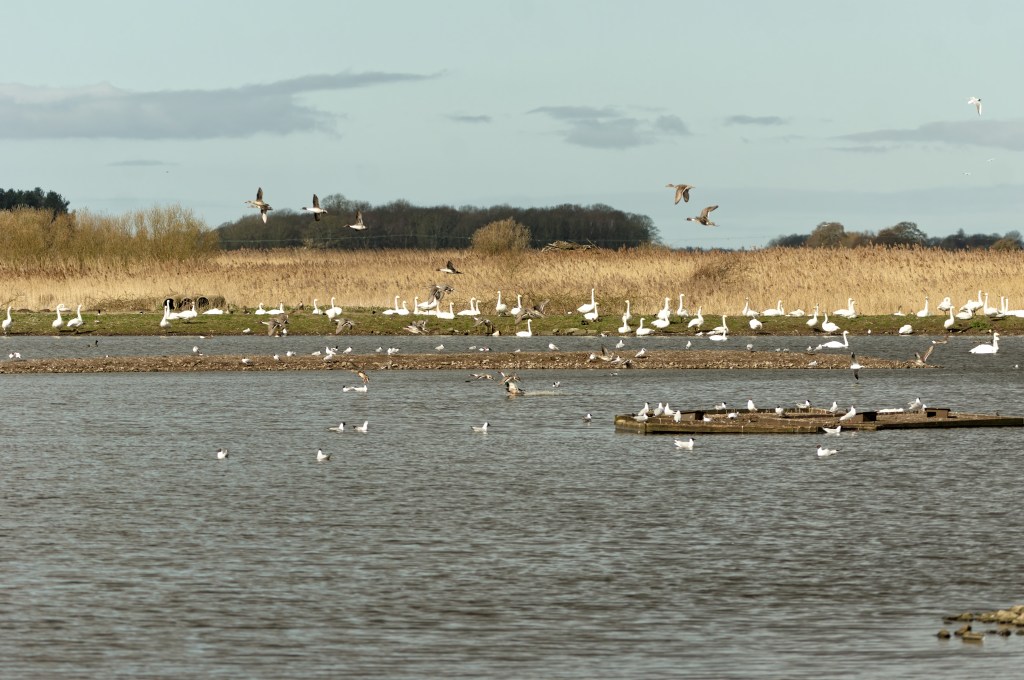
Recently, Backwoodsman was offered, and was very grateful to make, a visit to WWT Martin Mere. The visit took place on March 11th in 2025 – thank you Mother for taking me. We were fortunate to visit before the feeding stopped on March 16th; it seems likely that the five hundred or so Whooper Swans which had wintered on the reserve would probably then head back to Russia, weather permitting. According to social media posts, the numbers of Whoopers were down below three hundred by March 17th and there were just ten on the reserve by March 24th.
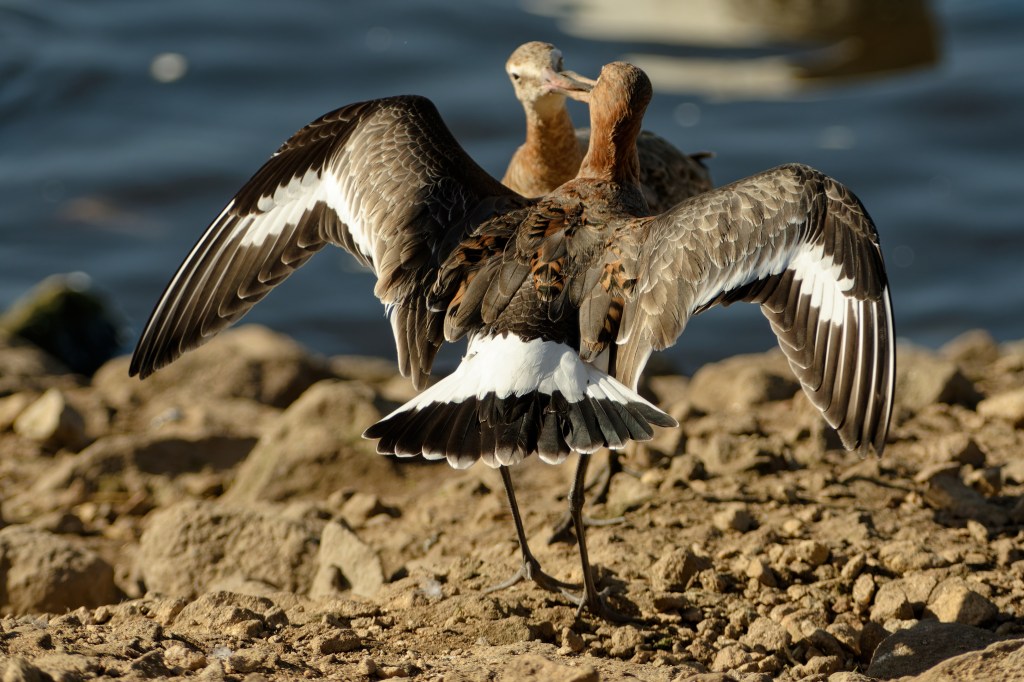
The Whoopers were quite combative but then the spring is a tense time for birds, as hierarchies are established and breeding rights contested.
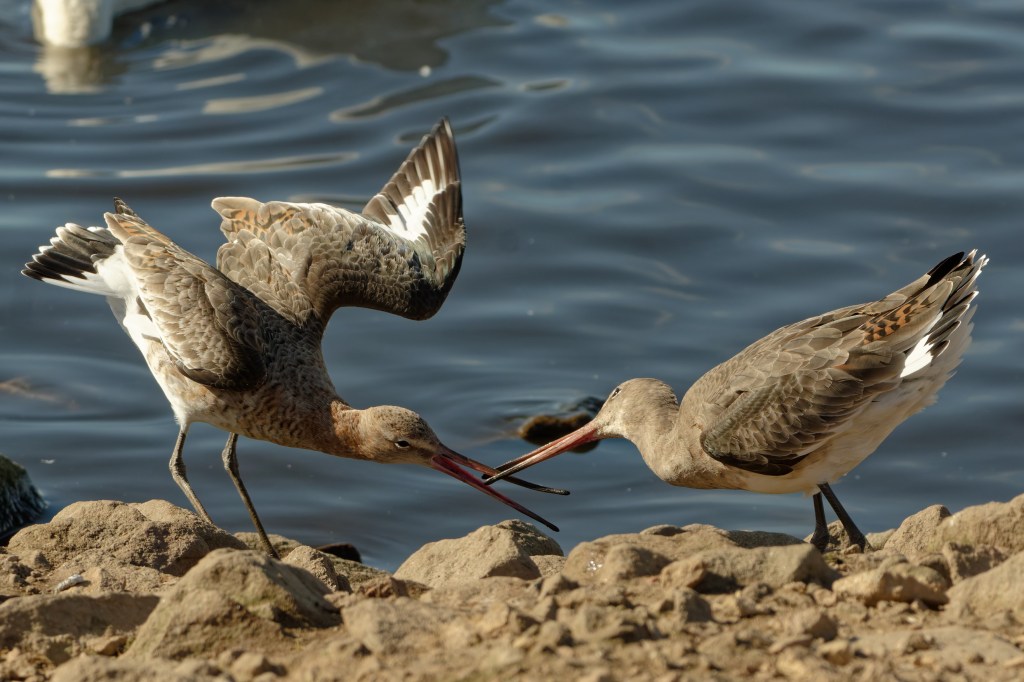
In front of the Discovery Hide, the Black-tailed Godwits were in a testy mood with bill-to-bill combat rife. The books don’t help much with this; while the excellent Waders by W. G. Hale describes the Godwit display behaviour, and refers to territory defence, it does not describe what Backwoodsman witnessed.
It was surprising to see the precision instrument that is the Godwit bill used in this way. Backwoodsman was also surprised to see the extent of the flexibility of the Godwit neck, which appears to be folded into a right-angle in some of his shots. Wader preening involves a range of contortions but these have mostly involved rotation rather than folding in Backwoodsman’s experience.
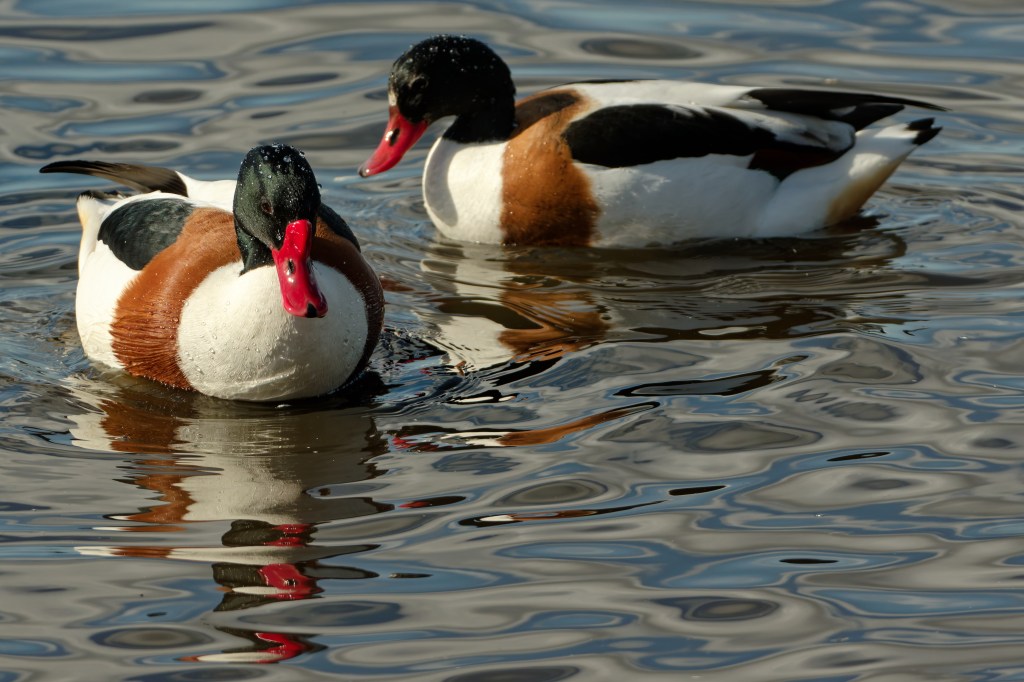
The Shelduck were at it too, with encroachment upon established pairs resisted strongly.
It is a treat to be able to sit in a hide while wild birds parade about just metres away. Whooper Swans seem to become quite relaxed after wintering at Hogganfield Loch and will come quite close, even when a big lens is being pointed at them. Godwit and Shelduck are something else entirely when Backwoodsman finds them in the wild with the former often taking to the wing, and the latter walking or gliding out to some distance. Not today!
The trick may well be in the feeding which the WWT undertake. At three o’clock sharp, a warden with a barrow emerged beside the Discovery Hide and began to hurl handfuls of grain to the gathering birds. They all came in; the Shelduck were all over it like seniors on a promise of a free biscuit.
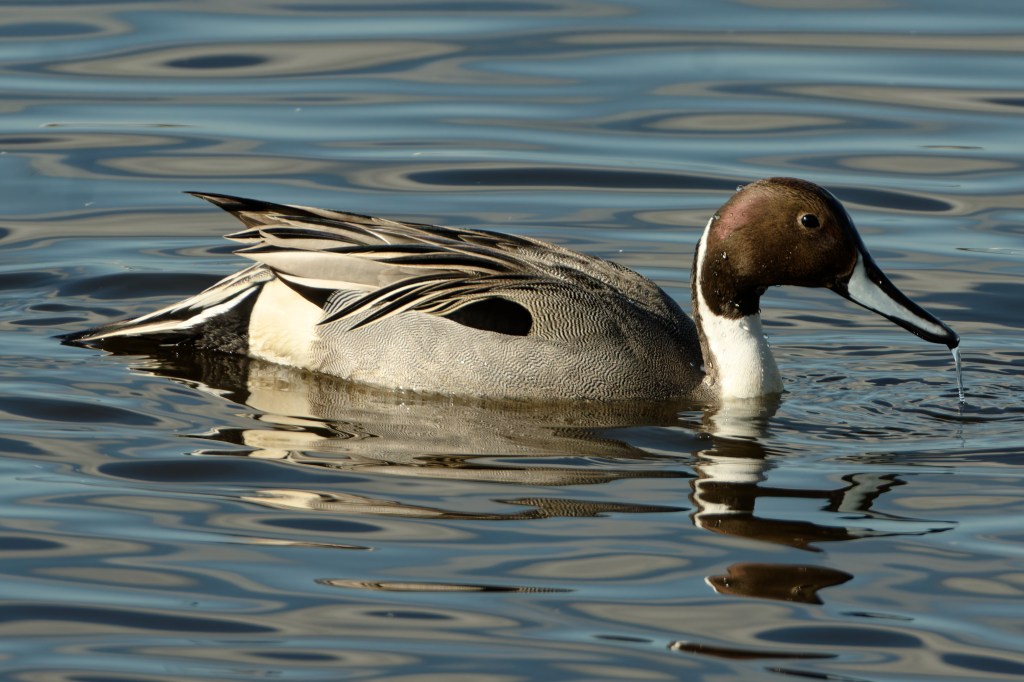
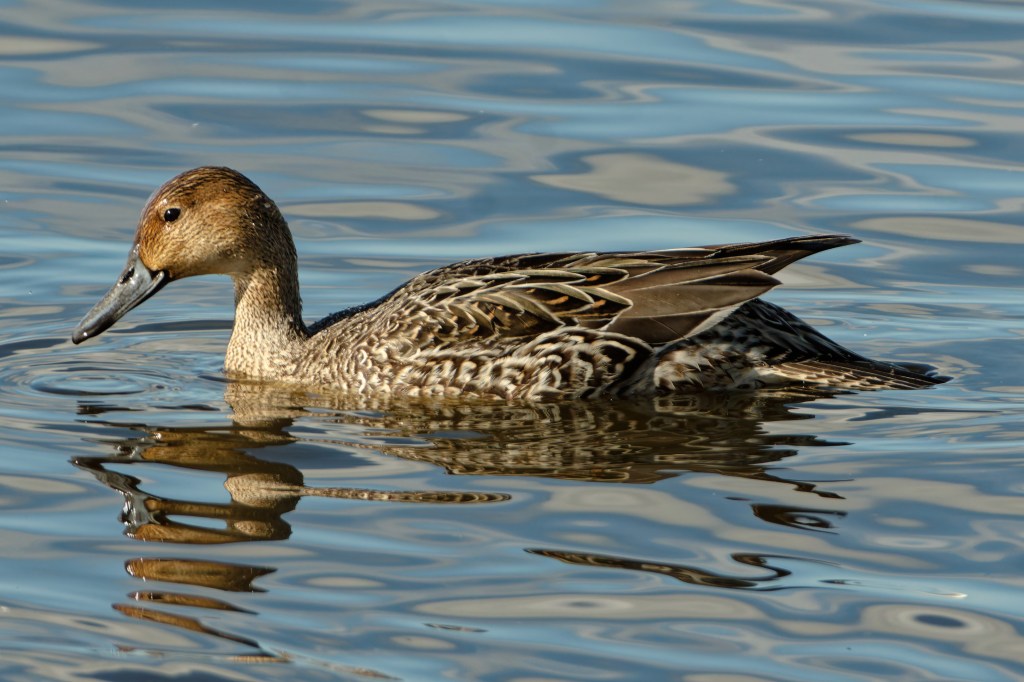
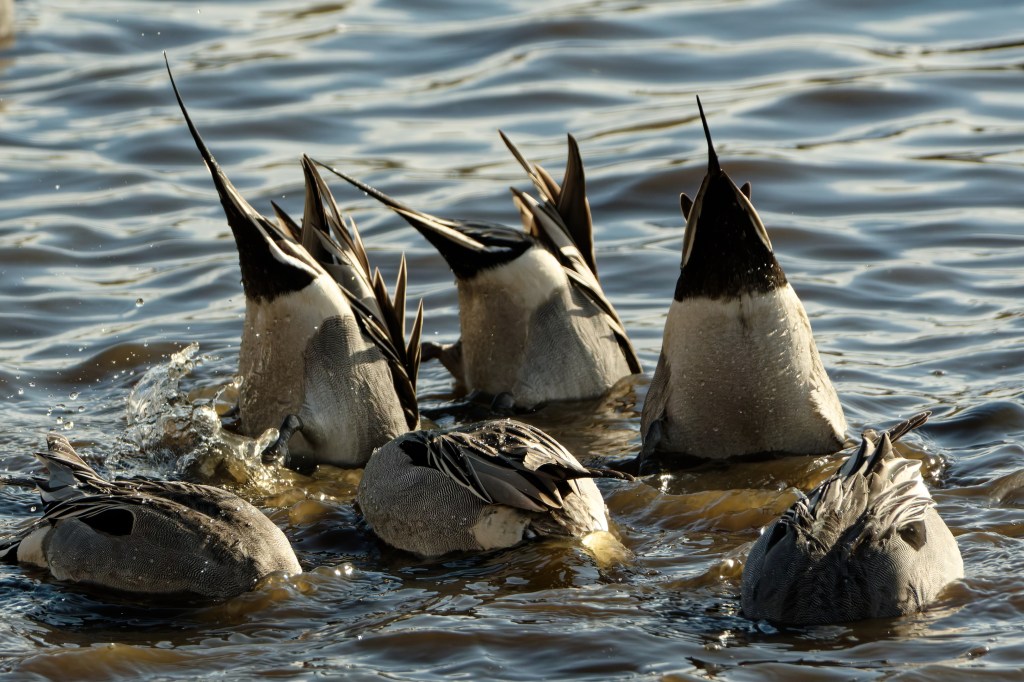
The waders did some tidying up between the bigger units and the Pintail fed in the shallow water at the edge of the mere using their long necks to get grain off the bottom.
Backwoodsman has been hoping to make this post for a few years now. The problem has been getting enough Pintail images to do something decent.
Sightings of Pintail have mostly been confined to the WWT reserves, though we once saw one bird at Troon, and a small group upriver from Cardross on a freezing winter day with horizontal rain, the kind of day when the camera stays in a waterproof bag if the photographer has any sense at all.
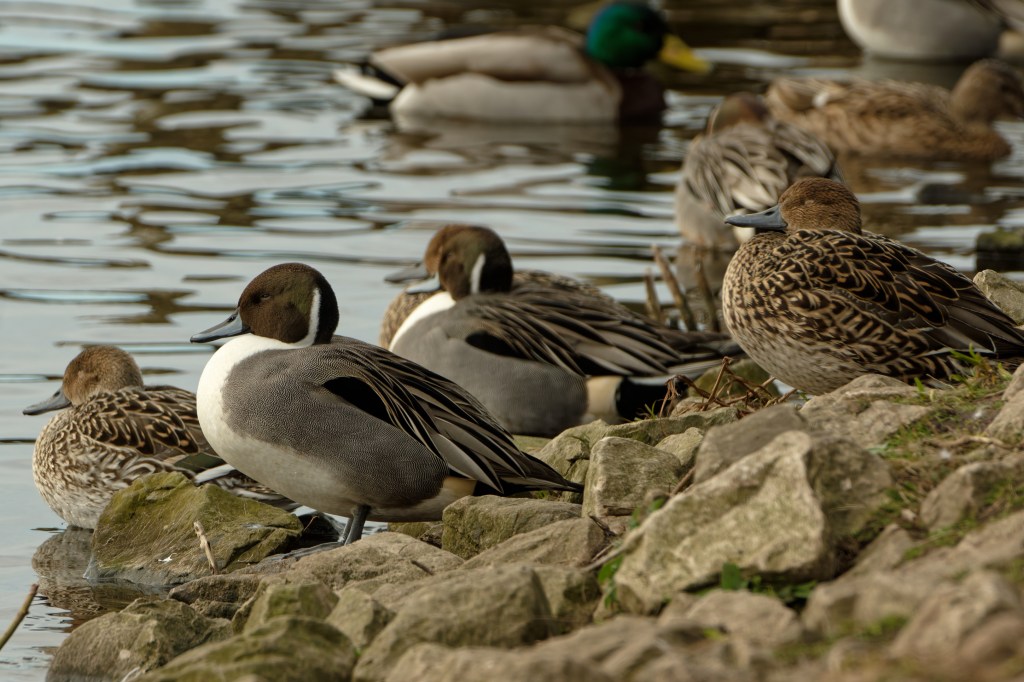
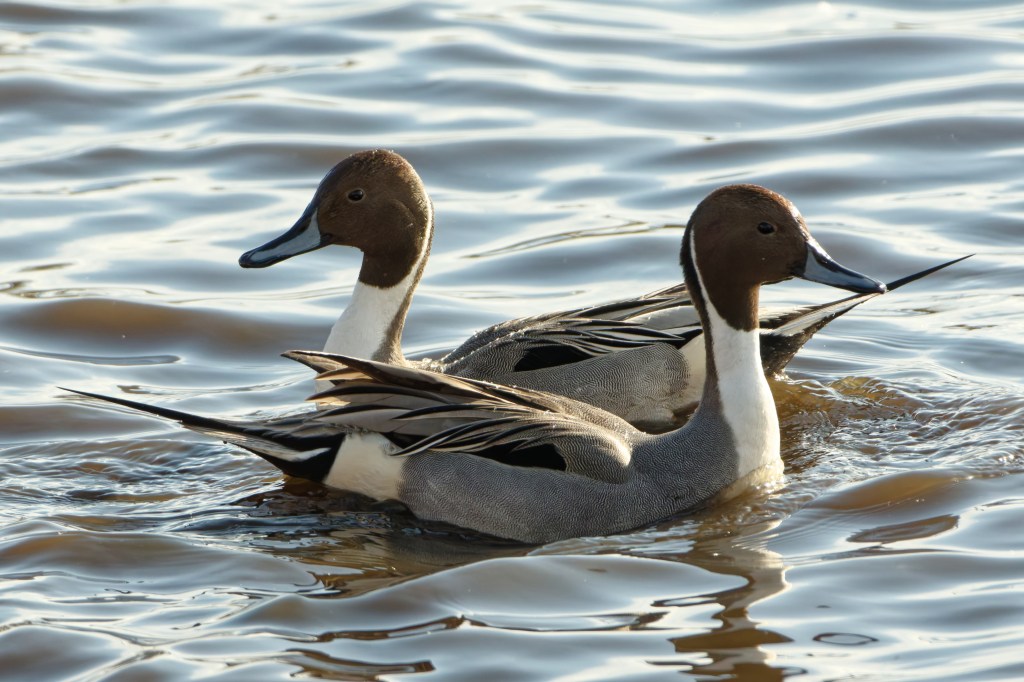
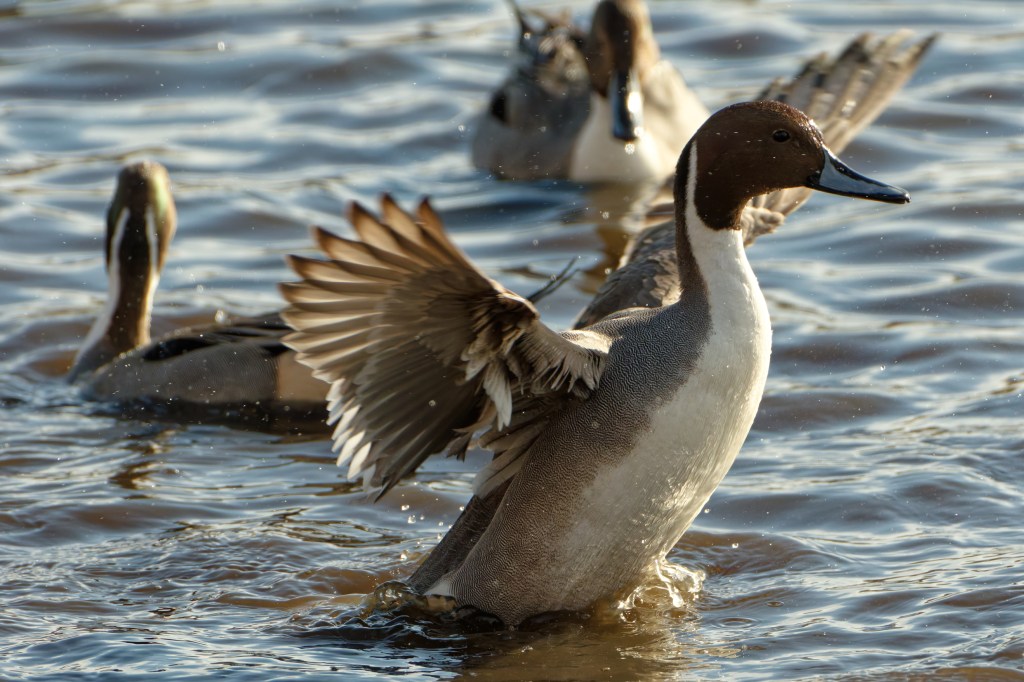
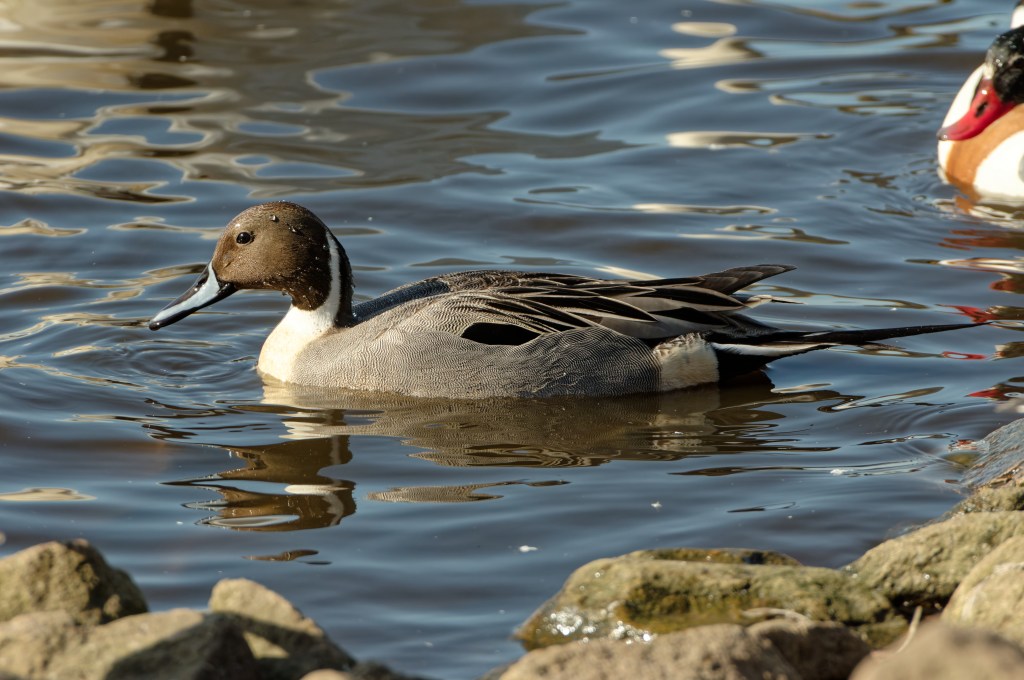
Getting right on top of them in a hide and in good light rather changed the game. There were Pintail on the wing (the first image in the post) and in repose, Pintail sailing around looking elegant, and then groups of them upending.
Martin Mere seems to be a stronghold of this species – the BTO highlights Lancashire as a popular wintering site. Pintail are very seasonal with of the order of twenty thousand pairs present in the winter, and fewer than thirty pairs breeding in the UK.
There is a BTO document describing their mass movements and saying that: “The breeding area of the Pintail covers a large area of the northern Holarctic, across North America and Eurasia. The Pintail is mainly migratory and in most regions is a long distance migrant. Wintering areas are spread out in western and southern Europe, across Africa south of the Sahara, southwest Asia, India, southern China and Japan. North American Pintails move south and leave most of the breeding range during winter.”
Backwoodsman looked at the Featherbase site hoping to find the long feathers which give the species its name. He failed to do the job unambiguously. Though the wonderful rich colours of the bird can be seen in the individual feathers, it is hard to assemble them into anything like as glorious as the bird itself.
Backwoodsman cannot look at a Pintail without thinking of le gâteau Opéra to be found in any good pâtisserie, always Backwoodsman’s favourite indulgence when in France.
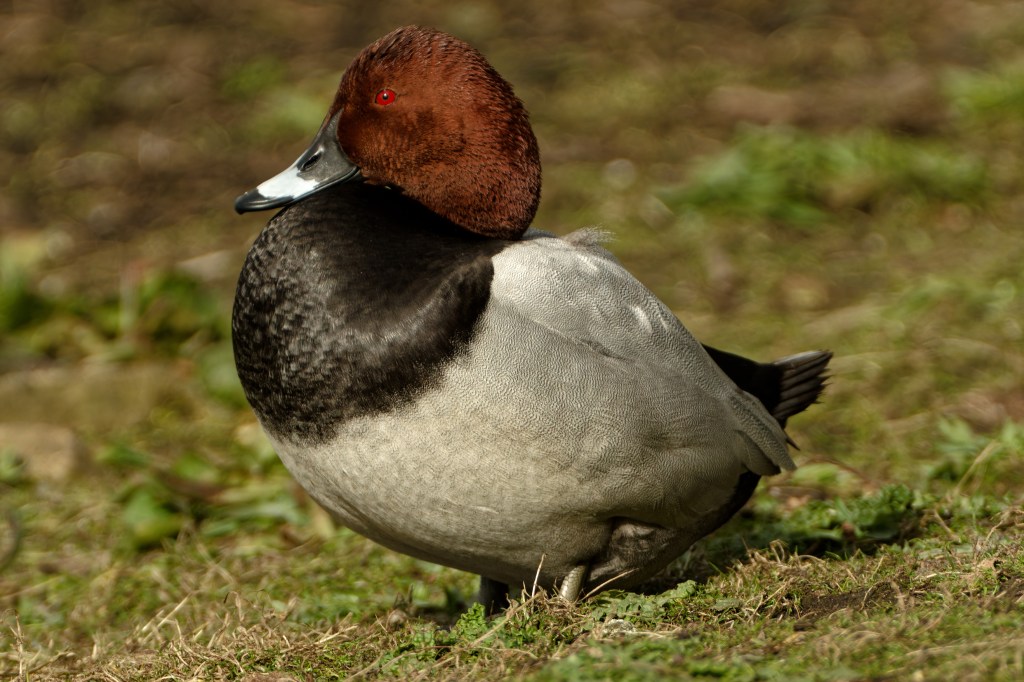
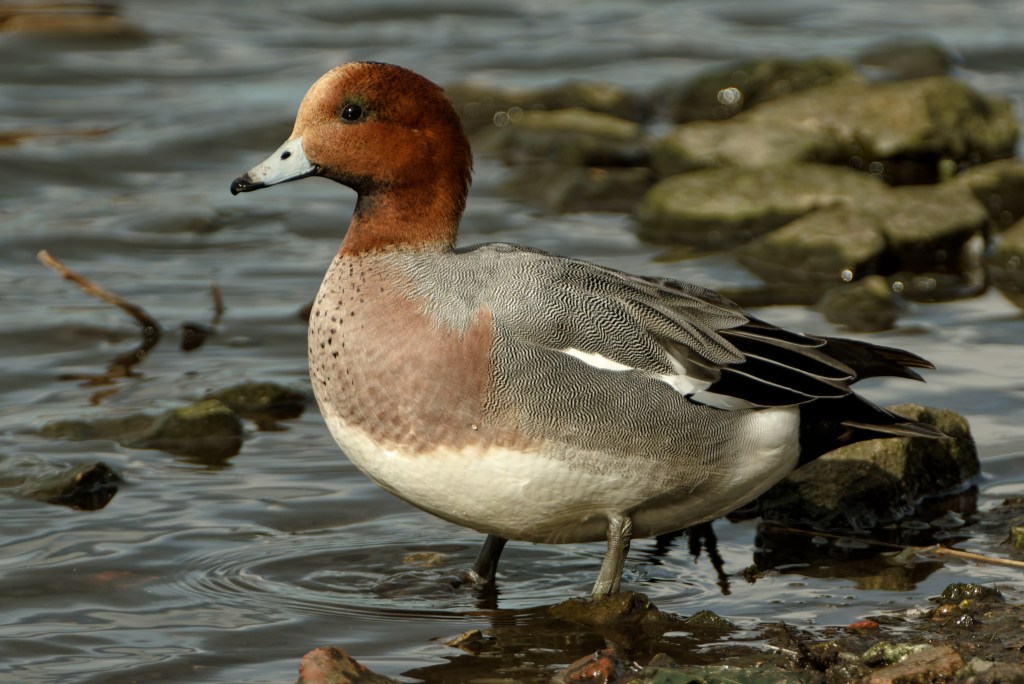
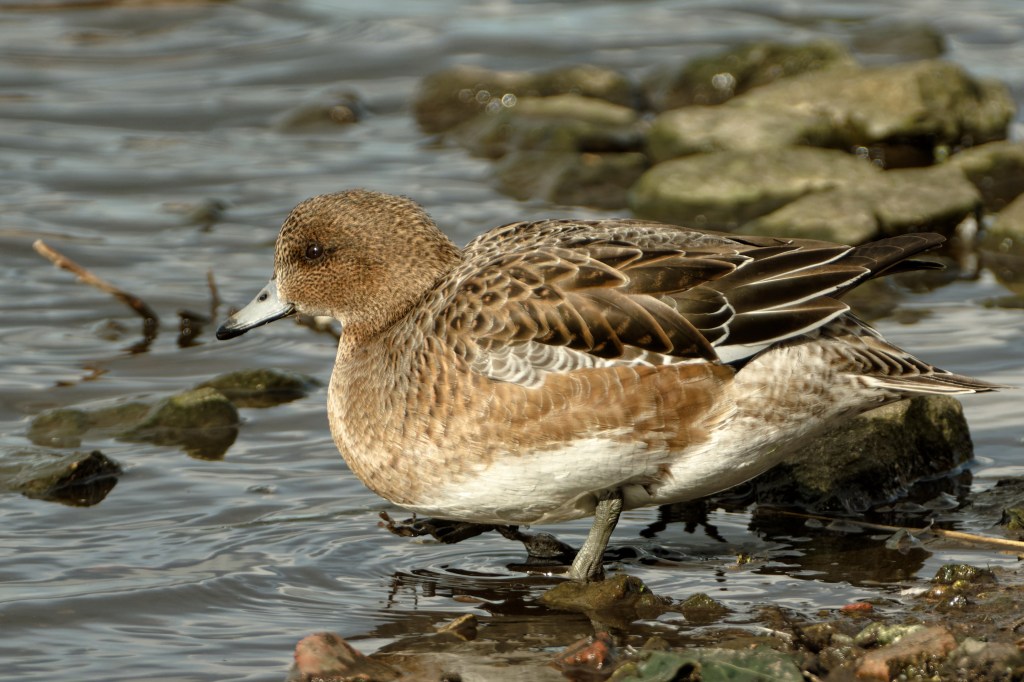
PS Backwoodsman thought you might like these gloriously-lit birds too; male Pochard, followed by male and female Wigeon.
Backwoodsman is finding the cheerful spring weather to be a poor fit with events in the wider world; writing has not seemed like a worthwhile activity. It’s a bit like farting in a hurricane (“so what’s new?” you ask). For example, Backwoodsman had the misfortune to watch a speech made by the PM to an audience of captive NHS workers (Thursday 13th March), televised by the BBC. In full-on call-me-Keir mode, the man once described by Alexei Sayle as “a fatberg blocking the possibility of making the world a better place” explained how all would be swept aside, or bleed on the altar of growth. Here is the background to Backwoodsman’s interest as reported by the BBC under the headline “Charities accuse Starmer of misleading spider claims”:
“Writing in the Daily Telegraph on Thursday, Sir Keir said the project was to “build more than 15,000 new homes” with a “17-minute commute into central London”. He wrote that the previous government had bought 125 hectares of former industrial land and quarries to build homes on, but the plan had been “blocked by Natural England” due to “the discovery of a colony of ‘distinguished jumping spiders'”. He added: “It’s nonsense. And we’ll stop it.” In a speech in Hull later the same day, Sir Keir appeared to refer to Ebbsfleet again, saying that “jumping spiders” had stopped “an entire new town”. He added: “I’ve not made that example up, it’s where we’ve got to.””
So OK, it’s not ethnic cleansing in Gaza, or the US and Russia carving up the European continent to suit themselves but it was unpleasant to see an elected Labour leader displaying such a loathsome attitude. “Are you tories in disguise, are you tories in disguise?” they chorus from the terraces.
In an attempt to recover from all this gloom, Backwoodsman has been thinking of a bird which brings cheer in the most miserable of circumstances, for example, Backwoodsman’s walk to the office in his former employ. This took in the decaying shopping centre of Glasgow, leading to the bridge which takes Cathedral Street over Queen Street station. And here is the view of the last two hundred metres; please note the presence of Best Kebab in the foreground.
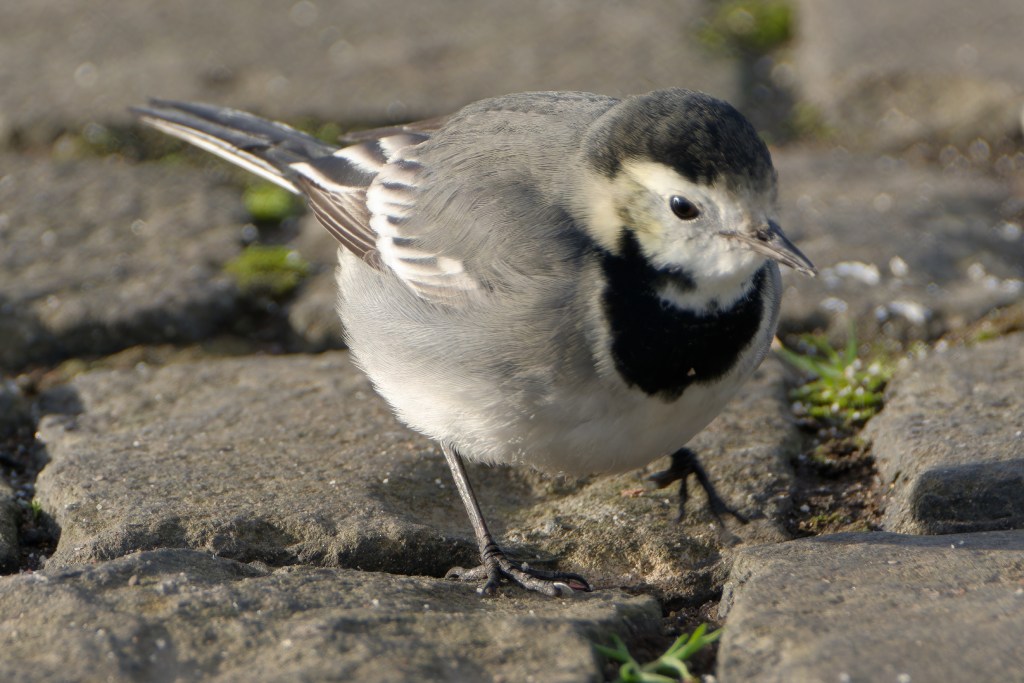
At lunchtime, this outlet would sell foul-smelling food to the University’s students; Backwoodsman shudders to think what went on in its premises as night came, but in the morning, it would occasionally resound with something that sounded like Rai music (as celebrated in Patrice Leconte’s 1990 film The Hairdresser’s Husband), and would usually be patrolled by a Pied Wagtail. There in a bob and a dart and a flash was something to improve the start of the working day.
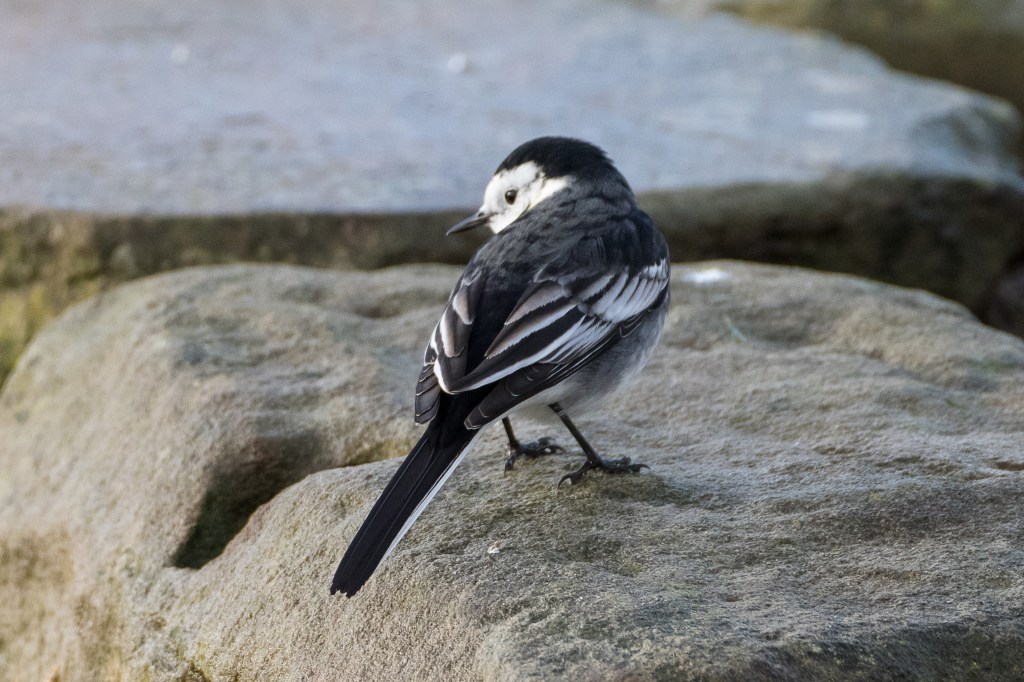
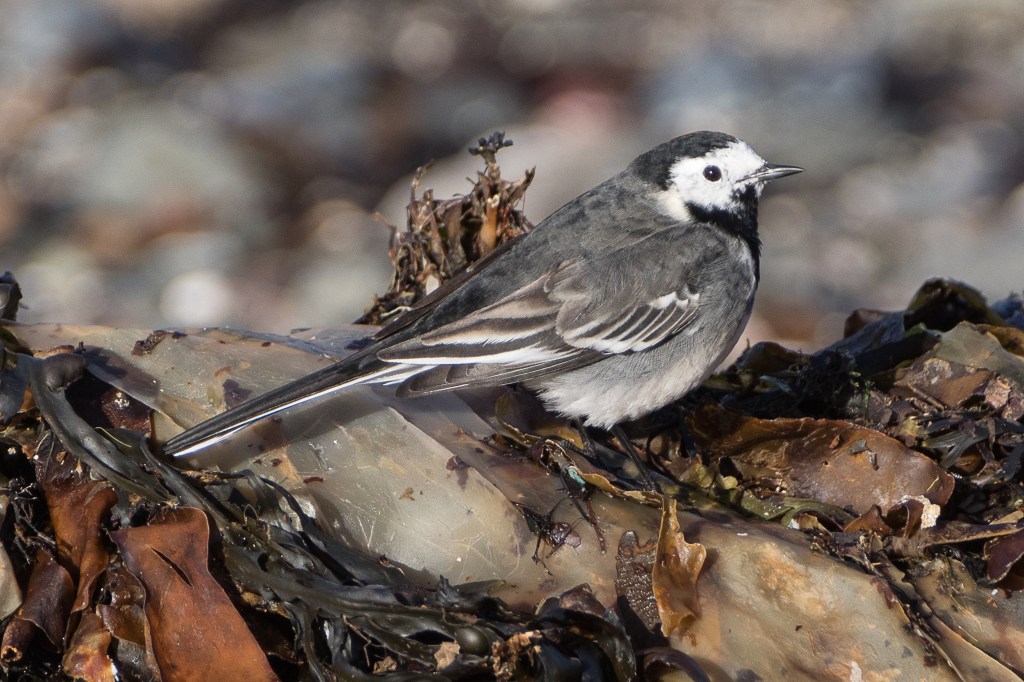
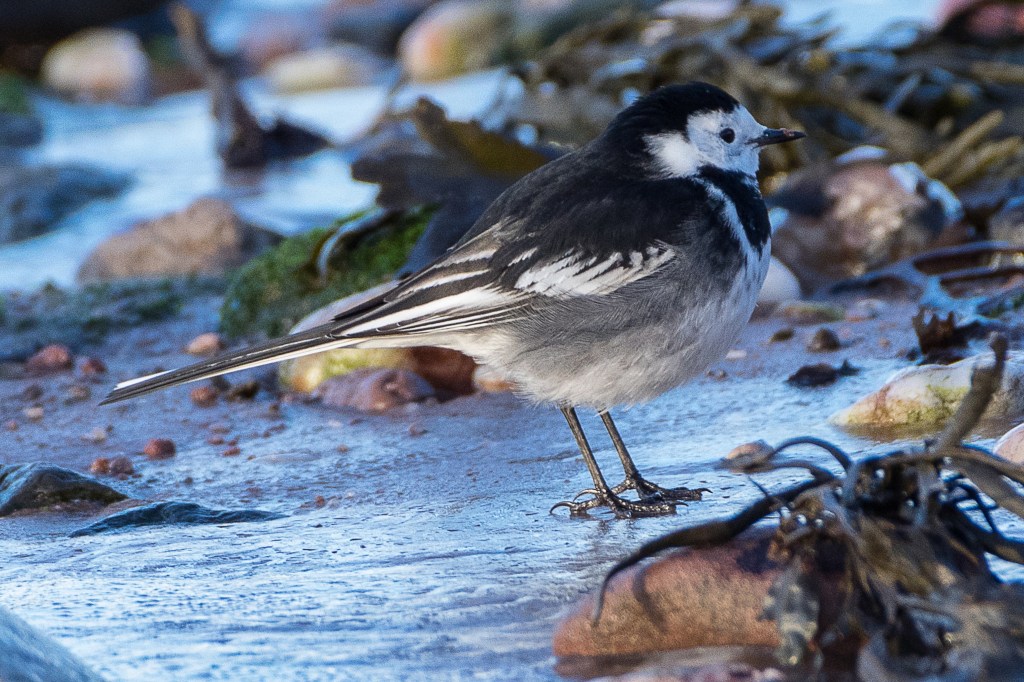
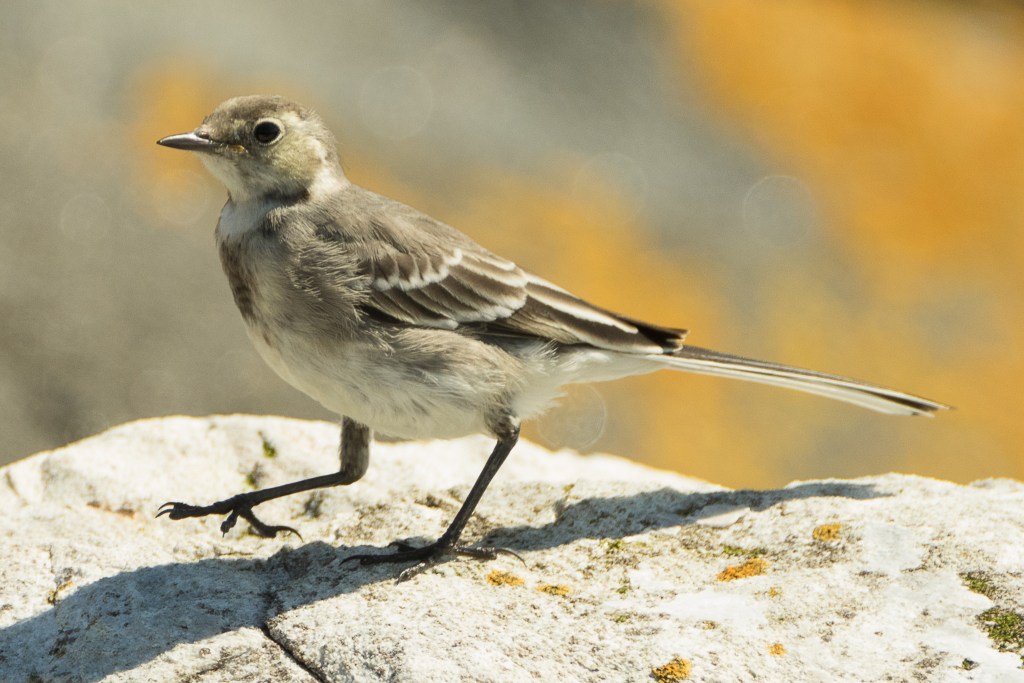
Pied Wagtails are just great, aren’t they? According to the BTO, they only last a couple of years on average but they pack a lot in, sometimes in hostile environments. There are quite a lot of them (half-a-million pairs) and their numbers seem to be growing. They are insectivores but are adaptable in their diets, a hallmark of a species which succeeds in an urban setting.
It is unusual not to see them on the Ayrshire beaches, particularly when the tide has rolled up a good crop of weed. It doesn’t take the insects long to colonise the decaying material and then there is food for all, Wagtails, Turnstones, Corvids and Starlings alike. Backwoodsman’s best Wagtail sighting was at Stevenston one recent winter afternoon when ten individuals could be seen in as many metres of beach. We used to see them from the windows of our flat; they would patrol the stonework of the neighbouring terrace. There is a territory on the Glasgow Harbour, and several on the new North Bridge estate (running routes) – how many could there be across the whole city?
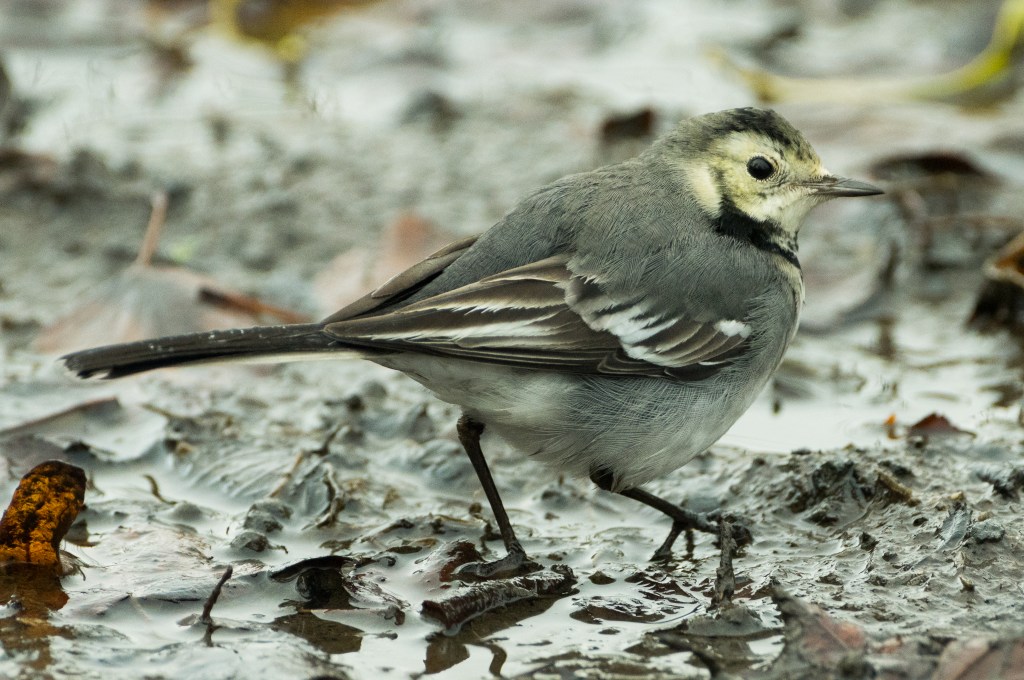
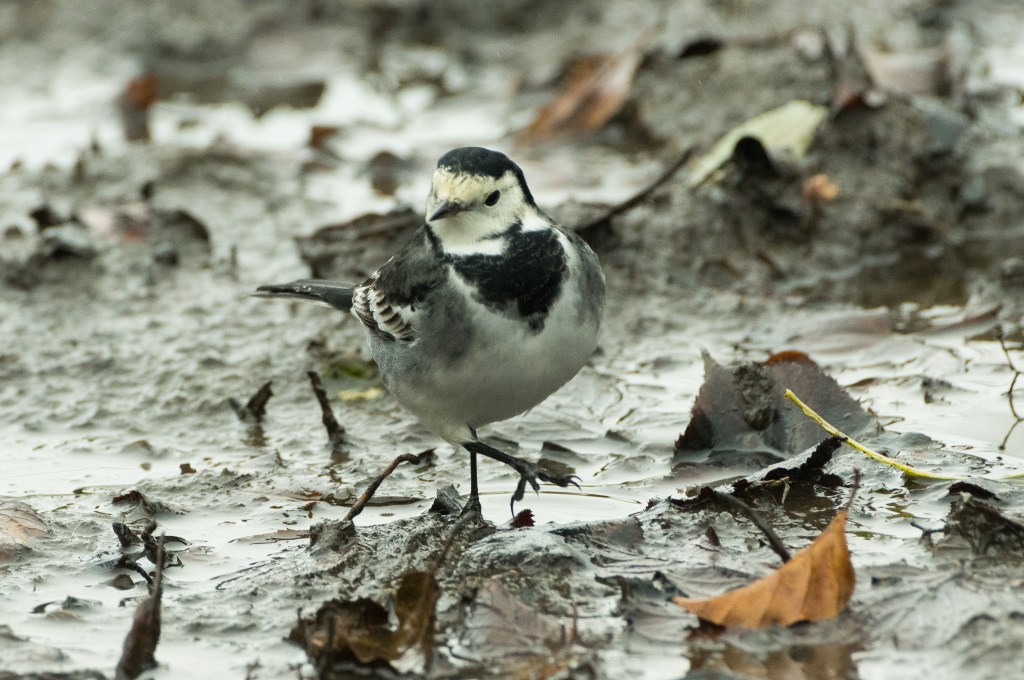
Backwoodsman finds them hard to photograph; they seem to vibrate, requiring a high shutter speed and then we get into all the usual boring stuff about high ISO, wide aperture and low depth of field. But every now and again, you get one when it is busy and neither looking nor moving. Here are two birds, one juvenile and one more mature adult, in the mini-Somme created by grazing stock at RSPB Baron’s Haugh in January. The juvenile has more yellow-cream, the adult more black-and-white.
First year or fresh birds are very pale; we found some at Troon. They were quite hard to see against the rocks of the coastal defences.
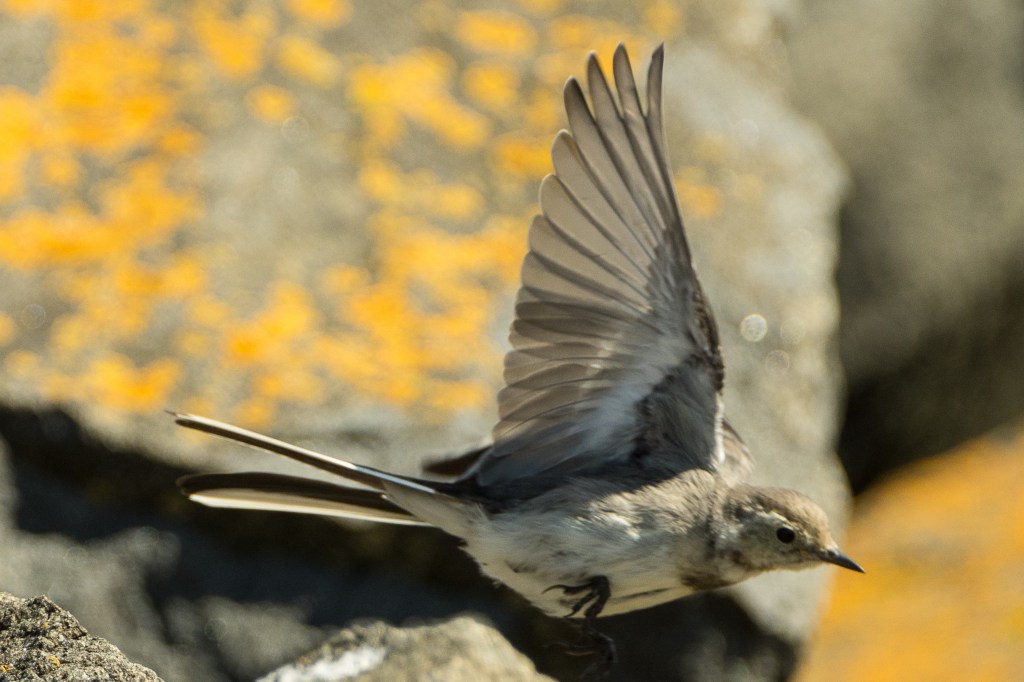
One almost gave Backwoodsman the shot he has always wanted of an adult, the one where the tail feathers are fanned in flight.
After many fruitless attempts in which a nicely focussed bird executes a vertical take-off and leaves the frame empty, Backwoodsman has abandoned this project.
But Pied Wagtails will continue to provide joy, wherever and whenever. They are always worth a look, and a second.
Backwoodsman feels that there has been little good light for months now. As he emerges blinking from the trees, fetched out by the longer days, he thinks back to a brilliant day just before Christmas when he visited the Claypits LNR on a mission – to find and photograph the Water Rail.
This visit had been thought about for months, ever since we saw a Water Rail on the Forth and Clyde Canal near Stockingfield Junction one Sunday morning. There was no camera to hand so Backwoodsman could only stand and gape as a Water Rail swam across the canal from the towpath side, emerged into the rushes on the far bank and began to forage in full view. All was serene for a few minutes until it was spotted by one of the local Moorhens; hostilities broke out immediately and the Water Rail was pursued down the canal towards the bridge. Our walk continued through the Claypits LNR where we found a couple of birdwatchers with cameras. We lingered too long and they were onto us: “We’ve got a Water Rail, have you seen it?” and so on. We told them about our canal sighting but they so weren’t listening. We left and Backwoodsman resolved to go back on a very bright, cold and midweek day when the reserve might be less contested.
On December 19th 2024, Backwoodsman headed off to the Claypits LNR. The plan was spend an hour or two on the reserve and then jump on a number 7 bus up to Possil Marsh to look for waterfowl. It was a brilliant Thursday morning and absolutely freezing. Backwoodsman arrived at the reserve and crossed paths with a young woman on a mobility scooter; she had seen the bird but not for long enough to get it in focus and capture an image.
Backwoodsman took up a position on the small viewing platform which overlooks the reedy inlet from the canal. The platform looks a bit like a Juliet balcony; anyone standing on it definitely looms, so stillness and silence are essential if anything lurking in the reeds is likely to feel confident enough to emerge for very long. A Grey Heron looked down on Backwoodsman’s folly from its perch across the canal.
Backwoodsman watched; the sun went behind some cloud, the wind came up the canal like a swinging blade and the temperature dropped. Nothing much happened until a long string of bubbles appeared in the small patch of open water Backwoodsman was watching; then there were swirls in the water of the kind that a large Carp would make. A long brown shape with a tail broke surface for a second or two, and was gone. Both Otters and Mink are present in the area. Another time perhaps.
There was a growing clamour as two people in camo and woolly hats came into view. They were shouting, and in seconds, Backwoodsman found himself the filling in a numpty sandwich. Backwoodsman was interrogated; was he from the Clyde Bird Group, or Nature Scot, or the Bearsden Bird Botherers? They were loud, they were moving a lot and they were insufferable. Backwoodsman headed off on a circuit of the reserve.
The numpties had gone when Backwoodsman returned and all was quiet again, save for the calls of a pair of Wrens. They sped through, but not before one had posed attractively in good light.
Then something rather wonderful happened; a female Kingfisher visited, and stayed for quite a long time. These are Backwoodsman’s best images of this species; good light striking the birds really brings the semi-iridescence to life. The bird visited a number of perches; Backwoodsman likes the use it made of the Great Reedmace.
Backwoodsman was very cold by now and started to head for home. While pausing by the inlet for a last look, he was overtaken by a couple of wild-looking chaps hurling whole slices of bread into the inlet. “Aye son”, they shouted, “have you seen the heron?” Backwoodsman was able to tell them that their quarry had been perching in a tree earlier that morning but had flown off. “Son, son”, one shouted, “there’s a wee Robin behind you.”
Backwoodsman turned to see two male Bullfinches in good light, so here is one of them. After a brief discussion of the differences between Bullfinches and Robins, the three of us agreed that it was pure freezing and time for home and we went our separate ways.
So no Water Rails then? Well not on this visit. As it seems unlikely that one will be seen and photographed in north Glasgow by this observer, Backwoodsman will share some images prepared on a visit to Slimbridge.
The Water Rail is really very striking, with the upper parts superbly camouflaged for foraging in reedbeds. This video has a bird foraging, and calling or “sharming” as it is known according to the BTO. The Wikipedia article cited at the top of this post is a recommended read: it is a good one.
It is hard to know how things will turn out for this bird on the Claypits LNR. Every time Backwoodsman runs through the Claypits site, he sees someone looming conspicuously by the inlet. Presumably they are after the same bird we saw near Stockingfield Junction, but it would be very exciting to think that there could be two individuals in this area of north Glasgow.