Goldeneye

“Many observers agree that the behaviour of animals is in part made up of stereotyped movements. The displays of birds are frequently cited as outstanding examples, and many students of bird behaviour have been able to dissect observed activities into stereotyped, component actions.”

 The form and duration of the display actions of the Goldeneye (Bucephala clangula), Dane, B.; Walcott, C. and Drury, W. H., Behaviour, 1959, 14, 265-281.

I think we first saw Goldeneye from the shore at Cardross on a high tide. Having got used to the Wigeon there in the winter, we were surprised to see small black and white ducks in the distance, notice their rather extraordinary head movements, and hear their calls.

Once we saw the cheek spot, there was no difficulty in identifying them but getting pictures was a different game – they stayed a long way out. They turned up on the Garnock in Irvine, putting on a good show but always drifting further and further out of camera range. When Hogganfield Loch froze almost completely in the winter of 2020/2021, the Goldeneye were forced quite close to shore to feed and carry out their displays. I had some great opportunities for shots as they threaded their way in and out of the melée of Mute and Whooper swans, Coots and Goosanders.

They went through quite a repertoire – the head thrown back, the stretch out to forty-five degrees and the snaking along the surface in pursuit of a rival. The females can be easy to overlook in the midst of all this hormonally charged contrasty glamour, and yes, most of my images are of the drakes but I do have one image which shows the beautifully textured flank of the duck.

I find the green sheen of the drake’s head quite tricky to get right in processing (I’ve had similar problems with Black guillemots and Goosander drakes). In some lights, you just get black and in others, a hint of unwanted purple shows up. I guess a green patch or highlight is about right.

The shape of the drake’s head seems to be quite variable – I thought that maybe it was to do with the vocalisation. When he stretches forward into the forty-five degree pose, mass seems to relocate from the equator of the head to give him what I can only describe as jowls. It’s a rather odd silhouette for a duck.

A brief dig in the literature revealed much – he’s just puffed his cheek feathers out. The scientific literature is truly enormous and it is usually the case that the question you wish to ask has been answered (at least in part) long before you got anywhere close to it. As I used to tell research students in professional life, a week in the laboratory saves twenty minutes in the library…

To gain the results upon which their Goldeneye article cited at the top of the blog is based, Dane et al., all Harvard scholars, painstakingly analysed hundreds of feet of black and white motion picture footage of groups of Goldeneye on saltwater in North America. They described and named seventeen distinct and stereotypical actions in flock displays and eleven pre-copulatory actions; I think I managed to photograph two – the Bowsprit (my forty-five degree pose) and the Simple Head-throw (the image at the top of the blog) – so I’ve a way to go. I look forward to trying to find and photograph Dipping, Drinking, Flicking and Nodding inter alia with the help of Dane et al., and some of the YouTube videos of Goldeneye.

With great regret, a sombre PS. Shortly after drafting this post on 15th November 2022, I read of the suspected arrival of Avian influenza at Hogganfield Loch in Glasgow. I suspect that Kathleen Jamie’s piece in the London Review of Books of 18th August 2022 entitled “Stay alive! Stay alive!” will have summarised the fears and hopes of all of us who marvel at the natural world and fear for its fragility.

Redshanks

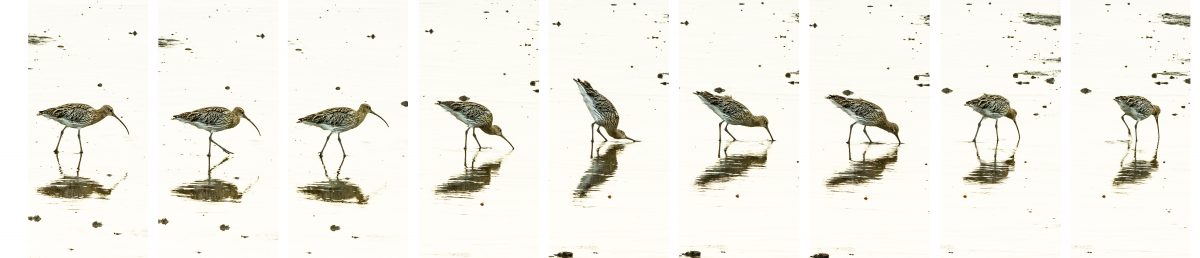
My first sightings of Redshanks were in East Lothian at North Berwick. At first, I only saw them in flight, sickle shapes flung across the sea and whickering as they went. Wild birds spot you a long time before you see them, and then they’re gone and you’re left wondering, and sorry for what you just did. Then you start to try to find them at the sea’s edge from a long way off, and you become surreptitious; sometimes they are just busy and you can get close and identify them, and then maybe photograph them.

Glasgow residents are fortunate to live near a cluster of sites, known collectively as RSPB Inner Clyde (an SSSI), which are of international importance for Redshanks. The reserve seems mostly inaccessible, apart from at Cardross, where you can leave the train and look out over the mud across Pillar Bank towards Port Glasgow. There will be birds to see in front of the sawmill, and on the Bank if the tide is low. There is some helpful signage urging dog owners to respect the birds which live there. It is hard to tell how much notice is taken of this. The last time I was there, a woman was paddleboarding with a dog on board close to the shore; needless to say, everything fled while she “reconnected with nature”.

Redshanks seem to be either full-on busy or in repose, no grey areas. They do look rather wonderful against a silver grey background like at Cardross, as the receding tide exposes the fresh mud and its harvest of invertebrates and crustaceans.

Perhaps the tide pools between Troon South Beach and Ballast Bank offer them a moat and more of a sense of security. I found a pair in dispute over turf, and an individual being statuesque. None of the three seemed to mind me.

At Saltcoats, the rocks in the Old Harbour and the breakwater beyond the old bathing pools offer places for them to rest up from their restless feeding. The size contrasts with the Dunlins and the Oystercatcher make some sense of the small/medium/large wader descriptors used in the bird guides.

The DEFRA Bird Survey has two listings for Redshanks – one under birds of wet grassland, the other under waders.

In the former case, the population has declined by over 50% – in the latter, only 4%. The RSPB has them on the Amber list. This confused me so I read on. The RSPB offers, as part of its advice to farmers: “There has been a significant decline in redshank numbers in many areas of the UK. On farmland, the main reasons for this reduction have been the drainage, re-seeding and fertilising of grassland.” So would it be facile to say that our UK winter numbers are steady but our breeding population has halved because of habitat reduction? If not here, where will they breed? Fortunately, there is nourishment to be had along the mud flats of the Clyde estuary and along the Ayrshire coast, and so there are Redshanks to enjoy. Long may they come.

Long-tailed Tits

I used to have a house in Birmingham; it had a long garden which was too much for me to ever manage but I used to try. There was a very old apple tree in the middle of a herbaceous border and I’d often find myself working under the tree as the light failed in the short afternoons of autumn and winter. Sometimes the tree would fill with Long-tailed Tits and they would flit and spin around the thin branches, calling constantly until they either noticed me, ate all the available insects or simply reached the next item on the agenda – it is hard to see them as anything less than purposeful. These were magical experiences and thirty years later, I began to wonder if I had added something in the recollection, a bit of volume here and some numbers there.

I started to notice them in Glasgow and for a while, I worked on a map which recorded my sightings of Long-tailed Tits in the West End of Glasgow. More often than not, I’d hear “zee-zee-zee” all around me but not see the calling birds, but there were places where they seemed to break cover regularly and in numbers. Lilybank Gardens, Lynedoch Crescent and Sandyford Place were all good bets for a sighting. That is, unless I had a camera with me, in which case no-show, or they’d be particularly hyperactive and defy the autofocus, so I’d just enjoy the birds and not worry too much about trying to get images.

In May 2020, when everyone was “reconnecting with nature”, I went out with the camera through the Park and onto the Kelvin Walkway in very bright sunshine. Just past Kelvinbridge, I was stopped in my tracks by what sound like a large number of birds. “WTF” uttered the inevitable headphone-wearing cyclist – “LTT!” I aimed at his retreating backside. There was an LTT creche just above my head with a couple of youngsters parked up for a feed and a number of adults bringing Mayflies to them.

It took me a while to realise that the lens focus range needed switching over and then I was away, getting my first and much sought after  images. Lots of people passed me by and no-one noticed what I was photographing, not unusual at all for the Kelvin Walkway.

Since then, they’ve visited the trees at the back of our house for a trapeze act and I’ve found them by Possil Loch and Bunhouse Lane and managed to get images which show their extraordinary agility. I’m posting now because I’m beginning to not only hear but see them again as the trees finally lose their leaves.     

A gallery of LTT images follows.

Thrushes

The season is changing; I went out for my ‘flu jab this morning and the sharpness in the air made me think of winter days in Kelvingrove Park watching the Redwings, and the other Thrushes. Having had the place to themselves for half the year, the Song Thrushes suddenly find themselves very far from alone in the fallen leaves.

Is this disturbing or do they relish the safety in numbers? It must be useful to have many other pairs of eyes to watch for predators and spaniels, and sound a collective alarm. The calls of the Redwings are not generally considered musical but their clamour animates the winter early mornings in the Park. I look forward to this every year; I wonder when they will come and anticipate seeing those small eruptions in the leaf litter which give them away.

Photographing them is often a long job as they rarely spend much time in well lit space. The seemingly magic shrubs below the Roberts Memorial keep the Redwings in berries throughout the winter and if you’re lucky, they’ll perch in the open in those bushes.

Hard ground brings them out into the open and one particularly wet spring morning saw hundreds of them on a large muddy patch where the dogs and their walkers had destroyed the grass entirely, taking earthworms, in what may have been a last big feed before the long flight home.  

It’s mid-October now and I’ve a while to wait. The Song Thrushes will keep me going; would that there were more of them. They seem to make eccentric nest siting decisions and their chicks seem to lack all the survival instincts so they’re a pleasure and a worry at the same time.

PS It’s now Saturday 29th October. I thought I saw the Redwings earlier in the week – my wife met the bird ringing man in the Botanic Gardens this morning and he told her that they’d arrived. I think that they are really quite early this year. I hope to catch up with them in the Park in the near future.

Some more images of Redwings and song Thrushes follow.