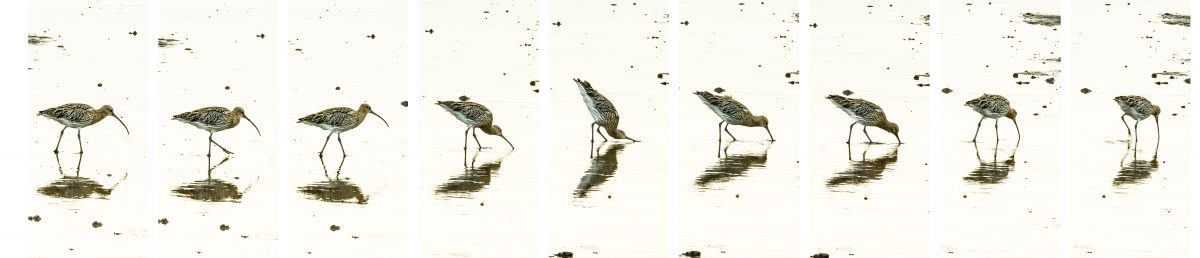

Our first sighting of Sandwich Terns came at Ardmore Point in 2017 – we saw birds on a rock out in the River and sought help from the bird app. They really weren’t difficult to identify – they look more dramatic and more imposing than the other Terns seen frequently in the UK. The image was acquired on older kit and is grainy, nice mussels though.
We waited a while to see the birds again; an August trip to Stevenston Point in 2023 provided the opportunity. While Troon shimmered in the distance, Sandwich Terns flew in to sit on the old pipeline which heads out from the foreshore.
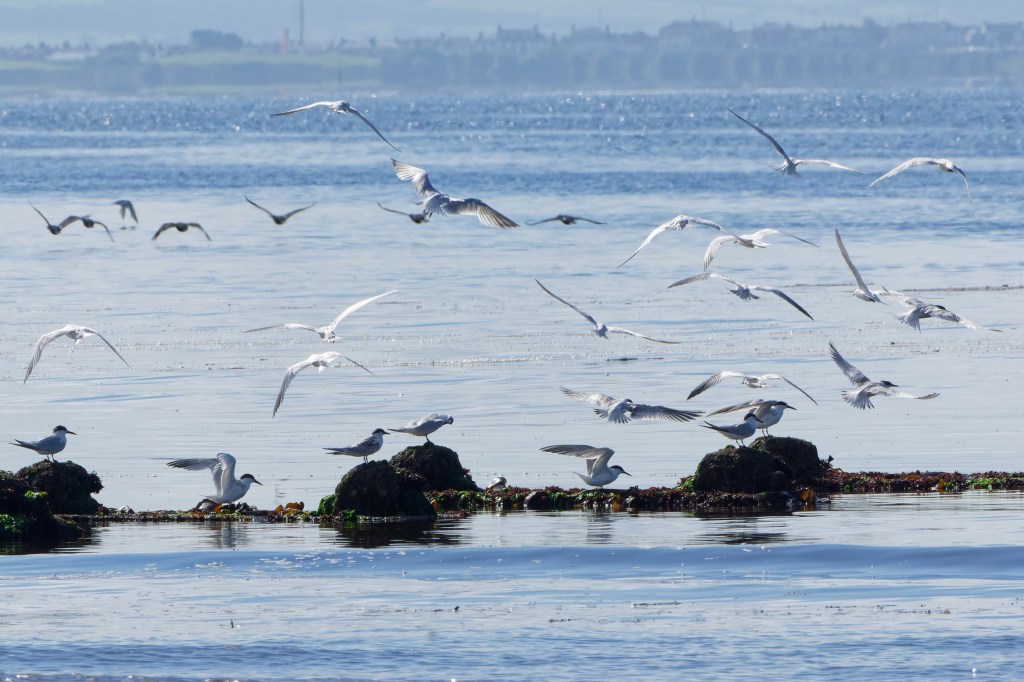
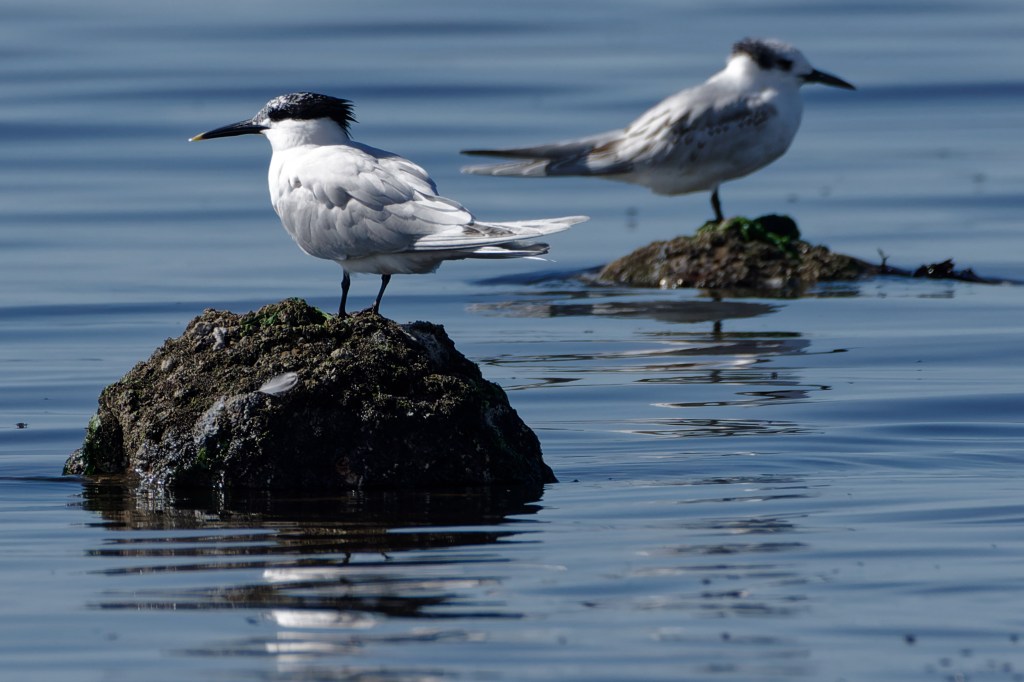
They were a large and mixed group of adults and chicks. The chicks have dark ends to white feathers; adults which have bred, moult out their black caps leaving them with a head which appears to sport an inexpertly blow-dried tonsure.
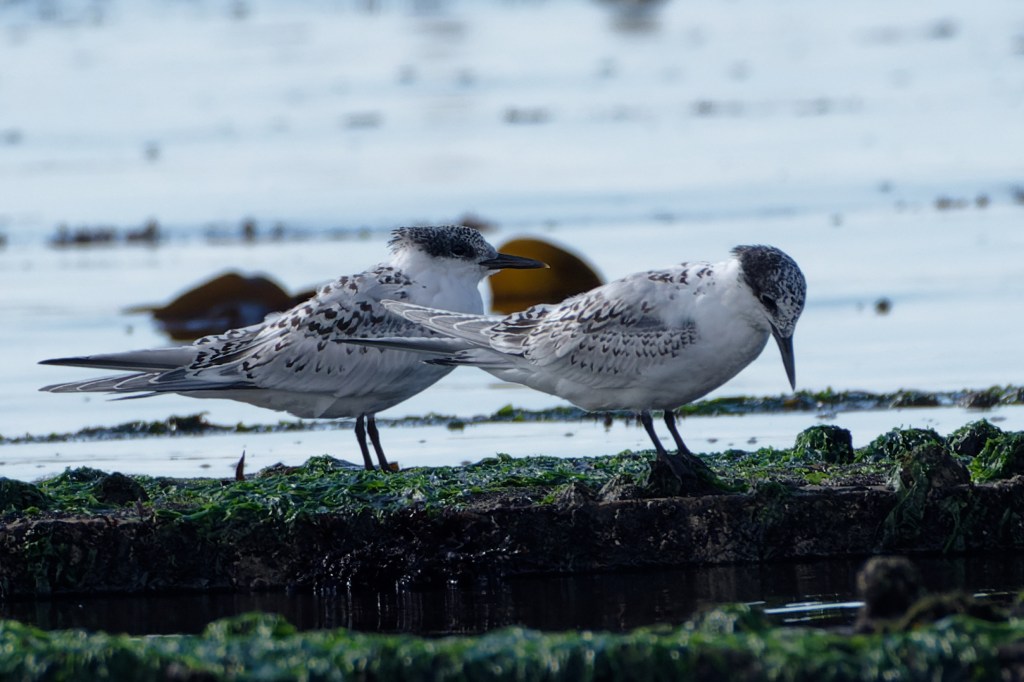
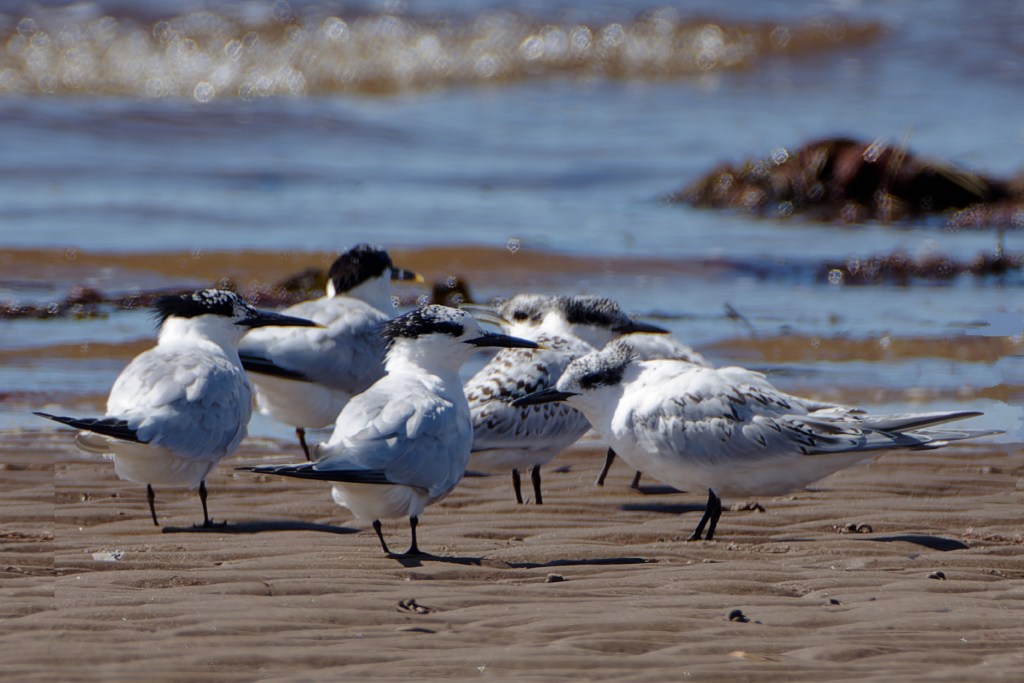
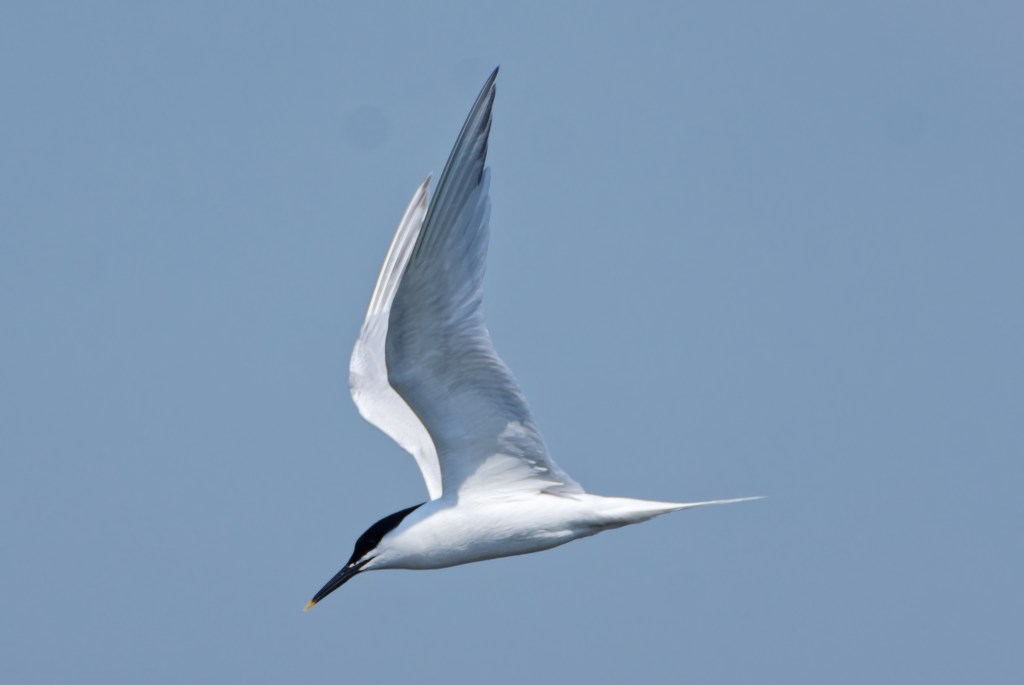
In full fig, the cap of the adult bird is intensely black and glossy; just when you thought the Terns of the southern ocean had all the style going, here is pure greyscale chic. And what a shape to be throwing!

The odd bird from this large group went fishing and came back with prey; unfortunately, none of the images of birds bearing Sandeels or Rockling are good enough to share.
Most of the birds were sedentary, seeming to wait for a turn in the tide, or the wind. We left them sitting along the pipeline; we hoped that none of the Ayrshire dog walkers would aim their animals at the birds, as they are wont to do when there are waders or other birds on the shoreline.
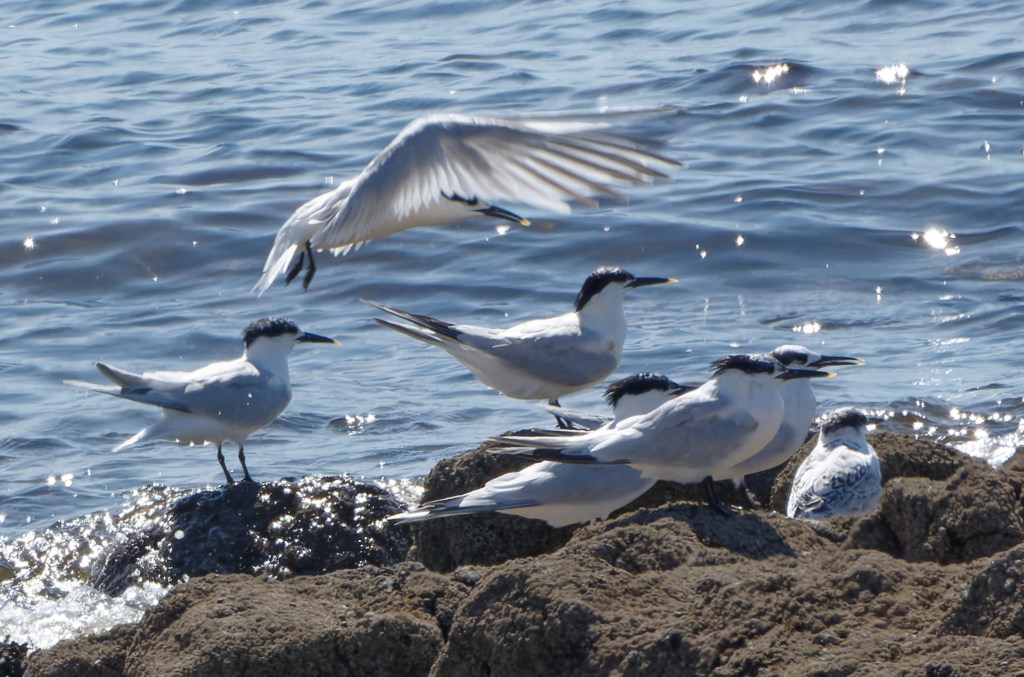
Like other Terns, these birds come to the shores of the UK to breed. As autumn arrives, they head south to Africa to over-winter. Backwoodsman is interested in where this group of birds at Stevenston has come from in the short term. The mixture of chicks and adult birds would suggest proximity to a breeding site – but where? This remains an open question.
It seems entirely reasonable that the locations of breeding sites are not publicised, unless they are located within protected areas. The NNR site at Forvie is a celebrated example of a successful Sandwich Tern breeding colony (though it did suffer when the Avian ‘Flu was at its peak).
The Terns make nests in the dunes at Forvie, with pairs packed in tightly. Unlike some of the other Tern species, they do not defend their breeding sites , responding to trespass and intrusion by abandoning their eggs.
Backwoodsman’s attempts to find reports of breeding sites on the west coast turned up a reference to Loch Ryan and a project funded by Equinor, a major generator of renewable electricity through wind farm installations. The project website claims that there are no Sandwich Tern breeding sites on the west coast of Scotland. “While these birds can still be spotted regularly in the local area, there is no longer any nesting activity of Sandwich terns around Loch Ryan or, indeed, across the west of Scotland.”
The project website refers to a now lost former breeding site on Loch Ryan and proposes to create de novo a purpose built environment high up the Loch. This sounds great; why, you ask, would Equinor bother? It appears that Equinor’s establishment of major wind farm capacity on the east coast may militate against Sandwich Tern migration and foraging, and that the west coast activity will take place in mitigation. BTO research appears to show that Sandwich Terns learn to avoid areas of the coast which have high turbine density, funnelling their activity through more open space. They also seem to be quite dependent upon Sandeels – this dependence seems to be bad news for seabirds generally due to fishery pressure, an issue discussed in the Puffin post, and revisited recently on the BBC.
Equinor own 80% of the Rosebank Field off Shetland, which was in the news again recently; its proposed expansion is now subject to judicial review which the UK government has decided not to fight, should the review find against the granting of further licenses. Backwoodsman scoured the list of new Renewable Energy Contracts (Contracts for Difference Allocation Round 6 results) announced today, but didn’t find Equinor in the document. Have they gone off renewables a bit, ermm, going forward?
So yet another species against which modern life seems to raising all kinds of barricades. Backwoodsman was reminded of his attendance at a reading by the late John Burnside which took place at Bar Gandolfi in Glasgow some years ago. It was just great; Backwoodsman became a Burnside fan-boy on the spot. Burnside introduced one of his poems by speaking about the Sustainable Shetland campaign. It had originated to fight the proposed Viking Wind Farm, an enormous development which would take place smack dab across the pathway used by Whimbrel as they made their way south from breeding grounds far in the north, through the UK and on to African wintering sites. This development seemed like a bad thing and Backwoodsman sent money to Sustainable Shetland for some years.
Well unsurprisingly, Sustainable Shetland lost. The Viking wind farm opened recently: “Power is flowing from the Shetland Isles to mainland Britain for the first time as the UK’s most productive onshore windfarm comes on stream. SSE says its 103-turbine project, known as Viking, can generate 443 megawatts (MW) of electricity, enough to power nearly 500,000 homes.” That’s all good then?
Five seabird species (including a Tern) joined the UK endangered or Red list in the last twenty-four hours; Avian ‘Flu has laid its dead hand here, but it seems most likely that human interventions will have been significant.
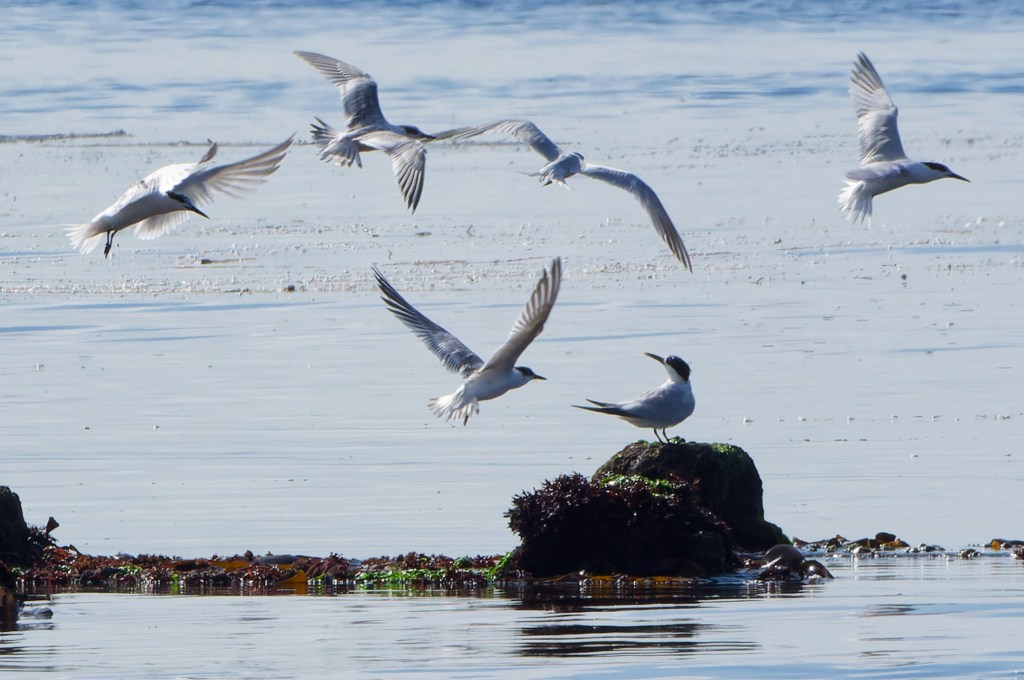
Anyway, we visited Barassie Rocks a couple of weeks ago, very close to the anniversary of the Stevenston visit when the Terns came to see us. There were of the order of a hundred birds sitting out on the rocks. The light was decent and there weren’t many dogs, probably because it was really cold, with a savage wind blowing from the south. It was all streaming eyes and shaky camera but whatever – the Terns were delightful to watch and within a reasonable range. Most were sitting, but suddenly, there was a bird on the wing, a glittering white blade slicing across the grey sky.
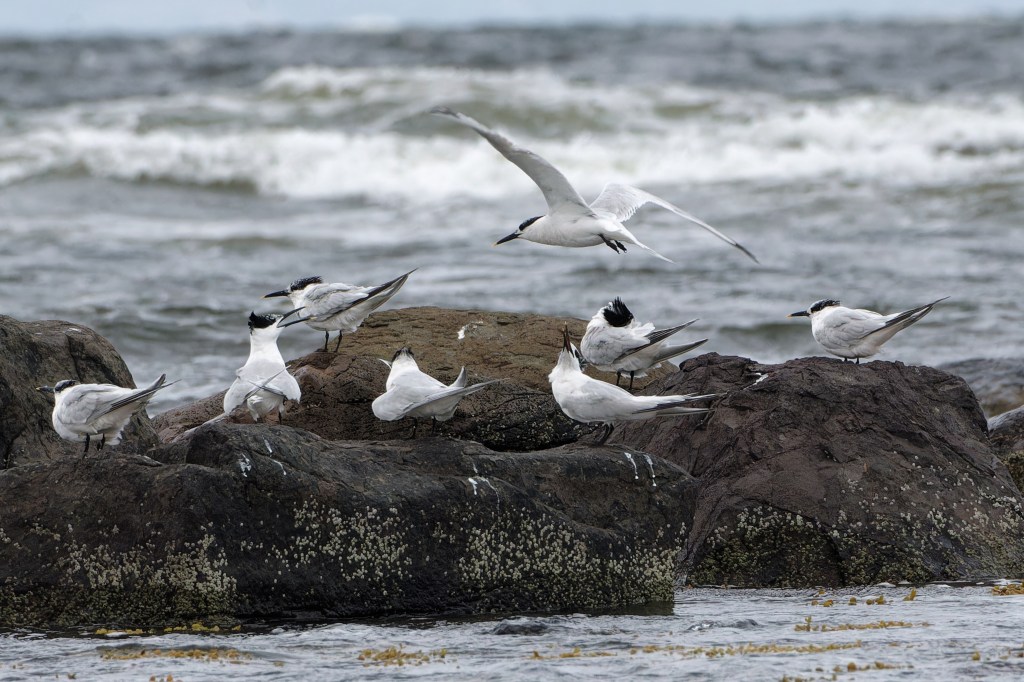
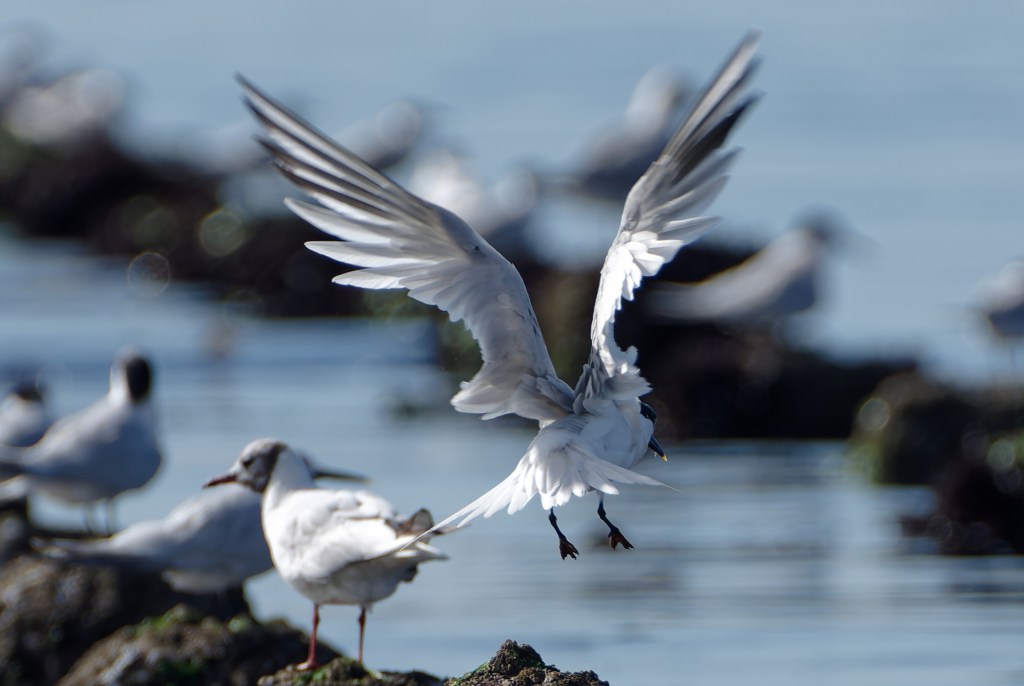
There was hoarse chatter between birds in repose and those flying above them: family groups perhaps, or partners bickering? The fishing behaviour is mesmerising; the birds glide close to the surface, looking. Then there is the climb, the fold of the wings and the dagger plunge into the sea, then up again and away with a small silver plunder.
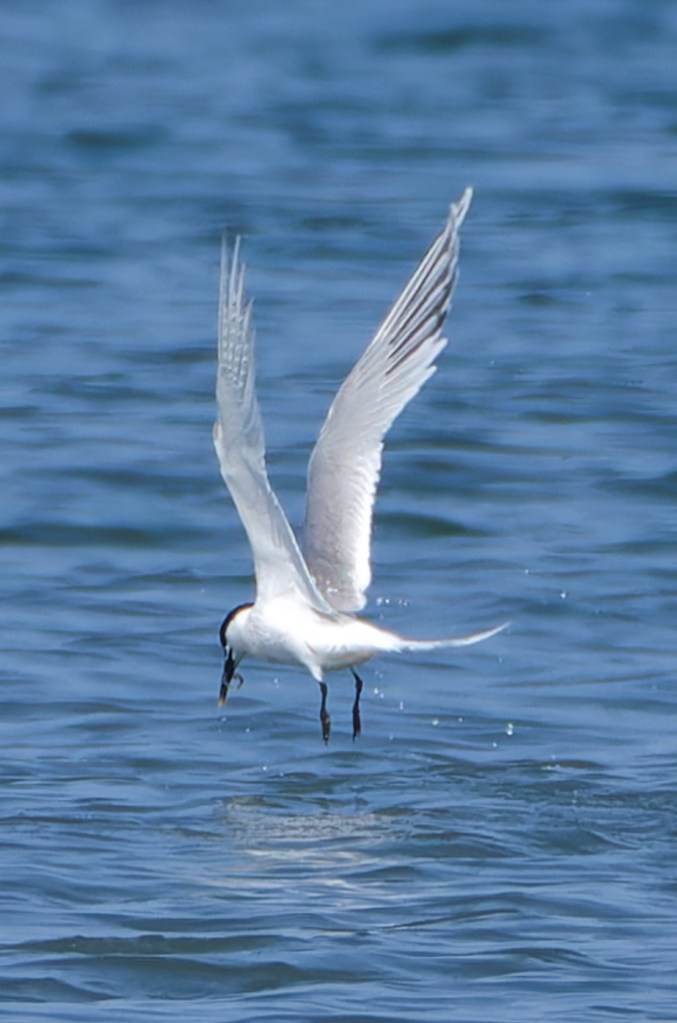
Can there be any shape more elegant on the wing than a Tern? Backwoodsman has tried really hard to get the moment of the dive, massive fail!
The Sandwich Terns will head south soon; the EuroBird Portal Viewer which features on the BTO website, suggests that they will be gone early in October, and back mid-March. Good luck Sandwich Terns on your long flight south; come back to us bearing the spring on your silver wings.
PS. It is hoped that the proposal for a new resort at Balloch will have been resolved once and for all by the time the Sandwich Terns grace our shores again.
 backwoodsman.org
Lovely article! For a bit more about Forvie’s Sandwich Terns, see this link… https://forvienationalnaturereserve.home.blog/2020/06/14/going-global-forvies-terns-and-their-place-in-the-world/
All the best, Daryl
LikeLike
Thank you Daryl. I did read your excellent post but accidentally deleted the link from my prep list when I was putting the post together. I hope to see a breeding colony one day and watch and photograph the courtship behaviour. My very best wishes for your work at the reserve. Jonathan
LikeLike