It’s that time of year again. The little students are back, shuffling along University Avenue at quarter-speed and rendering it all but impassable. In the subject villages, apprehensive staff ask each other about holidays, putting off the evil moment when teaching timetables must be contemplated and the questions from wonks about REF outputs, answered, or possibly deflected. So, we went to Golfo di Aranci in Sardinia and it was great, thank you. Faye took the appropriate Lawrence book and Backwoodsman took his camera kit, hoping to see all manner of Mediterranean exotica on the wing. Faye finished and enjoyed the Lawrence, regaling Backwoodsman with tales of the privations endured by Dave and Frieda. Backwoodsman stumped about with the camera, getting hot, but not seeing many birds. Hmmm.
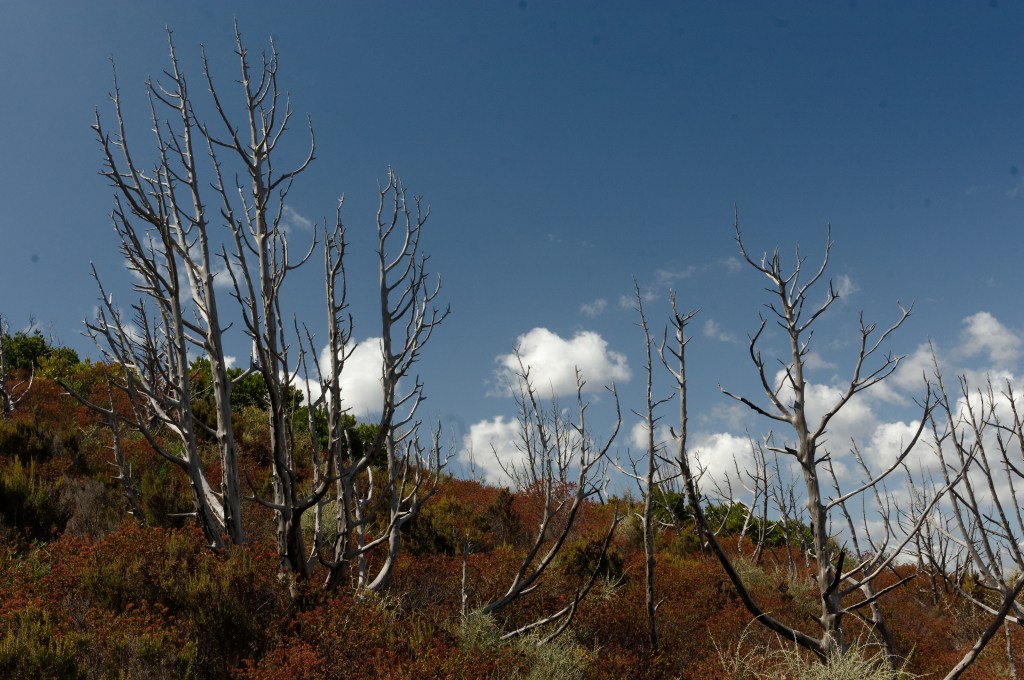
The landscape had a burnt look; under still conditions, even short walks would have proved difficult, but we had the benefit of a very strong breeze on several days. On such days, we could explore the Capo Figari, a headland made principally of Limestone (much of Sardinia is Granite). Several walking trails were available, including one (Sentiero dei Carbonai) which took us up towards the outcrop of Rocca Ruja (just left of centre in the image).
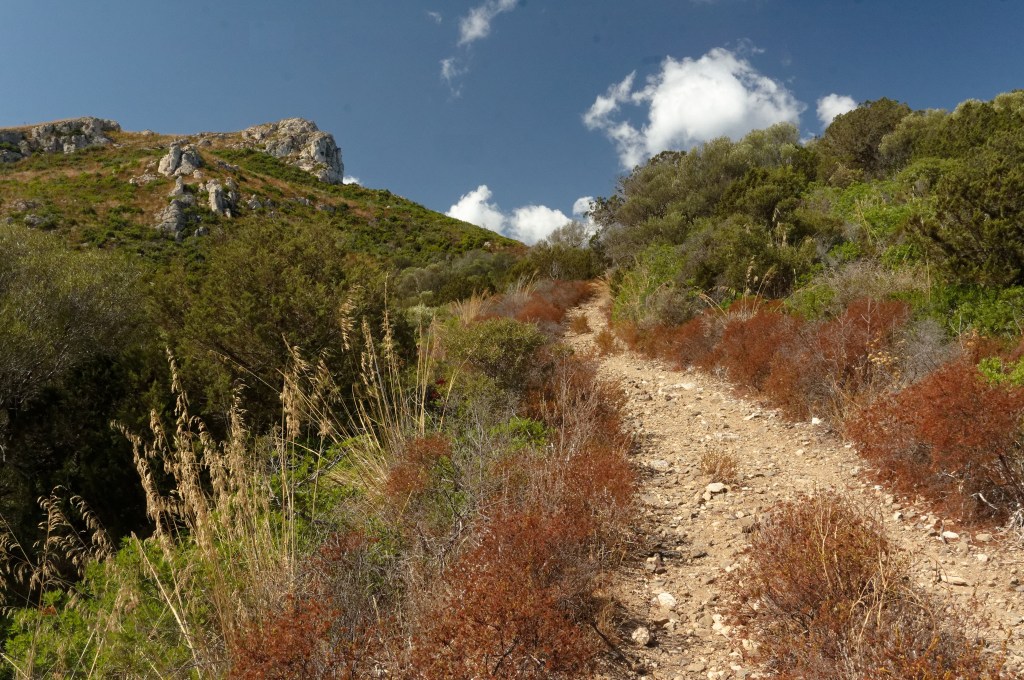
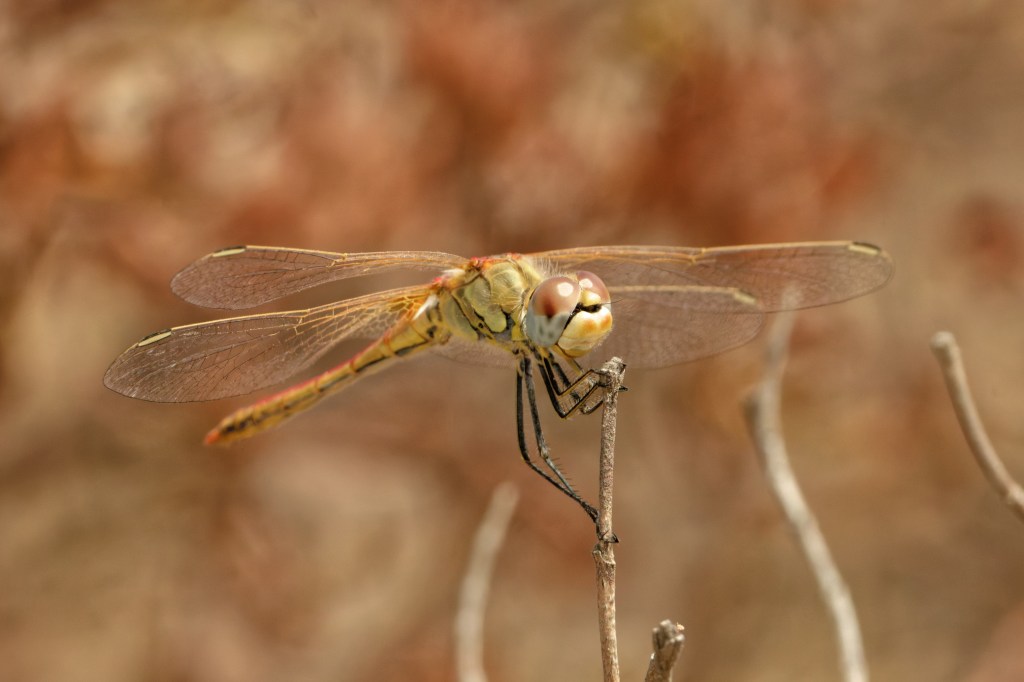
The track went over a shoulder at 83m and there we found Red-veined Darters.
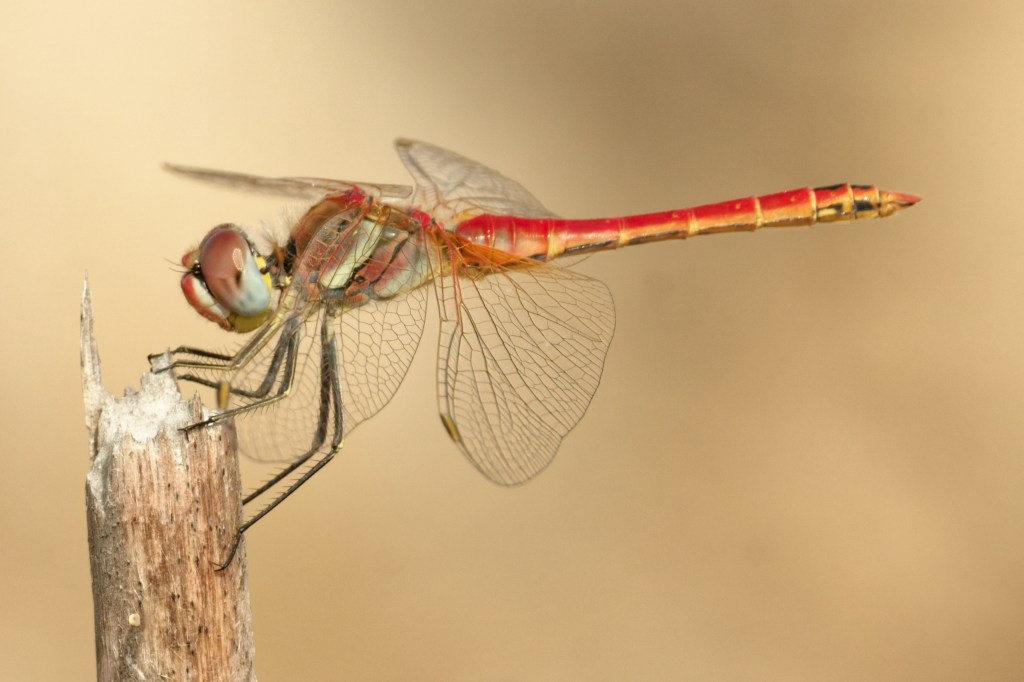
The superb light allowed quite a fast shutter speed to be used, which was important as the photographer was being blown about and the camera was doing its best to swing around on the monopod. The dragonfly was vibrating in the wind but between gusts, some decent images could be had. Backwoodsman is standing away and using full zoom to get a decent dataset without looming and disturbing the insect. The resolution of small parts of the insect like the bristles on the legs and the tufts behind the head is really quite pleasing. And don’t the colours sing?
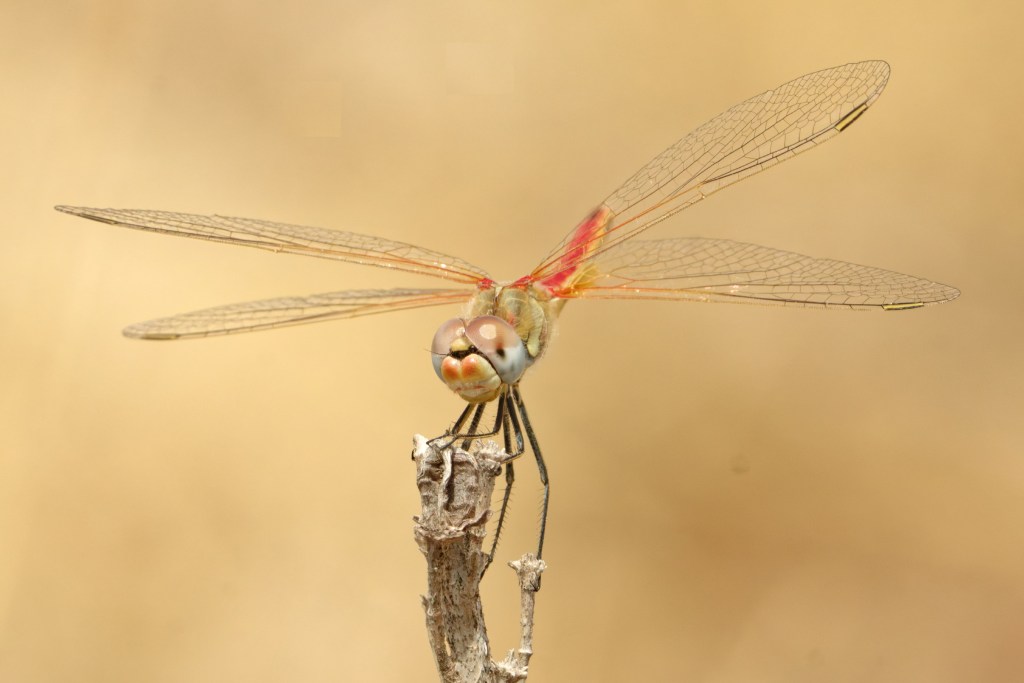
The Red-veined Darter can be distinguished by the blue eyes, pale pterostigma (wing spots) outlined in black, and the coloured wing veins (red in males, yellow in females).
From Wikipedia, it seems that “the pterostigma, a heavier section of the wing than nearby sections, assists in gliding. Without the pterostigmata, self-exciting vibrations known as flutter would set in on the wing above a certain critical speed, making gliding impossible.”
The insects had favoured perching posts which they returned to frequently, and from one day to another. This female perched nicely, showing the yellow wing veins really clearly.
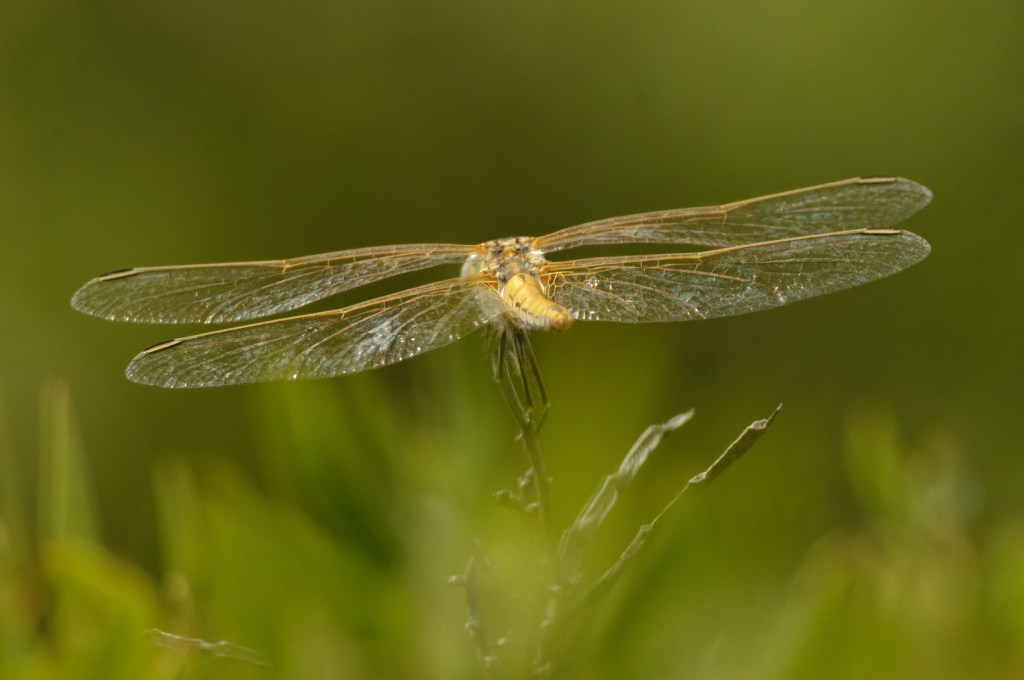
The blue eyes are shown well in this image.
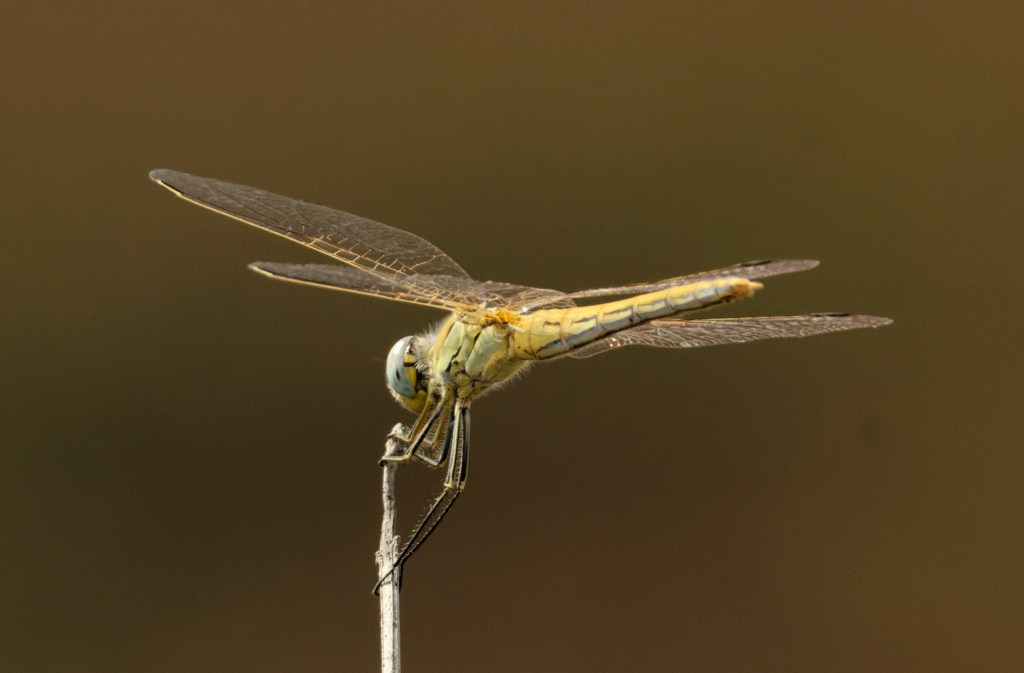
It would have been great to see a Darter take another insect on the wing and return to the post to eat its prey but Backwoodsman was pleased to see the Darters defy the gale and hang on to their perches for some good images to be had.
Backwoodsman did not know much about Dragonflies before starting to think about this post. Groups based in Australia and Sweden carried out original work to reveal some of the neuroscience upon which Dragonflies rely in their hunting. A commentator wrote in Nature that “Dragonflies are reported to successfully catch up to 97% of their targets, using clever interception paths that predict prey’s future location. Undaunted by swarms of potential distraction, they hunt within visually cluttered environments like the riverbanks they call home.”
The groups implanted miniaturised electrodes in the optic lobe of dragonfly brains to monitor electrical activity associated with the pursuit of prey. Processes of prediction, attention, and filtering were identified, located in a neuron named ‘Centrifugal Small-Target Motion Detector 1’, or ‘CSTMD1′
From the commentary: “When a prey-like target zips across the dragonfly’s visual field, some neurons encode the area ahead of the target, exhibiting an enhanced sensitivity in this region and suppression elsewhere. This likely prepares the dragonfly to respond to an imminent target and forms a prediction of the prey’s trajectory, even if it becomes obstructed (such as when it flies behind the leafy branch of a tree). The second property is ‘Selective Attention.’ When presented with a pair of rival targets moving on different trajectories, a dragonfly must choose only one for lunch, or risk missing both. In a winner-takes-all manner, CSTMD1 responds to just one of the rival pair, encoding the target’s trajectory in a train of electrical impulses, ‘spikes’, unperturbed by the presence of the rival distractor.”
The dragonfly can even strike “a balance between attention to one target and flexibility, allowing the world’s most successful predator to ignore other forms of visual distraction and keep its eyes on the prize.” The original (open access) paper can be found here. Figure 6 on page 9 represents the processes of target selection and the suppression of distracting signals graphically.
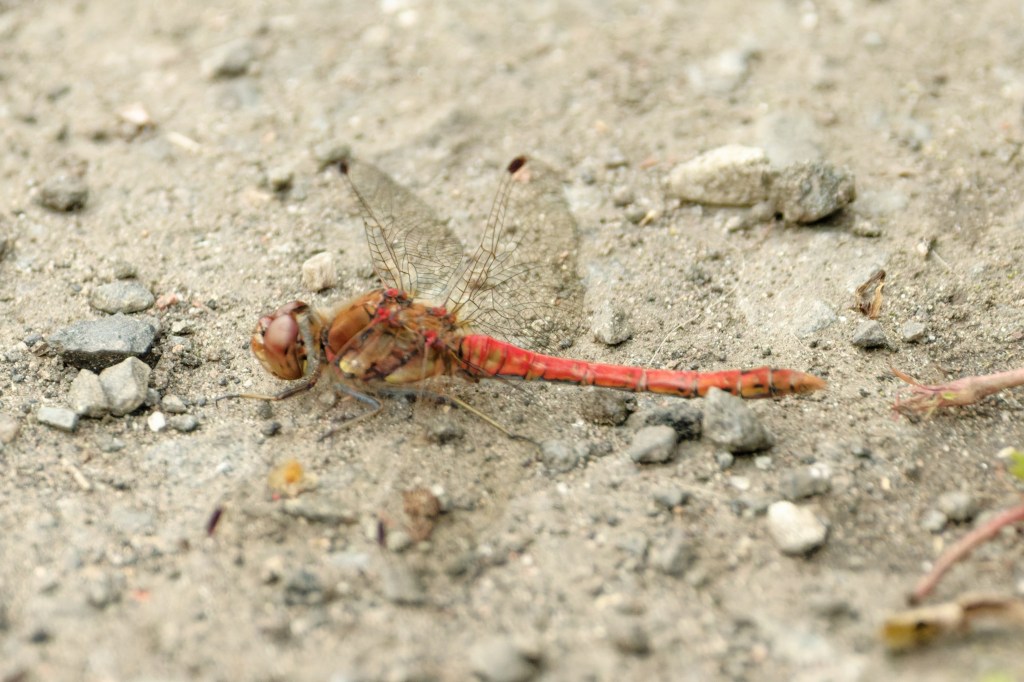
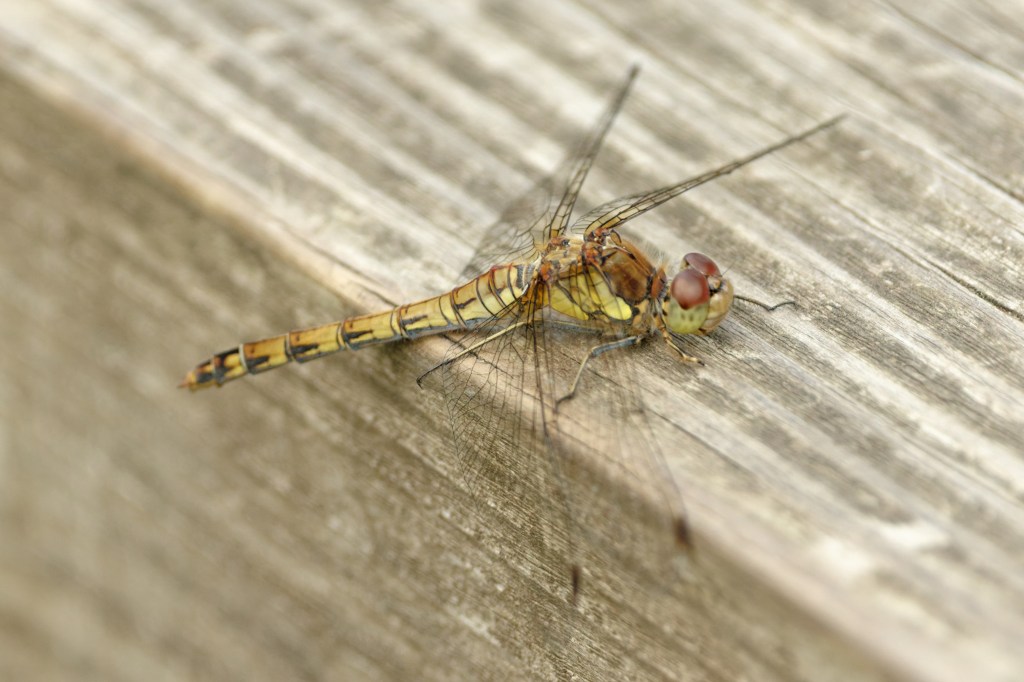
A search of Backwoodsman’s archives revealed images of Common Darters, a species native to the UK. Red-veined Darters are visitors – better to call them this rather than migrants, in case some yobs with flags show up and try to burn down the places in which they stay.
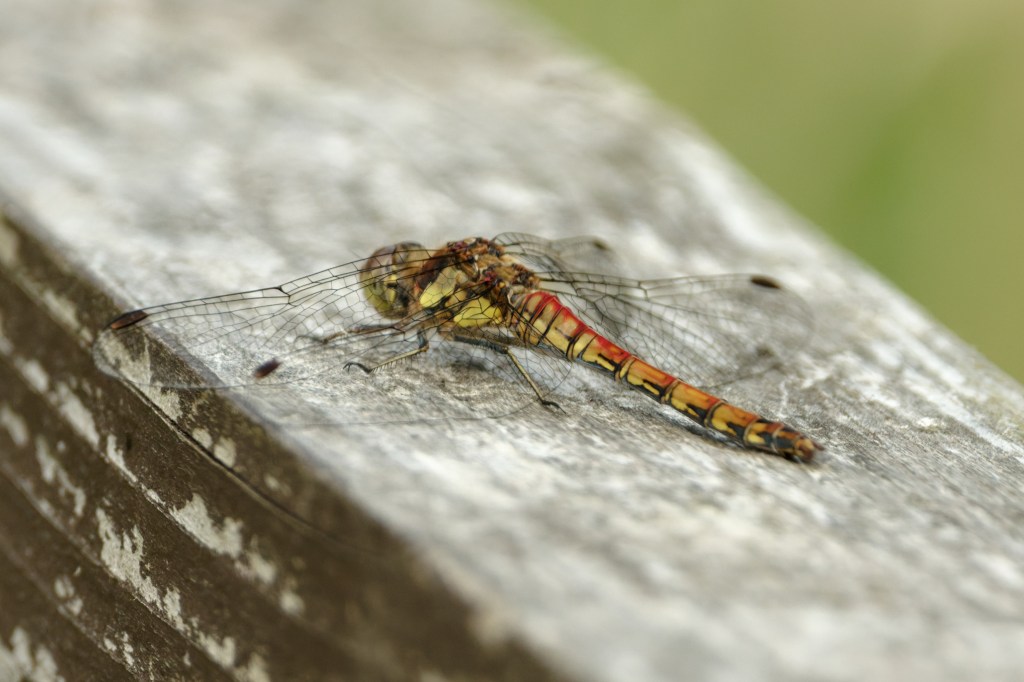
We came across these insects between Hogganfield Loch and Cardowan Moss. What a difference the strong sunshine makes to an image!
Other insects were to be seen in Sardinia and Backwoodsman used the Picture Insect app to begin their identification – Backwoodsman is a beginner when it comes to insects. Pale grasshoppers would ping skyward with a flash from beneath our feet as we walked. One stayed long enough for this image to be acquired.
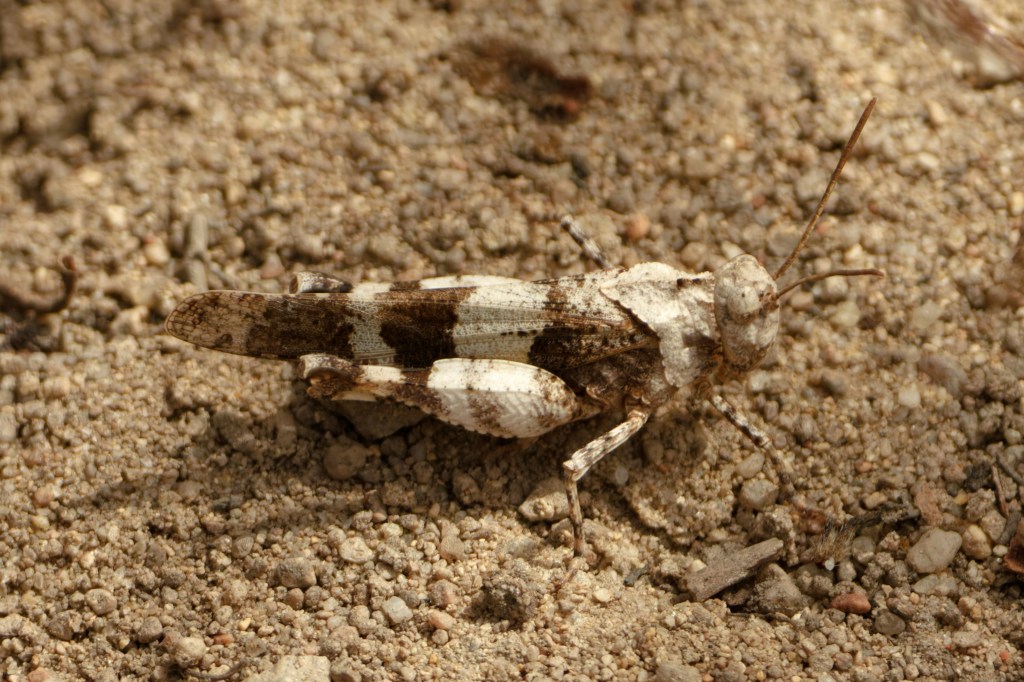
Picture Insect says this is Oedipoda caerulescens, the Blue-winged grasshopper. We did not manage to see the rather striking underwings clearly, but a flash of this delicate colour in strong light would explain the sudden brightness as the insects took to the wing.
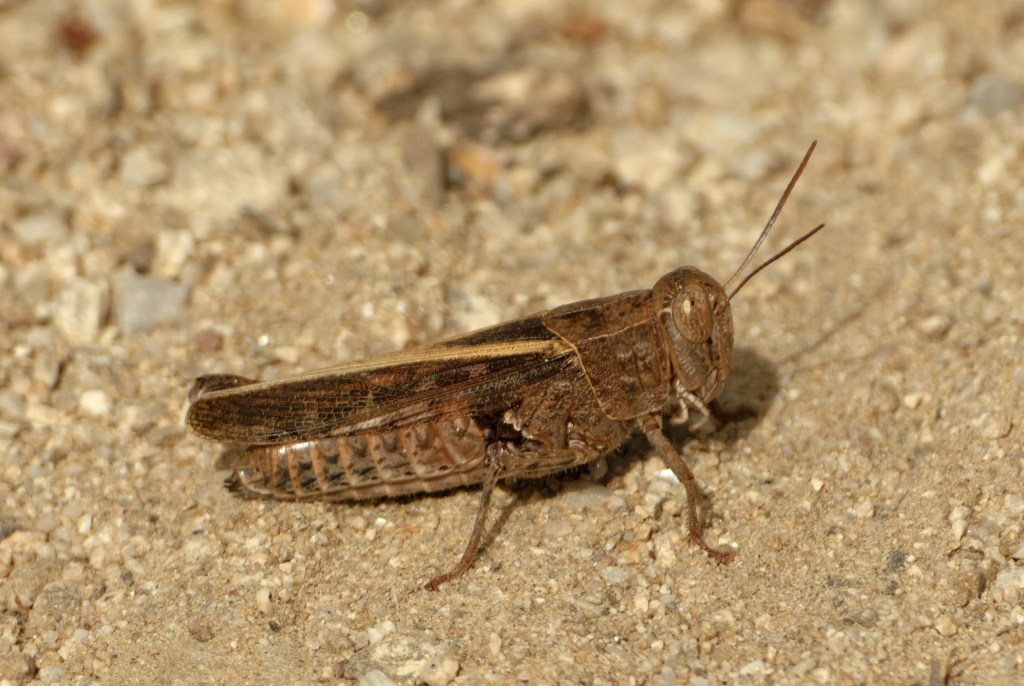
The App identifies this species as an Italian locust Calliptamus italicu. Locusts have been a bit of a problem on Sardinia in previous years with a serious irruption relatively recently.
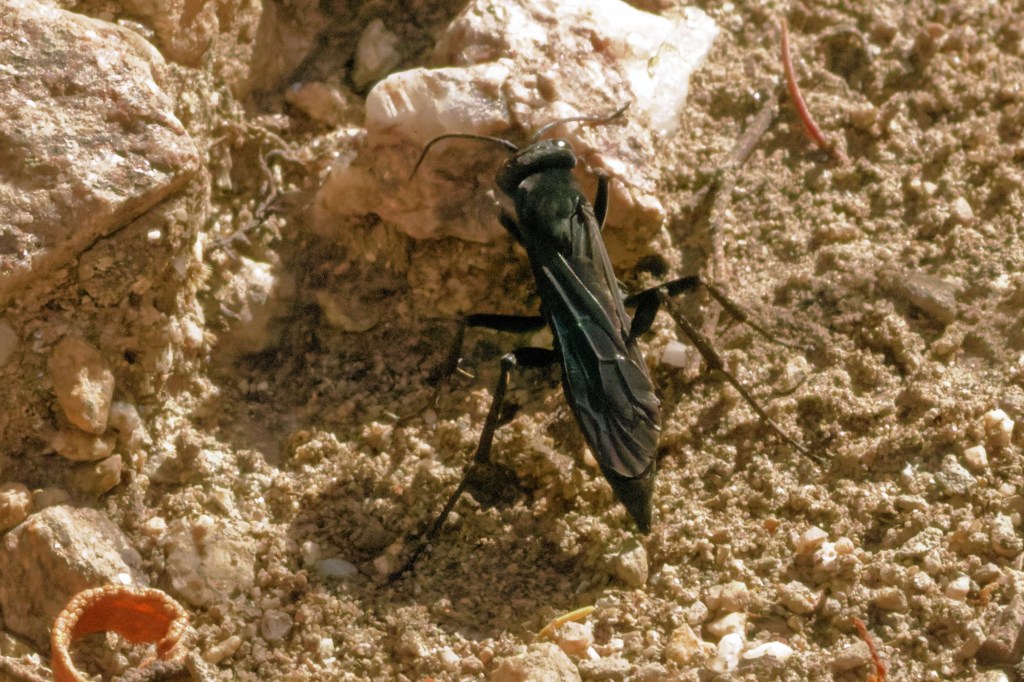
Picture Insect identifies this as a Blue mud-dauber wasp Chalybion californicum, a native of North America but known to have been introduced to Croatia. It is a spider hunter and our specimen was running on the ground, looking under stones and into crevices. There are a lot of different Chalybion wasps; see this link for a list of species. It may be that the training set (of only 4000 species) for Picture Insect has a North American bias, or the Blue mud-dauber may be on the march.
In this strong light and wing-folded posture, neither the blue colour nor the extremely narrow connection between abdomen and thorax are visible. This image has a similar overall appearance to our specimen.
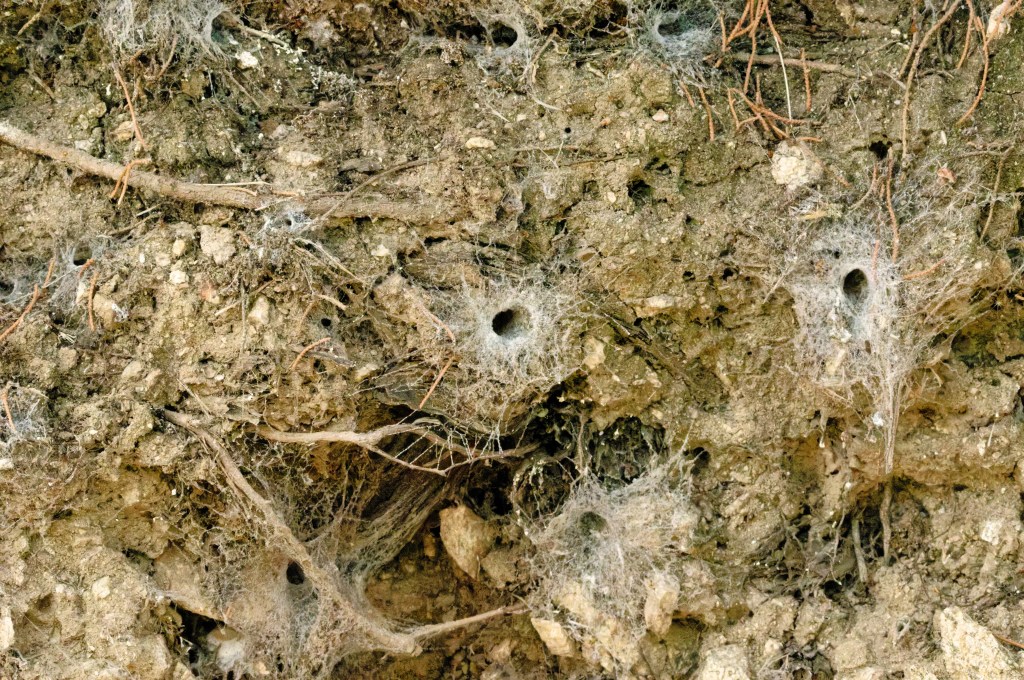
We also noted many silk-lined tunnels in the area where we found the wasp – it looks like the odd spider might be around for the wasps to munch.
No doubt about this chap though – a Tyrrhenian wall lizard, handsome with his malachite-green tail.
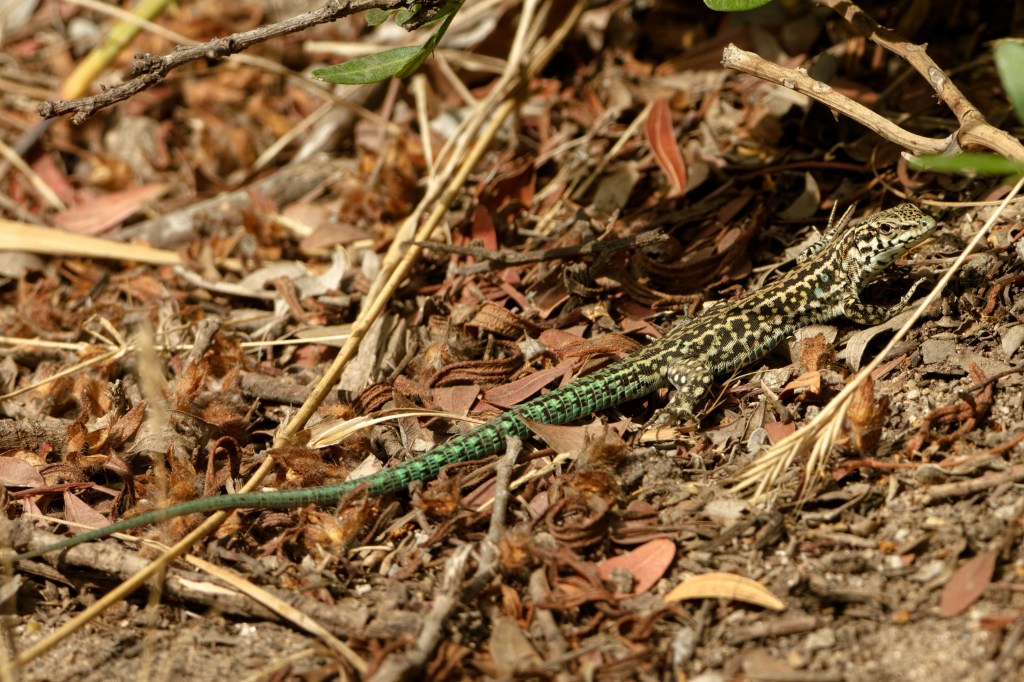
We saw many of these, usually just heading into the undergrowth, but occasionally pausing long enough to show just how splendid they are.
Of birds, we saw few. A flock of Green Parakeets sped from the undergrowth as we climbed towards Rocca Ruja. We saw an elegant falcon soar across the hillside then vanish, and hirundines (House Martins and Swifts) swept over our heads out on the Capo and at the hotel. We heard warbler-like clickings and scratchings from the undergrowth but found that the Merlin App was usually defeated by the strong wind or the lack of an internet connection. The songbirds behaved like they were hunted regularly, or predated in some other way.
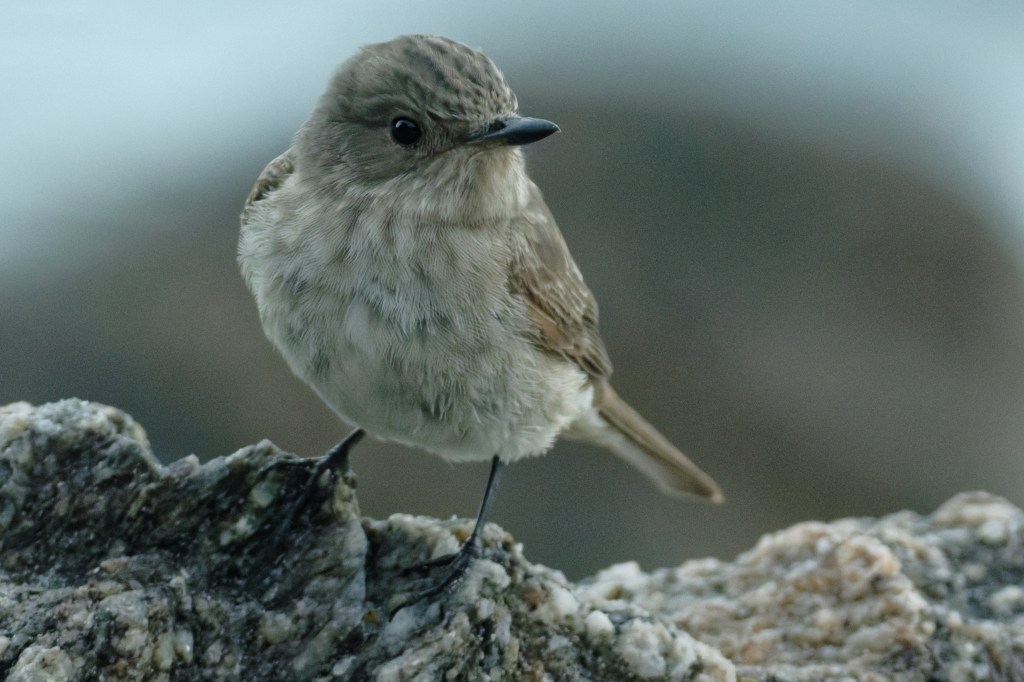
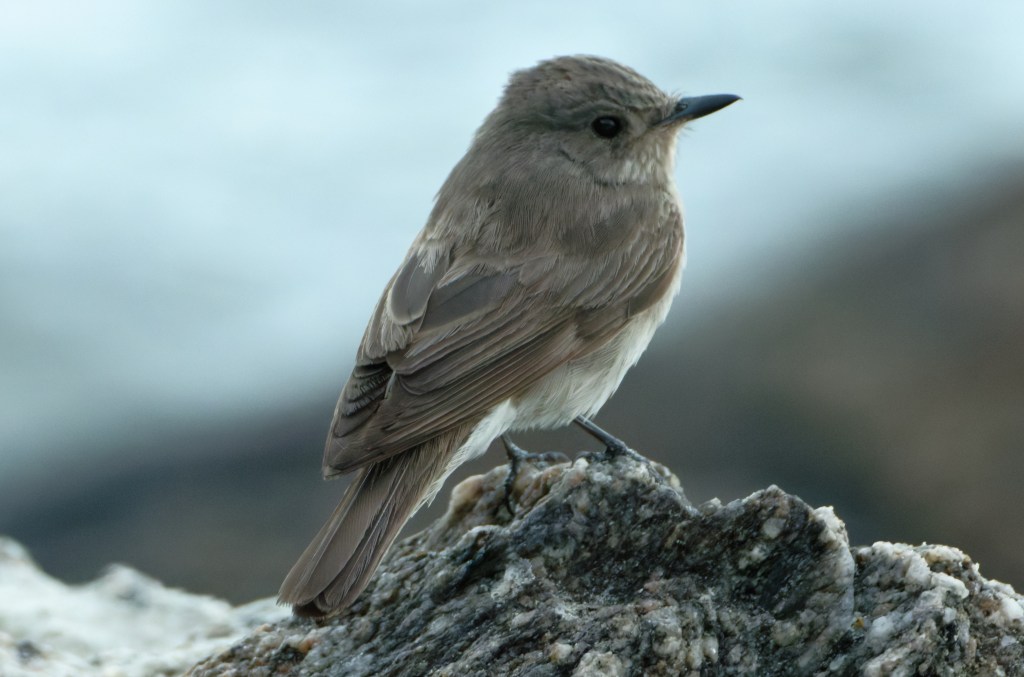
It was really only at the hotel where we came across a bird which would show itself. We developed an aperitivo habit and were visited on the terrace by a small chat-shaped bird which would perch, and fly out and down before returning to a vantage point. We were delighted to have the company of a Spotted Flycatcher. As the British Trust for Ornithology say “More streaked than spotted, this small grey-brown, long-winged flycatcher is a dashing bird of woodland, parks and gardens. Spotted Flycatchers spend the winter months in Africa and BTO research has shown that some head as far south as Namibia, around 7,000 km from their breeding location. A host of summer migrants are experiencing declines in their breeding populations and the Spotted Flycatcher is one of these. It has been on the UK Red List since 1996.”

Our bird seemed to have a territory bounded at one end by a thicket beside the hotel pool, and at the other by some rocks on the beach near the lifeguard’s chair and ladder. During the middle of the day, the bird could be heard moving about in the thicket; at the hour of the aperitivo, the bird would emerge and perch on the terrace rail, making very short flights to seize insects. But in the early morning when we visited the sea before breakfast, there were two birds, standing on the rocks for extended periods. Backwoodsman’s only real shots at anything with feathers! We were all in the shade, alas, but the image quality is not too bad.
They really didn’t seem to mind us, coming very close then darting away for fresh insects emerging from the piles of broken eel grass on the shore.
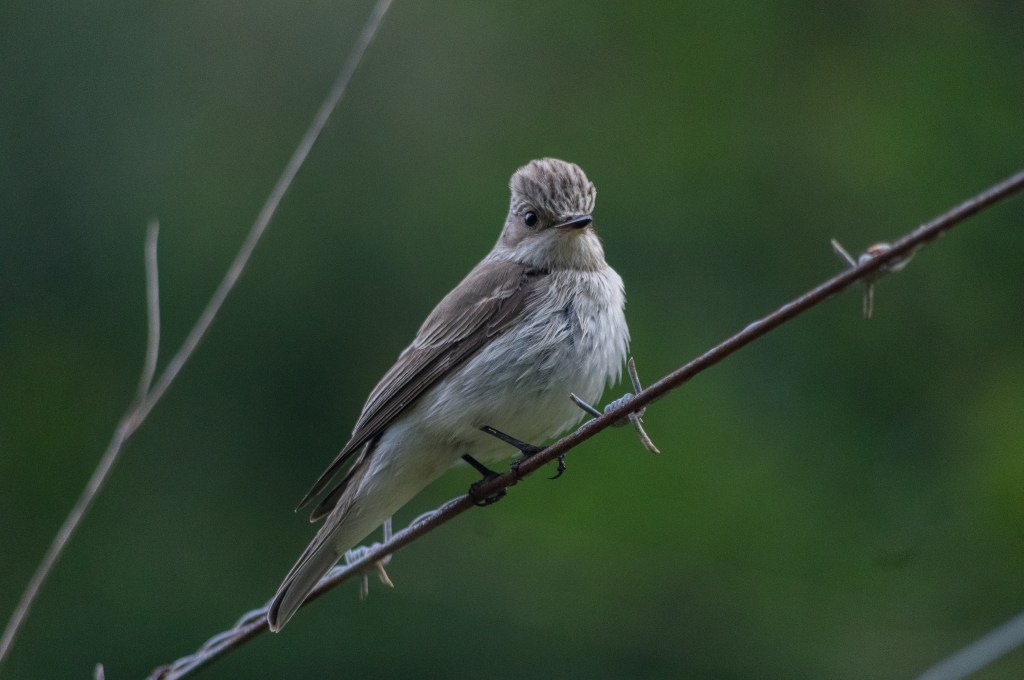
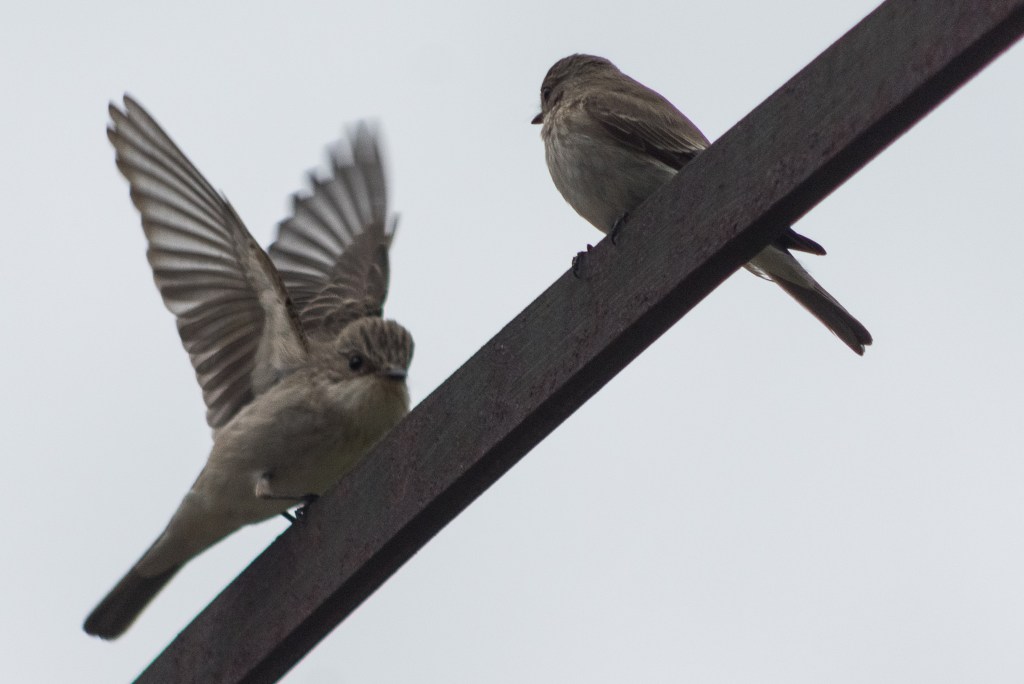
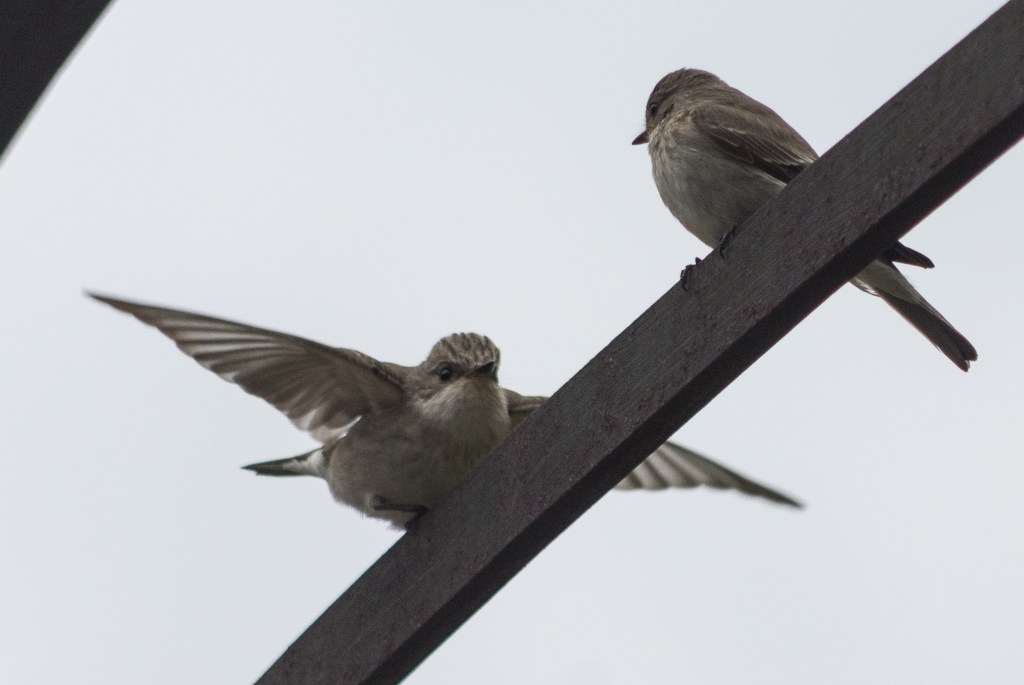
We had seen this species in Mallorca some years before – this bird has selected a good background. We also found a pair of birds making some wonderful shapes on that trip, and wondered if we were seeing a breeding pair, or an adult and a fledgling.
So that’s that. Bucket and spade packed away for another year but much to look forward to on the fresher shores of Ayrshire and the Clyde as the waders return for the winter. Our little part of Sardinia was vivid and beautiful and we certainly ate much better than Dave and Frieda, especially when we dined at La Spigola. Backwoodsman can imagine the hillsides ablaze with flowers and bouncing with birds in the spring.
 backwoodsman.org