Vigiljoch 1: through the air

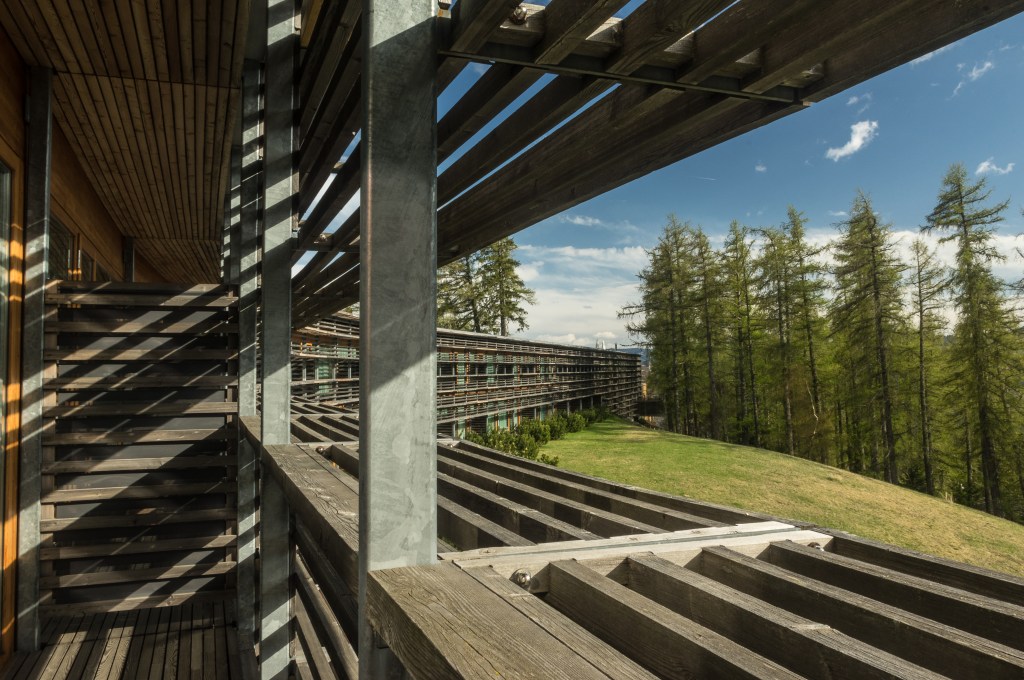
Backwoodsman had the good fortune to return to the Vigiljoch which stands above Lana in the Sud Tirol.  The mountain is really the first high point on a long ridge which extends many kilometers to the south-west. We stayed in a beautiful hotel (Vigilius Mountain Resort) which is reached fron the valley by cable car (Seilbahn); a chairlift (Sessellift) climbs from the hotel at 1486m to a spot height of 1814m.

The ridge is broad and undulating at that point with many well-marked tracks; those which head south-west climb steadily, reaching a spot height of 2608m at Naturnser Hochwart. We’ll return to this topic in a subsequent post.

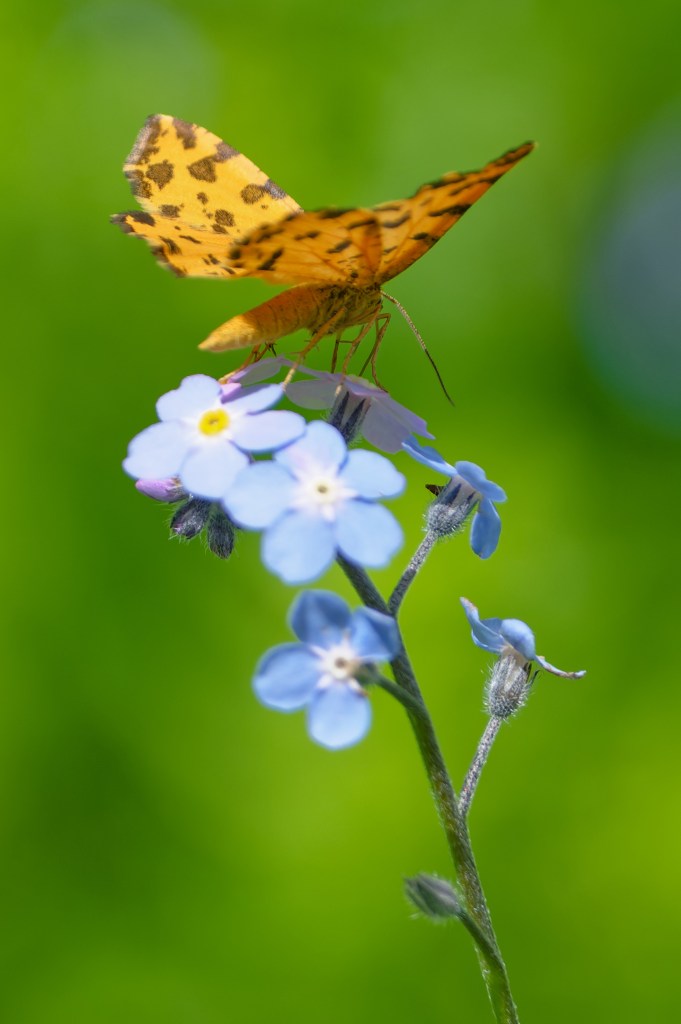
Our first visit took place early in May in 2019 when much of the land was trying to cast off winter: it was dry and tawny in colour. By mid-June, the timing of the 2024 visit, a transformation had taken place; there were flower-strewn meadows, much noise from crickets and grasshoppers, and butterflies on the wing. Backwoodsman is always pleased to be able to capture images of butterflies; looming is prevented by the use of the long zoom (though depth-of-field suffers). If you don’t loom, the butterfly may sit for you and show you both upper and lower wing surfaces. Patrick Barkham describes this approach of remote viewing in The Butterfly Isles.

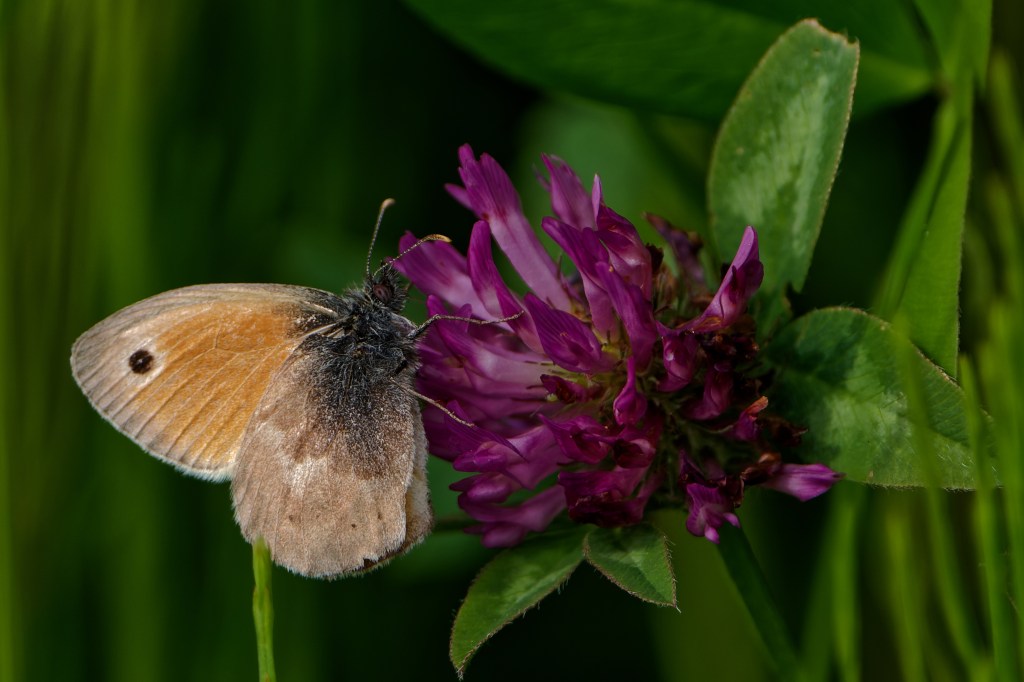
The Small Heath is not rare or unusual but it has settled on a Clover which makes for an attractive range of shades and tones in the image. Typically for this species, its wings are folded when feeding or at rest.

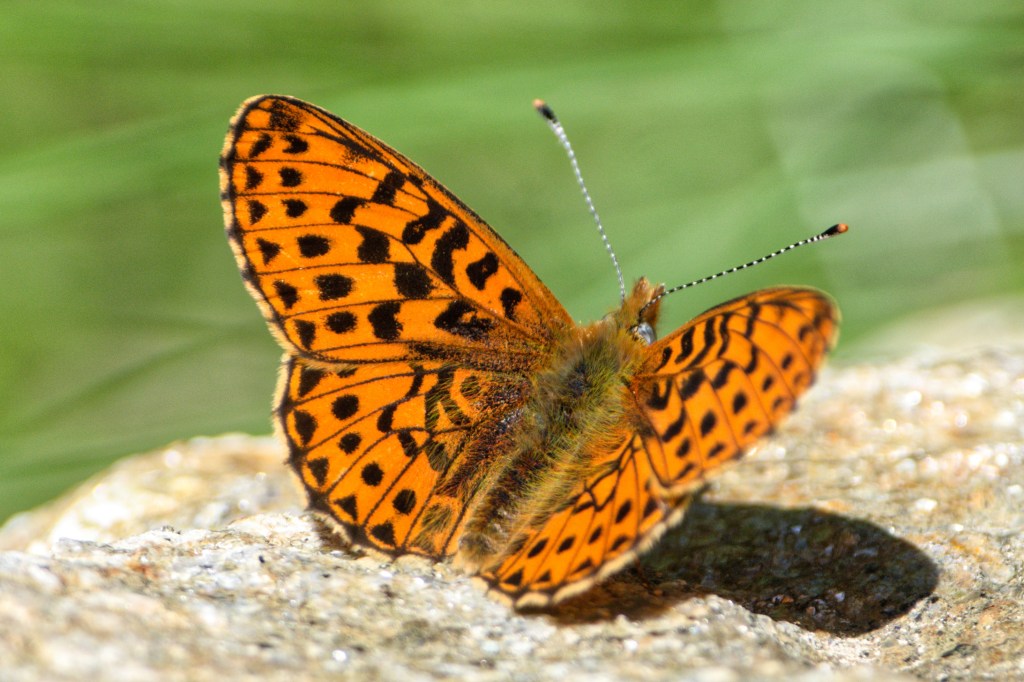
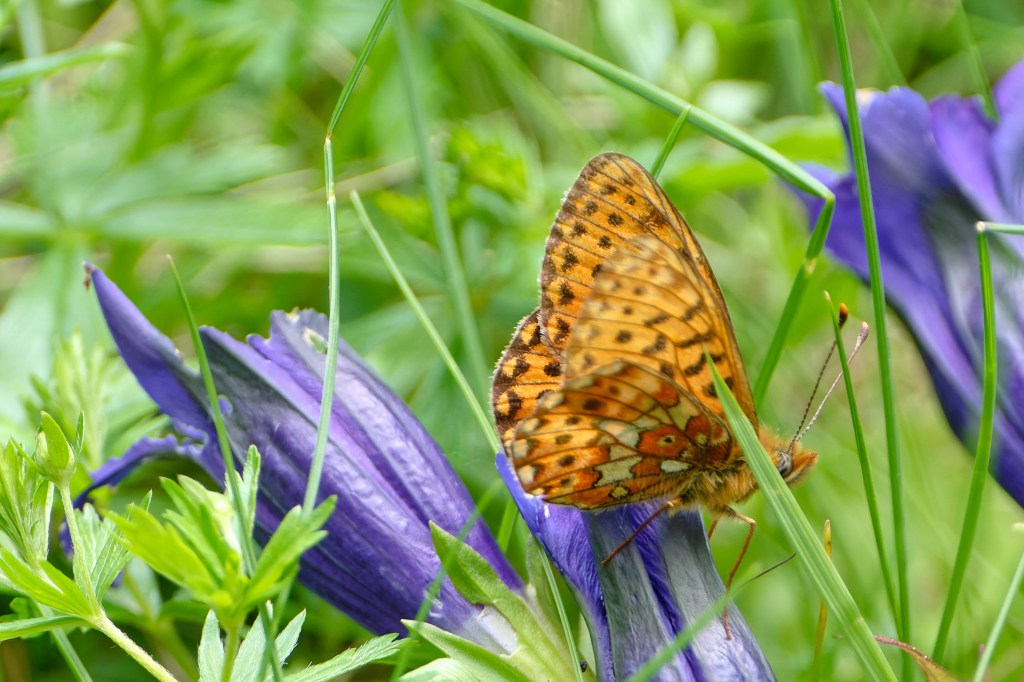
Strong light brought out the opulent colour of this Pearl-bordered Fritillary; the left hand wing and the body are in the same focal plane so the image is sharp, but the right hand wing is orthogonal to that plane. Backwoodsman is far from being a butterfly expert but believes the identification is correct; it is based on the pattern of black markings on the upper surface, and of white and yellow on the lower.

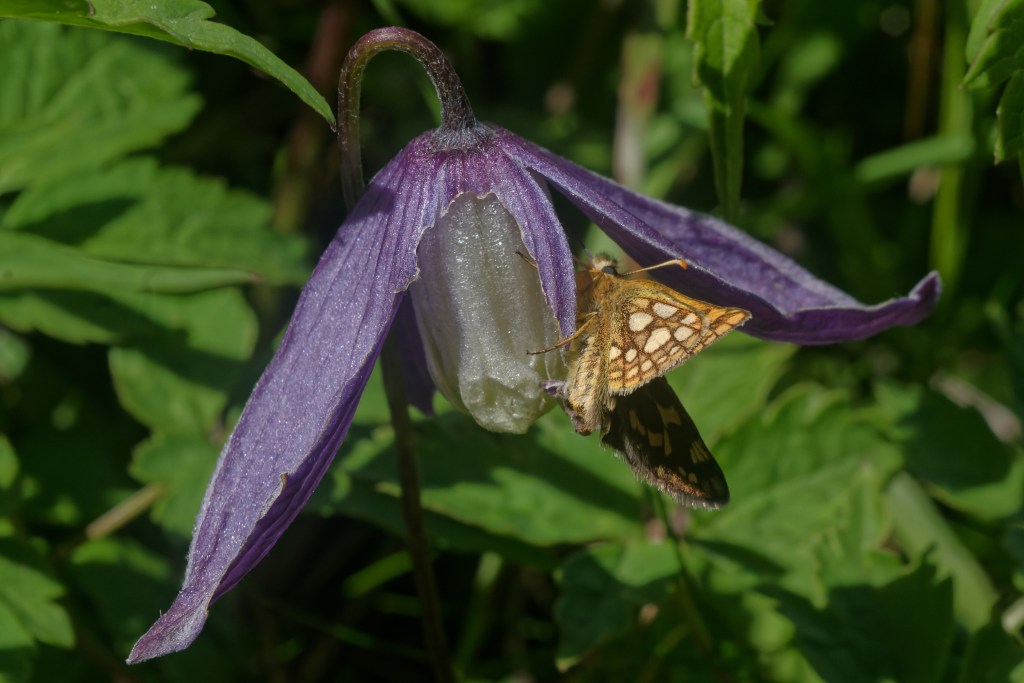
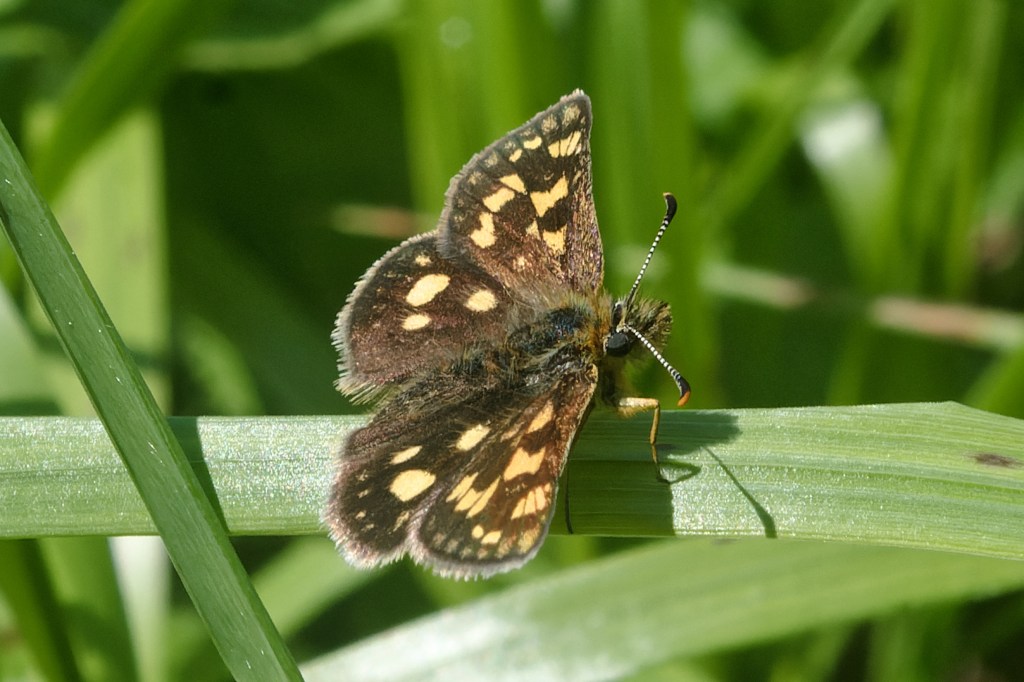
Backwoodsman has never set eyes on a Chequered Skipper before; this one posed very nicely, using a wild Clematis as a prop to show off the underwing. The depth-of-field in this image of the upper surface is quite good.

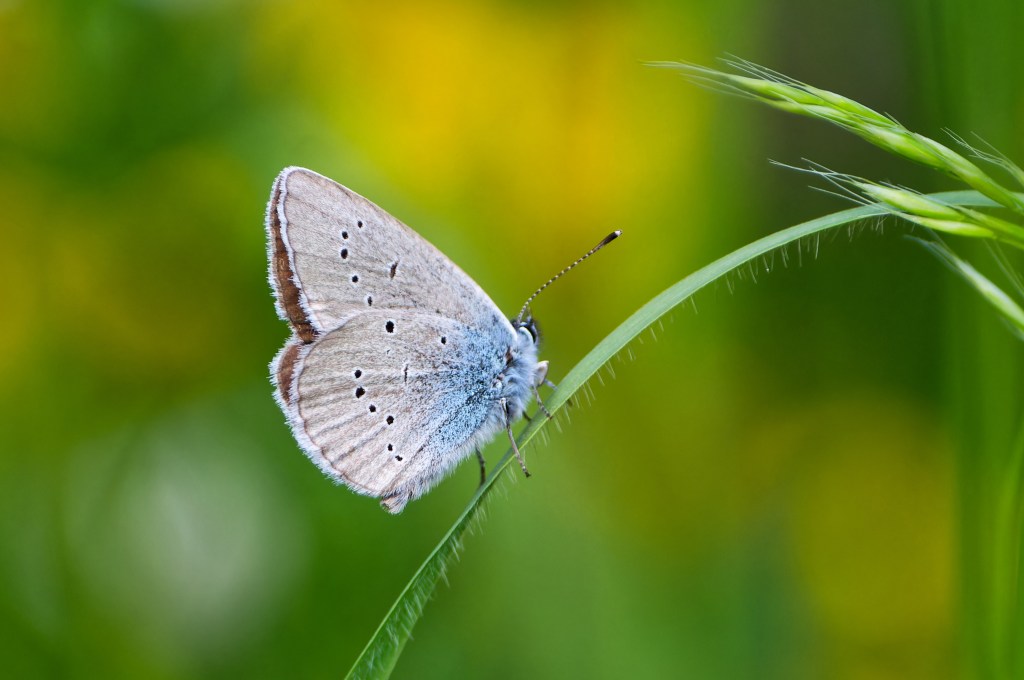
The meadow in front of the hotel yielded a couple of Blues, but Backwoodsman had to be very careful while prowling about here because of proximity to the buildings. The prospect of being mistaken for a papparazo was not pleasing, and might have led to a scene. Head down and be careful where you point that thing! This Small Blue is just showing the brown upper wing surface allowing the identification, but what is this second chap?

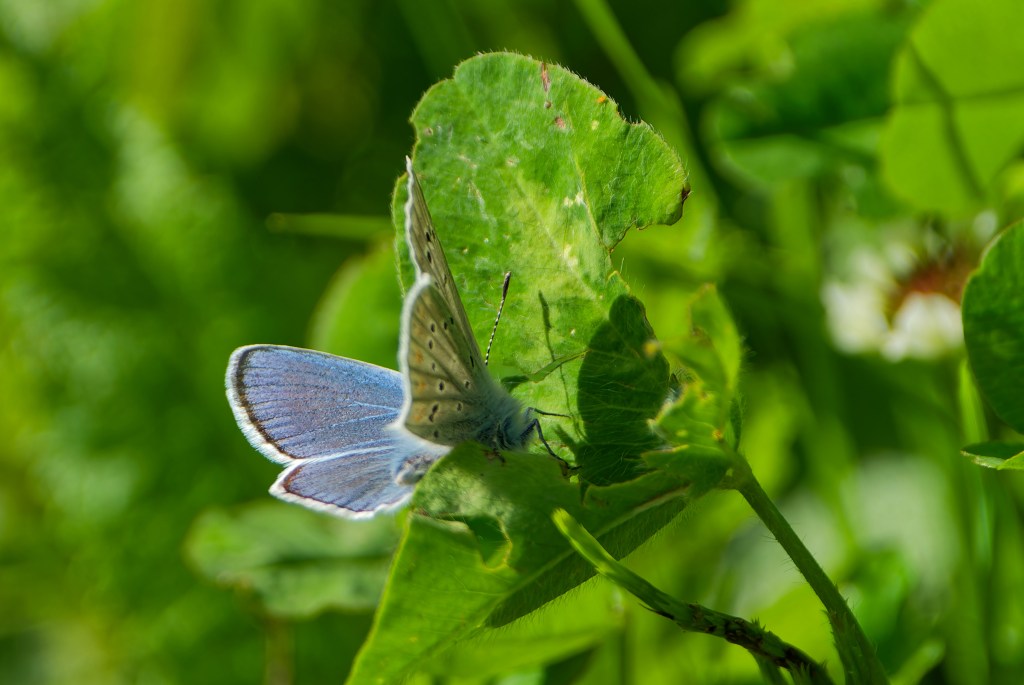
Backwoodsman’s money is on a Common Blue – this next one is definitely a Common Blue but please note the very strong pattern of spots on the lower wing surface. Could the strong light through the wing fade out that strong pattern of spots in the mystery species?

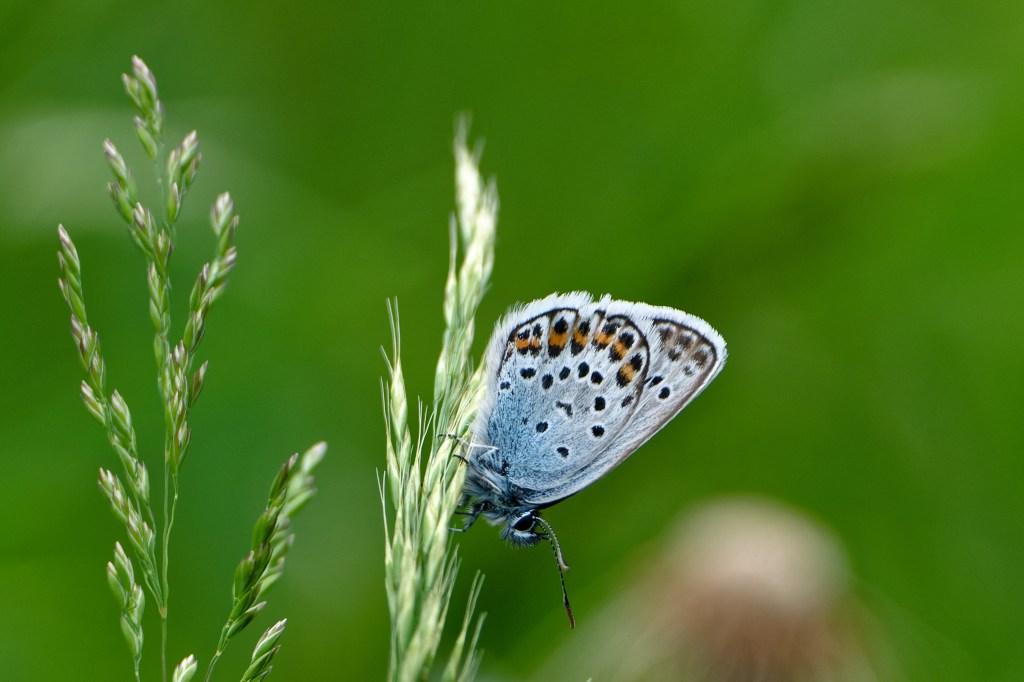
Finally, a female Silver-Studded Blue – little doubt about this one. The dusting of the body and wing bases is really quite something.

Backwoodsman was taunted by Clouded Yellows (shades of Omis again) – they would not settle. There were a few moments of exhilaration when an ochre creature flitted into view and settled but they were Speckled Yellow moths each time. One day, we’ll get a Clouded Yellow in the lens and focused.

Backwoodsman thought he had done quite well with this range of species but then, alas, he read a Naturetrek Tour Report from July 2018 and was well and truly put in his place. So many species! However, it is the case that groups of naturalists banged up together for a few days can get quite competitive, possibly imaginative even. On a visit to Shetland, we encountered a wildlife tour party lead by Iolo Williams from the BBC’s Seasonwatch operation, dining at the Sumburgh Hotel. “So, how many species have we seen today, then, look you, a hundred and seventeen wasn’t it?” intoned Iolo in ultra- lugubrious mode. “Don’t forget the Hobby”, said one of his clients. “Oh yes” he said “a hundred and eighteen then.” We were surprised, thinking a Merlin more likely given the northerly extremity. Anyway, everyone was definitely up for one more tick on the list, no matter how improbable.

So “where are the birds?” you bellow, “get to it you busker!”

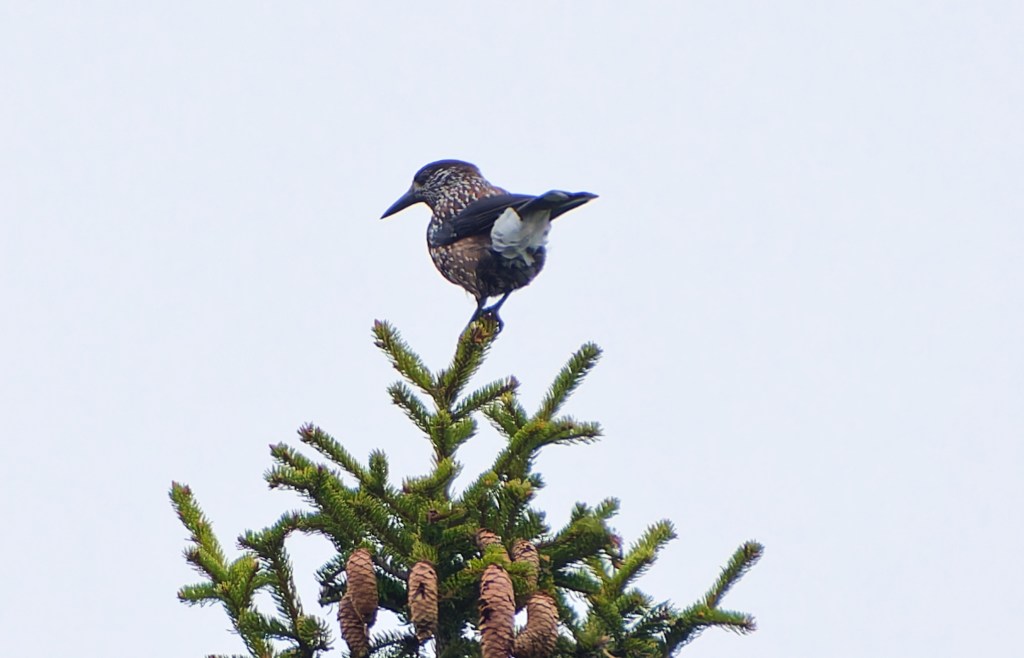
A hit list travelled to the Sud Tirol with Backwoodsman, because we had done astonishingly well last time. We had a one-off sighting of Spotted Nutcrackers in 2019. Snow came during our vist and there was some poor light; through the gloom, we saw a group of corvid-sized birds feeding on the ground in a woodland clearing. Perhaps the snow had brought some cones to the ground for them.

They were much in evidence this time, always right at the tops of trees, and noisy with it, but quite camera-shy. This one was photographed from the Sessellift in excellent light. The Wikipedia entry refers to their cacheing of pine nuts and their excellent memories of cache locations.

Various Woodpeckers flitted about; we caught a glimpse of the Black Woodpecker, an unmistakeable bird. Just a glimpse though, no time to photograph them. Great-spotted woodpeckers were about too, but not to be photographed. Backwoodsman made a recording of the Great-spotted which will turn up elsewhere; he also made this recording.

There is an interesting comparison of the two species drumming on the same tree on YouTube, along with separate recordings of the Black and Great-spotted on the excellent xeno-canto site. So what do you think? Backwoodsman thinks that the drumming in the recording seems more like that of the Black Woodpecker. I fear we’ll never know for sure.

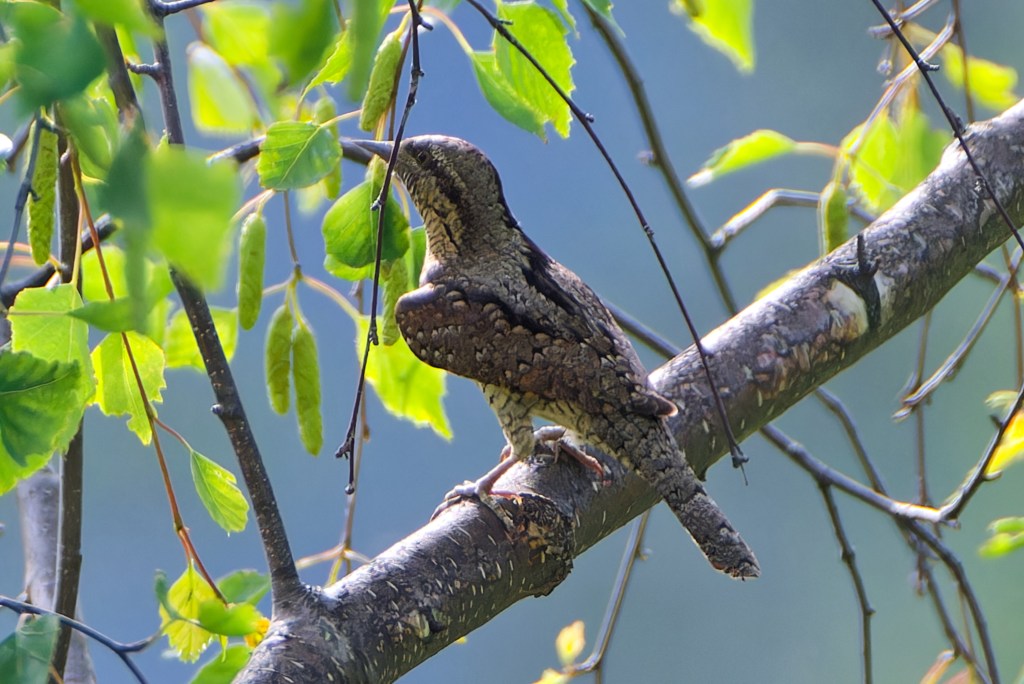
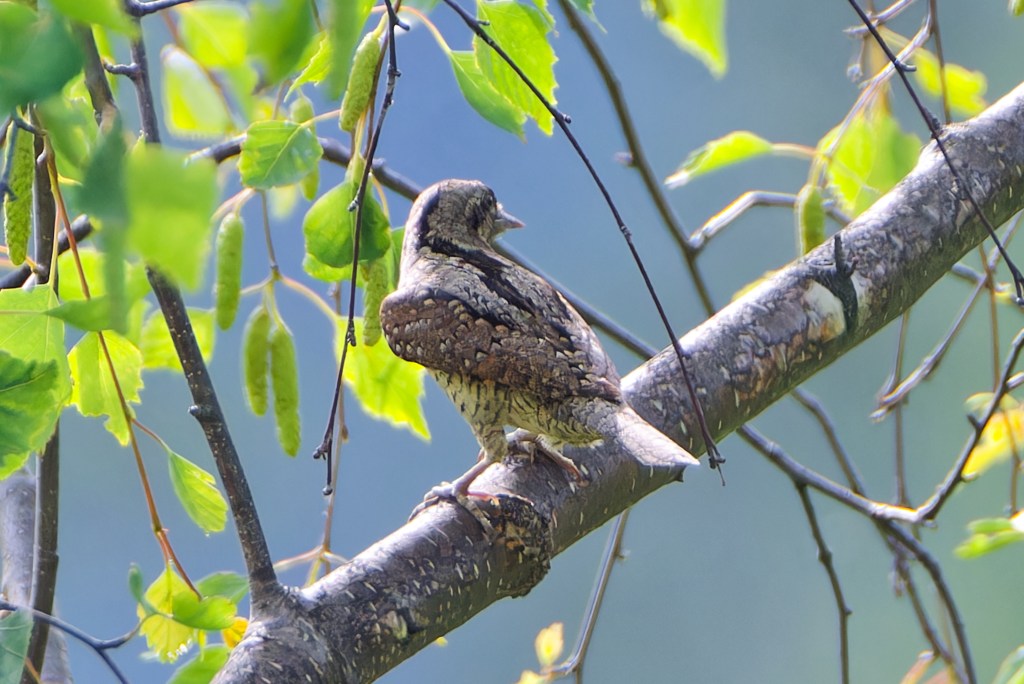
There is less ambiguity about the next Woodpecker species. On the way to the hotel meadow, Backwoodsman saw what he took for a distant Thrush lift off from the track and land on a branch in full sun, briefly. As usual, he shot first and worried about it later. He was quite surprised by what he saw in the back of the camera later on – a Wryneck, and what a lovely thing.

The similarity between markings on the bird’s back and those on the branch is really surprising; Backwoodsman has often wondered how birds seem to know where to stand, the case of Golden Plovers providing one of the most remarkable examples. The Wryneck is sitting in a Silver Birch; no shortage of those in this mountain environment but what an amazing complementarity. The feet are impressive and Backwoodsman is very taken with the boots.

Another list bird was the Ring Ouzel; we were beating them off with sticks in 2019, but they were more elusive this time, failing to show up when the camera was around. Perhaps Backwoodsman will catch up with them again in Scotland.

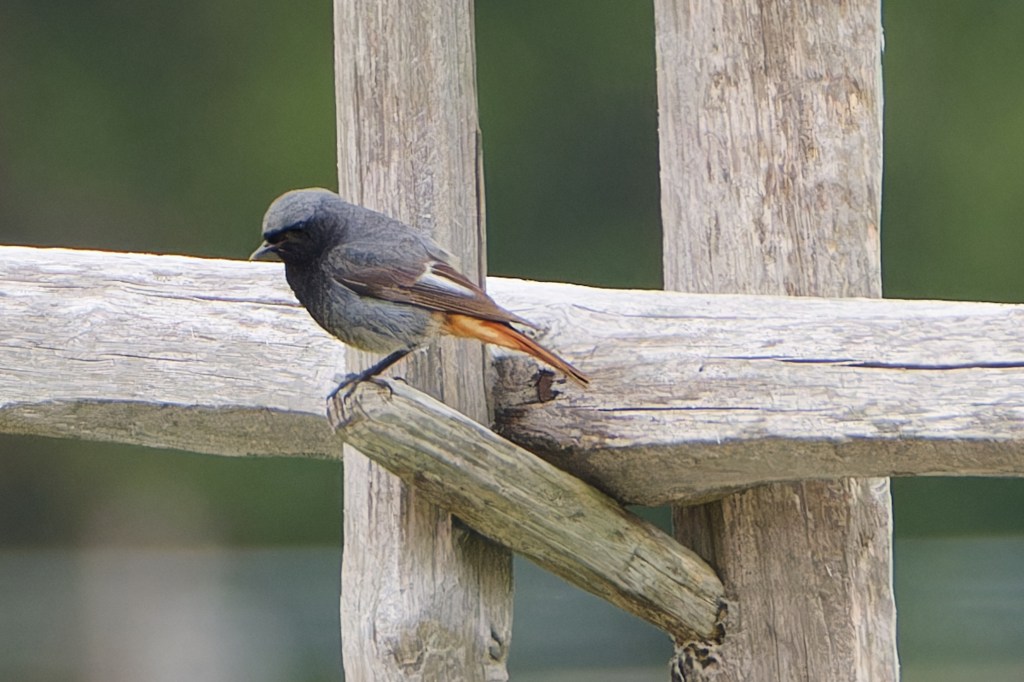
The Black Redstarts were more biddable but kept their distance. We spotted an adult male in the distance up on the top of the hill and photographed him.  

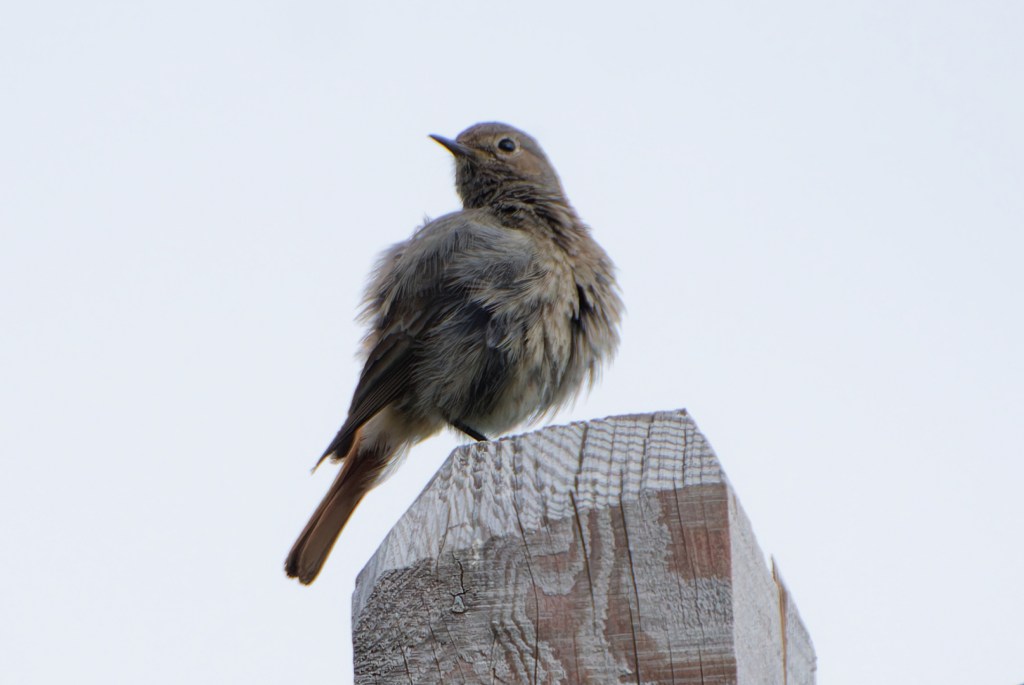
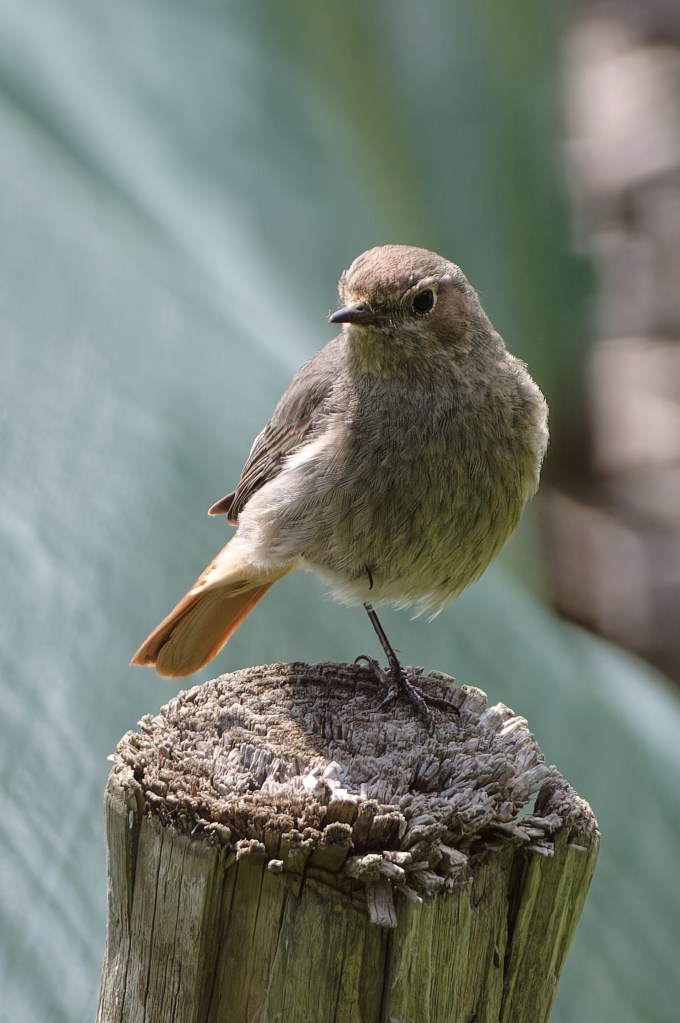
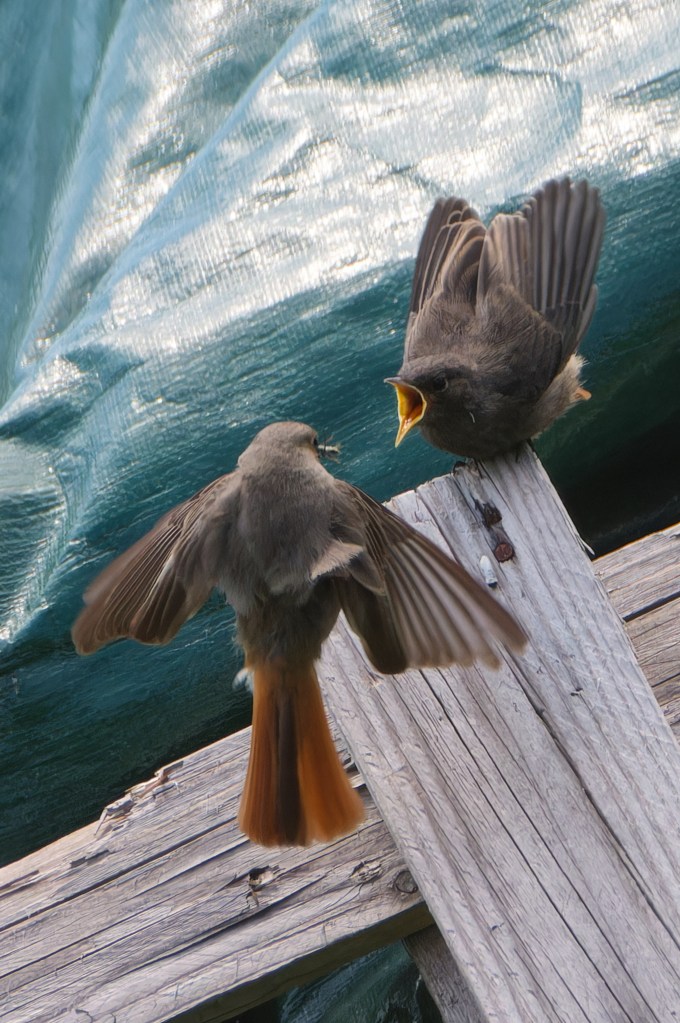
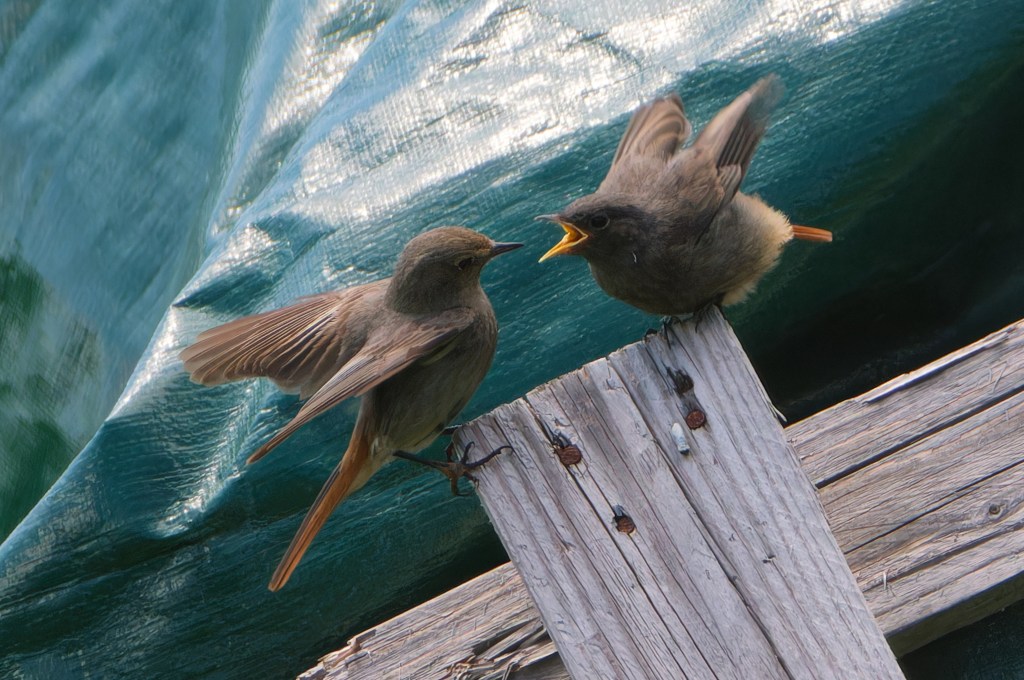
Then we returned from a trip to Merano to find an adult feeding a chick just outside the fire escape by our room. They were not to be photographed and Backwoodsman became pessimistic. He went outside to prowl and found a chick and an adult male; they liked a line of fence posts which descended a slope behind the hotel.

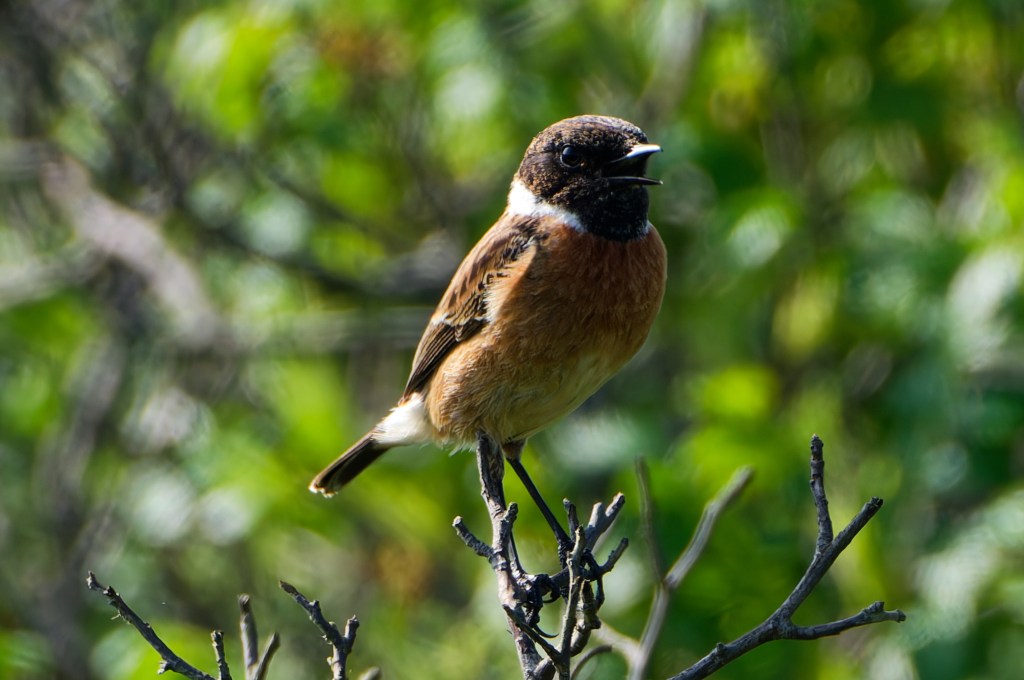
Things looked up on a subsequent walk in full sun. Redstarts are Chats, and like Robins, they do well around human habitation, and like Stonechats, they perch nicely. Here (second image) is a Stonechat from Barassie for postural comparison.

We detected some Redstart activity around a tarpaulin-covered woodpile near the fence of a house. The bars of the fence were sufficiently well-spaced for the camera to work at full zoom; things developed nicely on the other side of the fence as a chick appeared and was fed with morsels from the woodpile.

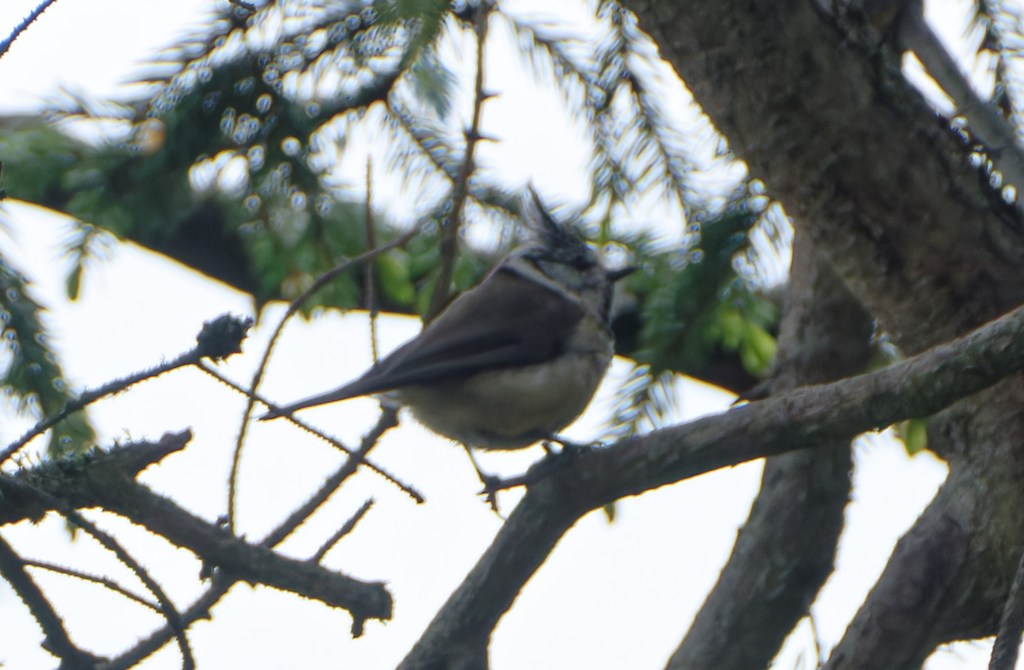
Crested tits were about and they were a tease. Backwoodsman managed a solitary image in poor light. There is a chance of catching up with these in Scotland, but it will take some work.

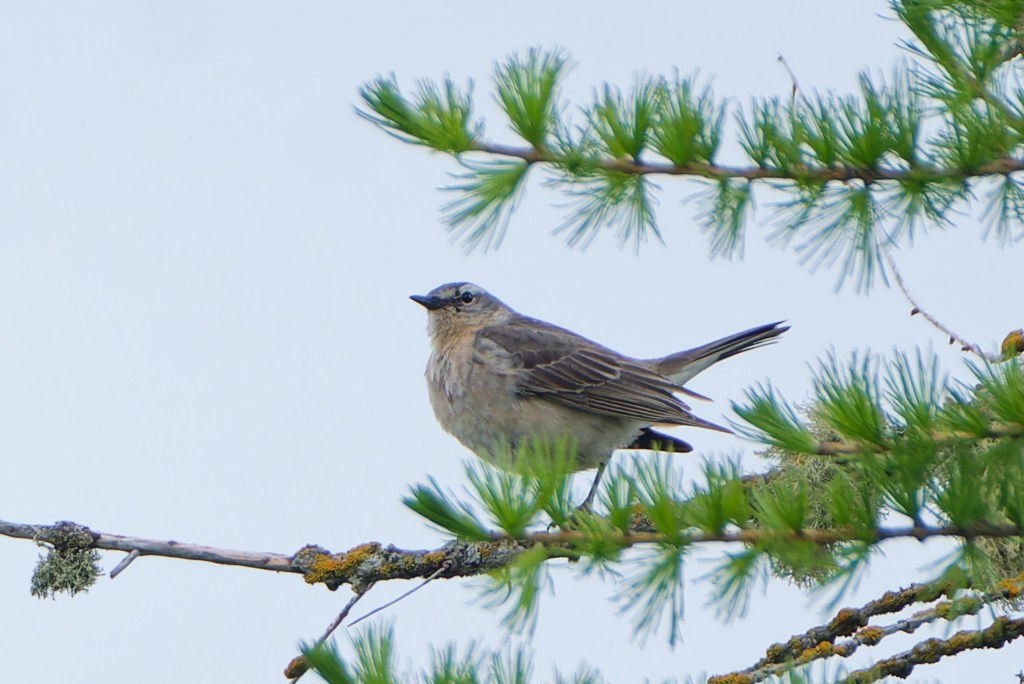
Finally, we spotted some parachute flight and very monotonous song, managing to trace it to this Water Pipit with the help of the Merlin App.

It was our first time to see this species; Rock and Meadow Pipits are more familiar from our Ayrshire and upland walks.

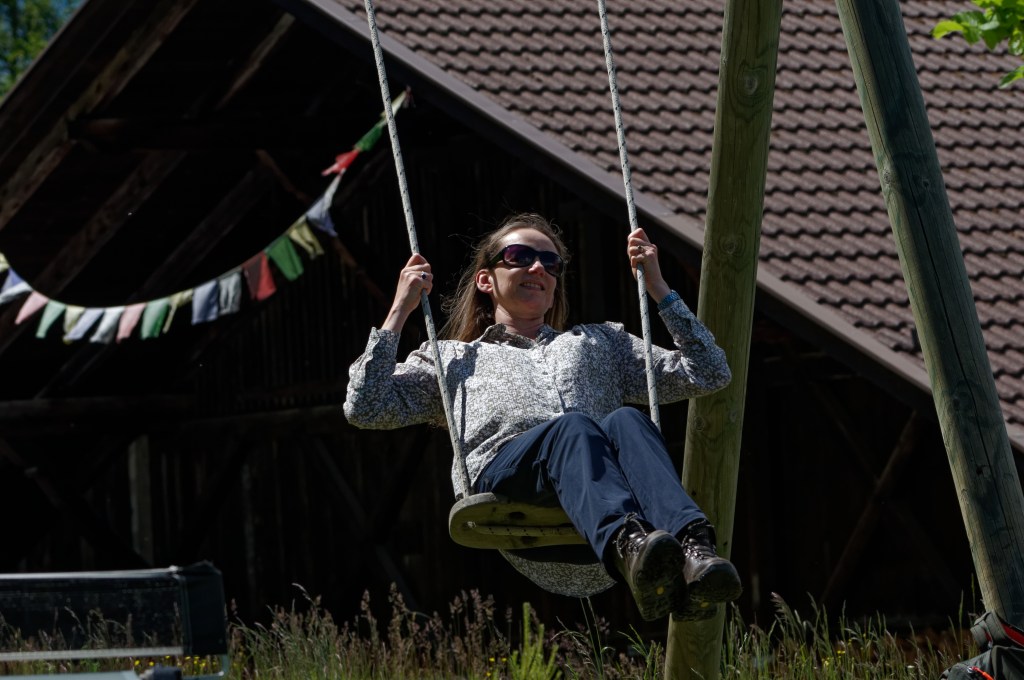
So that’s a short list but Backwoodsman hopes you find the images pleasing. There will be another post of flowers and landscapes once the processing is complete, probably in a couple of weeks. Until then, here’s Faye doing a bit of swinging (!) through the air at Eggerhof (we’ll be back there next time).

Black Guillemots

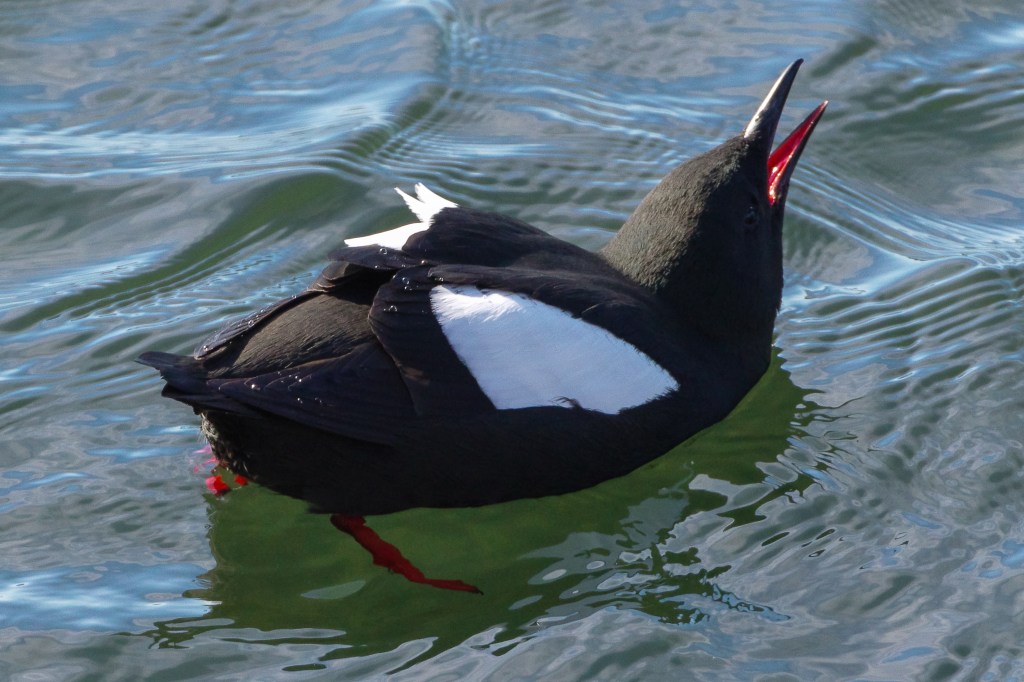
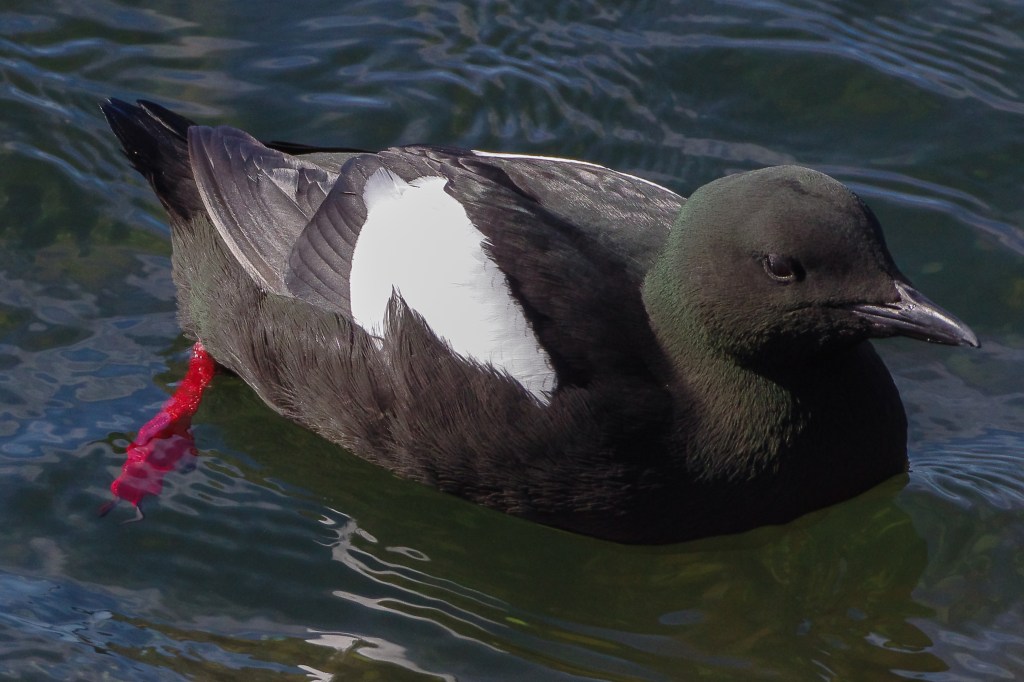
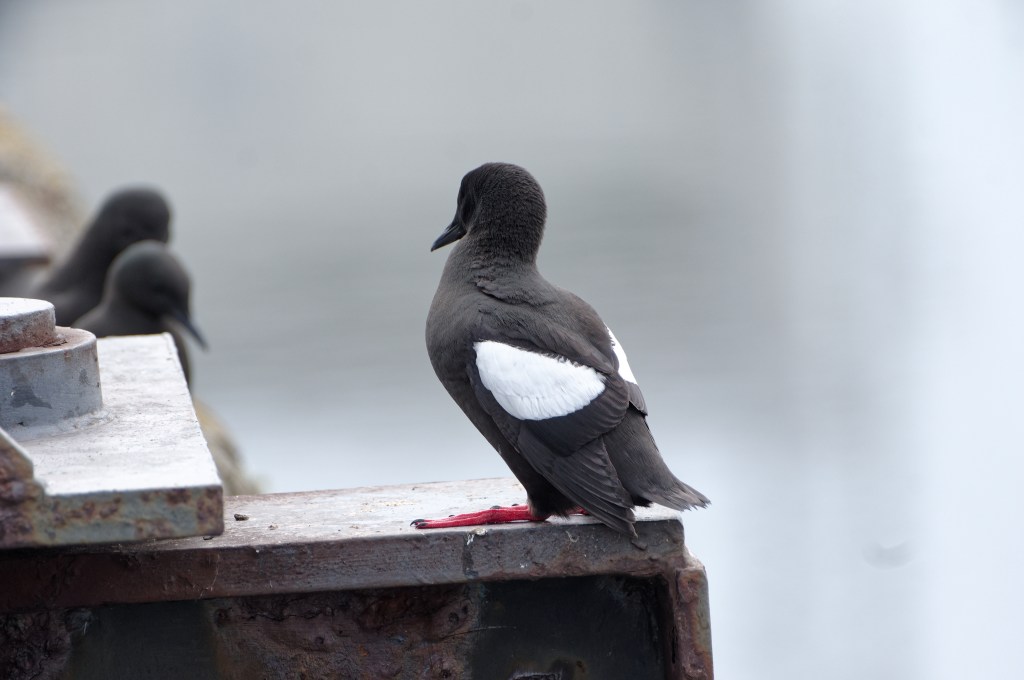
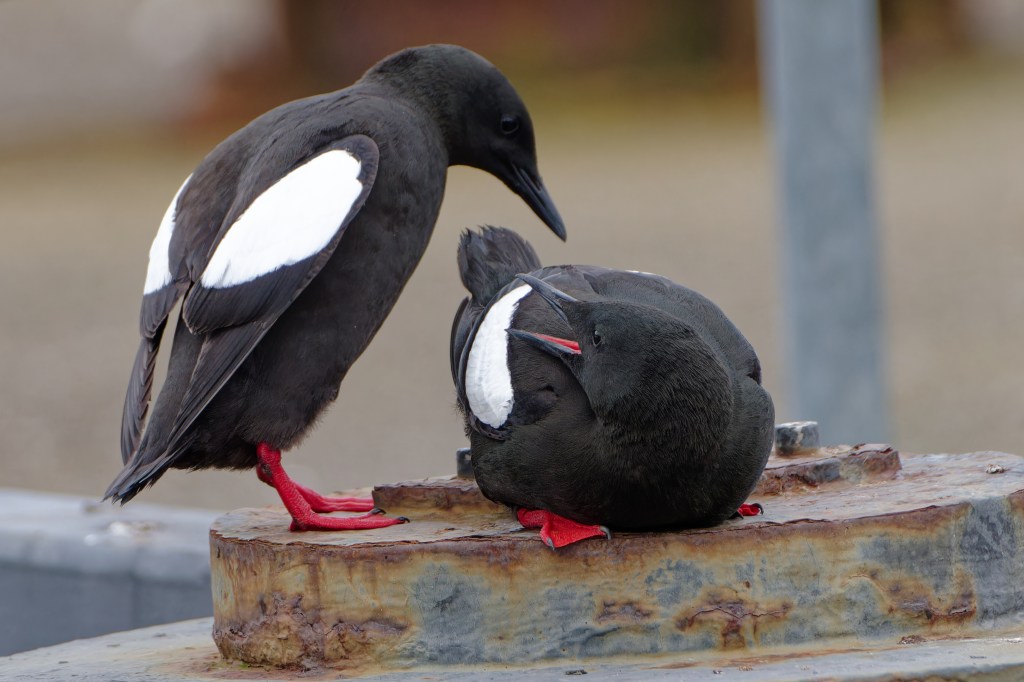
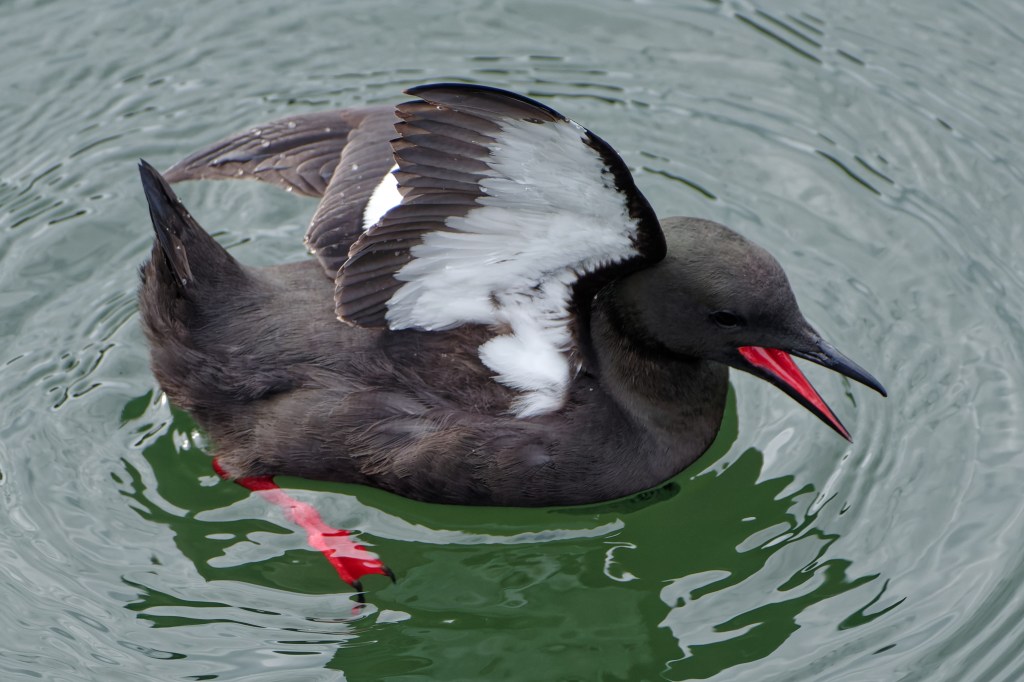
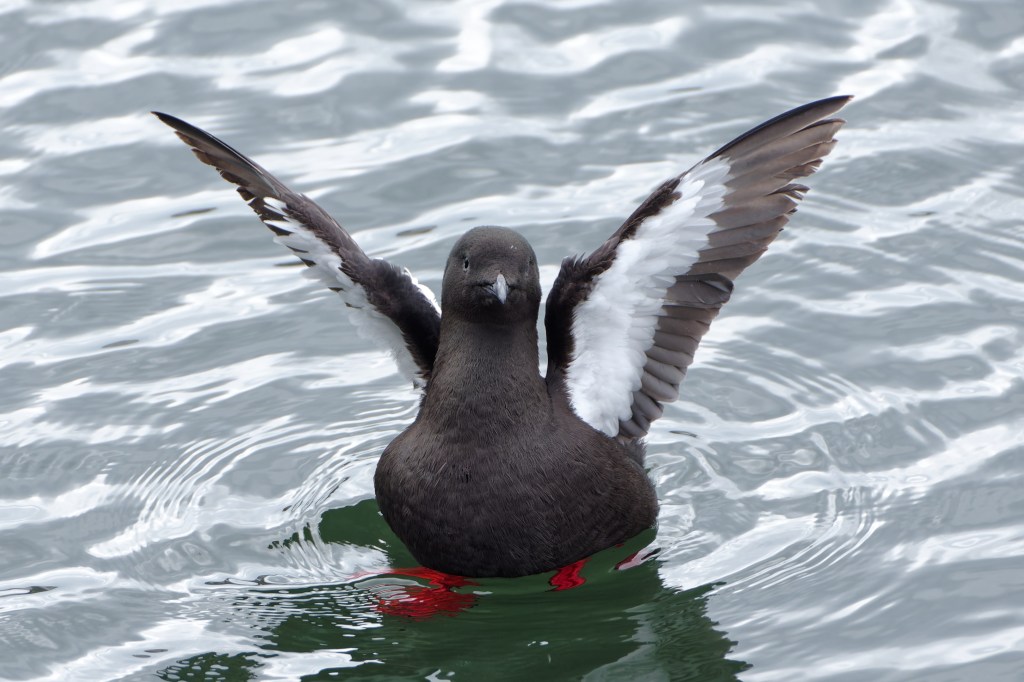
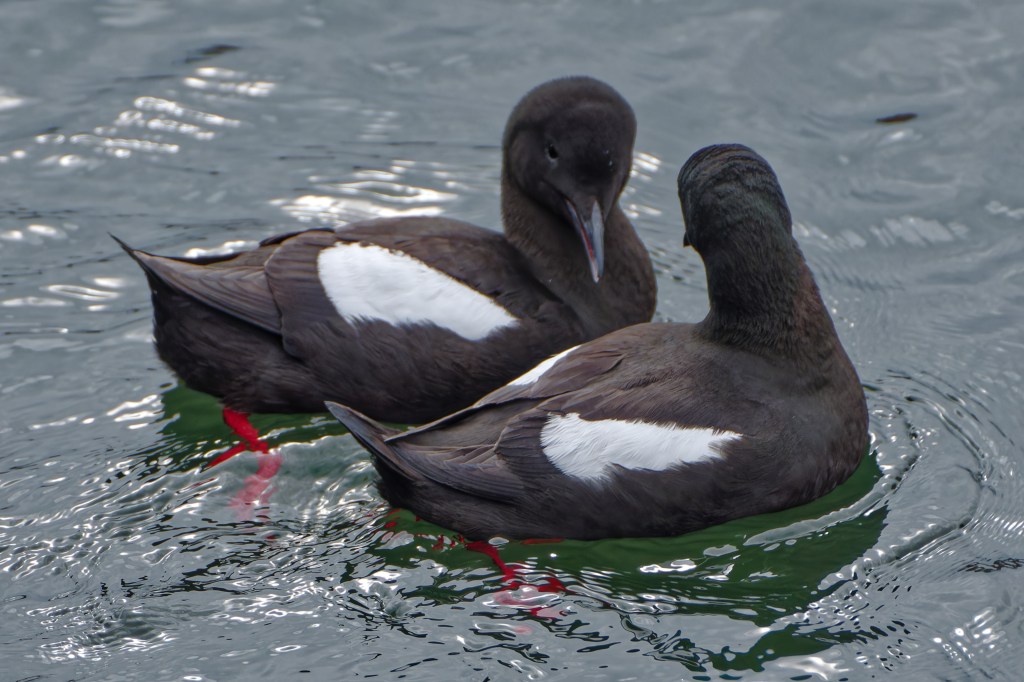
Some years ago, we visited Ardrossan Harbour just to see what was about, rather than to catch the Arran boat. A small waterbird caught our eyes – “Diver!” we chorused, but no, it was a Black Guillemot. We hadn’t seen them before and were struck by the red feet and gape when the bill opened. Our next sightings were in Shetland, where we found a pair in repose near Sumburgh Head in the summer sun, then one March at Saltcoats, where a small group in breeding finery had sailed into the old harbour. We returned to Ardrossan Harbour two weeks ago and found Black Guillemots again, really pleasingly, because the visit had been planned around them. They were on the water and sitting on the dockside.

The JNCC (Joint Nature Conservation Committee) Seabird Survey reports that “The black guillemot or ‘tystie’ is a circumpolar species, concentrated around the North Atlantic, Barents Sea, Baltic and smaller numbers around the Chukchi Sea in northern Alaska and north-eastern Siberia. Approximately half of the UK’s population breeds around the Northern Isles, with the remainder confined mainly to the coasts and islands of north and west Scotland. Their distribution within the core range is determined by the availability of suitable nest cavities that are safe from land predators such as rats, American mink, stoats and otters. Between censuses in 1969-70 and 1985-91, there was an expansion in the range of black guillemots, in particular the colonisation of new sites around the Irish Sea, including man-made structures (e.g. harbour walls, jetties, piers), and into north-east Scotland.” The UK population is of the order of forty thousand, whereas Guillemots number over a million. Black Guillemots live for around eleven years, breeding after the fourth year and forming small colonies to do so, whereas Guillemots mass on cliffs.

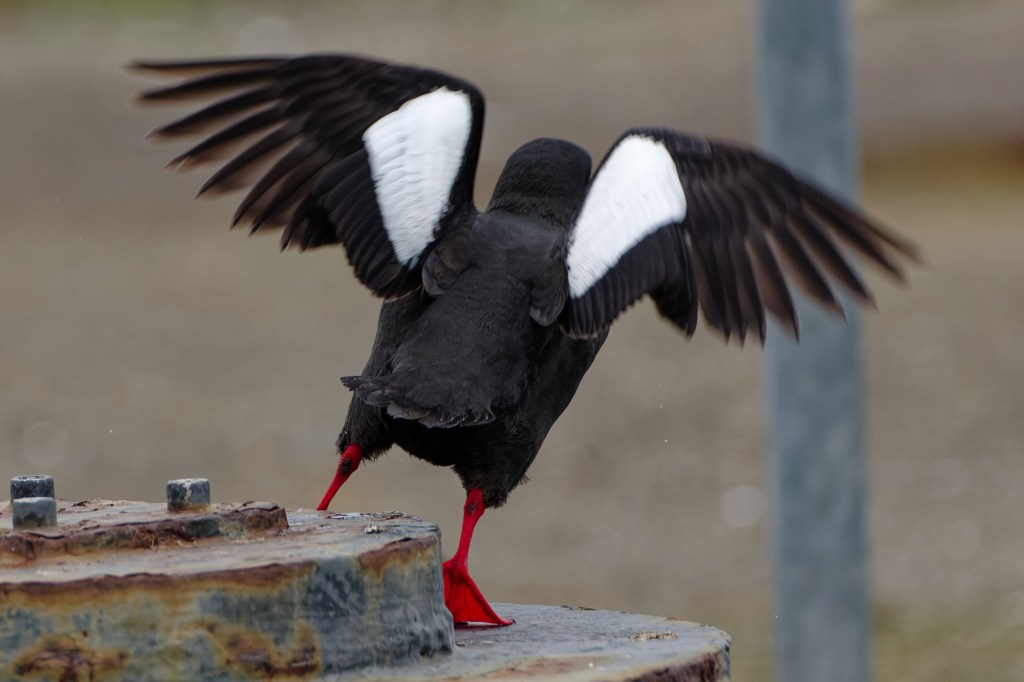
They were surprisingly tolerant of our approach, even when an excited Backwoodsman contrived to fall over this handsomely distressed and rather obvious bollard. A previous fall onto camera at Cardross had resulted in a cracked rib; Backwoodsman was more lightly wounded this time and the abrasions healed up within the week. More importantly, the camera was fine.

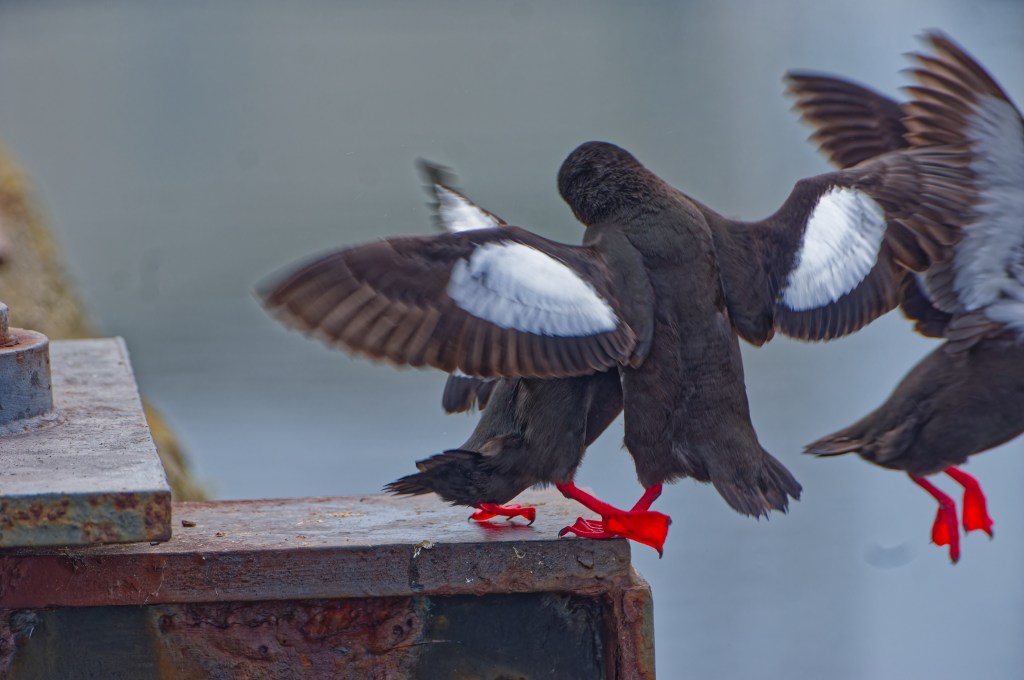
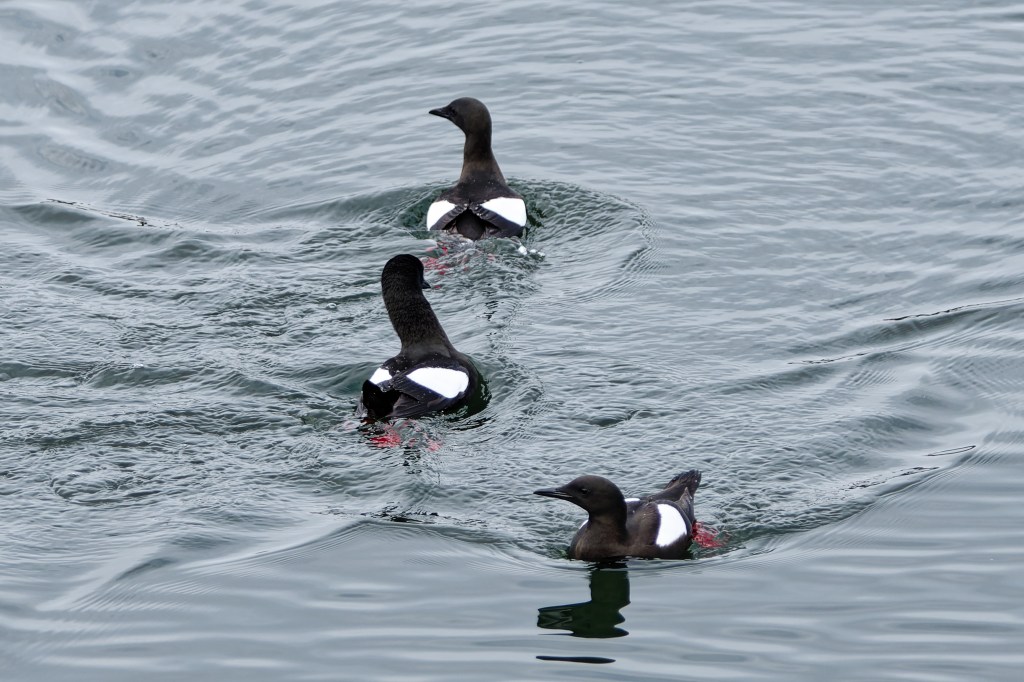
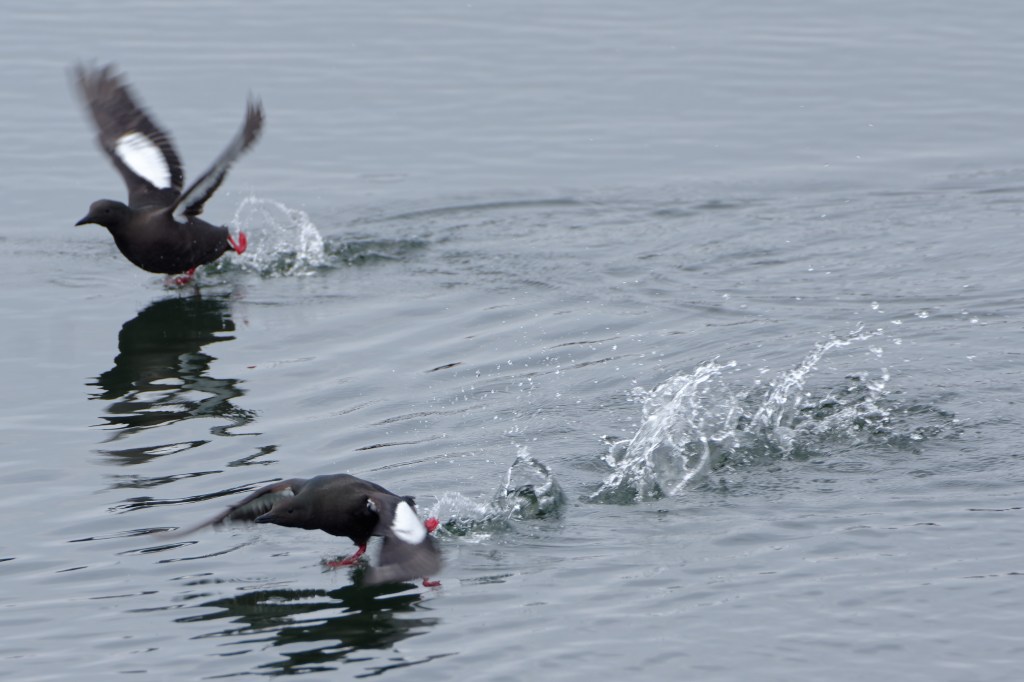
You may notice that there were three birds in the earlier shot, and three is definitely a crowd for seabirds in the breeding season. Before too long, the period of repose ended and the group took to the air and then the water.

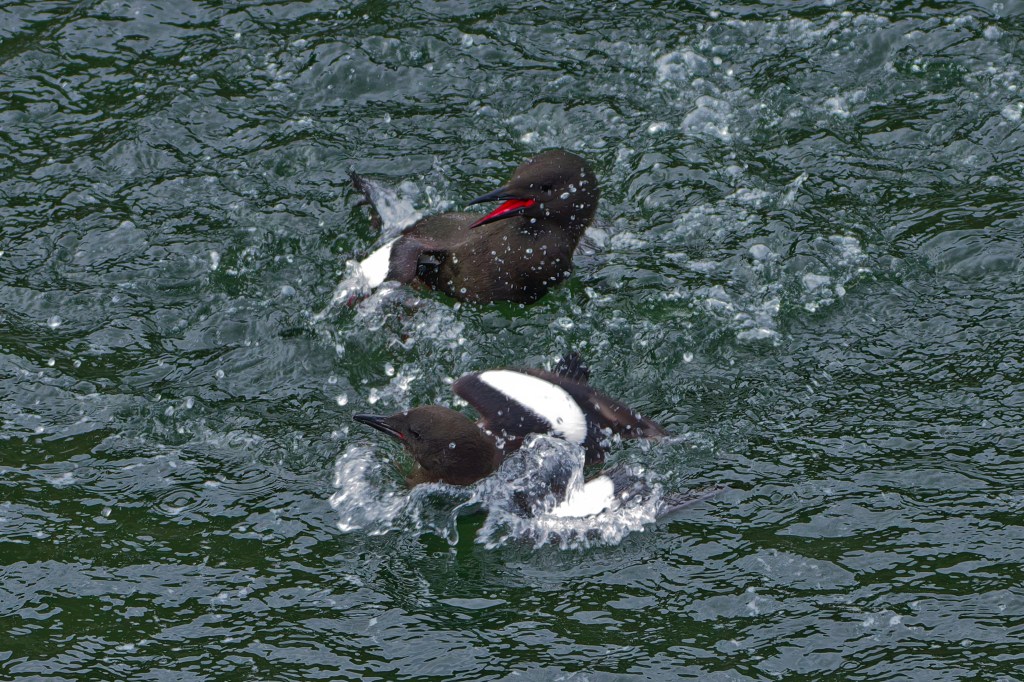
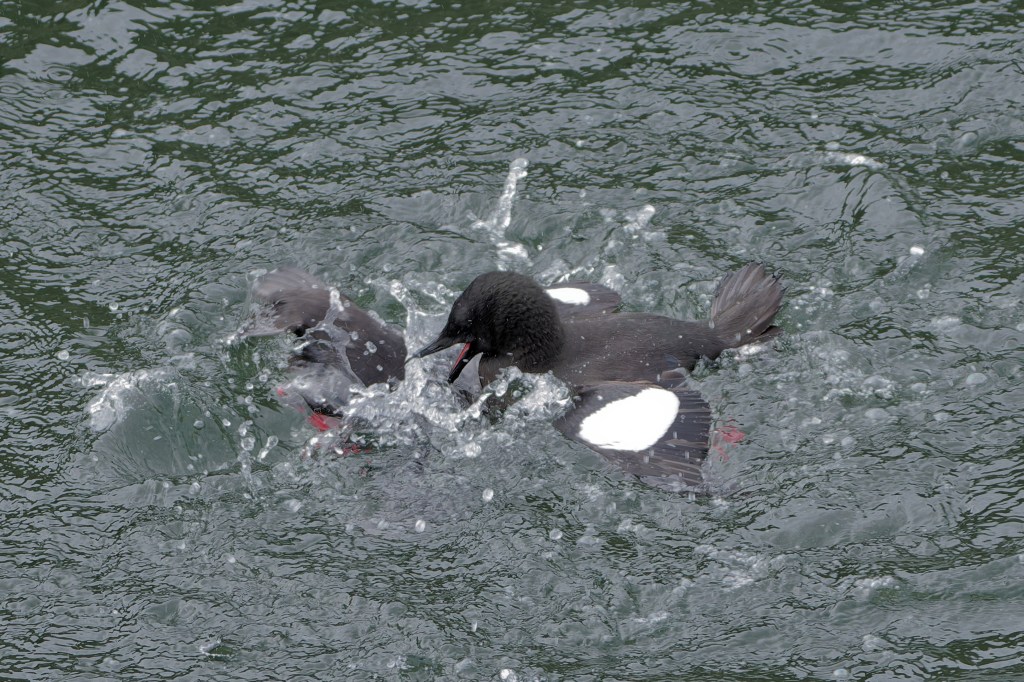
Violence ensued, as it tends to within avian threesomes; a pair of birds really went for each other, both on and below the surface. It was quite a sight. The shape of the bird in the second image is really interesting – are the wings and tail spread for stability and leverage, all the better to peck at the rival bird?

The vanquished bird was seen off and the victor displayed, had a freshen up, and then headed off for a bit of courting.
There was a display on the water, with the pair circling each other, then a second and vocal routine on the dockside.

The birds get noisy towards the end of the video. Please accept Backwoodsman’s apologies for the shakily framed video footage – it demonstrates the efficacy of sighting through the viewfinder rather than looking at the back of the camera.

When sighting through the viewfinder, you can brace the heavy camera against your head and crunch everything (arms, neck, lower body) tight to keep the gear steady, whereas the extension of the arms required to look at the back of the camera makes the shakes inevitable. It’s no big deal with a wee mobile but do try it with three-and-a-half kilos of camera, and then wonder why they want you to look at the back screen. It beats me.

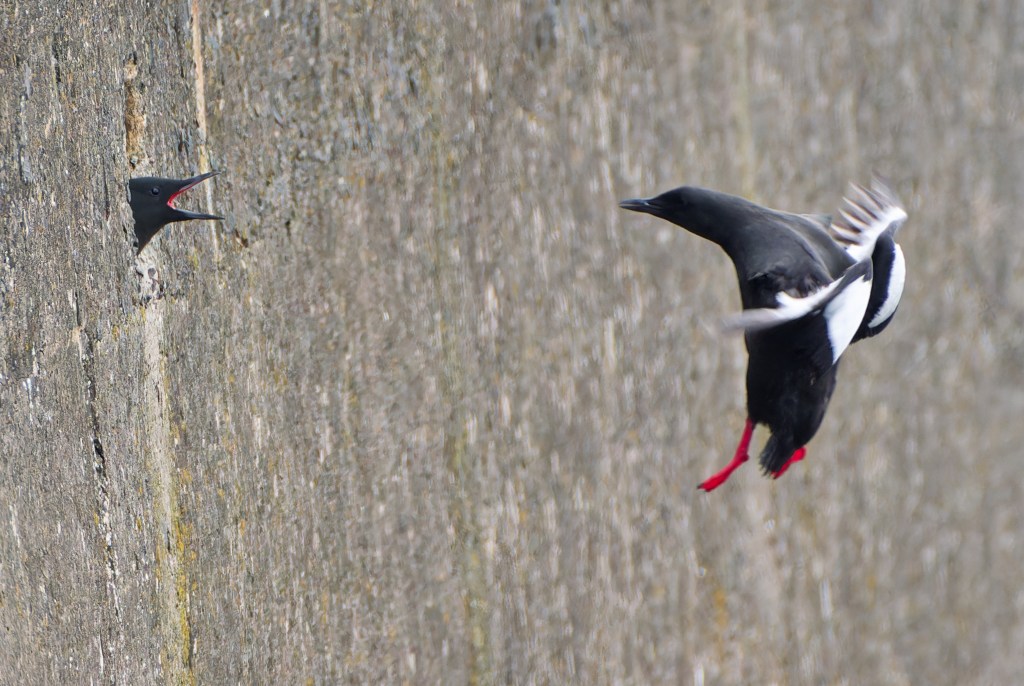
The JNCC document quoted from near the top of the post states that “The species is one of the more problematic seabirds to survey. It tends to breed away from the large seabird cliff colonies and prefers small rocky islands and low-lying, indented stretches of rocky coast. Nests are hidden in rock crevices and under boulders, which makes them extremely difficult to census during the breeding season.” Black Guillemots also seem to like drainage holes in harbour walls; on arrival at Saltcoats Old Harbour, we saw a bird’s head protruding and in due course, a second bird came to join it in the hole.

After a short interval, one of the birds left and flew right across to harbour to a second opening.
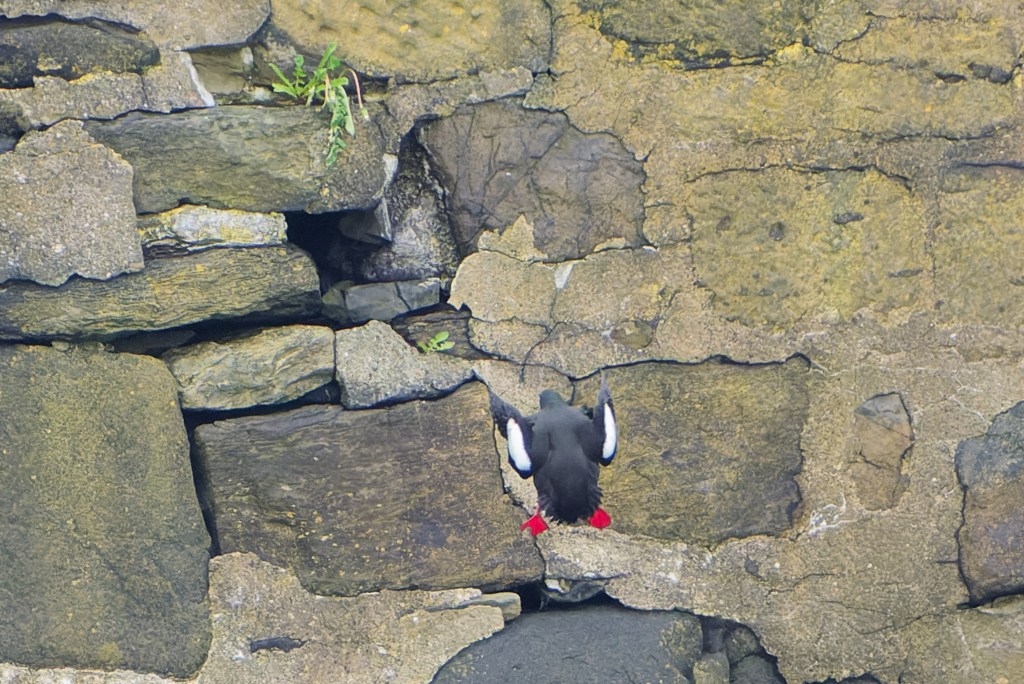
There were quite a few suitable holes in the harbour wall and others were occupied by birds. Some birds nesting in similar sites in Oban assumed celebrity status a couple of years ago.

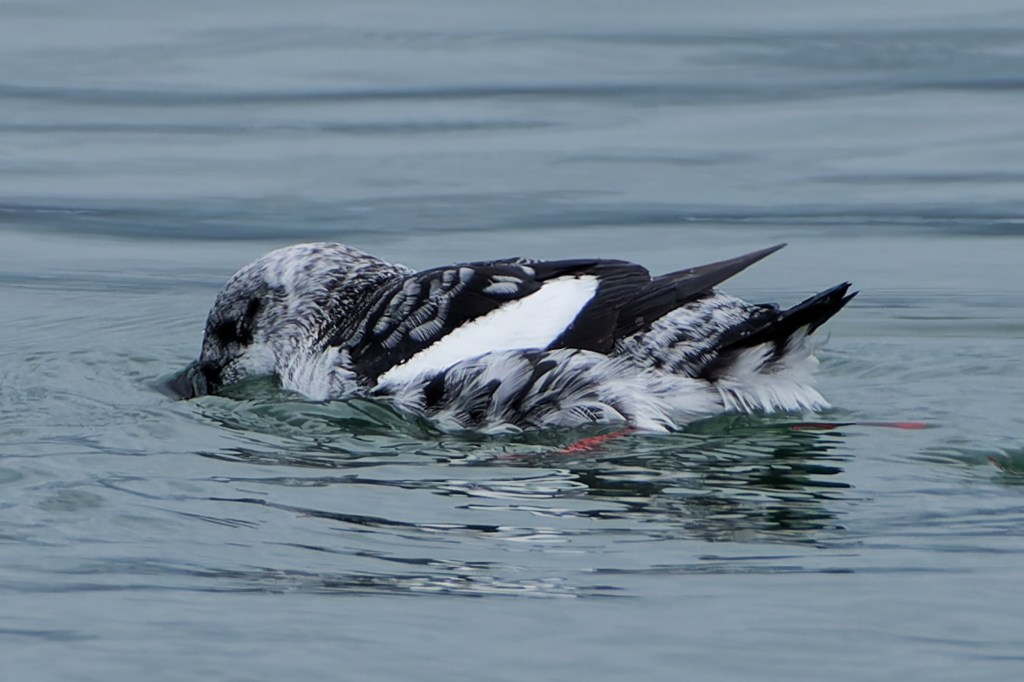
While writing the post, Backwoodsman remembered some images from our trip to Belfast in March 2023 and re-examined them alongside the illustrations in the RSPB book. There are the brilliant and unbroken white wing patches, and the red feet of an adult in winter plumage: juveniles have two dark lines across the wing patch and more orange-coloured feet.

Those of you embedded in academic life will recognise the phrase “light touch review”. It means “someone sent me this paper to review and I haven’t actually read it properly (or possibly, at all). But it’s by my mate so it must be good… Accept without changes.” Well the research for this post is definitely light touch and Backwoodsman is relying on visual appeal to slip this one by you. Backwoodsman hopes you enjoy the images of these handsome birds, and don’t mind the thin text too much.

Ospreys

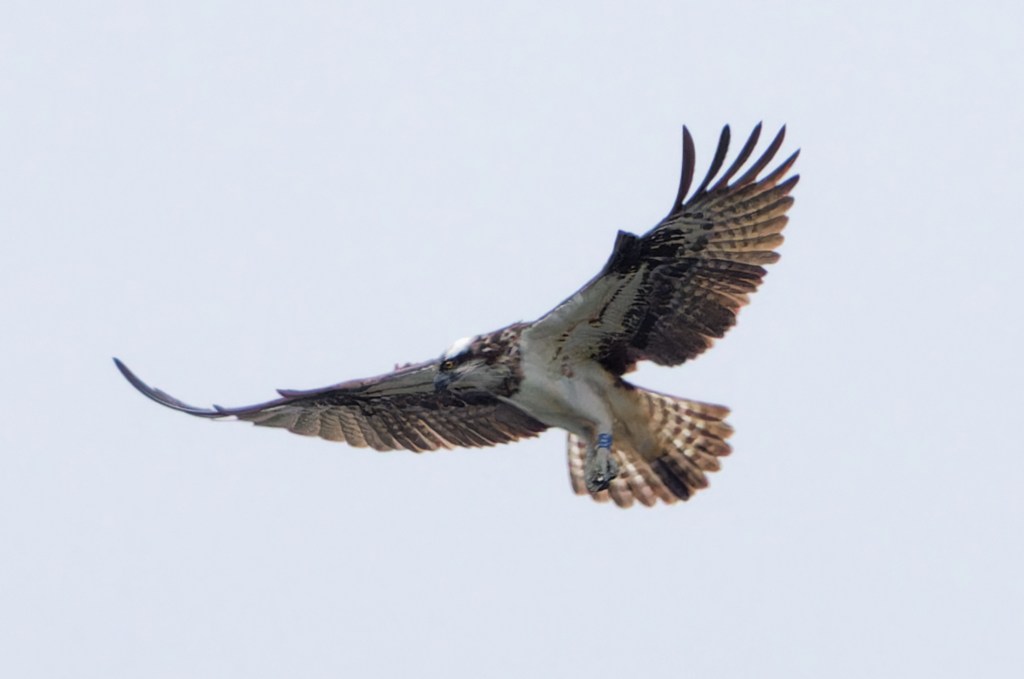
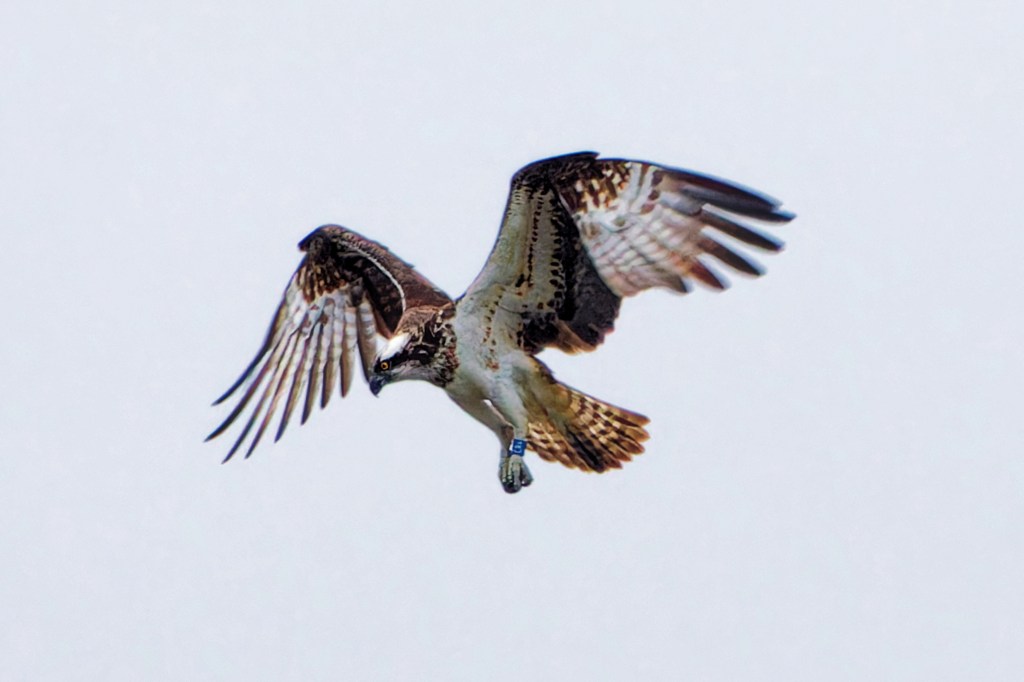
On our way to make a visit to Geilston Garden recently, we came across a chap looking out across a field in the direction of Murray’s. Spotting the binoculars Faye was wearing, he engaged us in conversation. He was keen to tell us about an Osprey nest on farmland not too far away. To be honest, Backwoodsman was quietly sceptical, though he had seen an Osprey over the Clyde at Cardross before (August 2020), and photographed it. Alas, Backwoodsman cannot read the markings on the ring. UK Osprey Information tells of the return of ringed individuals, with the colours and markings of the rings. Most of the action is around Loch Garten and the Tweed Valley, as expected.
There are always good tales to be heard at Cardross; some years ago, one chap was keen to tell of a White-tailed Sea Eagle which flew in regularly from Mull (had he followed it, perhaps?). This sounded like madness and Backwoodsman put his head down, got back onto the Redshanks he was watching and hoped his interlocutor would go quietly and soon. In contrast, Osprey man had detail, which was interesting, and we decided that we would allow a decent interval to pass and then return to Cardross and try to find this farm and the Ospreys.

On alighting from the train, we saw an Osprey overhead, which seemed very promising and we set off towards the farm. Backwoodsman is not disclosing the location in this post in case the twitcher social media has found a way of trawling the internet and harvesting bird sighting data (but if anyone wants it, and promises not to post it, it can be supplied privately). Backwoodsman has gone right off this business since the Waxwings episode, and would not want the farm lane clogged up with serried ranks of grumpy camo-clad pensioners with birdscopes, and their vehicles.

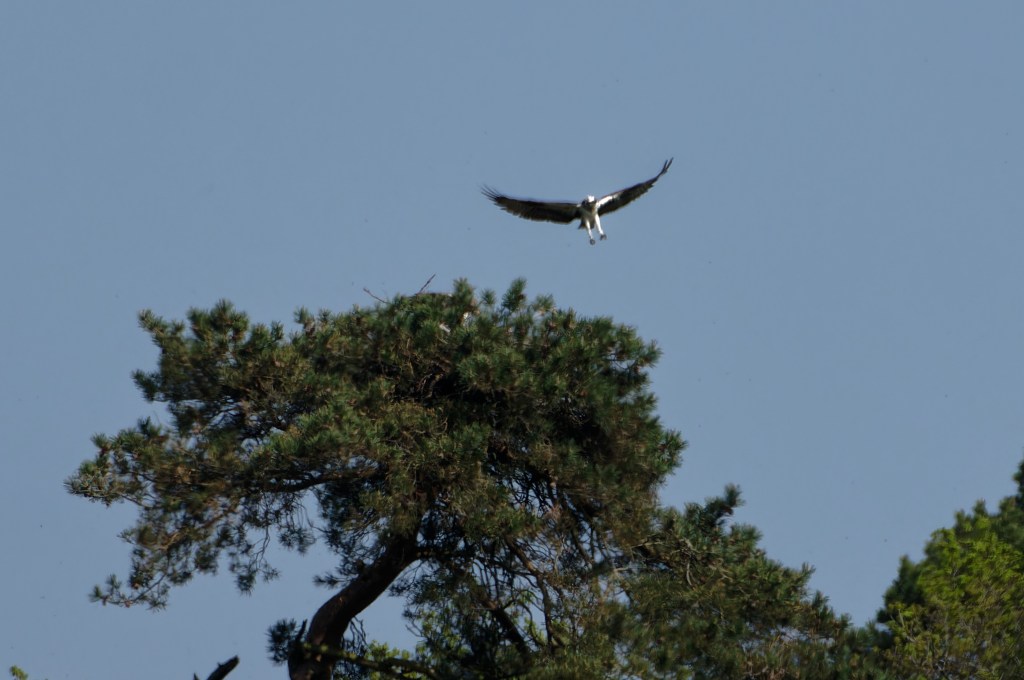
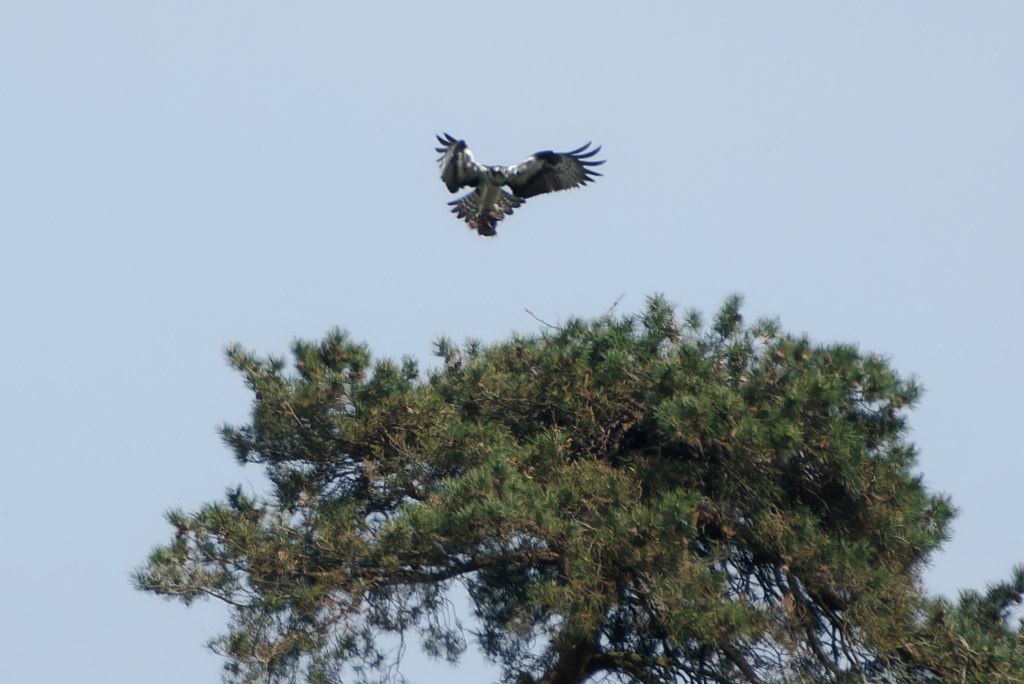
On arriving at the farm, we saw a chap dismounting a tractor and Backwoodsman approached. Far from the expected “ged orf my larnd!”, he told us that he thought there were Ospreys about, but no, we couldn’t go on the field because the cows were about to, which seemed fair enough. We took a punt on some trees which looked sufficiently knocked about to offer a nesting site to a pair of Ospreys and settled down to wait. Before too long, out came the Ospreys.

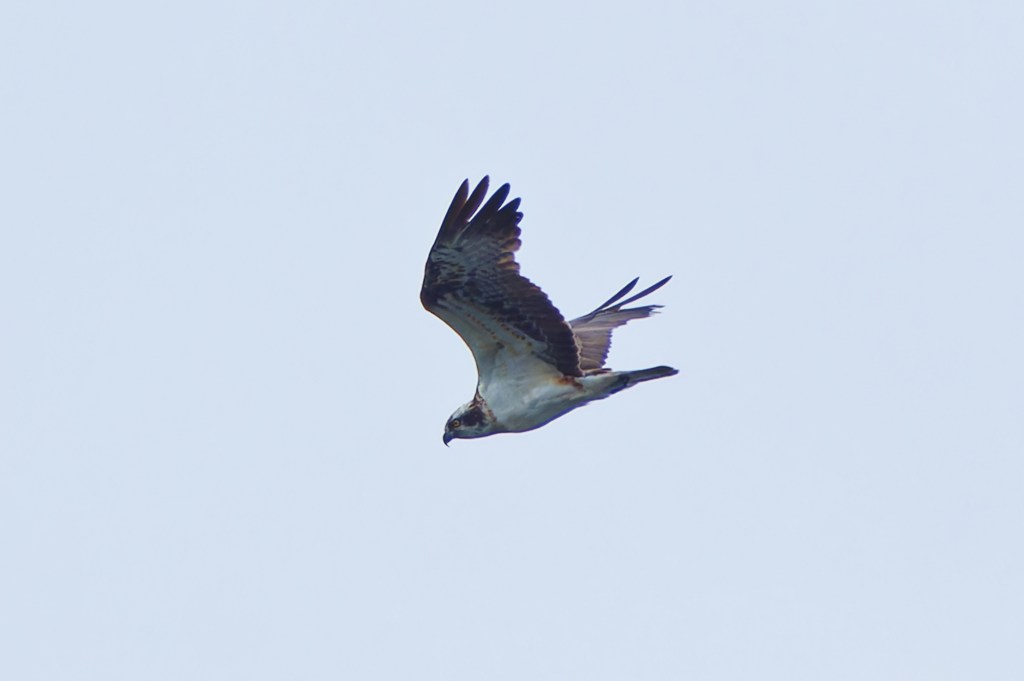
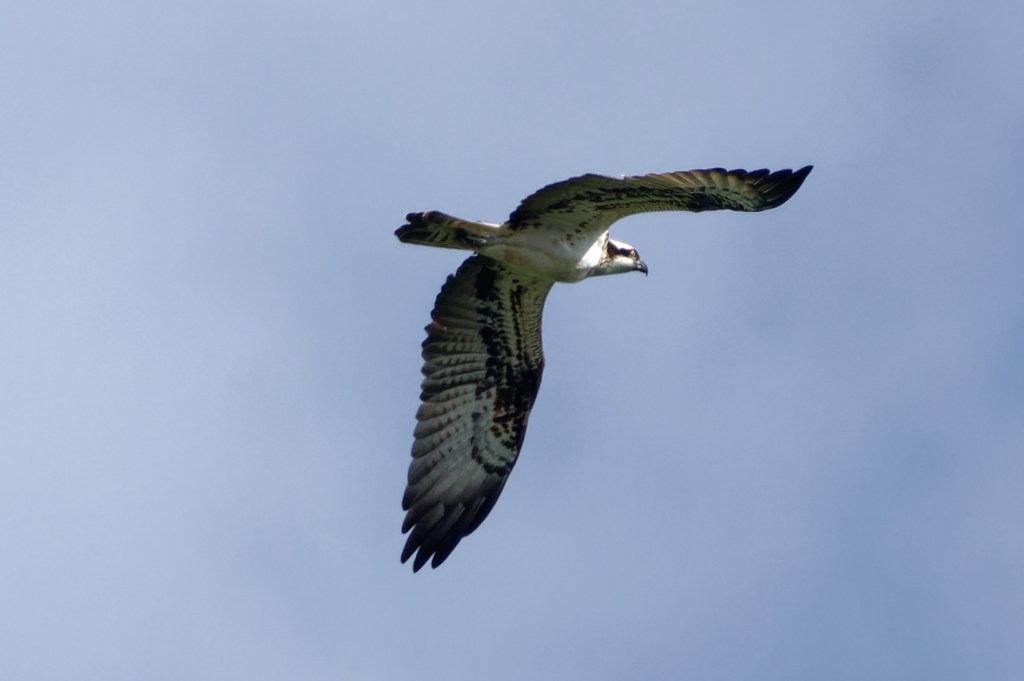
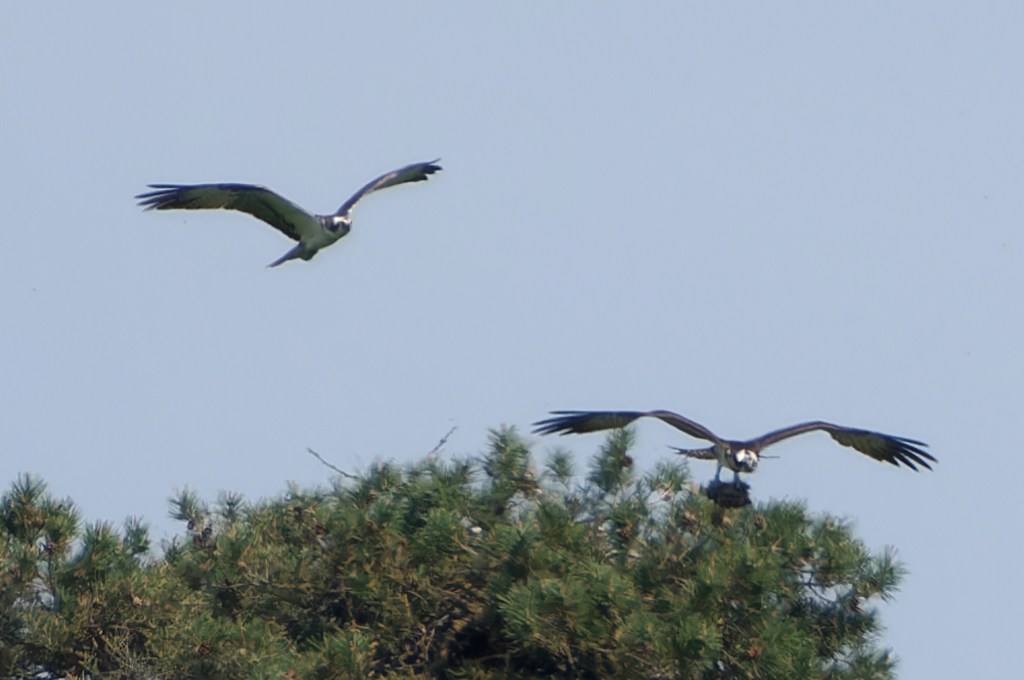
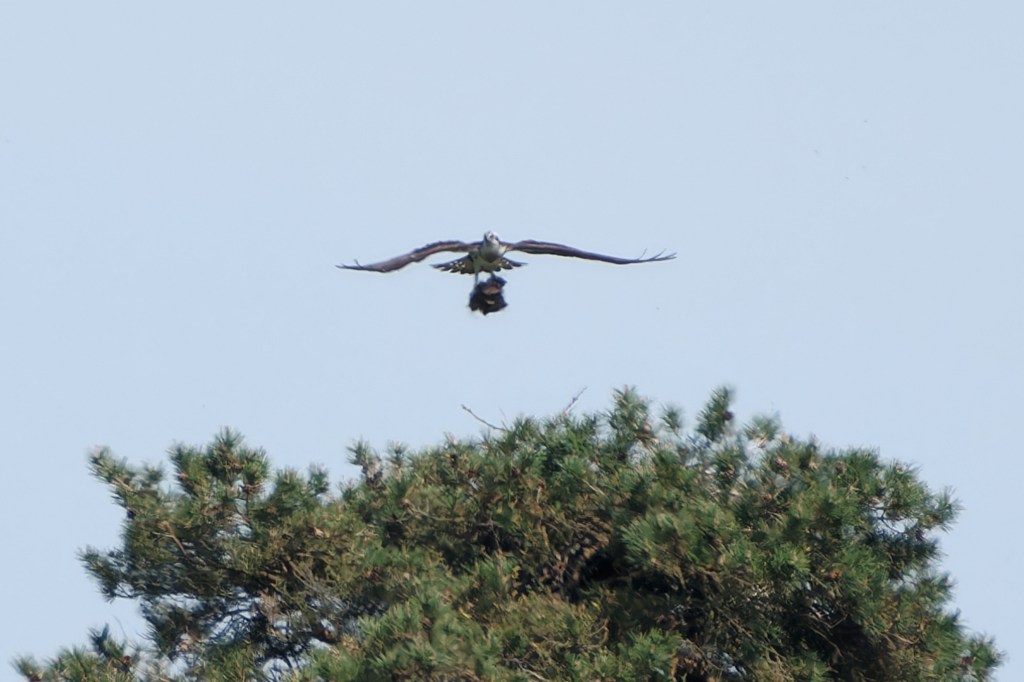
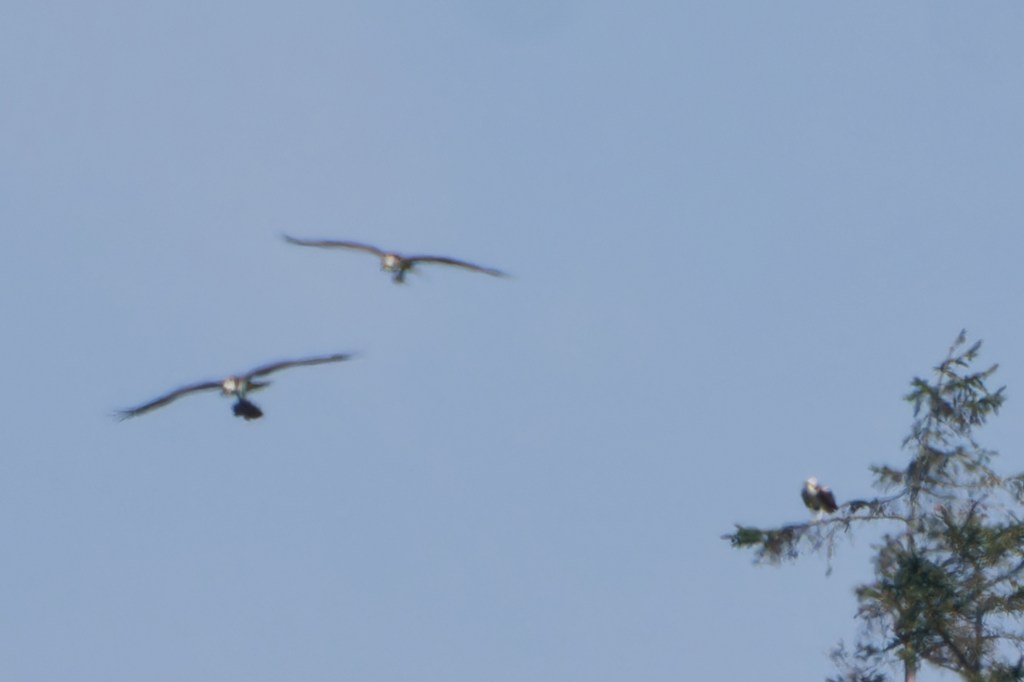
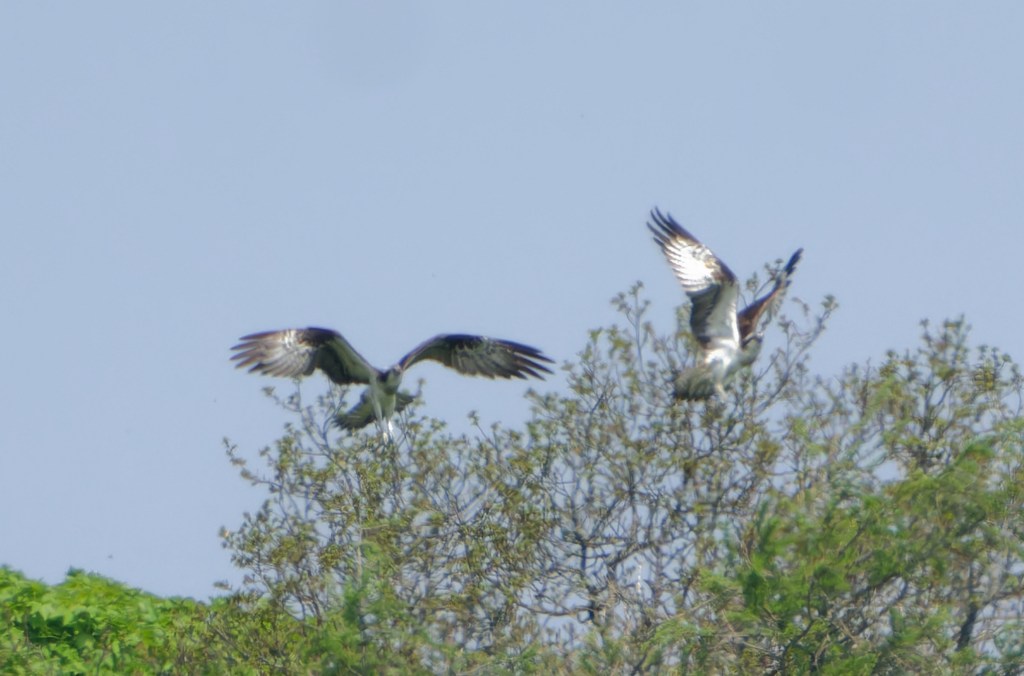
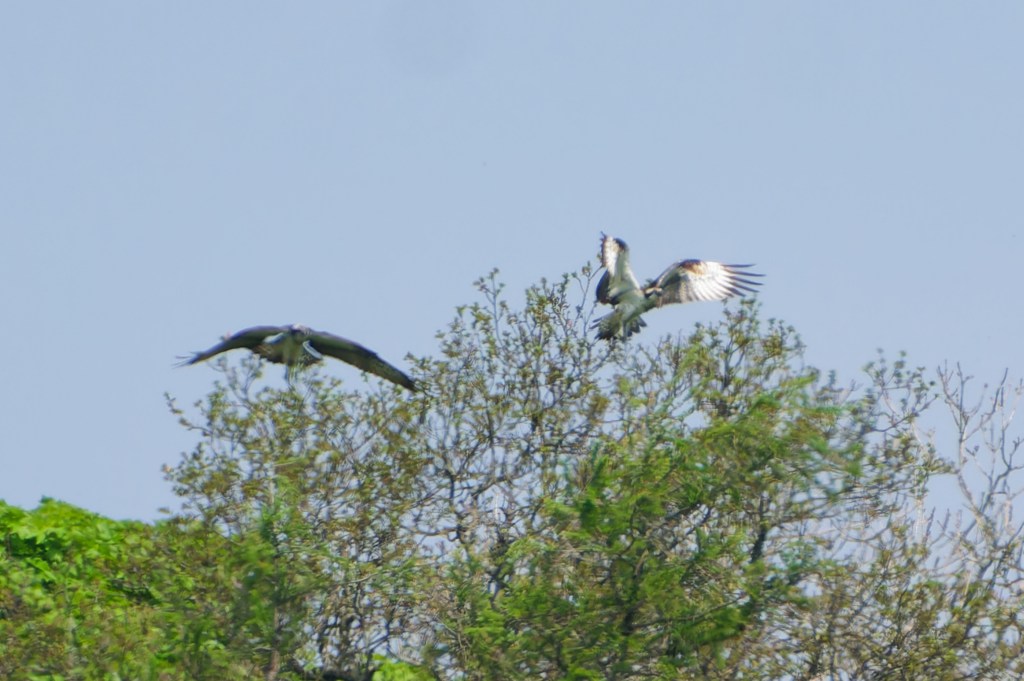
So no prizes for saying “hey, these images aren’t up to your usual standard, you busker!”. Agreed, but this is very long range shooting. Backwoodsman would be pretty confident of putting one through Bibi at this range but getting a sharp focus on a dynamic raptor, rather than a wizened and corrupt war criminal, is a tough gig, especially in very bright sunlight. Backwoodsman suspects that the birds probably covered fewer pixels than the spot area used to meter and inform the autofocus, which can mean that the camera spends most of its time hunting for a focal position. Backwoodsman feels he was pretty fortunate to get anything at all, and is only posting because the Ospreys threw some beautiful shapes, exhibited some interesting behaviour and are really not that common. One day, we’ll have to go sit in a hide somewhere and get the money shot of large Osprey with fish.
We were expecting to see an established pair on a nest, with regular traffic to feed ravenous chicks; this really isn’t what we saw. There was definitely a tree of interest – an old pine – but there was no evidence of a nest. A bird flew around the top of the pine regularly, sometimes perching, sometimes swooping by. And then, there were two birds.

The new arrival seemed to be carrying something; it looked more like a Greggs pasty than a fish but it was hard to tell at that range. It definitely interested a passing Buzzard and some Corvids. The laden bird seemed to be trying to attract the attention of the first Osprey but it wasn’t exactly welcomed with open wings. This went on for a while and then a third bird showed up.

This was so not a passing Buzzard; while the quality is poor, the white head of each bird is quite clear. Our friends Sabine and Peter had taken us to the RSPB Gartocharn reserve on Loch Lomond and we had seen some Osprey action across the Loch, so this area between the Clyde and the Loch clearly attracts Ospreys. Apart from Loch Lomond itself, and the Clyde, there is even a Trout Fishery quite close to hand (their website even mentions Ospreys).

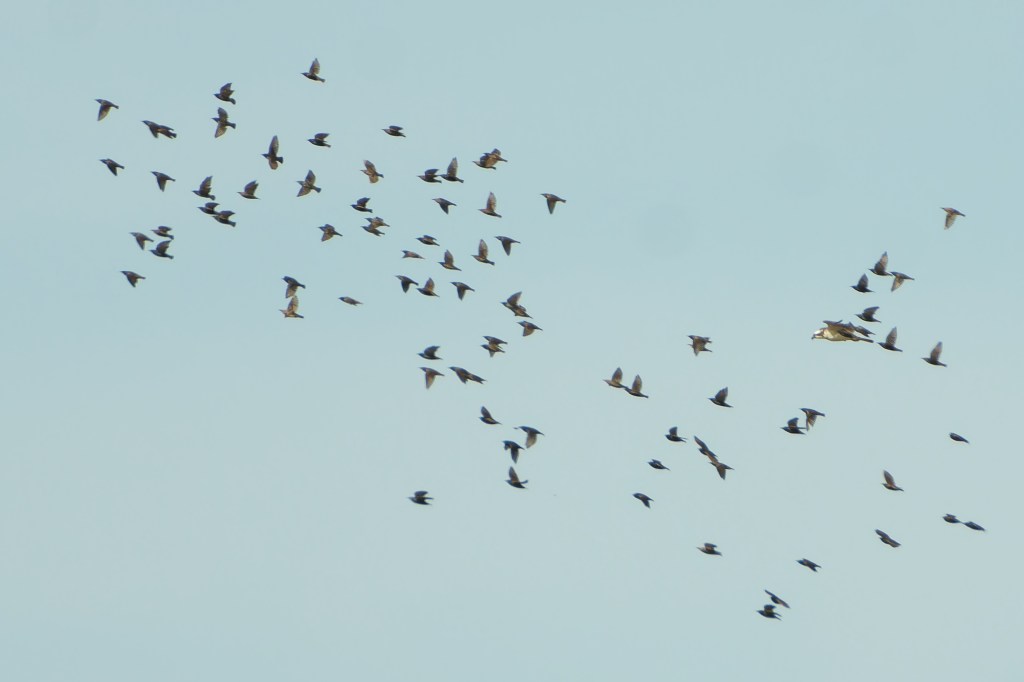
BTO population data is seven years out of date – they report 240 pairs breeding in the UK between 2013 and 2017. A recently edited Wikipedia entry tells us that “The population in Scotland was estimated at 250 breeding pairs in 2023” so it’s pretty special to see three birds together so close to home. We’ve been very lucky with Ospreys, what with this sighting, and the previous one at Cardross. We had seen a pair on Loch Etive near Taynuilt a few years ago (no camera) and an individual over the beach at West Kilbride (August 2023), terrifying a flock of Starlings. And all of this without venturing to Loch Garten.

Since our Cardross visit, Backwoodsman has striven to get the de-noising software to sharpen up these images, hoping for some extra pixels within the vague outlines. On Saturday, we learned that a Tory Big Beast (the only man able to defeat The Blob according to Simon Heffer writing in today’s Sunday Telegraph) had decided not to stand in the forthcoming general election. To mark the occasion, EJ Thribb (171/2)  might write:

So farewell then, Michael Gove,

They say you were the brains behind Brexit.

You were never short of big ideas,

But you left the detail to someone else.

As a proud former member of The Blob, it is with some regret that Backwoodsman feels that in the vagueness of these images, he now has something in common with the member for Surrey Heath, and hopes to post some sharper and more detailed stuff next time.

Fuut (or Great-crested Grebes) in Rotterdam)

If you’re only in it for the birds, do scroll to the end because that’s where they are. Backwoodsman headed to the Netherlands to stay on the SS Rotterdam and shoot some pictures, in camera-for-hire mode in support of Faye’s Ocean Modern project, and to admire the city and have some nice dinners.

It has been some years since this great ocean-liner greeted the waves bound for the sea, its home, to paraphrase Louis Dudek, but it is still an imposing sight, and to Backwoodsman, a nostalgic one. In the nineteen-sixties, Backwoodsman was often taken by his Granny Dagnall to see the Pier Head in Liverpool. Childhood memories sometimes privilege impact at the expense of accuracy, but in recollection, it seems that it was possible to turn right by the landing stage for the Mersey ferries, and walk along the quayside beside the towering steel plate of big ships secured by the bewildering catenaries of mooring lines, ropes that seemed thicker than tree trunks to a small boy. Seeing the SS Rotterdam from the quay on the Maashaven brought back many happy memories.

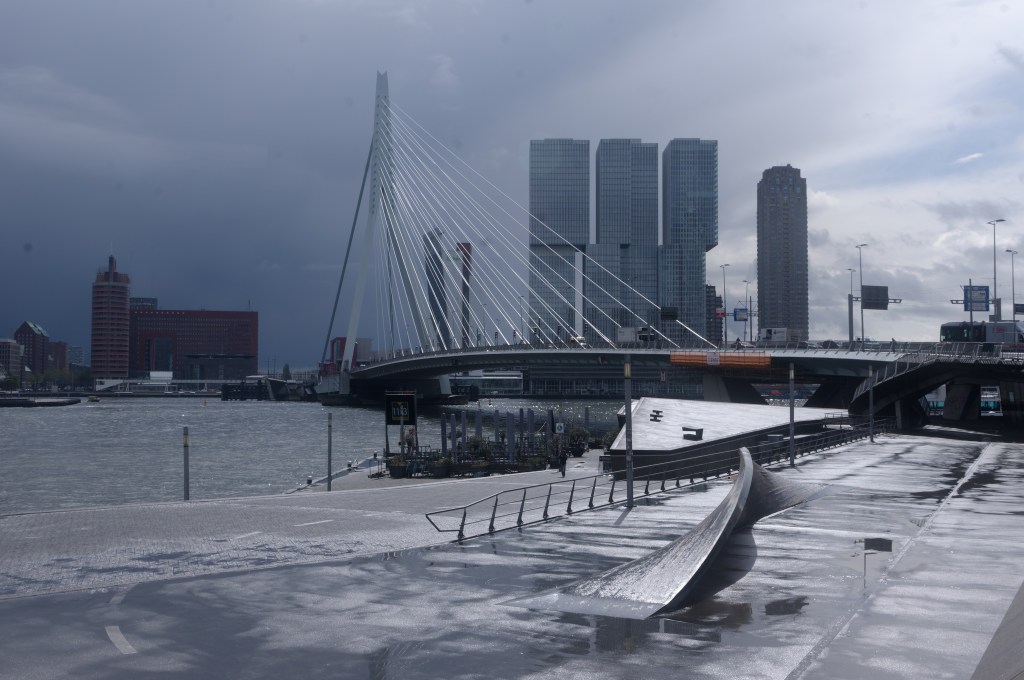
Built environment is not generally Backwoodsman’s best thing but Rotterdam seemed to have some very interesting buildings. He was particularly struck by the interconnected towers that are De Rotterdam (seen here behind the Swan bridge), and Depot Boijmans Van Beuningen, shown here with the reflected high rise of the city.

There were many examples of built environment of a much softer kind; Wisteria clearly enjoys the harbourside climate, they were everywhere and in full and glorious bloom.

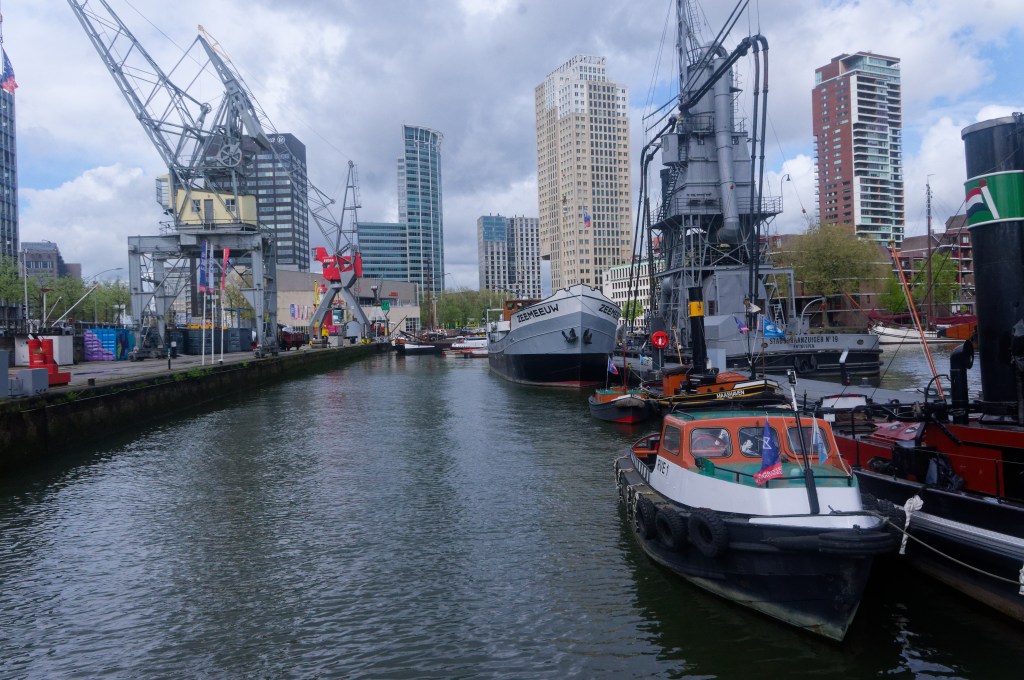
The weather was hostile but it opened up for a trip to the Maritime Museum which sits at the junction of Leuvehaven and Wijnhaven.

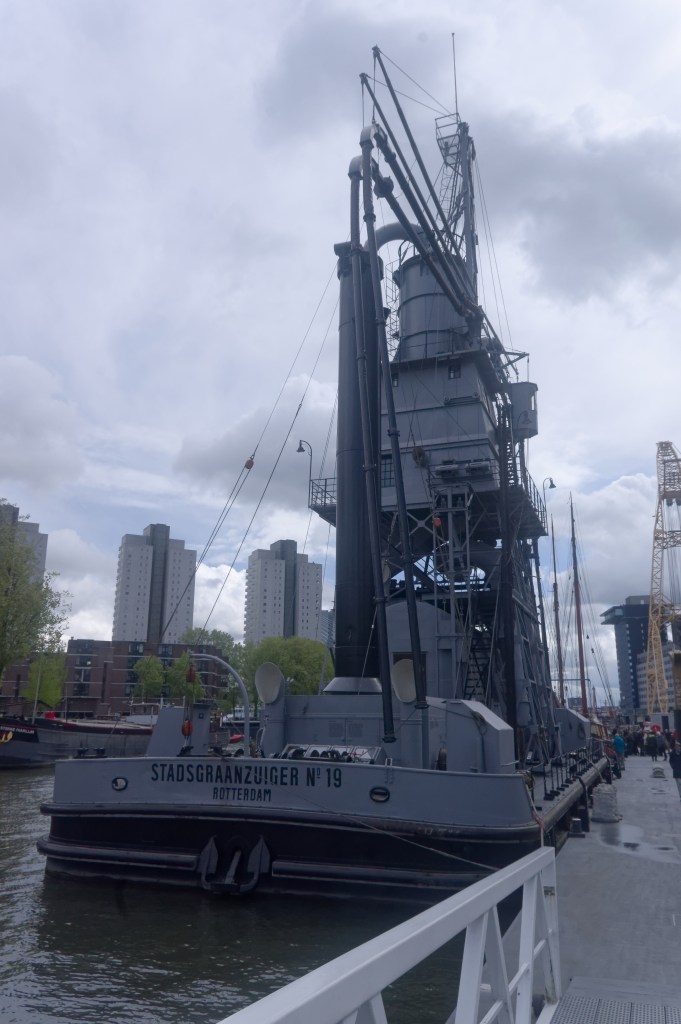
The most impressive of the many vessels moored outside the museum was the grain elevator Stadsgraanzuiger No 19, a class of vessel used to decant grain from the holds of very large vessels onto much smaller barges of shallower draft. The introduction of the grain elevators laid waste to the jobs of thousands of dockers in northern European ports.

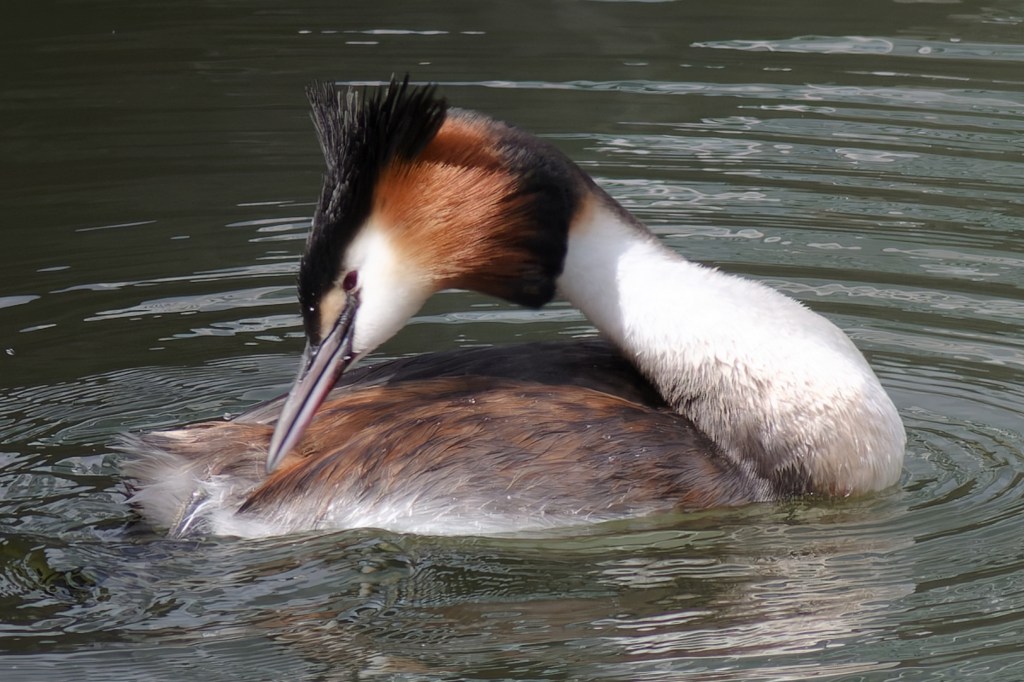
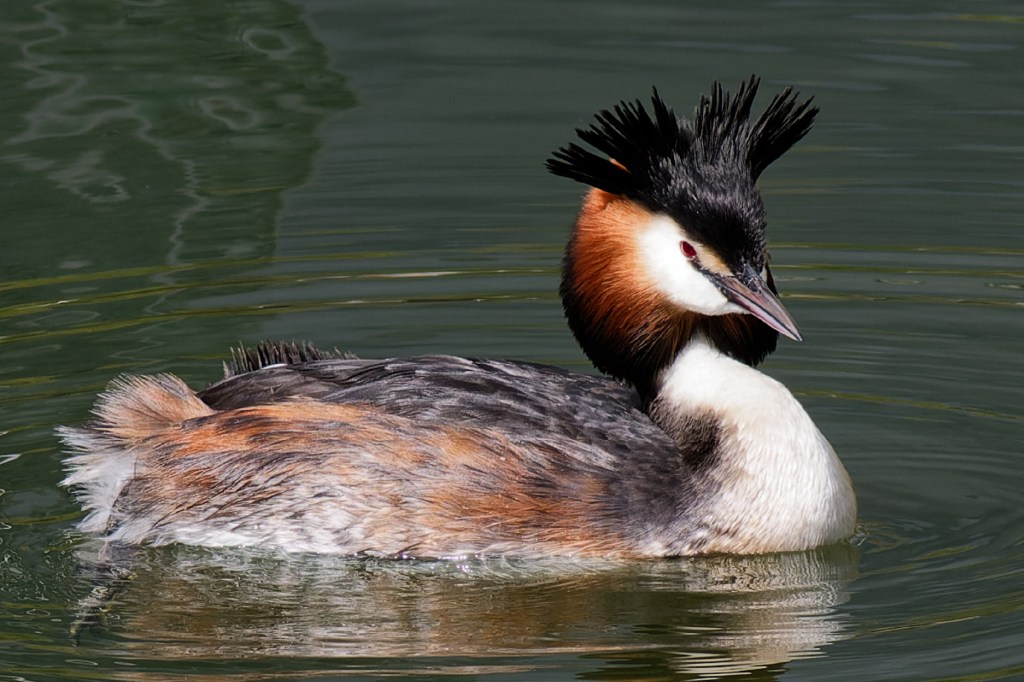
Backwoodsman had spotted a Great-crested Grebe on the water, and was very pleased to see it. A few shots were fired, more for form’s sake than in the hope of a decent image. He wasn’t prepared for what happened next as a relaxed-looking Grebe or Fuut, as it is in Dutch, came really close.

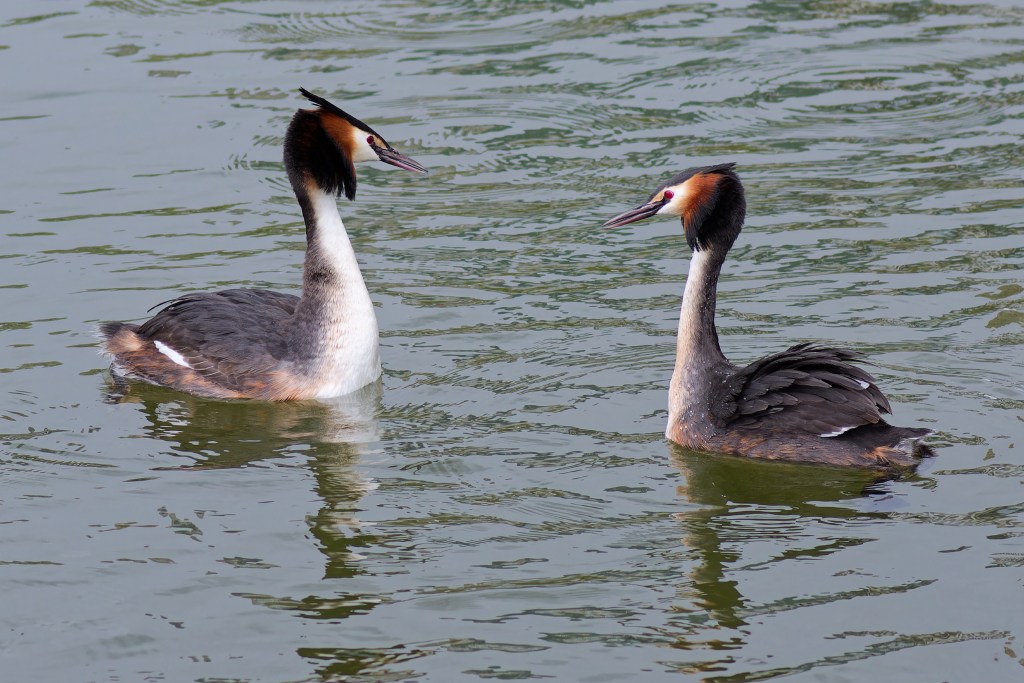
Really, what are the chances? These nervous birds usually sail away from this photographer until they are just out of range of a decent shot. Backwoodsman carried out a quick lens change (to the longest one available, a mere 100 mm telephoto) and knelt in the very limited cover available. The Fuut went about its business, and was then joined by its partner!

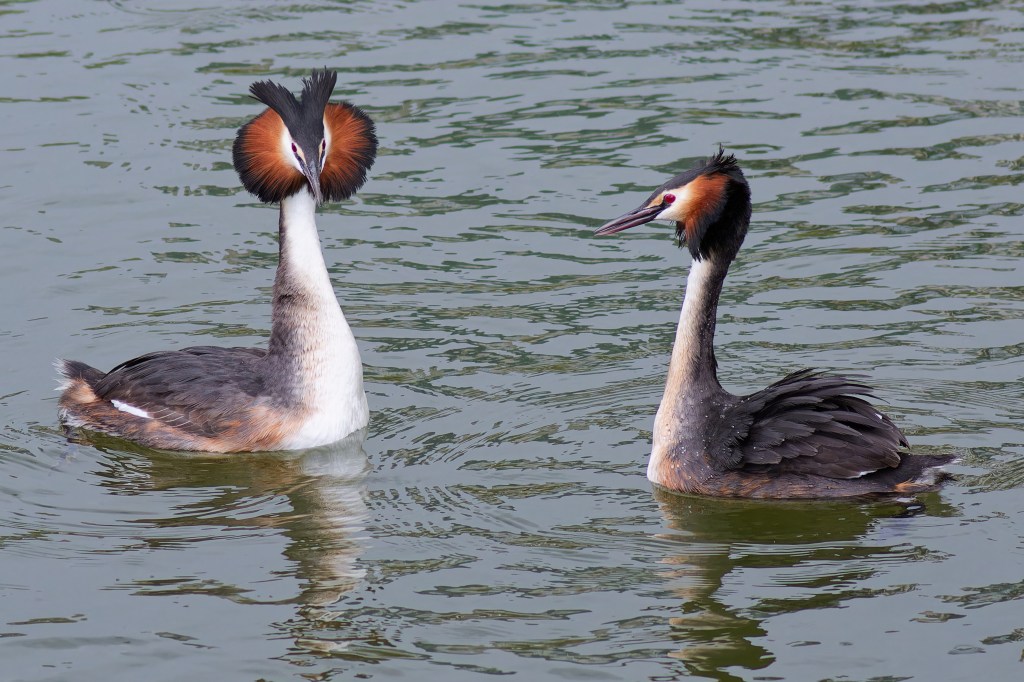
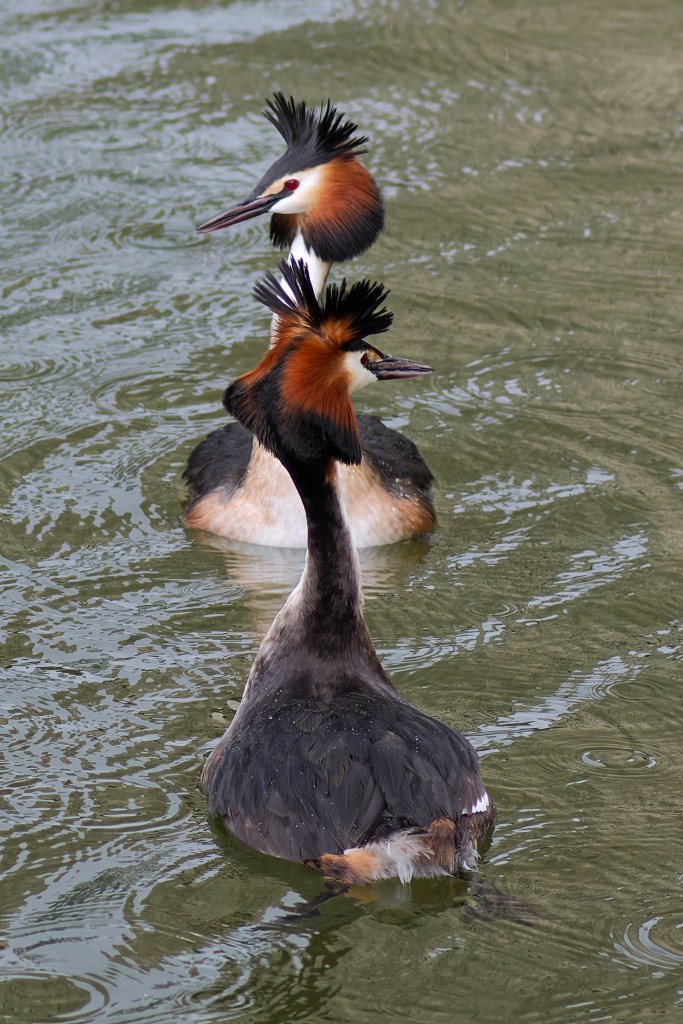
The rain started and the Grebes began to display. Backwoodsman has posted on this species before but these images are much better than what he had available at the time, so please enjoy them, if you will.

What a treat! It was also pleasing to capture some video footage, complete with passing euro-siren. Backwoodsman regrets shooting this in profile.

The rain grew heavier and it was time to leave the Grebes to their amour. A white knuckle ride on a water taxi into the teeth of the gale took us home to the SS Rotterdam.

And the dinners? The standout was HMB restaurant (for Hummingbird, birds again); McAfee really doesn’t like their website so I’m not putting in a link. Deft, delicate and delicious plates, but should you go, don’t be put off by front of house. Backwoodsman hasn’t been looked-up-and-down by a fat bloke in double denim since the nineteen eighties.

The final image is a draft poster of the displaying Grebes. It was made in Powerpoint so the quality of the jpg file is low; Backwoodsman is working on something he could print up for the wall.