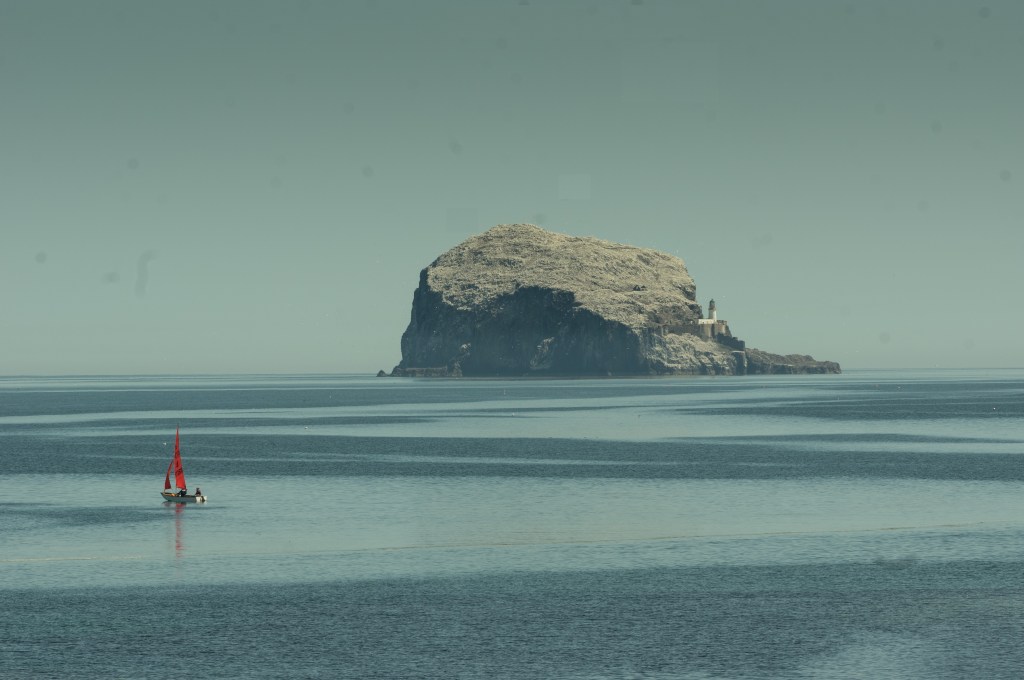
Backwoodsman has made not one but two visits to Bass Rock, “the world’s largest northern gannet colony”, recently. Both visits took place on trips organised through the Scottish Seabird Centre in North Berwick. We’ve been trying to get on one of these boats for a year or two; they are booked up well in advance and Faye made our bookings early in the new year. As the dates approached, we scrutinised weather forecasts, dreading the possibilities of gales and downpours. Neither arose; instead, we had two dry days, one grey and slightly gloomy and one blessed with brilliant light. The view of the rock through the window of the Scottish Seabird Centre on the much brighter day is at the top of the post. If you can scroll up on the image, you will see individual Gannets in the sky and sitting on the rock in the colony.
Distant views of these birds were fairly common from our visits to the Ayrshire coast, with the stretch from Stevenston Point to Saltcoats usually the best bet. The Ayshire Gannets could well be from Ailsa Craig, one of the major gannetries in the west of the UK. The birds would stay well offshore and fish, and photography would be unproductive. We were about to have a very different experience.
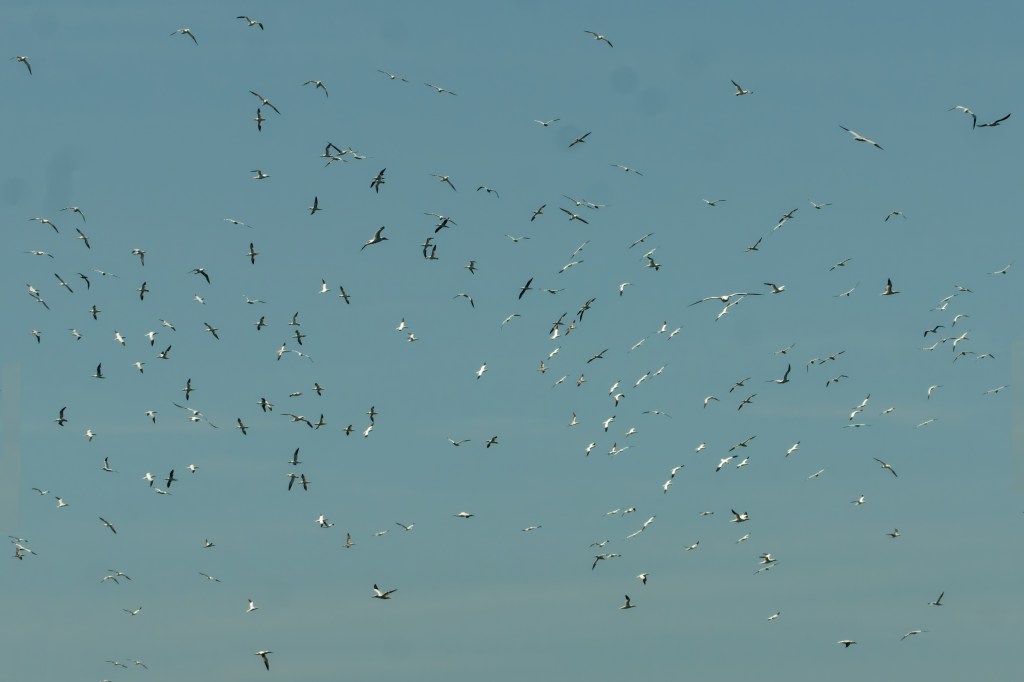
As we approached the Bass, we saw a sky full of Gannets. They were not fishing, but soaring on stiff wings and glittering in the bright sunlight. In Sightlines, Kathleen Jamie describes a visit to a Gannetry beautifully. Indeed Gannets grace the cover of her book. She writes, of her approach to the colony: “It was exciting, like a fun fair; the closer we got to the cliff edge the more we could hear the racket, the more the breeze brought us the smell.”
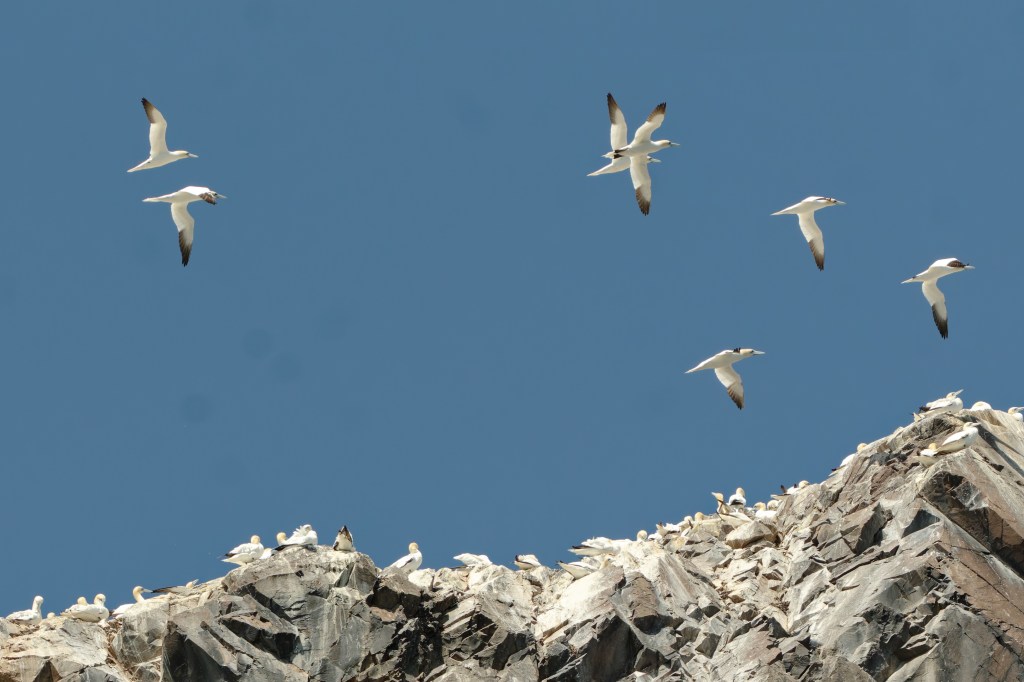
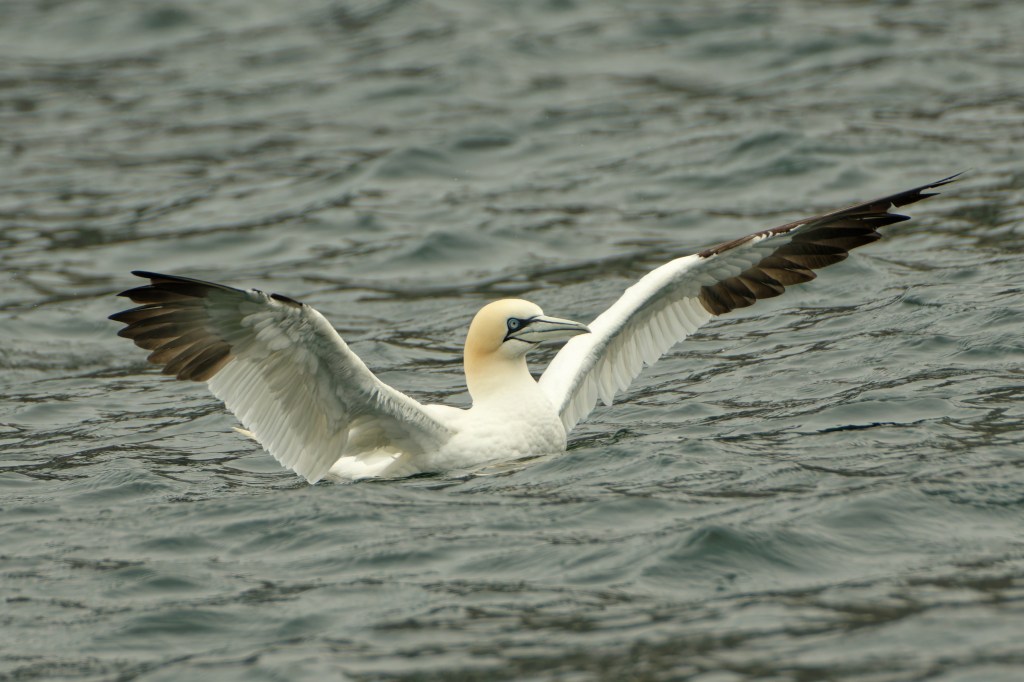
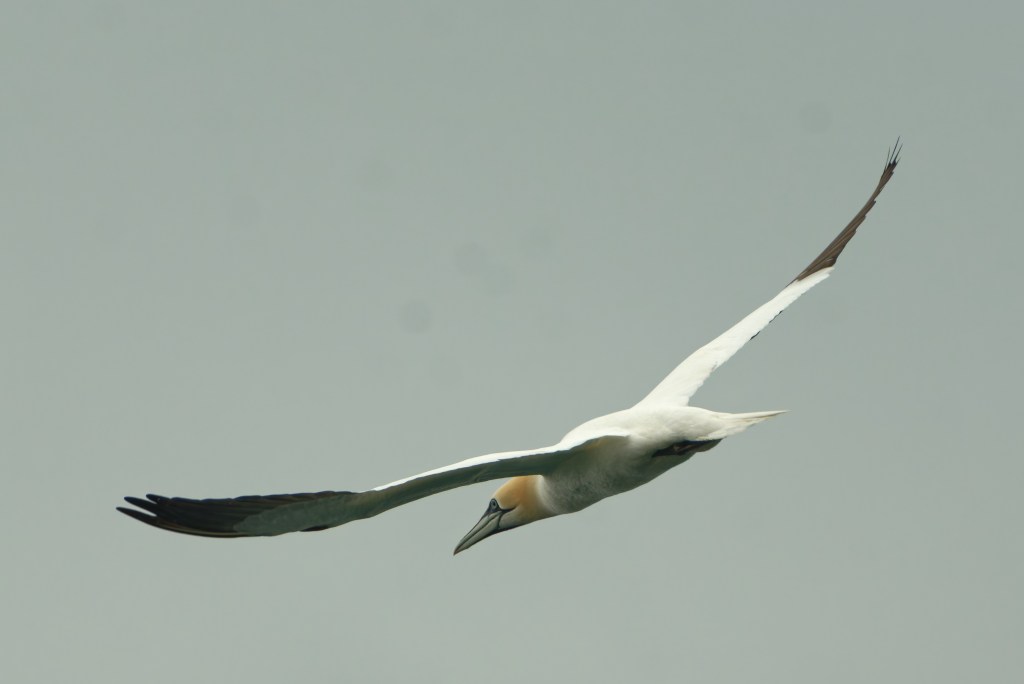
Sensory impacts all round! As we grew closer to the rock, birds crossed our path and the two metre wingspan made its considerable visual impact.
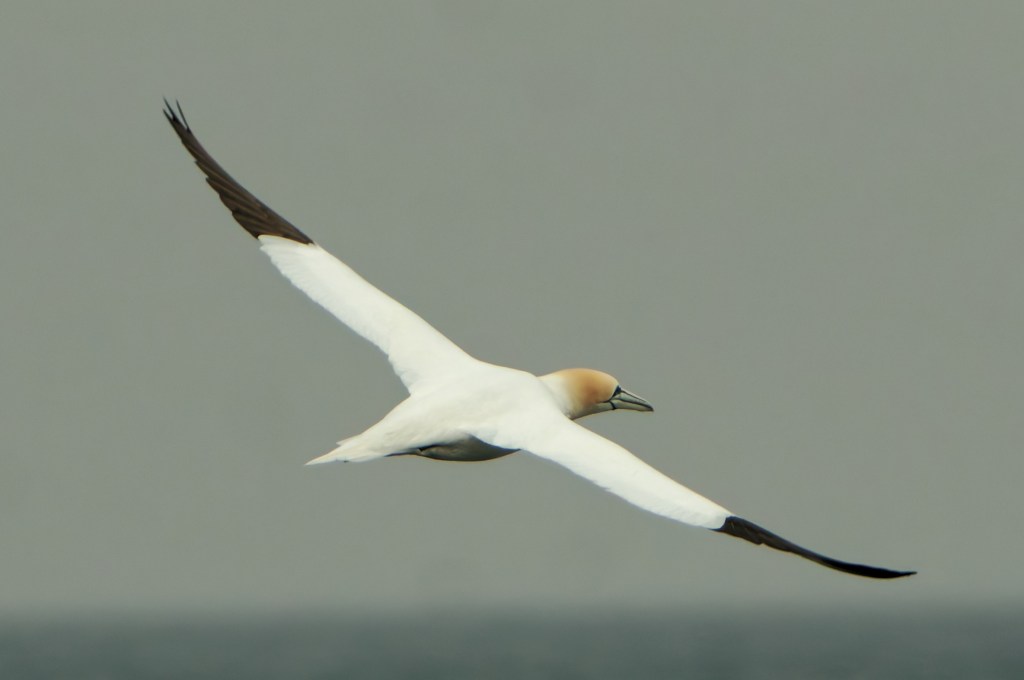
Birds approached bearing feathers and seaweed for nesting material.

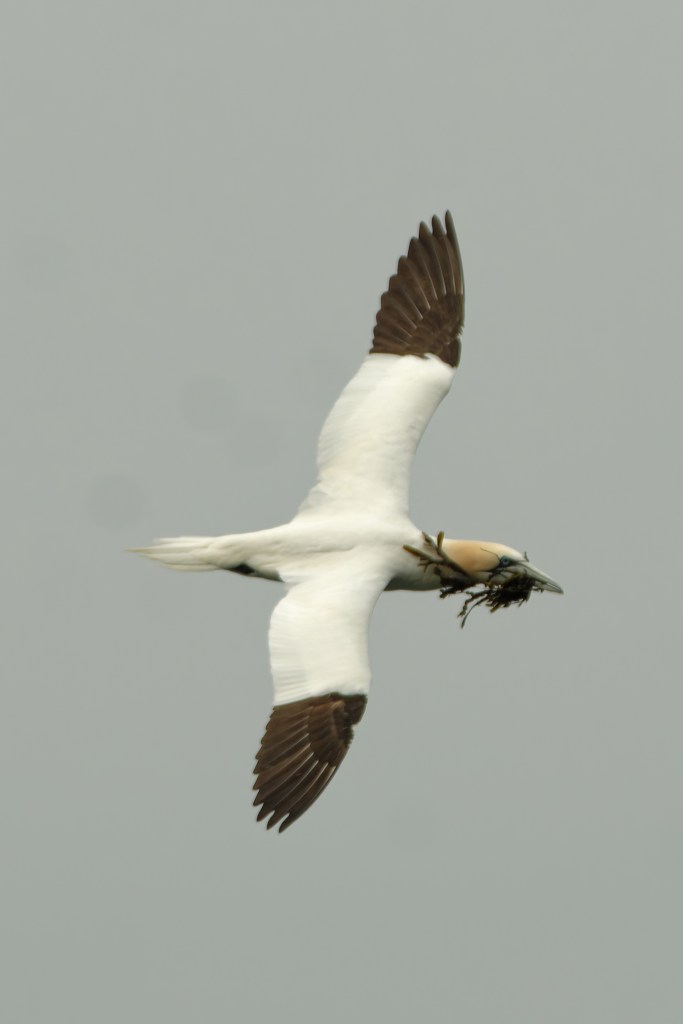
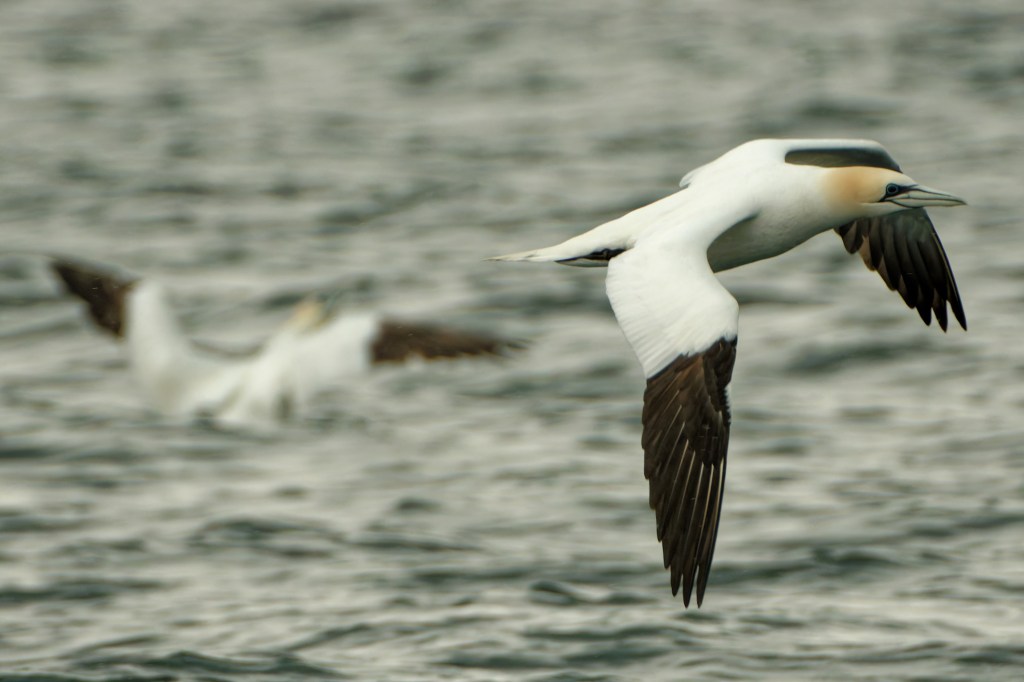
The smell and clamour grew and we began to see birds sailing by.
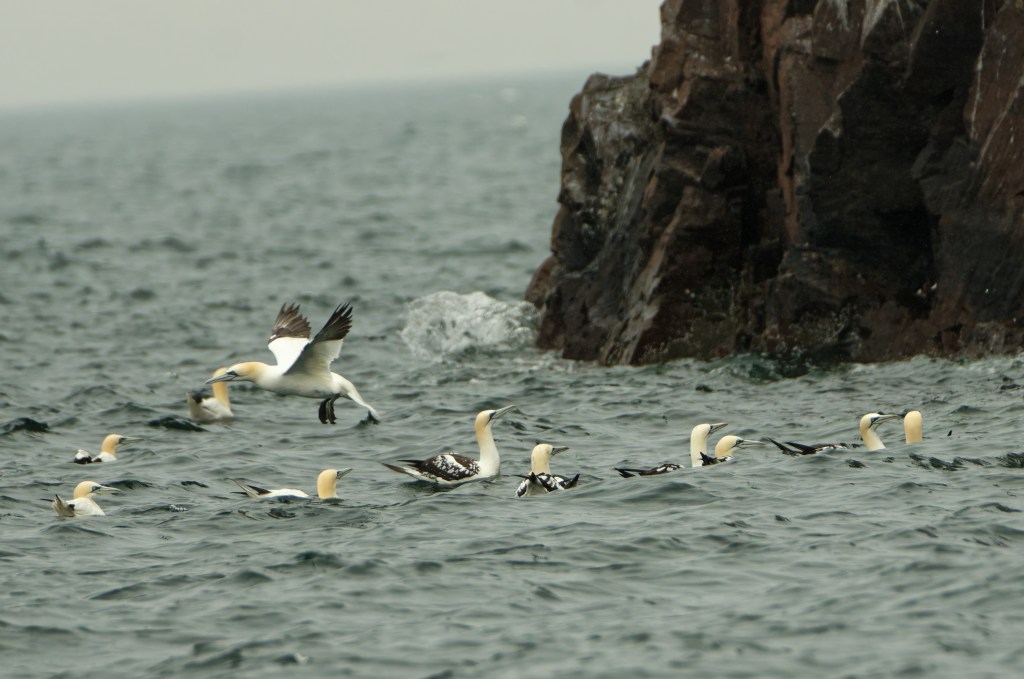
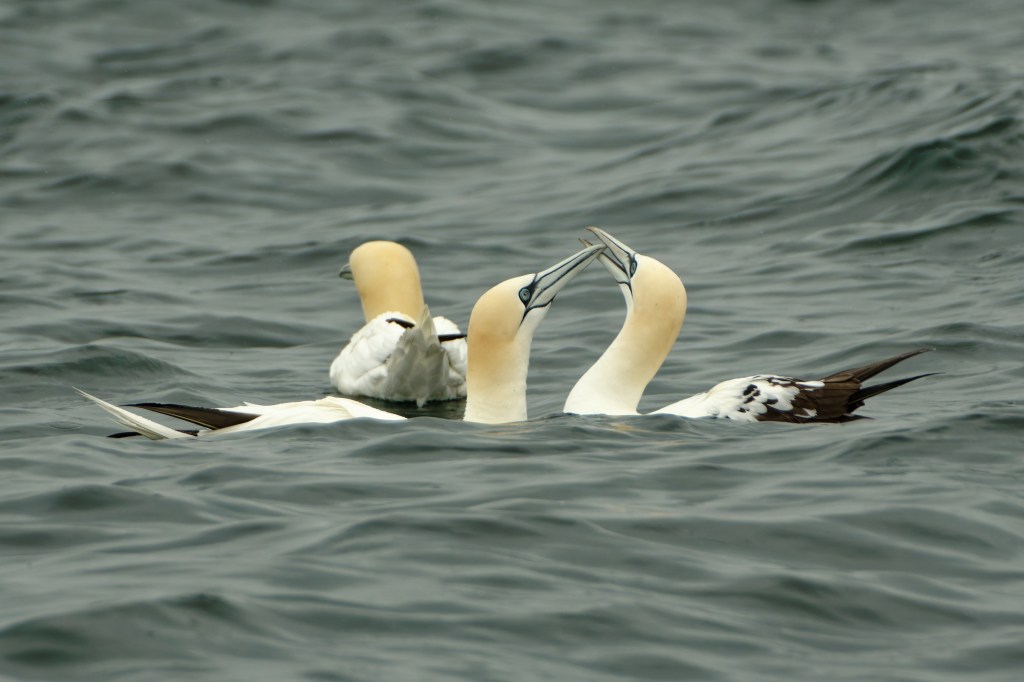
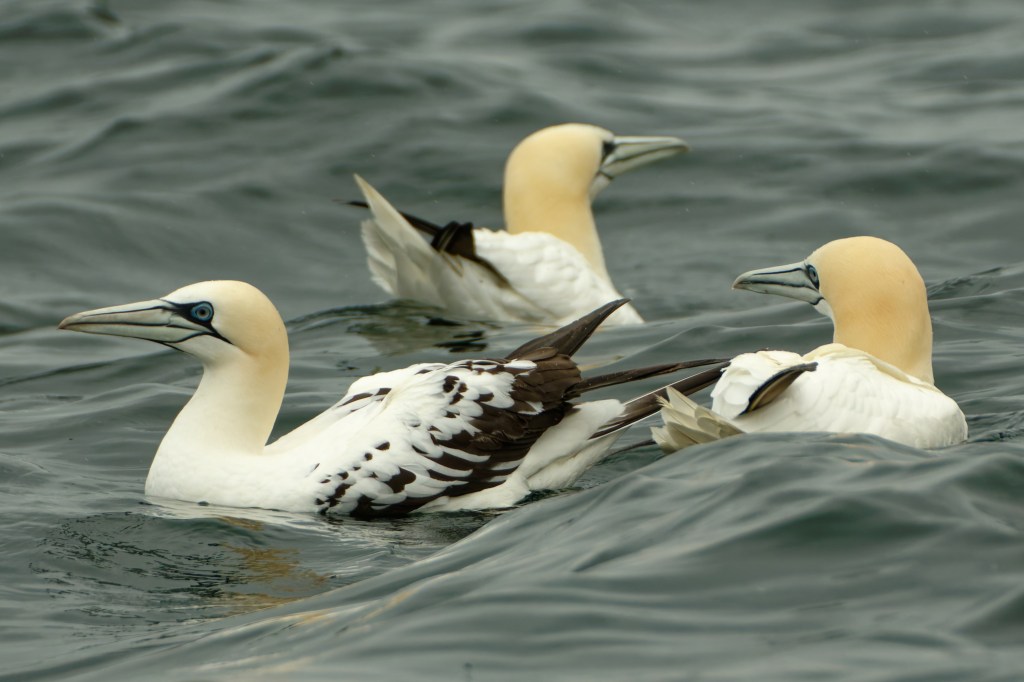
You’ll notice birds with quite a lot of black feathers; these are sub-adult birds. Gannets attain their adult plumage after four to five years.
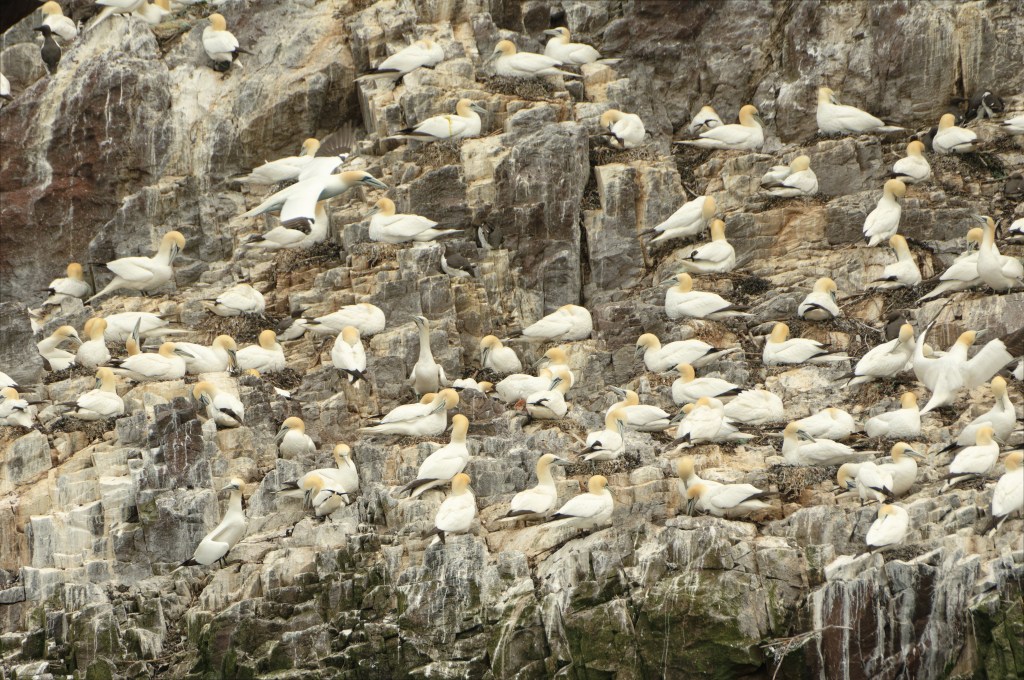
The view (and the smell and the sound) at the foot of the rock was overwhelming. The nature programmes often explain how a raptor attacking a flock of birds will be confused by all the movement and may fail to catch anything. Backwoodsman felt somewhat bewildered by the sheer range of targets. Time to focus (ho ho).
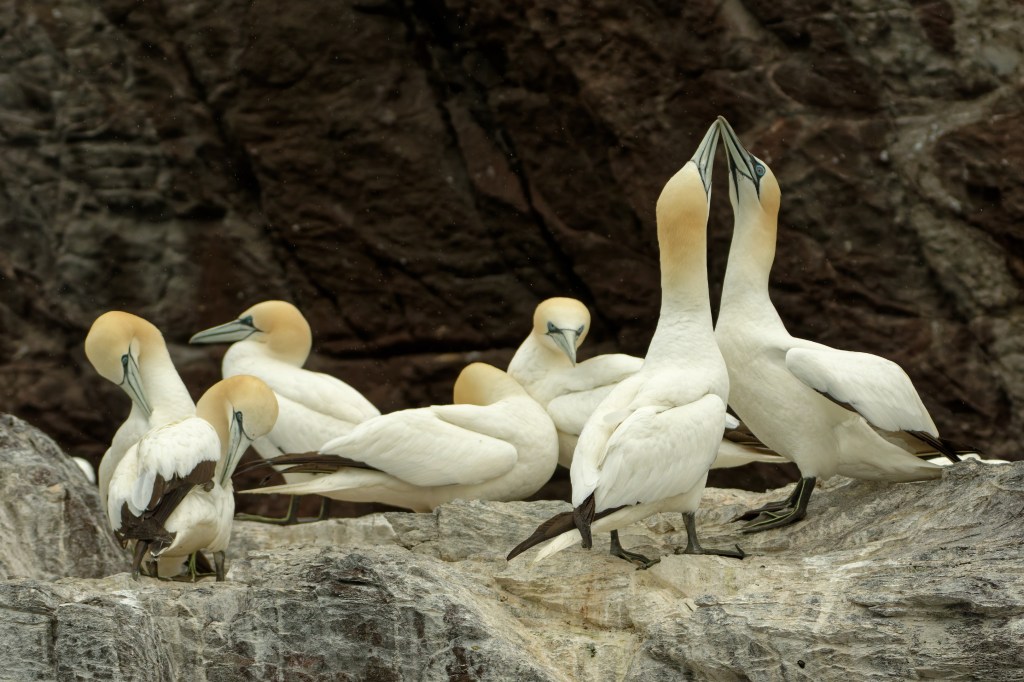
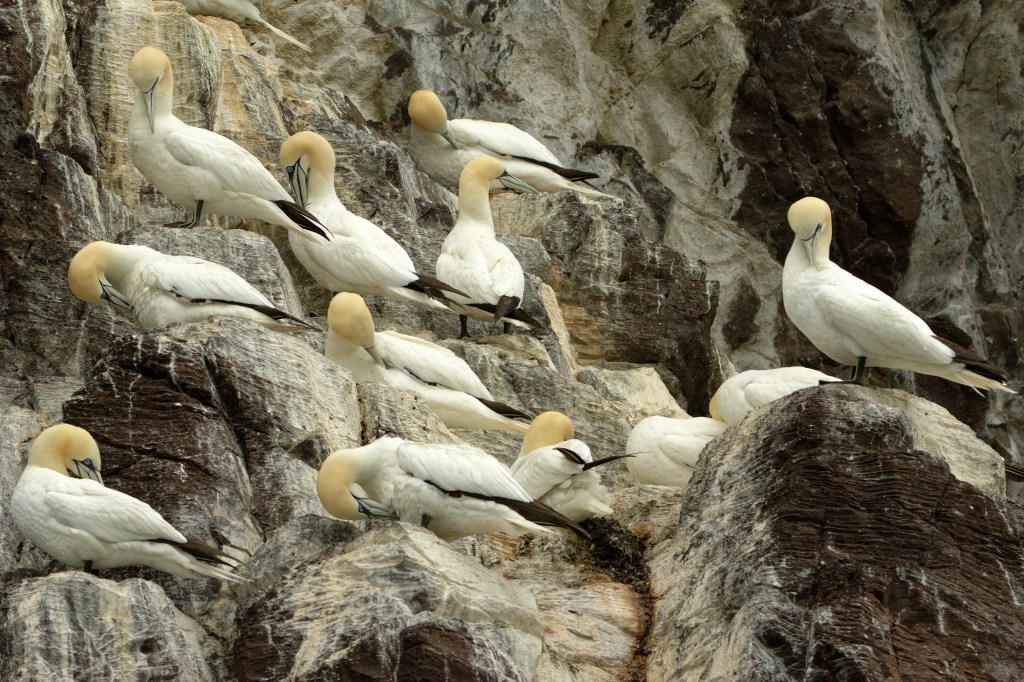
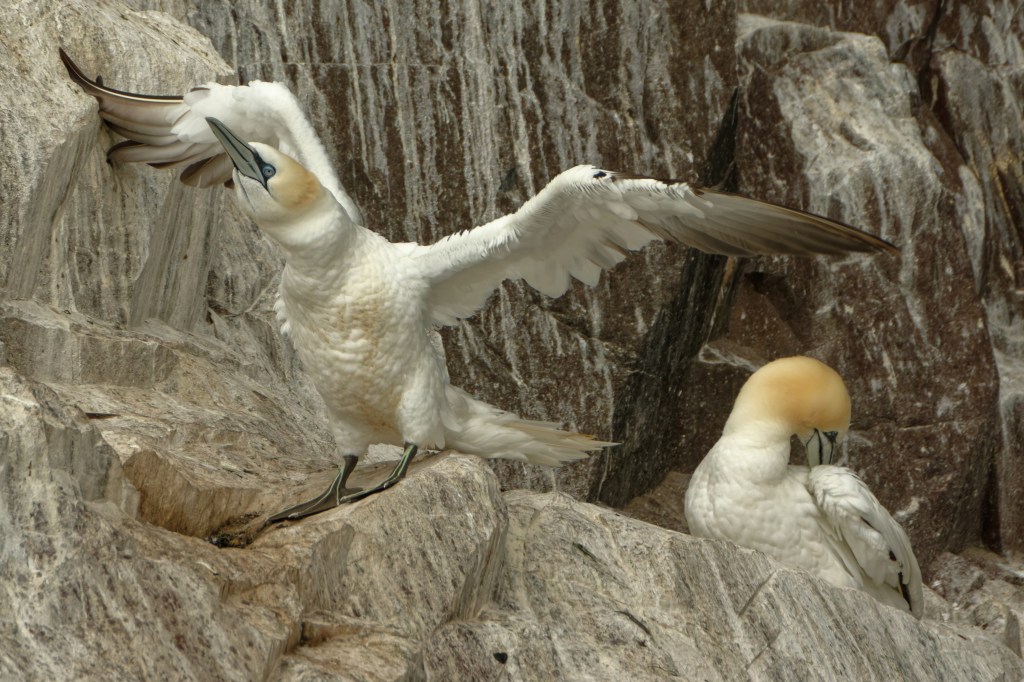
The Gannets are bonding in the top photograph; this seems to be only part of their ritual life, described in this review.
Gannets boast some remarkable adaptations (air sacs, binocular vision, lens shape changes) which help them to survive their extreme dives, and locate and home in on fish from the air and below the surface. The original publication of the vision study has a very nice graphic describing Gannet dives (it refers to a related species).
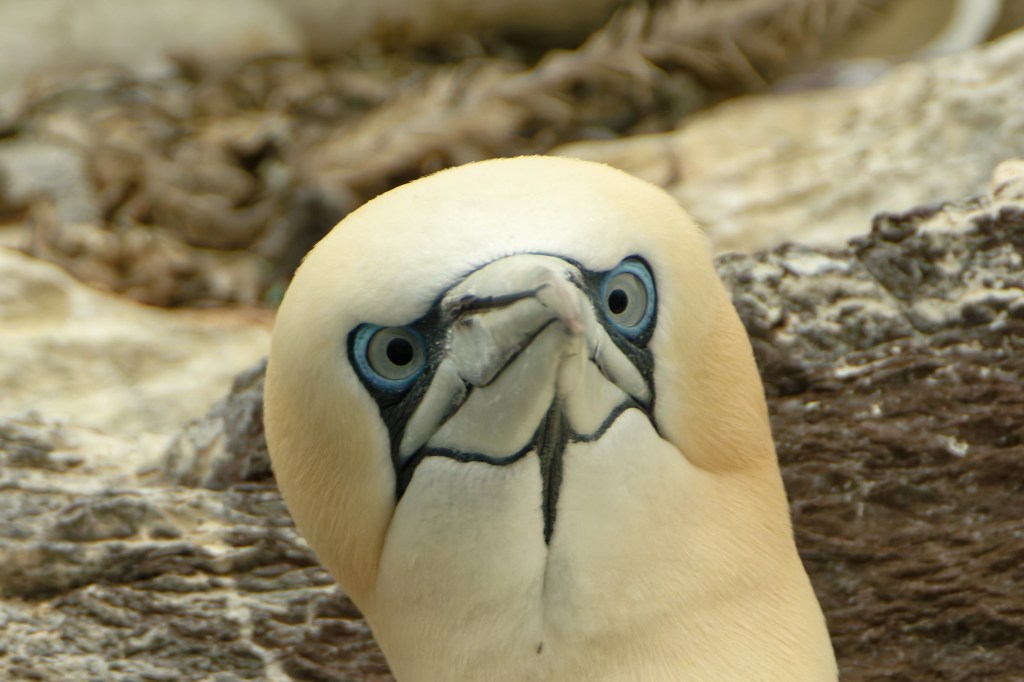
Being looked at by a Gannet is a slightly disconcerting experience.
The eye colour also reveals a bird’s history of Avian ‘Flu; in the first image below with the blue rings, the bird has not been infected with the virus, but the bird with the black eye in the second image is a survivor.
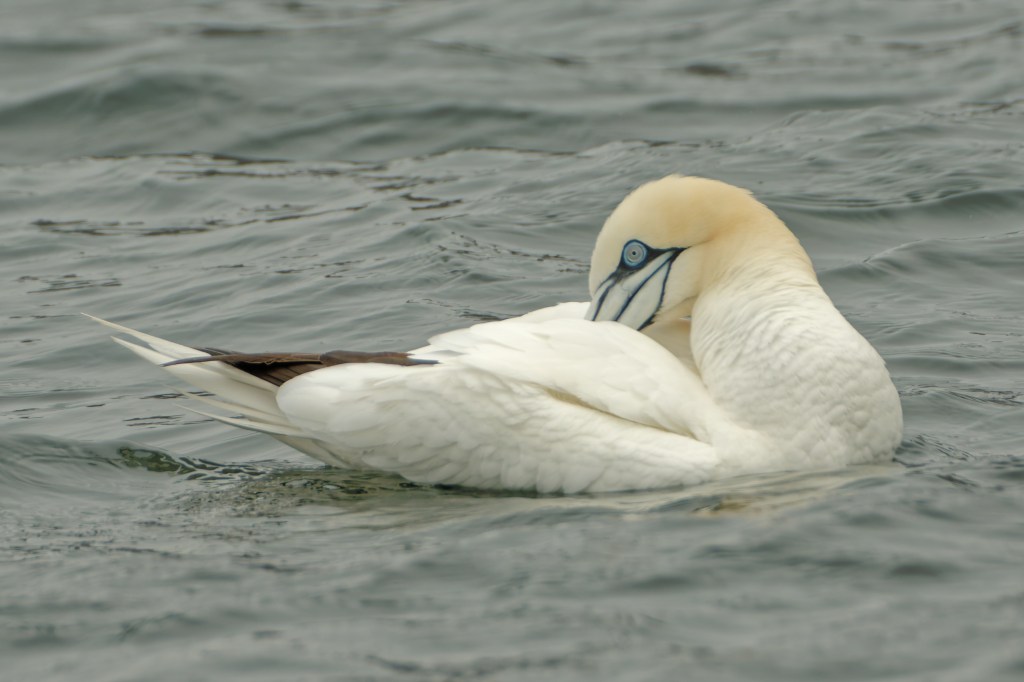
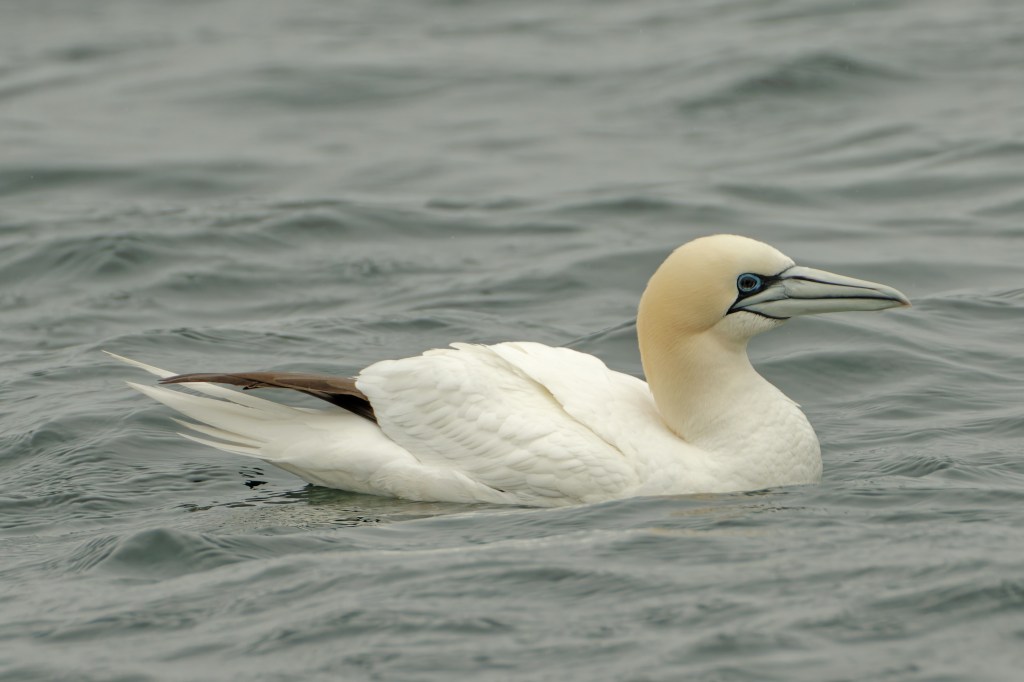
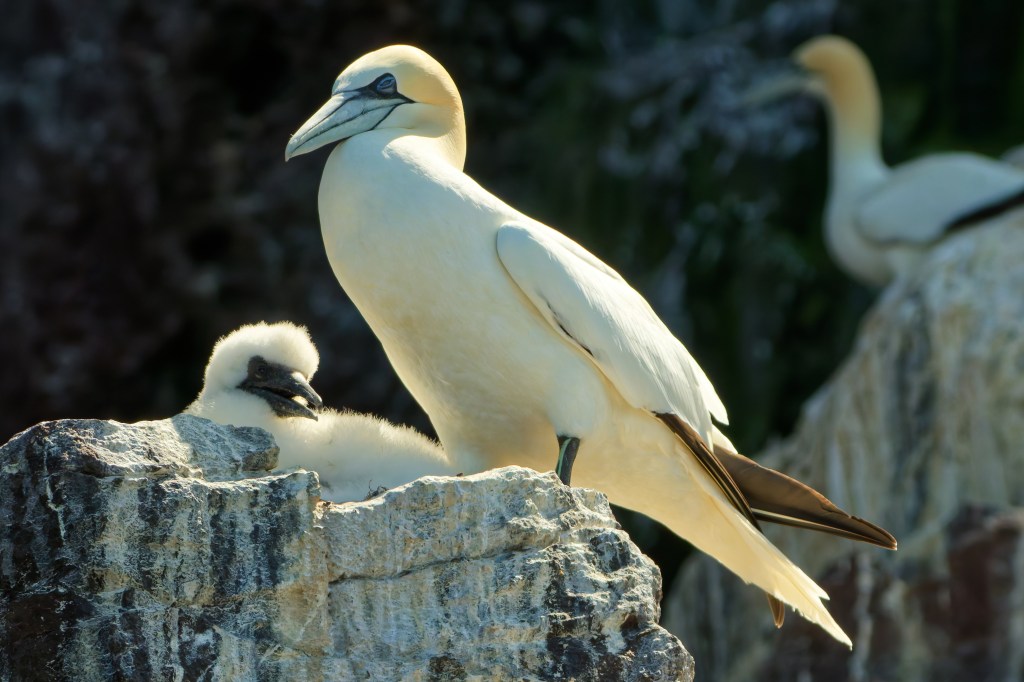
A pair of Gannets will attempt to raise a single chick – some were visible when we visited on the bright day. As it grows, this bird will take on the dark plumage of the juvenile.
As we left the Seabird Centre, we passed a table upon which some campaign material had been set out – it referred to the Berwick Bank Project proposed by SSE Renewables. The company say that “We have conducted comprehensive aerial bird surveys during the development of Berwick Bank. The enormous amount of data we have collected has enabled us to refine our proposals and put forward a more environmentally friendly design.” In a recent post (15th June 2025), the company revealed that it was reducing the area of the project by 20% as it prepared for consent submission.
Glasgow-based environmental consultants MacArthur Green (now part of the multinational SLR Group) wrote an opinion on Gannets and windfarms in 2021, which includes this:
“A case might be made that there should not be a requirement for compensation for offshore wind farm impacts on gannets because the UK SPA suite for gannet is certainly overall in Favourable conservation status, with breeding numbers on the suite as a whole about 90,000 pairs above the population level at designation of these sites, and with every SPA in Favourable conservation status for breeding gannets. Furthermore, it could be argued that there is over-provision of SPA protection of this species, with more than 95% of the UK population of gannets breeding within sites where they are a designated feature. However, Britain and Ireland hold most of the breeding population of gannets, so this species is particularly important for us in a global context.”
Quite a lot is known about Gannet migration: “The Gannet Morus bassanus is one of the seabirds considered most at risk from collision mortality at offshore wind farms in UK waters, so a better understanding of migration routes informs assessments of risk for different populations. Deployment of geolocators on breeding adults at the Bass Rock, Scotland, and Skrúður, Iceland, showed that the timing of migrations differed between populations, birds from Bass Rock passing south through UK waters mostly in October and back in February while birds from Skrúður passed south through UK waters mostly later, in November, but returned north earlier, in January. Many birds from both colonies made a clockwise loop migration around Britain and Ireland. Only a minority of birds from the Bass Rock returned northwards to the colony through the southern North Sea. A counter-intuitive consequence is that many Gannets moving northwards through waters to the west of Britain and Ireland in spring may be birds from North Sea colonies. Although Gannets normally remain over the sea, one tracked bird appears to have made a short overland passage in spring from the west of Scotland through central Scotland to the Bass Rock, whereas most returned around the north of Scotland.”
The case against the project is based more on the presence of the installation in an area which the birds will use to feed, rather than it being a hazard flung across a migration route: “A globally important area for seabirds will be severely at risk if a proposed offshore wind development, Berwick Bank, is approved. The proposed development is immediately next to the Outer Firth of Forth and St Andrews Bay Complex Special Protection Area. This is designated for its globally-important seabird populations. The proposal is for a 4.1 GW project with 307 turbines, each one 355 metres high to blade tip. If it is built, it will be one of the largest in the world. Berwick Bank, in its current form, would be more destructive to seabirds that [sic] any other proposed offshore wind farm in Scottish waters. It has the potential to kill tens of thousands of seabirds and to displace tens of thousands more over its lifetime. This area is used extensively for Kittiwakes, Puffins and Gannets. What’s more, shallow waters near the shore are the most important for many seabirds to find food for their young.”
It remains to be seen how the Scottish Government will handle this. There is more about the campaign here and a link to a petition.
Would it be trivial to end by saying that one of Backwoodsman’s favourite restaurants is named for this most impressive seabird – The Gannet in Finnieston! Backwoodsman hopes not, and likes how a diving bird is celebrated in the logo.
 backwoodsman.org