

Backwoodsman had the huge good fortune to be taken to the Aigas Field Centre recently. The trip was a twenty-fifth wedding anniversary present, and what a good one it turned out to be. We took the train from Glasgow Queen Street to Inverness and were collected at the station for the ride towards Beauly and into Strathglass where House of Aigas sits. The area supports a very large HEP Scheme (Affric-Beauly hydro-electric power scheme) with power stations at Aigas and Kilmorack, a significant amount of local infrastructure and a contentious history, which makes for a most amusing read in this Wikipedia entry.

SSE proposes to build new lines in the area including a big one running from Spittal in Aberdeenshire, to Beauly. New substations will also be required, with one of these planned near Beauly. We started seeing protest banners as we hit the A831 heading in the Cannich direction. Backwoodsman was forearmed having watched the BBC Panorama programme “Rewiring Britain: The Race to Go Green” in which “Justin Rowlatt meets the people taking sides in the battle over rewiring Britain”. It was an interesting watch, what with Rowlatt skipping in and out of helicopters like an excited puppy.

Backwoodsman will return to the vexed question of “Rewiring Britain” later on but before that, here is what we went for. The Aigas Estate is managed for wildlife and many Red Squirrels live on the property. While these rodents abound in Scotland, they are usually far too quick for Backwoodsman’s camera but not this time. The Pinewood Hide at Aigas offered the opportunity to lay traps; a bin in the corner of the hide contained shelled peanuts and whole hazelnuts. The latter could be shelled and served (fast food) or presented whole in their shells. A squirrel would take longer to scoff a nut in its shell, and might do some cute stuff with its little hands while it ate. Backwoodsman is an angler and spends a lot of time thinking about multiple lines and how to feed them to attract fish in different ways (usually unsuccessfully), so off we went with some peanuts here and hazelnuts there and there. A Vole was clearly watching this caper – they are very fast but like eating. Even wild animals are not daft – they know where the food is going to go in and they watch those lines. Perhaps you would argue that these animals are becoming, or have become, semi-domesticated?
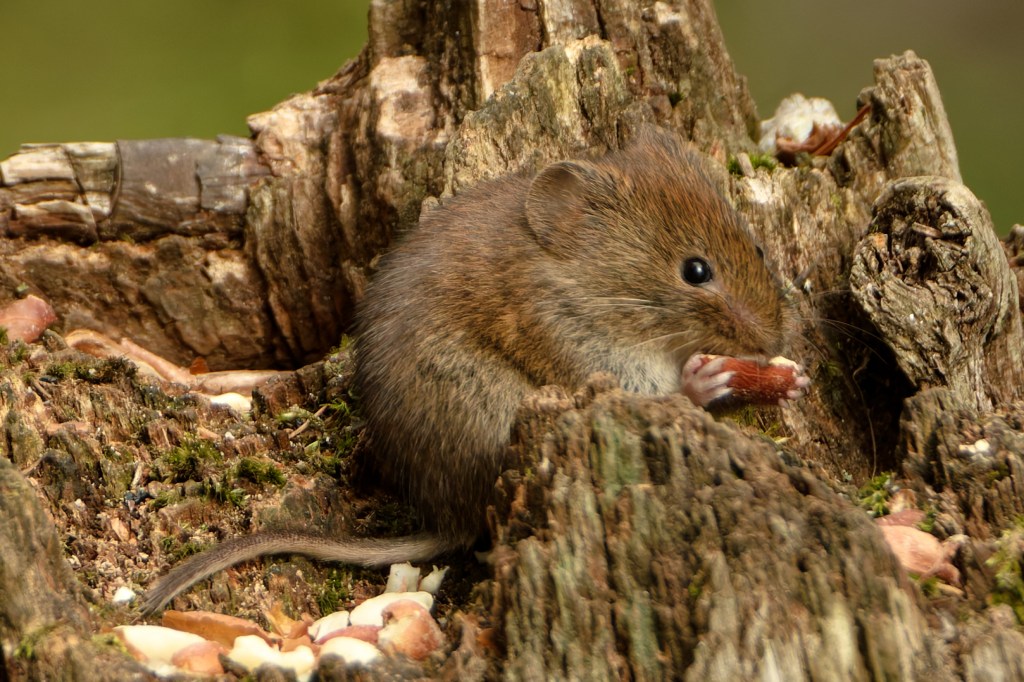
A poster in the hide identified this tiny rodent as a Field Vole. Backwoodsman’s copy of the book Britain’s Mammals (p. 72 of the updated 2021 edition) suggests that Field Voles and Bank voles can be distinguished by tail length and degree of hirsuteness of their ears. In this image, the tail is half the length of the body, spot on for a Field Vole, but in all these images, the ears seem quite prominent and really not hidden in the fur. Backwoodsman will defer to the local expertise.

So here is a gratuitously cute image.

Anyway, then the squirrels came. We saw several animals, mostly very pretty but there was a somewhat thuggish looking animal and we watched it destroy a flimsy bird feeder, just like the Grey Squirrels do at home. If you are struggling with this issue, fit a Squirrel Buster feeder, they work so well.

Anyway, the Red Squirrels ran through quite a lot of repertoire and delighted us. There are a few Squirrel Nutkin poses in this set of images!




Backwoodsman confesses that he is not entirely immune to the charms of Grey Squirrels – they have a way about them. There is a place in Kelvingrove Park where students from East Asia go to feed Grey Squirrels and take photographs; the squirrels attending this site know how to put a best paw forward. The whole narrative of invasive species versus native species is a slippery one, but it is disagreeable to think of Red Squirrels being driven entirely from large swathes of territory and infected with viral disease. Fortunately, Reds are being looked after and may be said to be on the march (or possibly bound); one even turned up in Bishopbriggs, just a few miles from where we stay, last summer.

So “Rewiring Britain”…”Do you have to??” bellows Backwoodsman’s limited readership. Well, some quite interesting things came up in the programme and Backwoodsman has looked into some of them. Opponents of the Beauly pylon line were very keen on buried cables and Backwoodsman wondered about the merits of overhead versus underground. Much of the following content seems consistent with Emma Pinchbeck’s comments on the issue:
“Although underground cables may be less prone to faults, they take longer to repair on average than overhead lines, since repair involves locating the fault, excavating the cable, completing the repair and reinstating the cover. The difference in repair times increases with the voltage such that, at 132 kV and above, overhead lines are out of service for a far shorter time than underground cables. At times of low demand, underground cables are also prone to brief overvoltages and system instability which may constrain the operating flexibility of the transmission system.”
And:
“At higher voltages, the disadvantages of underground cables in terms of higher capital cost, greater down time due to faults, the potential for greater environmental damage and loss of useful land have precluded their widespread use. High voltage underground cables tend to be reserved for circumstances where overhead lines are impracticable, such as in dense urban areas or sea crossings. In exceptional circumstances, where it has not been possible to avoid routeing lines through areas of designated landscape value, there have been occasions when lengths of underground cable have been installed to preserve the visual amenity. “
And:
“Care is taken to minimise damage to farmland, which with underground cables could be significant and take a long time to recover, with possible disruption to drainage and water courses. When in service, both overhead lines and underground cables which cross agricultural land impose constraints on farming operations.”

Punters just don’t want pylons and neither do their MPs – this from John Lamont, Conservative MP for Berwickshire, Roxburgh and Selkirk.
“Our countryside could be scarred, which would damage tourism, leave businesses out of pocket, and risk the environment. Agricultural land could suffer, which could affect farms and reduce the amount of produce made here in the Borders. I believe there is another solution – instead of so many overhead wires, underground cabling should be considered.”
There’s a few votes in that from the chaps in purple corduroy trousers and waxed jackets. Is a cable buried in your farmland, which you might plough up at any time, so much better than one in the sky, which you can drive underneath safely? Backwoodsman has no view.

Pylons are not attractive but it would seem to be necessary to have some to maintain the National Grid. Will it come down to a judgement based on aesthetic concerns? If so, we might be in for some trouble: just check out the dwelling and outfit of the lady leading the anti-pylon campaign on Deeside in the Panorama programme (05:05 onwards). The Rivers Glass and Farrar are both lined with pylons and HEP stations currently. Neither are exactly virgin lanscapes so does it matter if some taller pylons go in here too for the greater good? One of the young Aigas wardens made a good point while we were out in his van; the construction of the new infrastructure will push volumes of heavy traffic down small roads which are not really made for this purpose. This will clearly be problematic and it is hoped that every effort will be made to mitigate the impacts.

There are ways of looking at energy development which seek to benefit the communities which host the infrastructure. Becky Ford in the Spring/Summer issue of ReSource, the house journal of the Royal Society of Edinburgh, and representing Community Energy Scotland, writes that the need for communities and industries to work together for collective good “…allows for care for people and place – not as assets or resources to exploit but as intrinsically valuable ecosystems which can sustain life for all.”

The Suffolk objectors were very focussed on offshore infrastructure as well as buried cables and keen to cite efforts in the Low Countries. It is possible that they were talking about Belgium’s energy island (and video), a huge offshore infrastructure build which will collate cables and outputs from a major array of wind turbines. “As the world’s first artificial energy island, the Princess Elisabeth Island is our flagship project. Located off the Belgian coast in the North Sea, the island will serve as an electricity hub that will bundle together the cables leading to wind farms in Belgium’s second offshore wind zone, helping to bring the electricity they generate back to shore. It will also act as an intermediate landing point for interconnectors that link Belgium to other European countries.”

Belgium is still doing overhead cables though, despite what the SEAS people said. For example: “Lamifil supplied 260 km of AAAC UHC (Ultra-High Conductivity) overhead conductors for a vital and unique backbone upgrade of Belgium’s national grid. Belgium’s national grid operator Elia is continuously developing its high-voltage grid system or ‘backbone’ to support the energy transition and increase interconnectivity within the European grid network.” Other Low Countries are at it too.

The UK hasn’t been too great at major infrastructure projects over the last couple of decades; three characters will convey the scale of the problem – HS2. We’ve been busy getting on with the important stuff of delivering austerity and securing our Brexit freedoms. Backwoodsman has the merest suspicion about how all the objectors in the Panorama programme might have voted on the inglorious day. He does not see them as supporters of the current policy of the Labour Party under any leadership and wonders how they feel about any approach to Net Zero on any timescale?

There is so much to understand about the energy industry but it does seem clear that our demand for electricity will only rise, unfortunately, particularly as more and more data centres are built and electric cars plugged in. It would seem better to avoid building the data centres, find ways of moving people around that don’t require the proliferation of EVs and generally attempt to moderate our use of energy resource, but that isn’t how things are done now. Renewable energy resource will be generated far away from the main points of consumption and it will need to be connected into the grid. Growth is all, even if it’s growth of dumb sht we really don’t need. Or possibly even want, given an either/or/choice, like, shall I have pylons in my back yard, or shall I not lease that new electric SUV? Ideally, I get the new tank and someone else gets the infrastructure. Result! Backwoodsman opts for a live-in Red Squirrel, thank you.
PS Backwoodsman has just been asked “Do you mean that petrol cars are better than electric cars?”. No, just that fewer cars, whatever their fuel, should be our goal, especially for us city folk.
 backwoodsman.org