
In her first novel Oranges are not the only Fruit published in 1985, Jeanette Winterson described the strange upbringing of a young girl beset by an oddly religious parent. As if this were not challenge enough, she is forced to learn cross stitch at school. She produces a sampler bearing the following legend, from Jeremiah (8:20):
THE SUMMER IS ENDED AND WE ARE NOT YET SAVED
Academics huddled in the trenches and waiting for the whistles to blow and send them over the top to face the machine-gunned demands of wonks, and all those students with mennl-elf, will recognise the peculiar melancholy brought on by the second half of September. June came and you were confident of getting those calculations run, making some starting materials for some project students to do wonderful things with in the autumn, writing and submitting that grant, preparing all your classes and supporting materials in good time and order, and finishing those four star papers. But no-one would ever leave you alone for more than half–a-day at a time…and now ” The summer is ended etc.” And to make matters worse, many of the birds of summer are heading south, and it will be a while before wintering birds reach us.
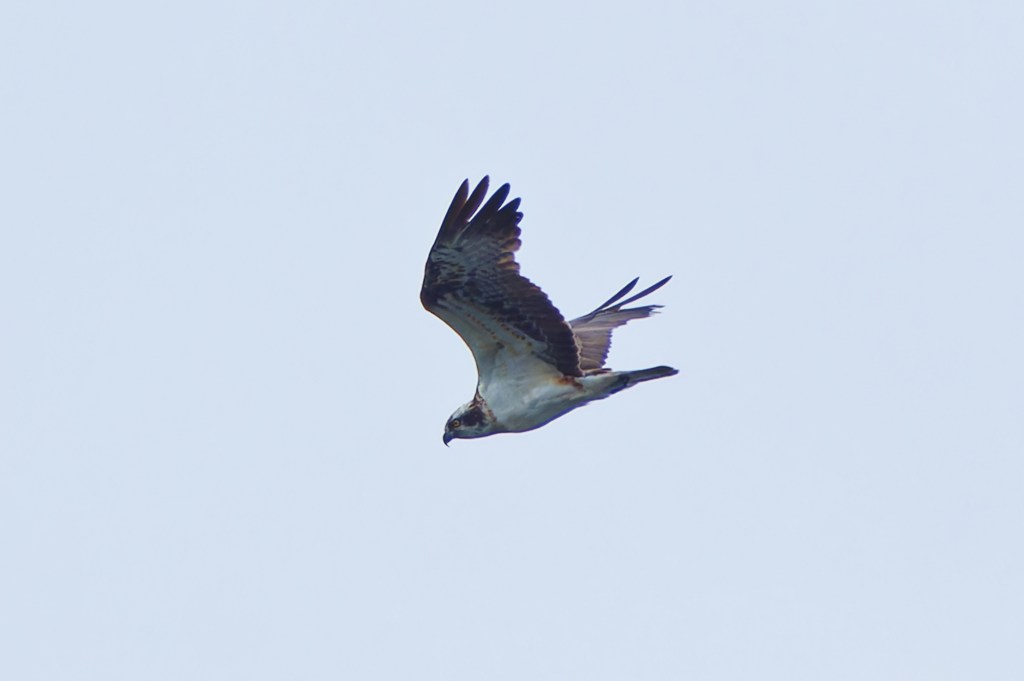
Backwoodsman has probably had his last sight of an Osprey over the Clyde estuary for this season (end of July in this case), and it seems most likely that the Hirundines will have left us too by the time this post is made.
Very unusually, Backwoodsman cannot remember his first sight of a European Barn Swallow with any confidence, which is a little disturbing. There are half memories of birds passing across the surfaces of school cricket fields, fast enough to set the dry grass of the outfield aflame, but the details which usually anchor these memories cannot be found. Instead, it was an enamel badge which provided Backwoodsman’s first recoverable memories of the Swallow.

A very small Backwoodsman wore a dark green anorak which was covered in enamel badges; he didn’t really care what they were and he lacked affiliation with any of the organisations represented upon them, but if he liked the badge, that was it. They could have been anything; a nice bit of enamel and it’s on there and worry about it later when you get quizzed by grown-ups. But this one is not to be forgotten; what a piece of design! The bird is styled superbly and the sunburst echoes the Kyokujitsu-ki or Rising Sun Flag of Japan (another great bit of graphic design) persuasively. Details of the travel organisation which had these badges made are not to be found by Backwoodsman, alas.
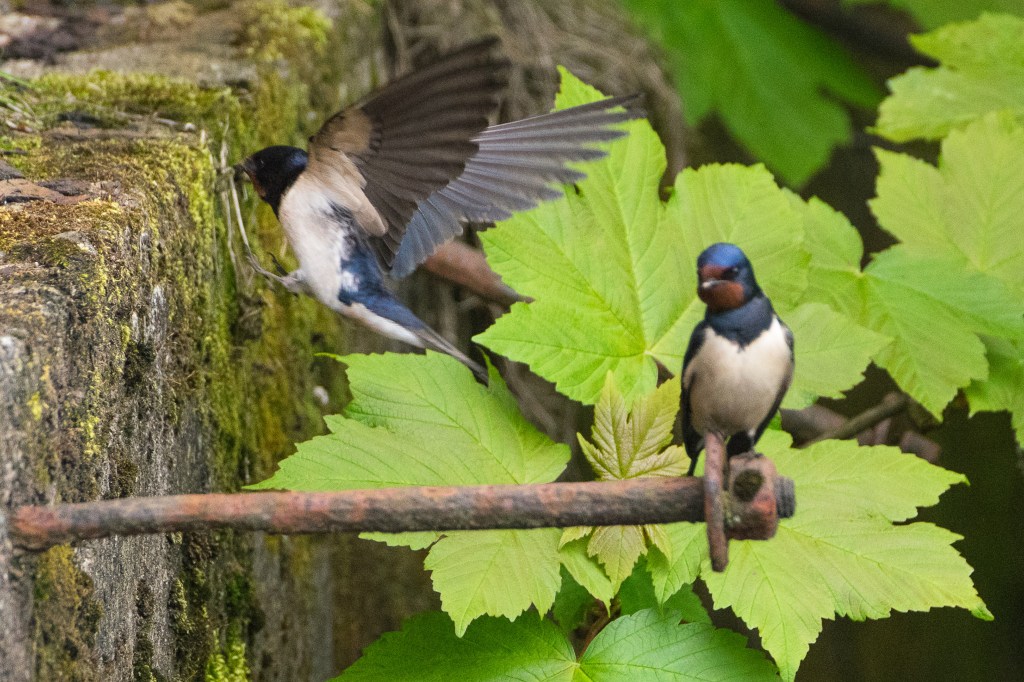
The BTO tells us that “Swallows must be amongst the most popular birds – their arrival each spring in the northern hemisphere presages the onset of summer. Swallows are easily recognised with their slender bodies, long pointed wings and forked tails; martins tend to have much less deeply forked tails. While the deeply forked tails may help their manoeuverability in pursuing aerial insects, in many species they are also used as a signal of male quality, those who can grow longer, and importantly symmetrical, streamers being the most favoured by the females.”
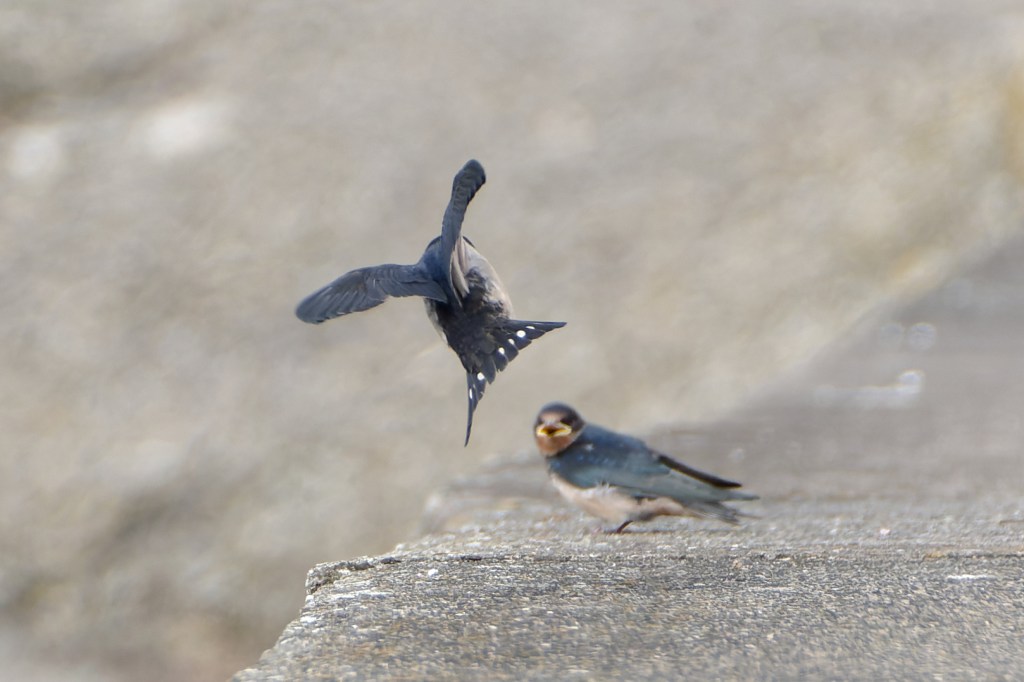
Swallows like the sawmill at Cardross and the place where the Geilston Burn spills out over the mud. Backwoodsman suspects that they make nests in the big (barn-like) shed at the western end of the sawmill yard. On a recent visit, Backwoodsman found a group of Swallows of various vintages. The young ones still have the yellow “feed me” mask.
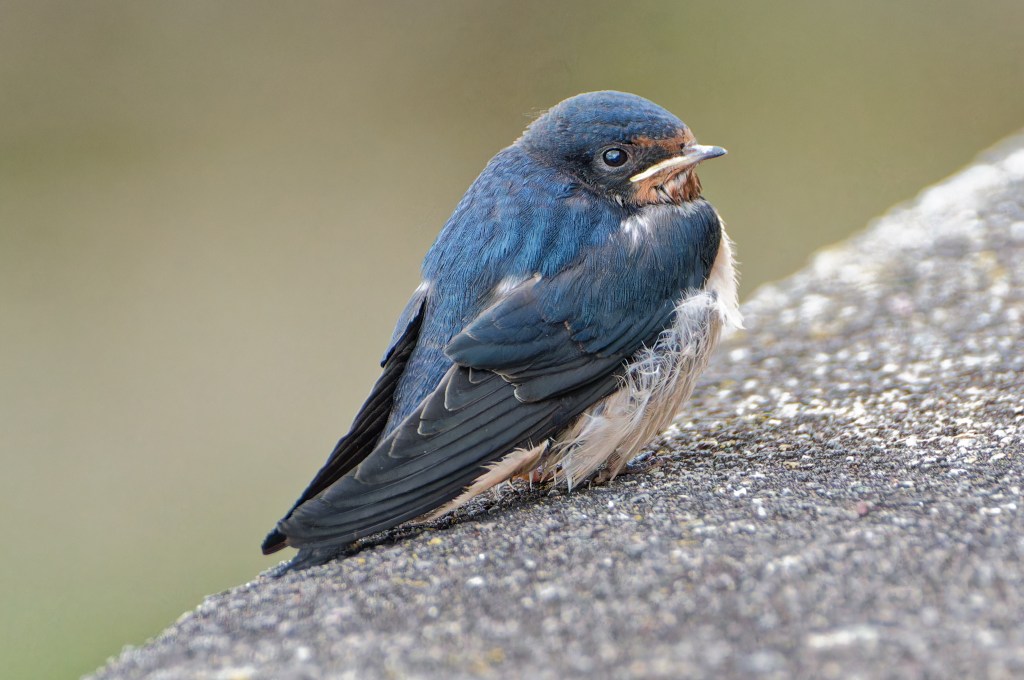

Backwoodsman attempted to track birds either taking insects from the surface of the burn, or drinking from the fresh water as it ran out into the estuary; it is hard to tell which. Better executions of these images would win competitions – these would not.

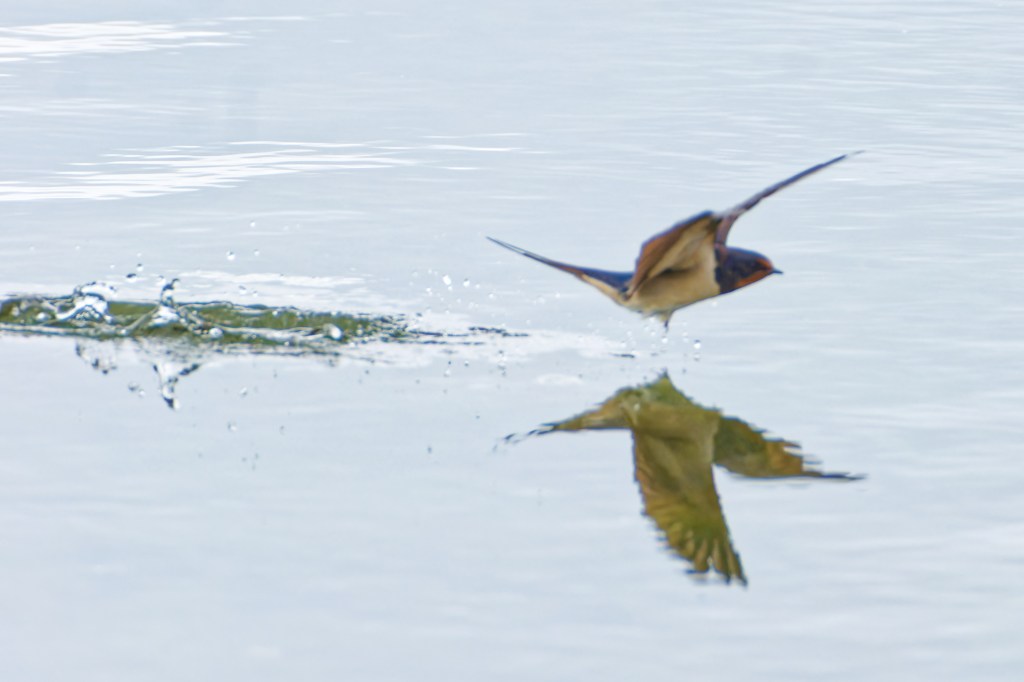
We are told that the way to get good shots of fast-moving birds on the wing is to anticipate where they will be, pull a focus on that space, wait for the bird to enter and then fire. Of course, focussing on thin air is a challenge, so you have to find something solid at about about the right focal range (some ripples on the water in these cases) and hope for the best. As you need a fast shutter and therefore probably a wide aperture to keep the ISO down, your depth of field will be shallow and the scope for error almost unlimited. This is what you get, v1.0. Backwoodsman is a mere novice when it comes to birds on the wing.


Sometimes, the Swallows are still – they must get quite tired from all their “hawking“. Backwoodsman has failed to find a satisfactory definition of this term, though it is very widely used. Presumably it means to fly rapidly after prey and catch it on the wing? Swallow flight has been studied quantitatively using fast cameras and wind tunnels (and written up in an open access paper): there is something called the Strouhal number which relates wing beats and speed. The quantitative work has wingbeats around 7-8.5 Hz and speeds across the ground of up to 14 m s-1, or of the order of 30 mph in Rees-Mogg units. There is, of course, some infamous discussion about Swallow flight dynamics in Monty Python and the Holy Grail, which you will find here, and here.
Somewhat aspirationally perhaps, InterCity trains used to sport a swallow livery. This recollection got Backwoodsman thinking about the national rail system we used to have, and the fragmented thing we have now, and how the future of rail transport is being ransomed by HS2; the thoughts follow a depressing trajectory. No-one can revel in the national pickle that is HS2 but there is some amusement to be had from the situation. In the recent Panorama programme HS2: The Railway that Blew Billions, Andrew Gilligan says (see 38:30-39:50) of Johnson, grand emperor of “levelling up”, “he quite liked big, stupid projects…of course, this was big and stupid to an extraordinary degree…”.

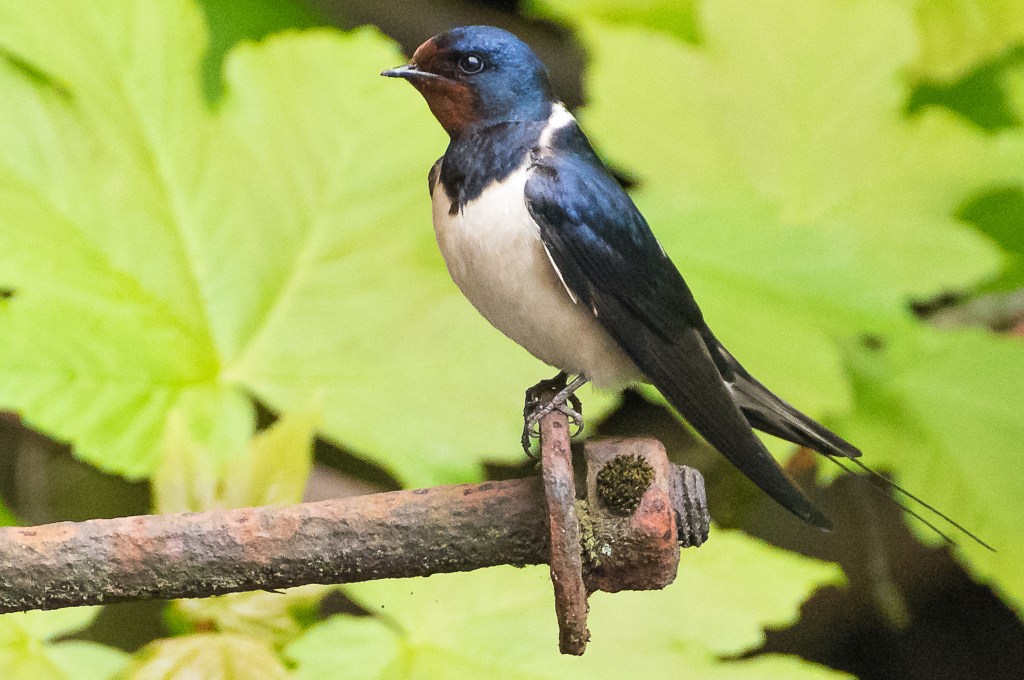
When Swallows do sit still in good light, their semi-iridescence can be enjoyed fully. There is a nice walk from Bishopbriggs towards Kirkintilloch along the Forth and Clyde Canal and it passes through an awkward space beneath the Hungryside Bridge, where your life may be taken by a weekend warrior on a bicycle. The bridge seems to be a Swallow nesting site and we were fortunate to find some birds resting. It was early May; presumably, they were busy building nests, or possibly looking after eggs. They look in really good condition.

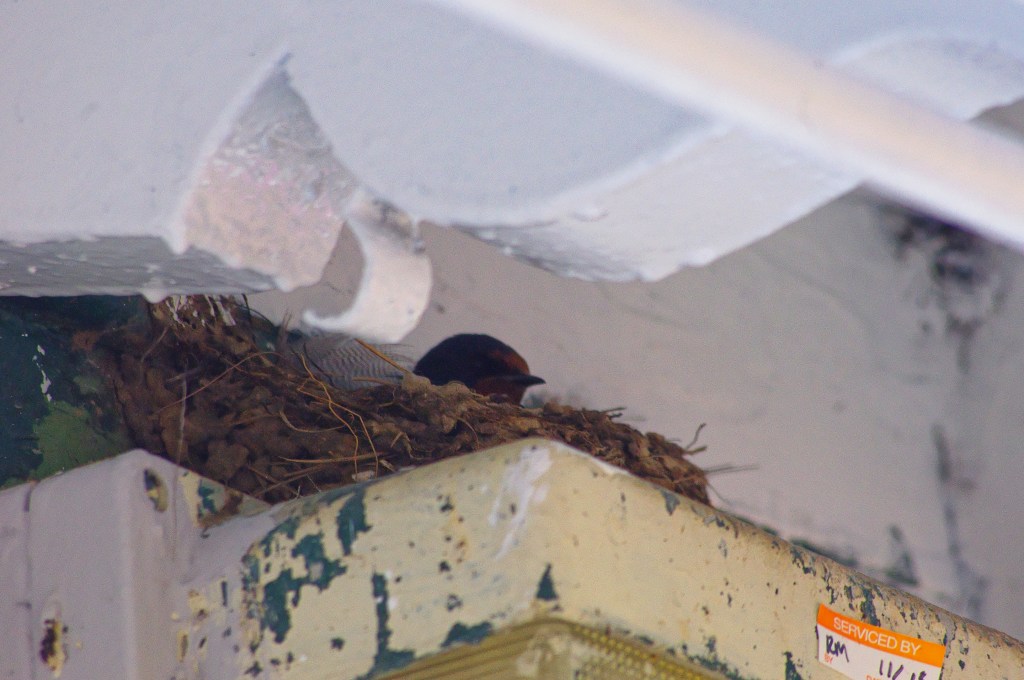
Swallows are said to return to the places where they hatched and fledged; Crianlarich station has hosted nesting Swallows for as long as we have been visiting. They make nests on the tops of small pillars which are up close to the roof. Crianlarich station really isn’t busy and the Swallows will have hours without disturbance while they gorge themselves; there are always plenty of insects in the Highlands when the sun comes out. This image was taken in mid-June and the birds were definitely on eggs by then.
If Backwoodsman was a Swallow, he would head south through the UK while the weather was good, feeding up along the way, before starting on the long flight to South Africa. The EuroBirdPortal shows the Swallows clearing out of Europe almost completely around mid-November in 2023. The data for the UK is a bit confusing, but it is interesting to follow the timeline from the end of January, as the birds begin to show up on the Iberian peninsula, and then flood north and east through the rest of the landmass. Backwoodsman will be waiting.
 backwoodsman.org