
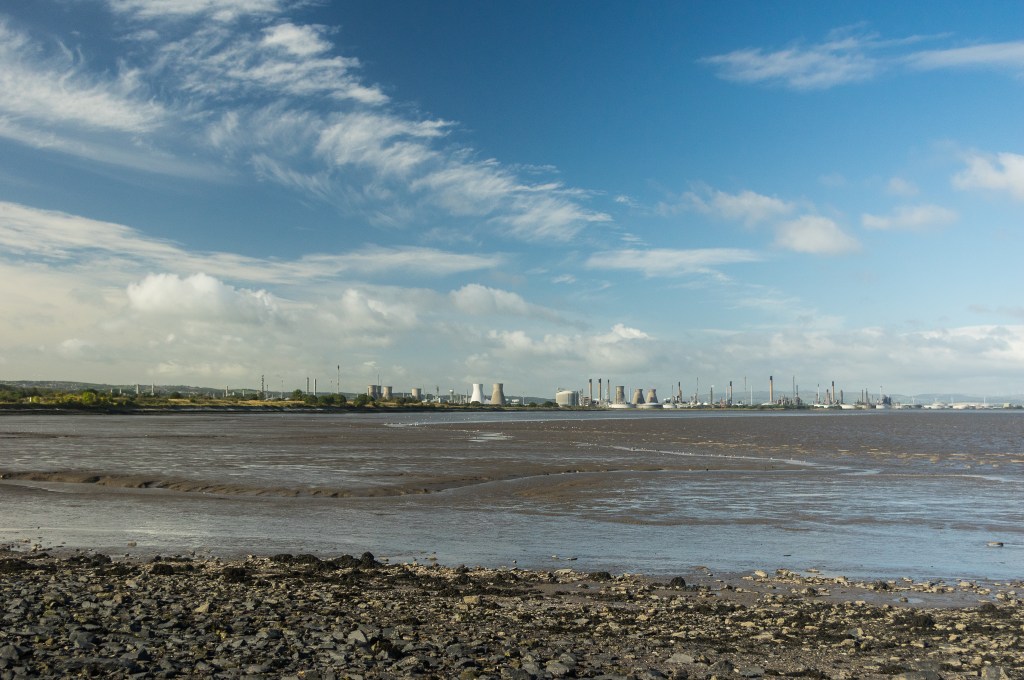
I cannot remember where my first sighting of Black-tailed Godwits took place but Kinneil Lagoons is possibly the strongest candidate. “The lagoons were created when the intertidal zone was reclaimed in 1969, when a seawall was built along the seaward side as part of the Kinneil Kerse landfill site operation. The lagoons are linked to the Forth through a series of large pipes in the seawall, which allows sea water to come in and go out with each tidal cycle. The resulting saline lagoon/mud habitat is an extremely rare habitat on the Forth.” The Grangemouth industrial complex looms large in the near-distance beyond the lagoons as the Forth makes its way north west towards the Kincardine Bridge and Alloa.
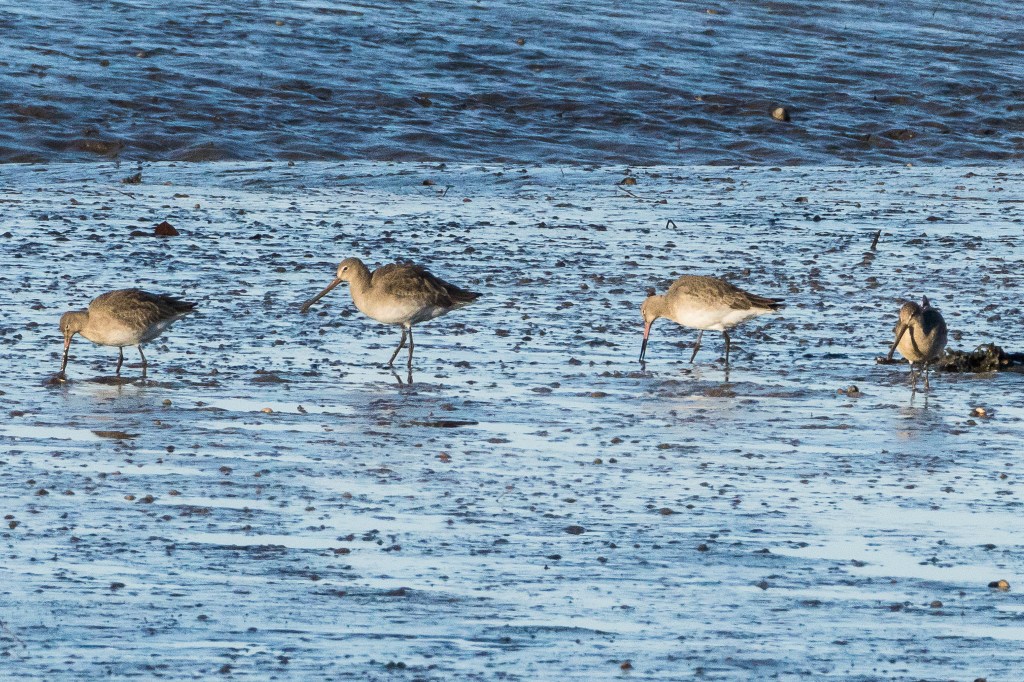
We visited the site in September and November 2018 and saw very large numbers of Knot and Black-tailed Godwits. Most of the photographs from these trips are rotten but three are just worthwhile because they show the numbers of birds, and the black and white tails and wings of Limosa limosa.


We are hoping to revisit the site again soon, though with some trepidation – Falkirk Council was accused of destroying some nesting sites when it carried out some “work” at the lagoons in 2021, according to the Falkirk Herald. However, Knot and Black-tailed Godwits go outwith the UK to nest, so it is to be hoped that this unique site is still attractive to wintering waders. We also hope that we can still get to it, and will not find it beyond a fence.
Very few Black-tailed Godwits breed in the UK – 53 pairs according to the RSPB. One crazed spaniel could probably see off the lot. Schemes have been started to boost numbers of the birds. Project Godwit points out that “Historically, black-tailed godwit numbers declined in the UK as a result of land drainage and habitat loss. The population of godwits in the fens today is small and vulnerable, and appears to be limited by poor breeding success”. Project Godwit is “undertaking research at the Nene Washes (just outside Peterborough in East Anglia) to understand what is driving the productivity of black-tailed godwits at this important site.” The project is “headstarting” birds on the Nene Washes. Black-tailed Godwits are a Schedule 1 species under the Wildlife and Countryside Act 1981, which means that they are “Birds and their young, for which it is an offence to intentionally or recklessly disturb at, on or near an ‘active’ nest:” Under licence, eggs are collected and incubated by Project Godwit. Hatchlings are kept warm and hand reared, then moved on to polytunnels where they can forage before being released. The RSPB is involved in similar work. I found a nice YouTube video which summarises the actions.
While few Black-tailed Godwits breed in the UK, many visit for the winter. The data dealing with Black-tailed Godwit migration is rather good; there are quite a few ringing and tracking schemes active and some of the birds are even known by name.
To summarise, “the UK’s breeding black-tailed godwits winter in Africa, while the birds that spend their winters on the south coast of the UK [and Scotland] nest in Iceland. Those that nest in Iceland are actually a different subspecies (Limosa limosa islandica) to those that breed in the rest of Europe (Limosa limosa limosa)” according to the Wildlife Trusts. These birds number ca. 40000 according to the RSPB. The European population is of the order of 100000 pairs, so the contingent wintering in the UK is continentally significant. There are also of the order of 10000 passage birds which use UK wetlands for a feed en route; these birds are making the journey across from continental Europe before heading south to Portugal and West Africa according to Project Godwit.
Black-tailed Godwits turn up on the Clyde at Cardross; one winter afternoon, we followed the waterline towards Ardmore Point and came across this group in the light of the setting sun.

We’ve seen them at Montrose Basin, another great site for wintering birds.
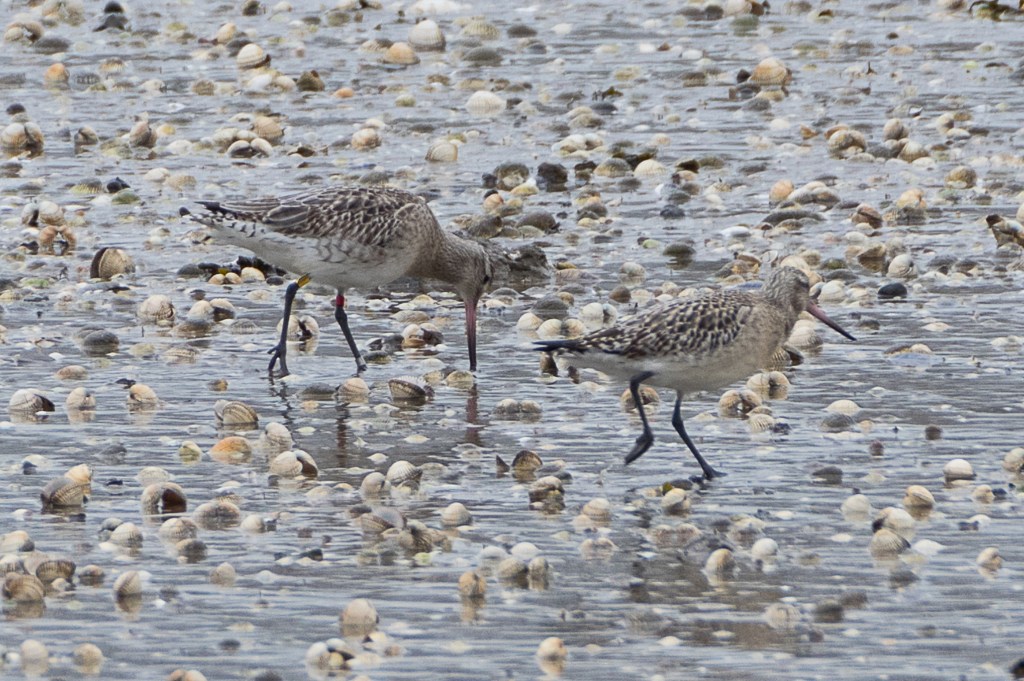
I’m very fond of this image from the Shell Beach in Belfast, mostly because of the texture provided by the cockles.
The Godwits won’t usually allow close approach so getting images with some real detail requires special arrangements, like hides or zoo conditions: bring on the WWT! I have images from WWT Martin Mere (from a hide) and WWT Slimbridge (from the Waterscapes Aviary). The first two images were taken at Martin Mere; the black and white tail and wing feathers are clear to see.
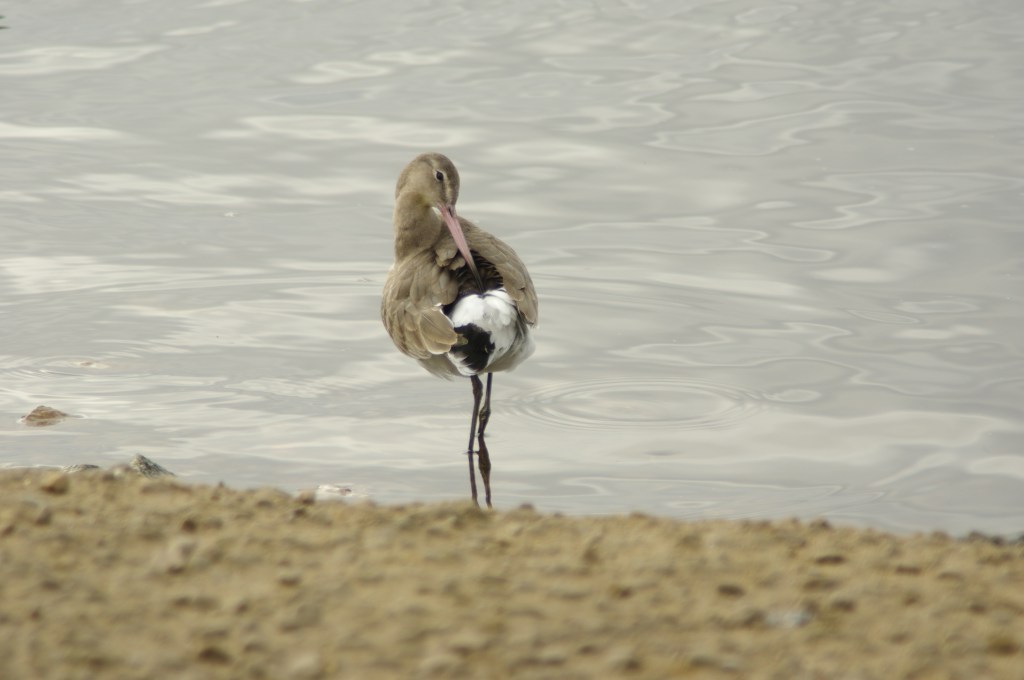
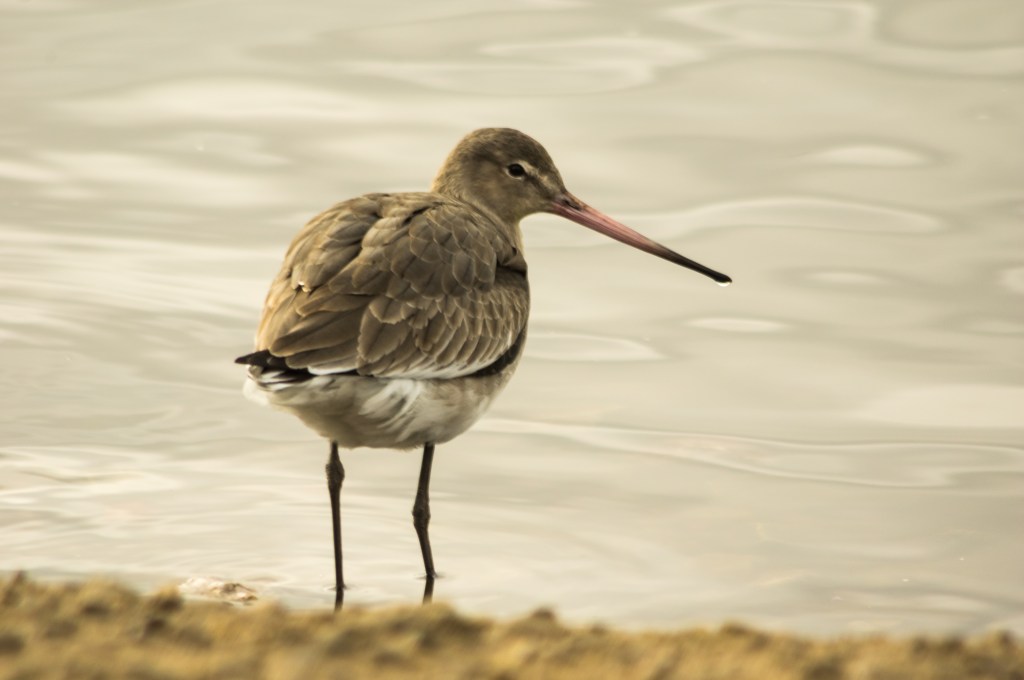
In the next two images from Slimbridge, there is just a hint of the characteristic tail and wing colours. There is a confusion species – the Bar-tailed Godwit, which has a slightly upturned bill. The bills of these birds look straight across all the images.
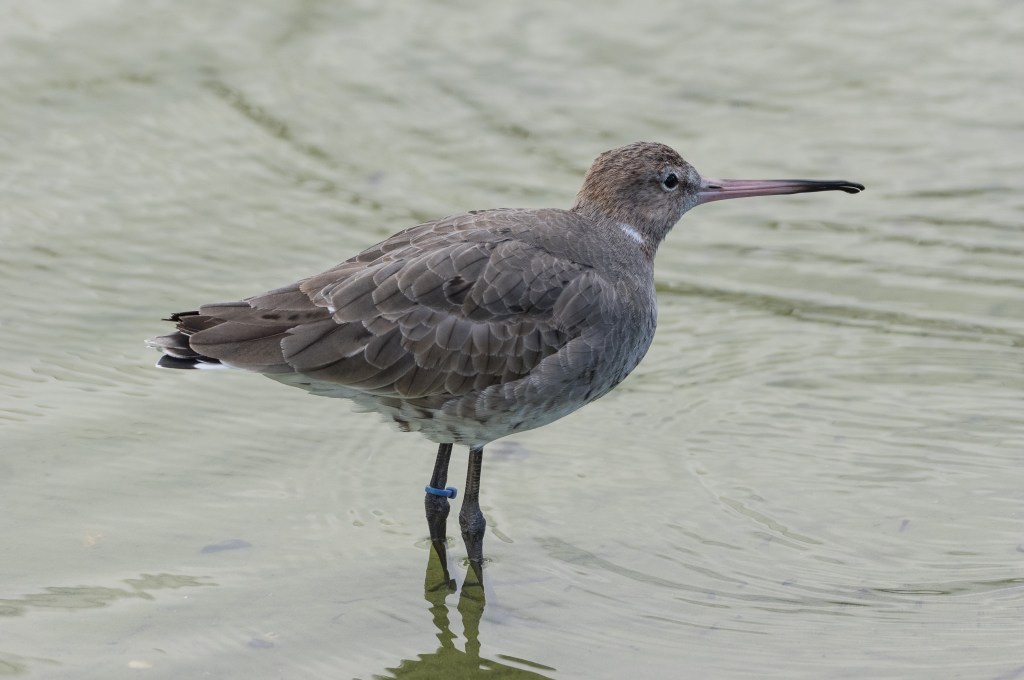
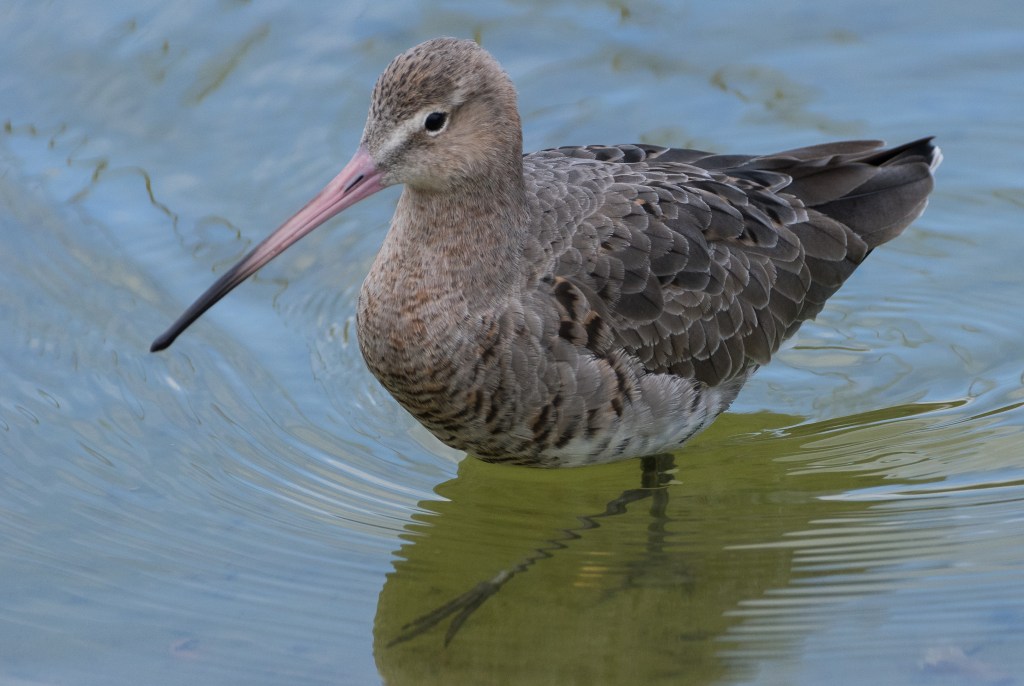
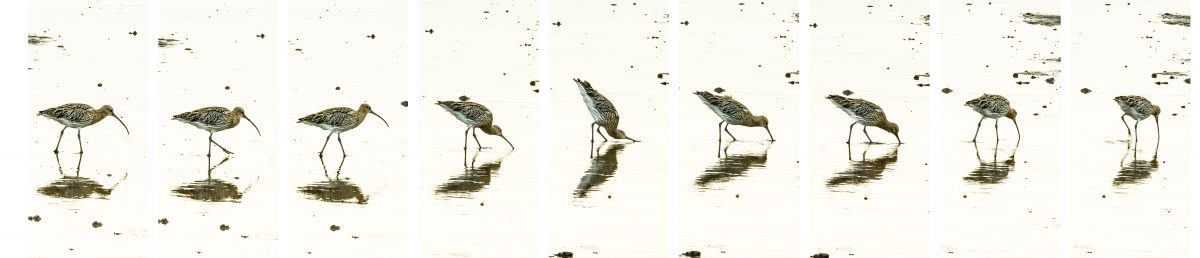
However, there is a trick which Godwits of both species might pull on the observer – it is called rynchokinesis. Professor Richard Chandler has written about this extraordinary business in British Birds (R. Chandler, British Birds, 2002, 95, 395-397): “One’s first experience of a wader deliberately bending its upper mandible is a surprise; at first sight, birds’ bills seem to be such rigid structures. The upper mandible has, in fact, some flexibility, and waders can occasionally be seen exercising this flexibility, no doubt a form of stretching, a comfort action to keep the feeding apparatus in good working order. Cranial kinesis is the ability of birds to move the upper mandible in relation to the skull (Burton 1985). It takes two forms: pro[1]kinesis, in which the entire upper mandible hinges where it is attached to the skull; and rhynchokinesis, where the base of the upper mandible is fixed rigidly to the skull, and bending takes place some distance along the mandible, nearer the tip than the base. In the case of rhynchokinesis, the bone structure of the upper mandible allows the flexibility.” So the upper part of the bill bends slightly upwards – Professor Chandler doesn’t say this but his short paper has some good images. I haven’t even seen this behaviour, never mind photographed it; I will certainly be looking for it in the future.
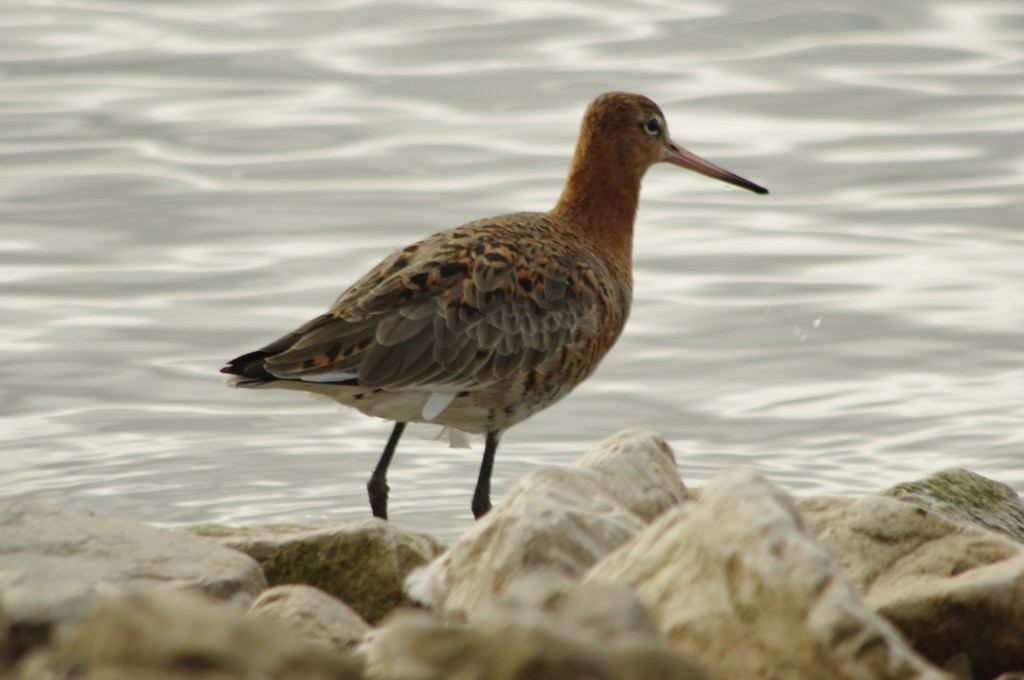
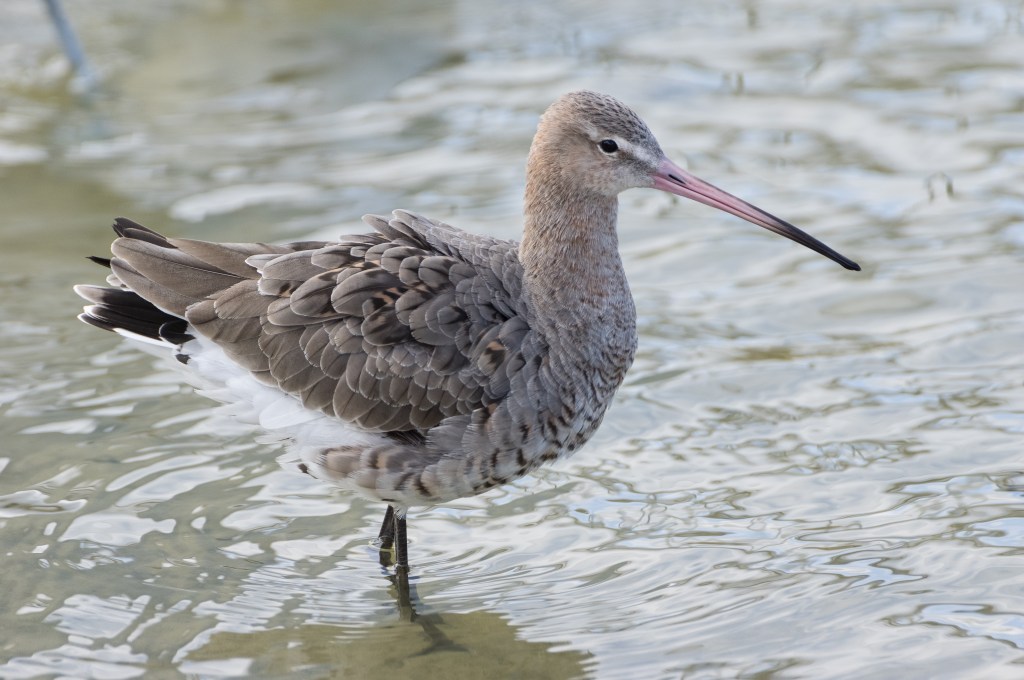
The Black-tailed Godwits should be with us for a while now; I will try and find some soon in the hope that I can find individuals in the glorious rufous breeding plumage (above), or in some vestige of it (there is just a trace in the image below). Where will they be? Time to revisit Kinneil Lagoons, or possibly RSPB Barons Haugh, where I might be really lucky and get close to some Lapwings too.
 backwoodsman.org