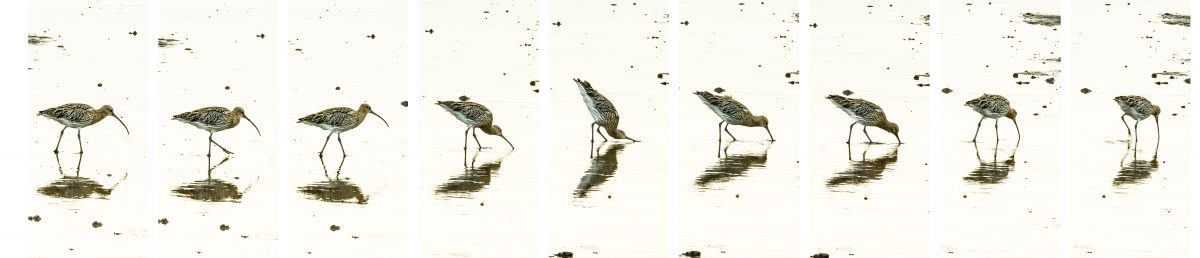
I look forward to the arrival of the geese in the autumn; they herald the coming of colder weather. The fishing will be harder but the landscape will be more beautiful and after a few decent frosts, less full of unpleasant biting things (clegs, midges, ticks). From my seat on the Avanti, I have seen geese flying in from the West in huge numbers, usually around where the line passes close to the Solway Firth. I am always moved by the sight.
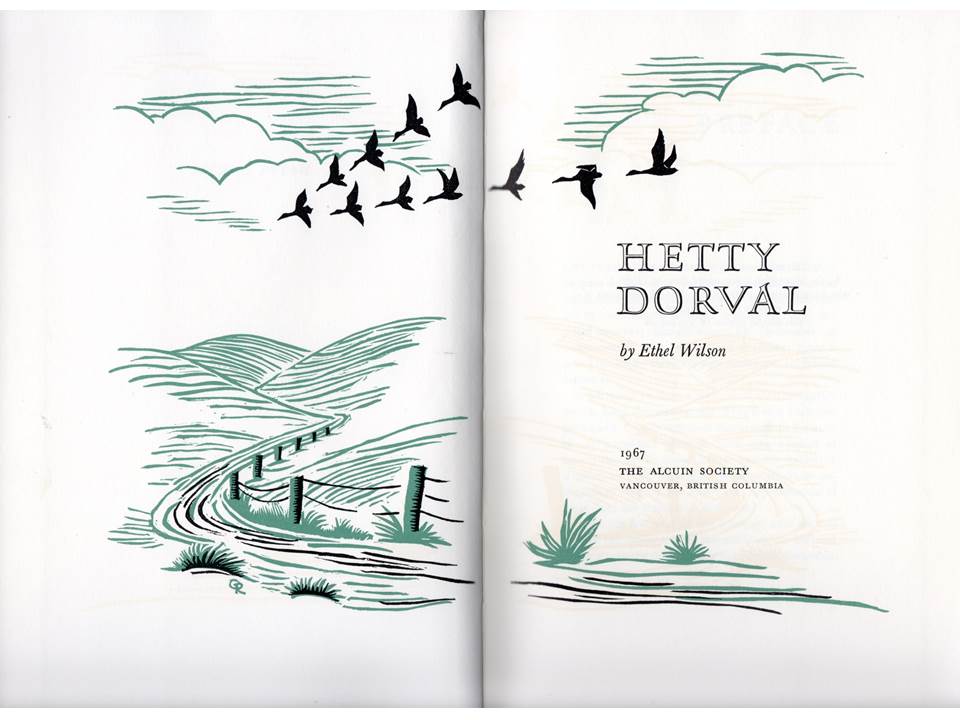
Looking for a kindred spirit, I groped blindly towards the shelf of Canadian fiction and Faye guided my hand towards a beautiful edition of Ethel Wilson’s 1947 novel Hetty Dorval, illustrated with lino-block engravings by Gus Rueter. She showed me the frontispiece , and then took me to page thirty eight where the two main characters, Frankie and Mrs Dorval are riding out from Lytton, when:
“We came out on the point of one of the hairpin turns and my ears, which were used to country silences and sounds, heard that sound that will thrill me till I die. I reined Maxey in at once, and quite forgetting the importance of Mrs. Dorval, pointed up and said, “Look!” Mrs Dorval reined in, too, and said “What? Where?” She shaded her eyes with her hand and looked up as I did. She could not see as quickly as I could that out of the north came a thin long arrow, high in the sky. Then her eyes picked up the movement of the fluid arrow rapidly approaching overhead, and the clamour of the wild geese came more clearly and loudly to us. The valley of the Fraser lay broad below, lit by the September afternoon, and the geese, not too high, were now nearly overhead, travelling fast. The fluid arrow was an acute angle wavering and changing, one line straggling out far behind the other. It cleft the skies, and as always I felt an exultation, an uprush within me joining that swiftly moving company and that loud music of the wild geese. As we gazed, the moving arrow of great birds passed out of sight on its known way to the south, leaving only the memory of sight and sound in the still air. “God,” said Mrs. Dorval. Then, “What a sight!”
Very sadly, Lytton (in British Columbia) was destroyed by a huge wildfire in 2021.
I have always assumed that the geese I see from the train are heading in for the winter; the Caerlaverock and Mersehead reserves on the Solway Firth advertise good views of wintering geese. I had also assumed that some of them were Canada Geese, and that Canada Geese came to us from Canada… This jolly map shows the migration of Canada Geese in North America. I have failed to find anything similar for the European populations. The British Trust for Ornithology was helpful, as usual.
“This introduced species is now widespread across England and Wales, but has a somewhat patchy distribution in Scotland and is localised in Ireland. Native to North America, the Canada Goose was first introduced to Britain in the 17th century. UK numbers have more than doubled since 1994, the result of predator-free nesting sites, good feeding opportunities and low hunting pressure. While North American populations are highly migratory, those here are largely sedentary. However, many individuals make a significant moult migration to favoured sites, such as the Beauly Firth, where they complete their annual moult.”
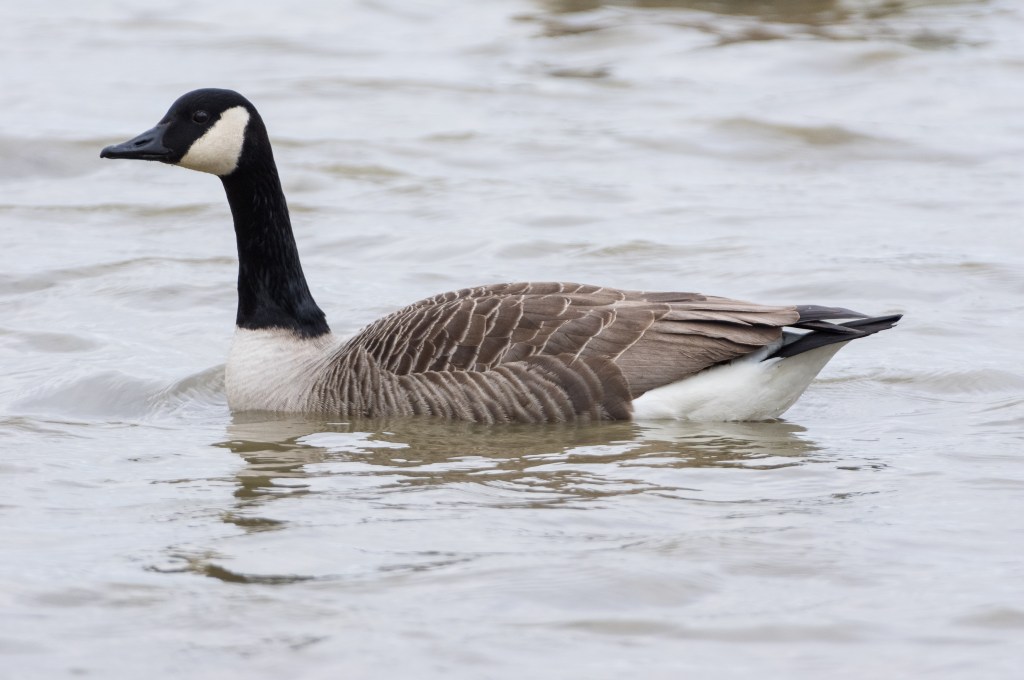
It seems that my train geese are probably other species entirely, and that the Canada Geese which cross my path spend the whole year with us. I have photographed them in many of my usual locations; they are a good size guaranteeing a decent image at relatively long range. Their colouring is very subtle and close examination of the feathers reveals some wonderful textures.
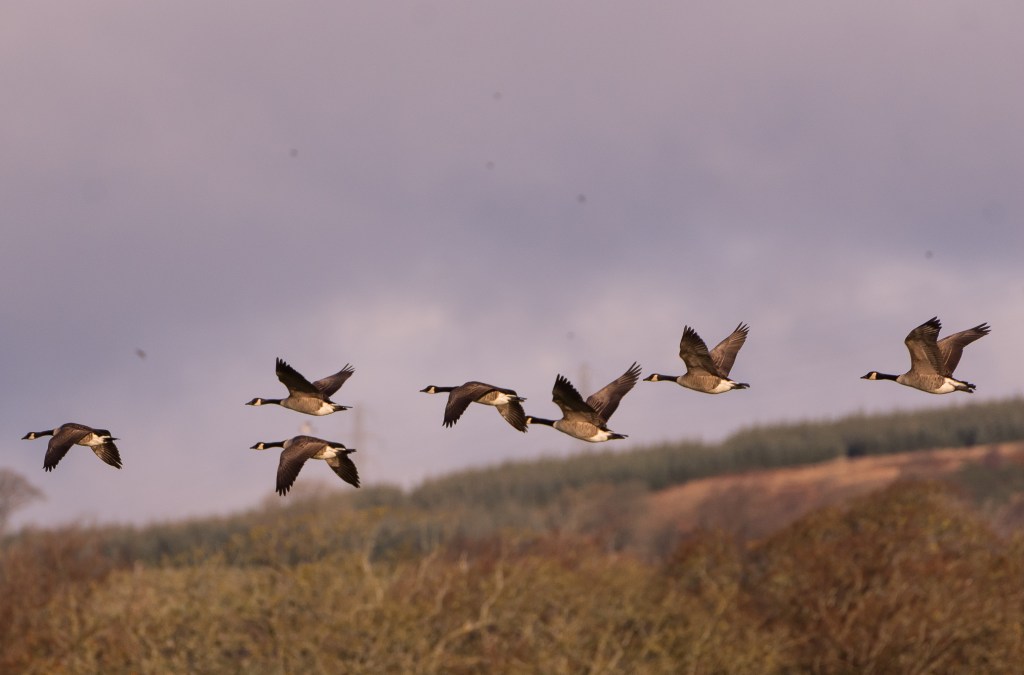
Wilson’s description of the birds in the air is wonderfully evocative so I will start with some images of flying birds. We were walking between Cardross and Ardoch when this group overflew us; there are around seventy birds here. They weren’t describing a fluid arrow, but they were only flying a short distance from one grazing site to another.
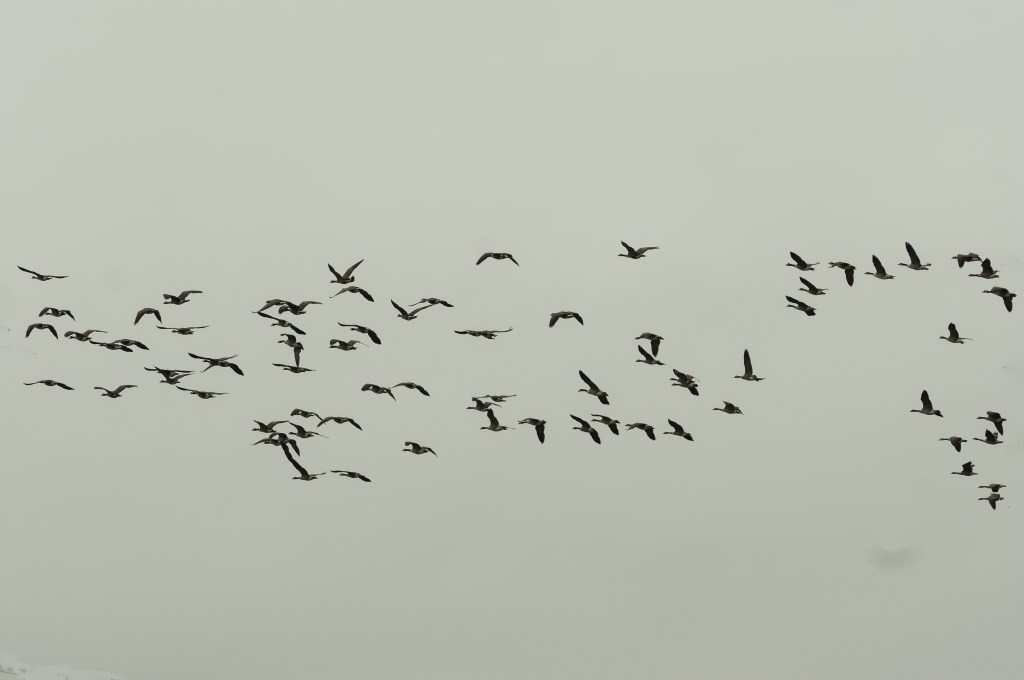
These geese, photographed from just by the sawmill at Cardross, were “lit by the September afternoon”.
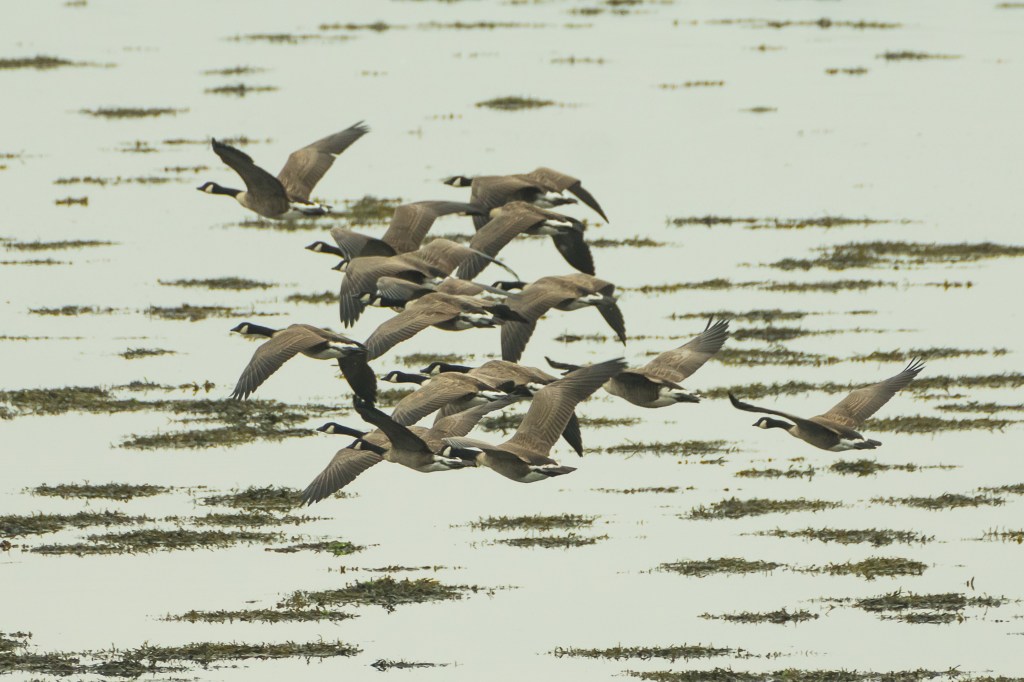
I was able to follow a group as they headed for the water; the light is poor (a grey, overcast day) but some of the wonderful texture on the upper wings is starting to emerge and it begins to sharpen as they come in to land.


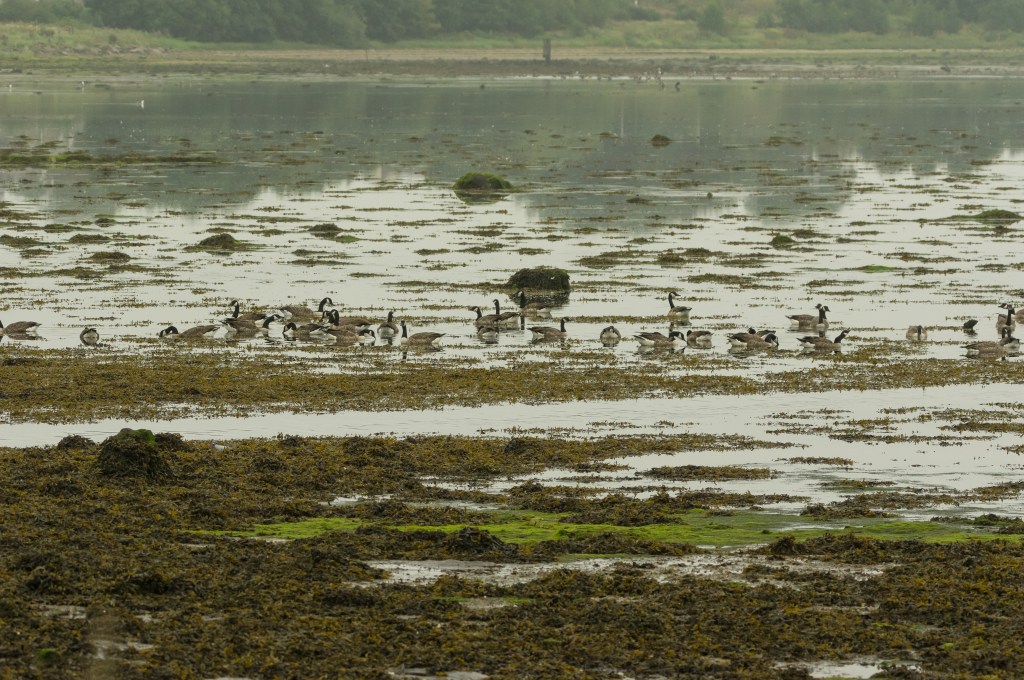
This feeding group, though just offshore, was quite nervous of the camera. I did not approach more closely.
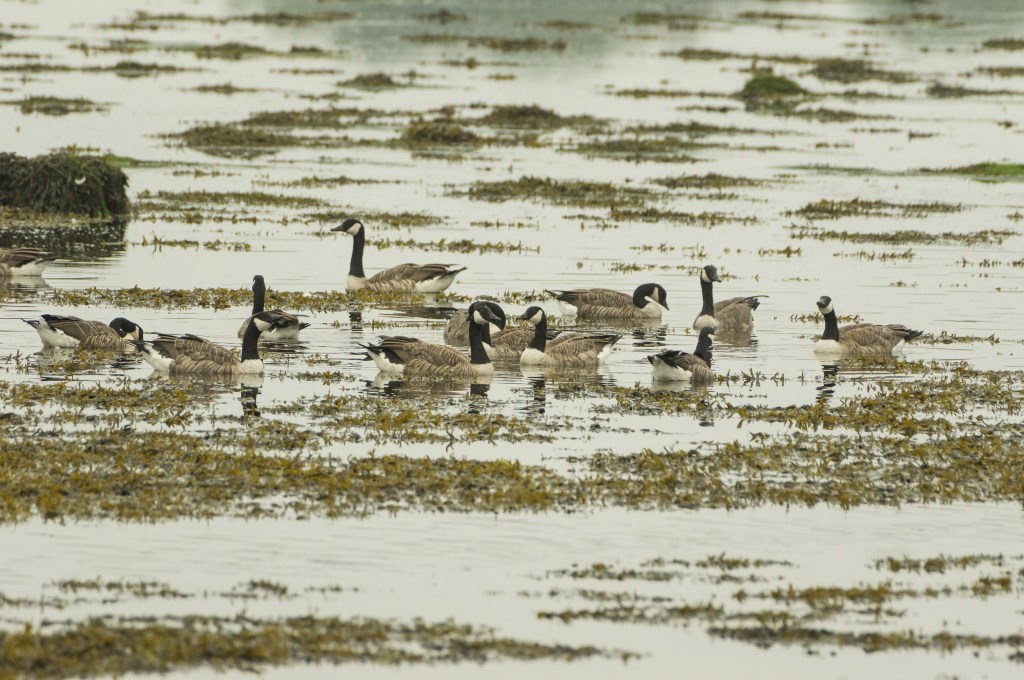
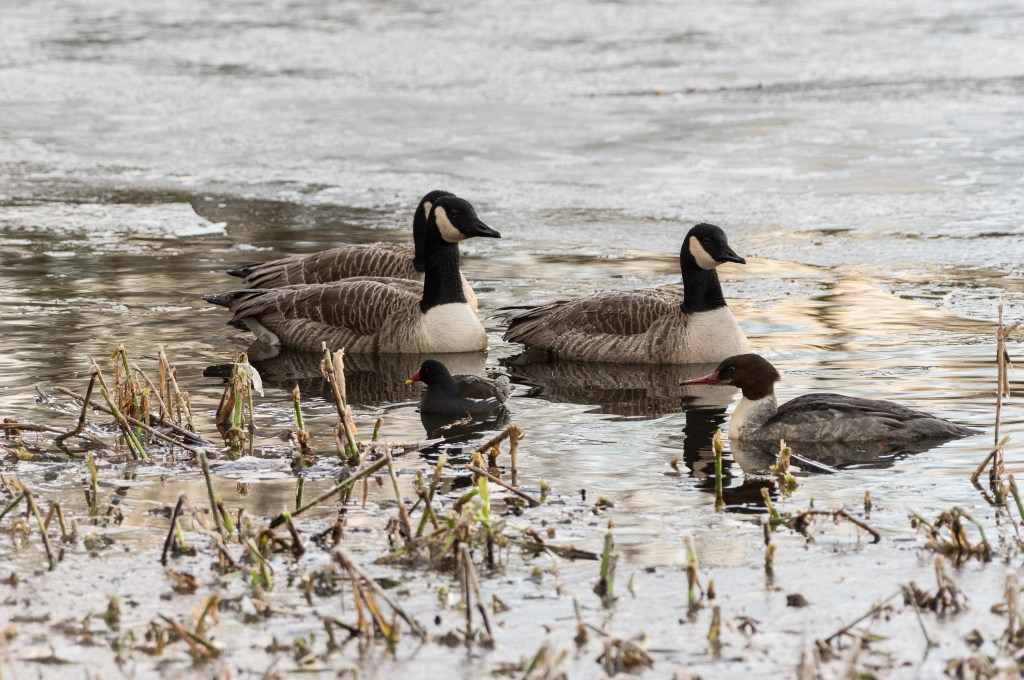
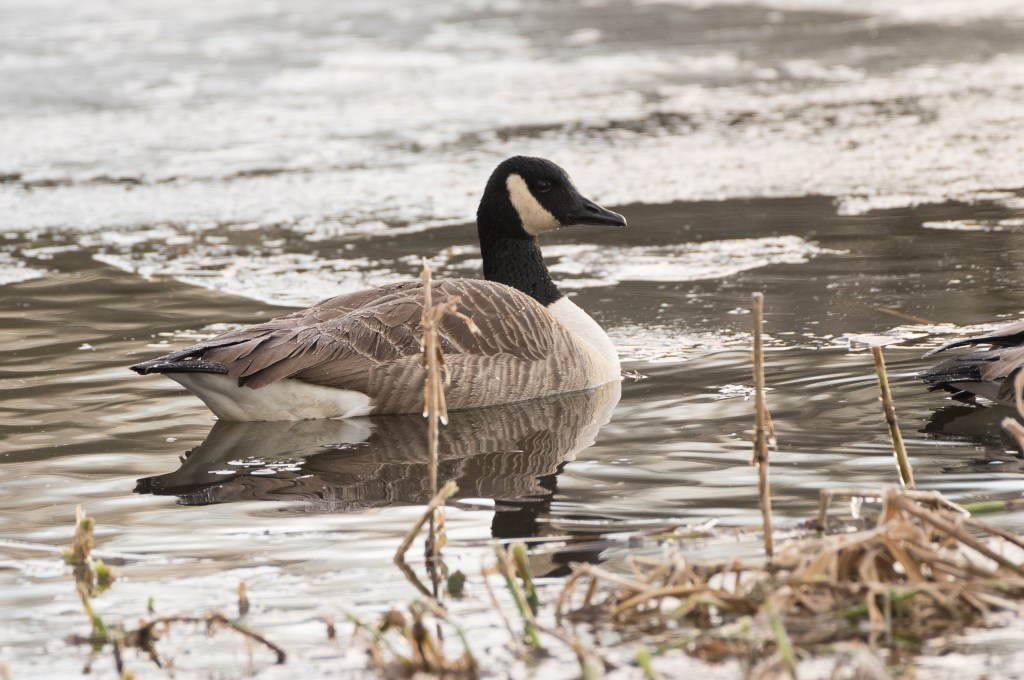
In urban settings, Canada Geese can grow bold. At the University of Birmingham Vale Hall of Residence site, the students who lived in the Wyddrington Hall would “revise” for their summer examinations around the lake which lay at the centre of the site, my wife-to-be among them. However, their studies would often be interrupted by the Canada Geese which had taken the site for their own and become quite aggressive on their territories. At Hogganfield Loch, the Canadas allow relatively close approach, in the winter at least. I like this useful scaling image with the tiny moorhen, the larger Goosander and the seriously chunky goose. At close approach, the textures of individual feathers are revealed.
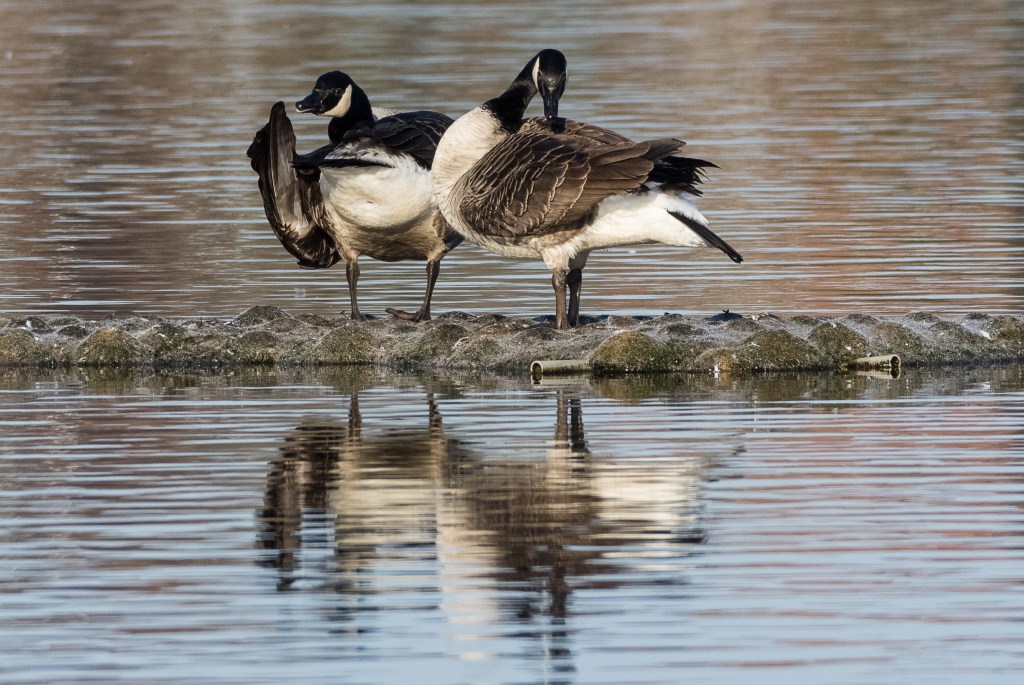
I wonder if this pair are making plans for later in the year?
I travelled to RSPB Lochwinnoch in July, not expecting too much from the visit. As I looked at one of the reedbeds from the Channel Hide, I became aware of the heads of Canada Geese rising slowly into view. Soon, the birds stepped out with their young and the families began to forage.
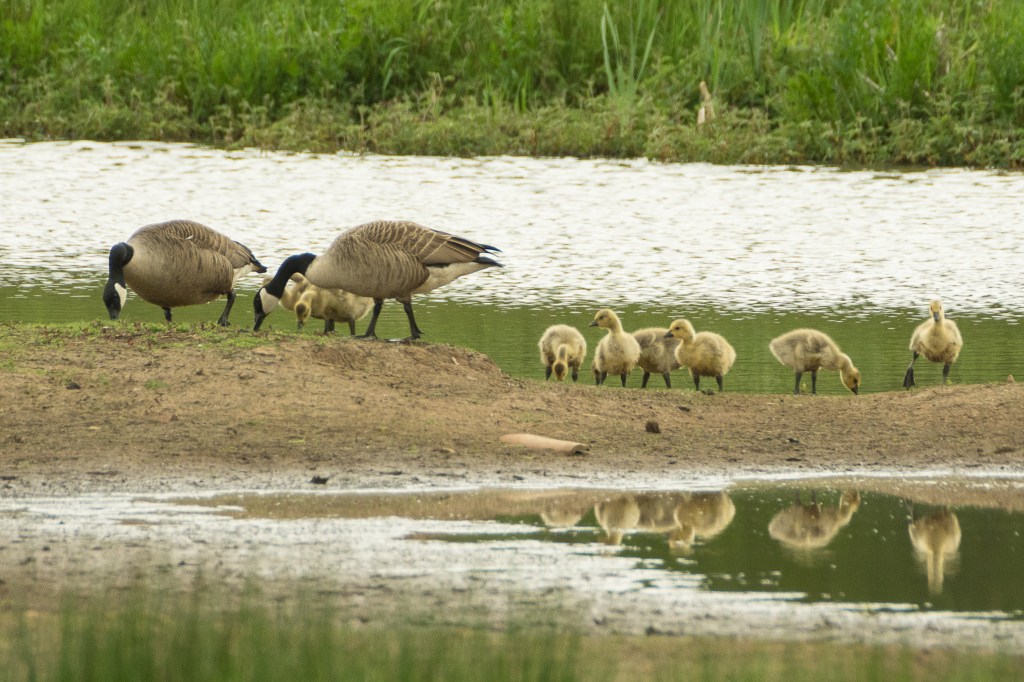
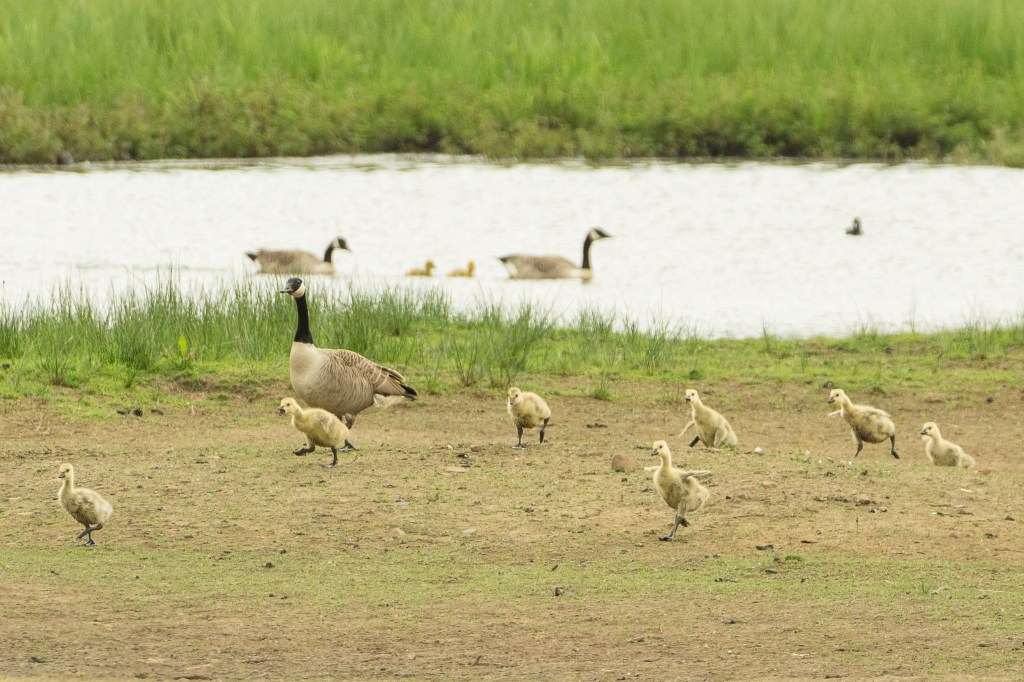
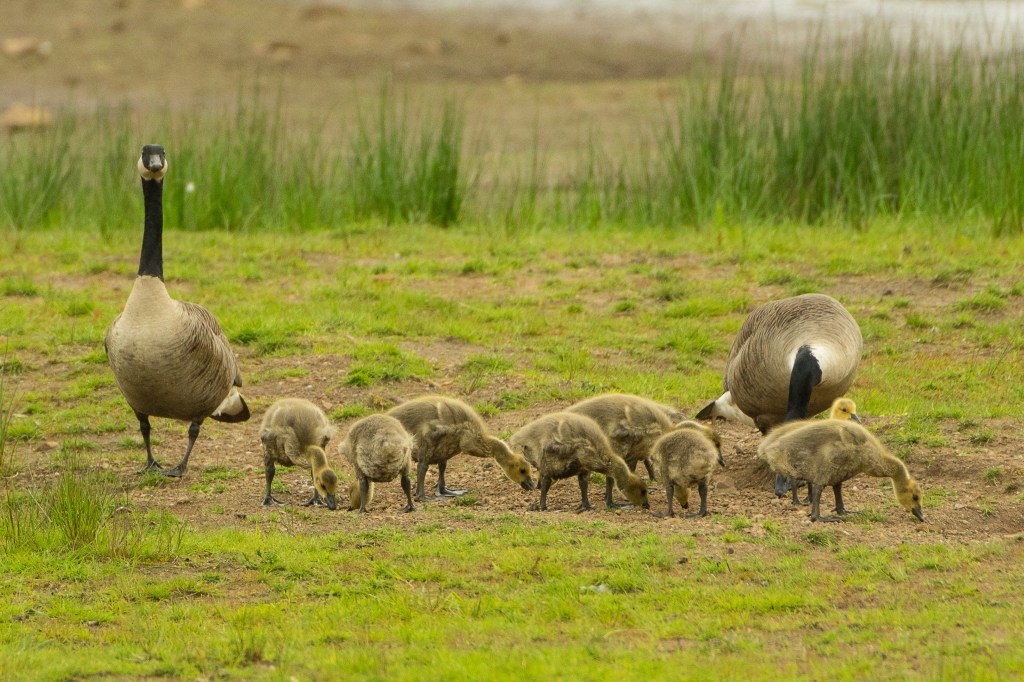
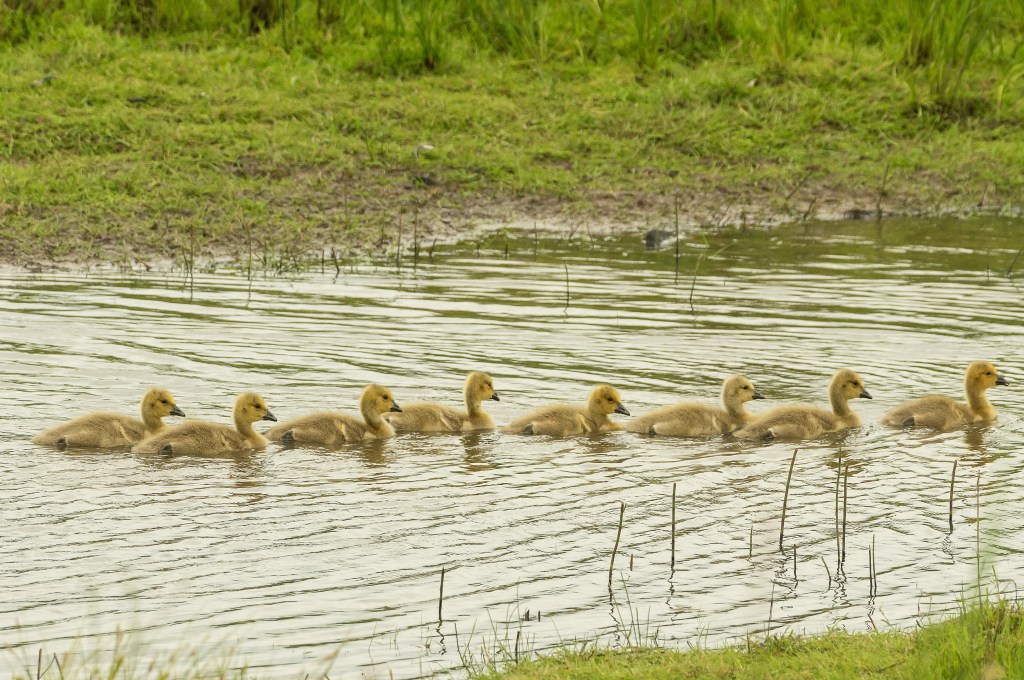
I had missed the really tiny goslings, but it was delightful to see these slightly more mature and robust-looking individuals. The pair of birds I had stayed with had produced eight goslings, an excellent replacement rate even if not all eight survive and breed themselves. Canada Geese are seen as a bit too successful in some areas and licenses to control them can be had. As they are not eating my crops, I can celebrate them with impunity and share Frankie’s exultation at their sight.
 backwoodsman.org