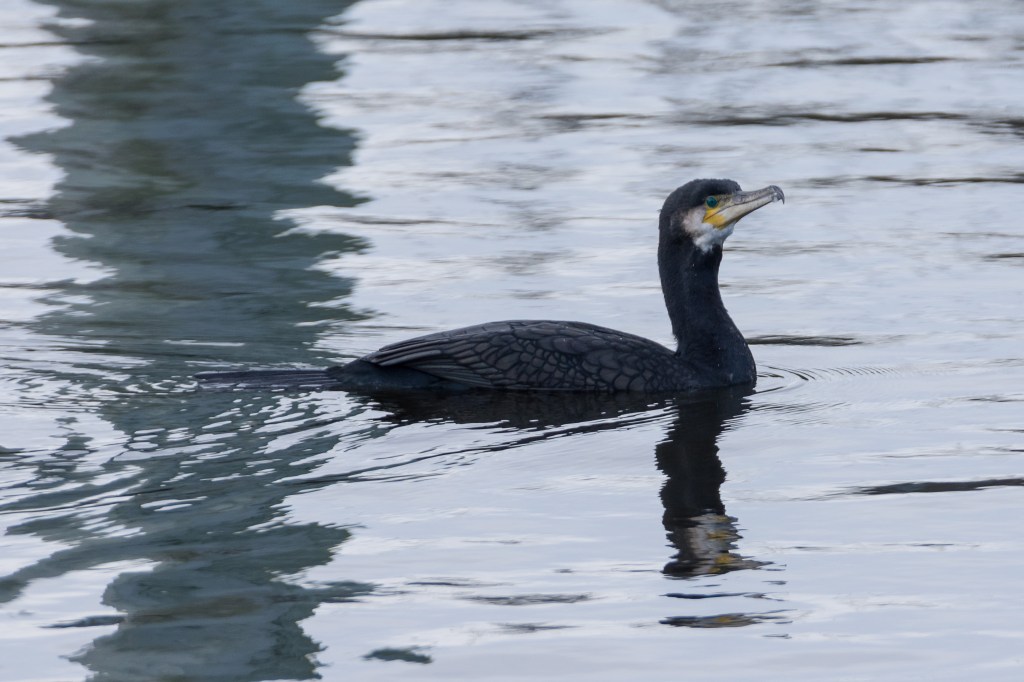
Cormorants get a bad press. This Danish chap has them as “The most hated bird in the world.” Hey, get in line! We’ve feral Pigeons, Magpies and bin-bag shredding and chip-stealing Herring Gulls to process before we get to you. This short film made about the Avon Roach Project (anglers) states the case against the birds, though with a distinctly Brexity “Euro-Cormorants, comin’ over ‘ere, eatin’ our English Roach” whiff, alas. When I used to fish the Forth and Clyde Canal, I would be told “you won’t catch anything here, pal, too many effing Cormorants” on a regular basis.
The BTO (British Trust for Ornithology) is informative and measured about anglers versus Cormorants (though slightly euphemistic at the end of the last sentence). “Cormorants were once entirely coastal in habits but we have seen an increasing trend for inland breeding, a behaviour first documented here in the 1950s. Our population is made up of birds from two different races, one of which – the continental race [my italics] – is responsible for the colonisation of inland waterbodies. Cormorants make use of regular roosting sites, with some individuals remarkably faithful to these over time. The expansion inland has brought the Cormorant into conflict with commercial fisheries and anglers, and the presence of these birds has not been welcomed by all.”
The Avon Roach Project film blames the decline of the finest natural Roach fishery in the UK on the influx of Euro-Cormorants. Cormorants eat about 0.5 Kg of fish a day and they can swallow large fish but the main damage is done when they catch a lot of small fish, which cannot then grow to replace the older larger specimens which die through natural causes (or possibly from being dropped on their heads by specimen hunters from the South of England).
The Avon Roach Project film was urging anglers to lobby their MPs to introduce legislation to allow the control of Cormorants. Their campaign succeeded; it is now possible for fishery owners to apply for a licence to kill Cormorants though BTO research published in the Journal of Ornithology in 2013 concluded that “The key questions of whether Cormorant control has the desired effect of reducing predation at fisheries, and how cost-effective it is compared to other measures, remain to be answered.”

The Scottish Government has an interest in what Cormorants (and Goosanders) are taking from the nation’s rivers and through the Marine Directorate, has studied the stomach contents of birds which have fished four of the important game rivers, publishing the results in 2022. Their interest is piqued, at least in part, by commercial concerns.
Freshwater angling is big business in the UK – particularly for Carp in England, and Salmon and Trout in Scotland. During the financial year 1 April 2021 to 31 March 2022, the Environment Agency sold over nine hundred thousand fishing licences in England (we don’t have them in Scotland), generating an income of over twenty million pounds. Some of this income is spent on fish breeding which enables the restocking of the major river systems with native species. This licence income is a relatively small amount compared to other spend. A government press release from 2018 stated that recreational angling puts very close to one-and-a-half billion pounds into English economy; this had edged closer to two billion pounds in a 2019 report from the Rivers Trust. The bulk of this spend arises from English anglers enjoying seventeen million fishing days per annum and spending on average thirty-five pounds on bait, tackle, day tickets, and travel on each of those days. It follows that a bit of lobbying muscle arises from this spend; the shooting of a few Cormorants may seem like a modest concession when billions are changing hands.
I’m always quite pleased to see Cormorants, even when they might be taking the silvers from under my nose. They just look so marvellously adapted to what they do. Sometimes on the canal, I’ll see a big swirl in the water and I’m thinking that I’m seeing one of the canal’s legendary carp and then a Cormorant will emerge a few metres away.

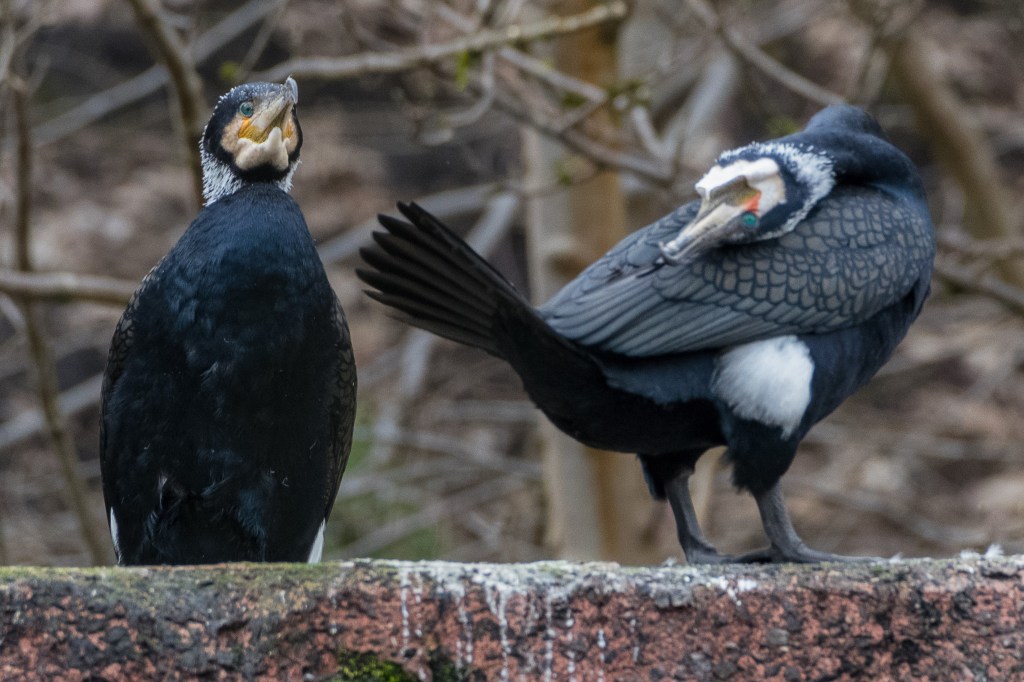
There is usually a Cormorant or two on the Kelvin; I found this one by the Botanic Gardens bridge. There are some stone pillars, which look like they used to support a bridge, further upstream above the weir in Maryhill, and I found this pair of birds resting up. We’ve seen them there a few times.
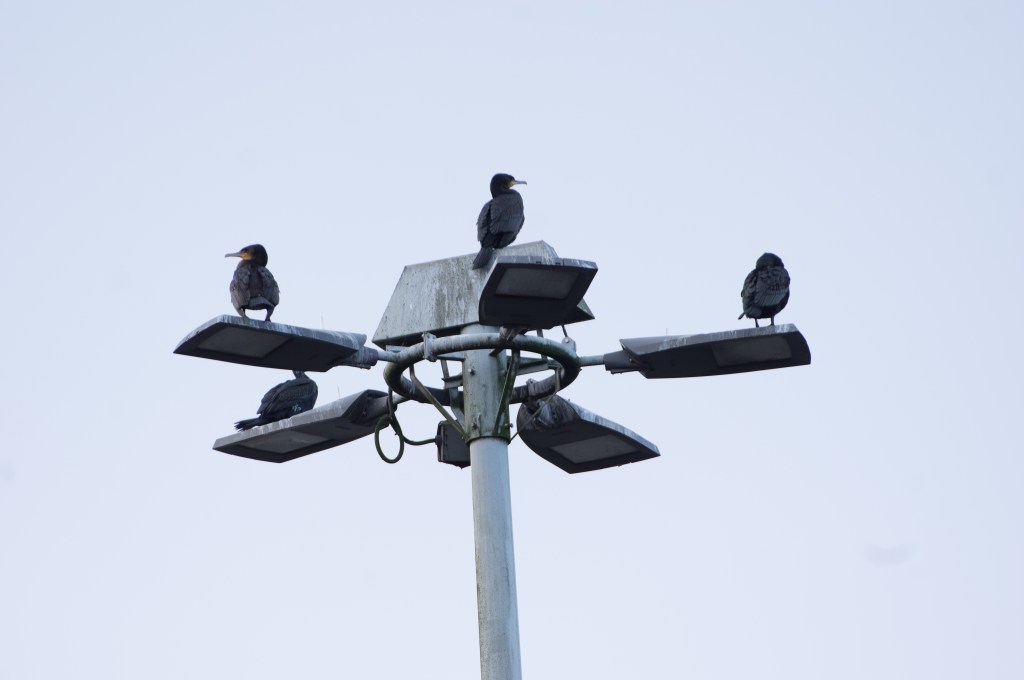
They favour the Dundas Hill end of the canal – the lamp standards which tower over the M8 seem to pass muster as a place to rest.
From there, it is a short flight to the Wakeboarding Park which offers a range of great perches and is probably full of small fish.
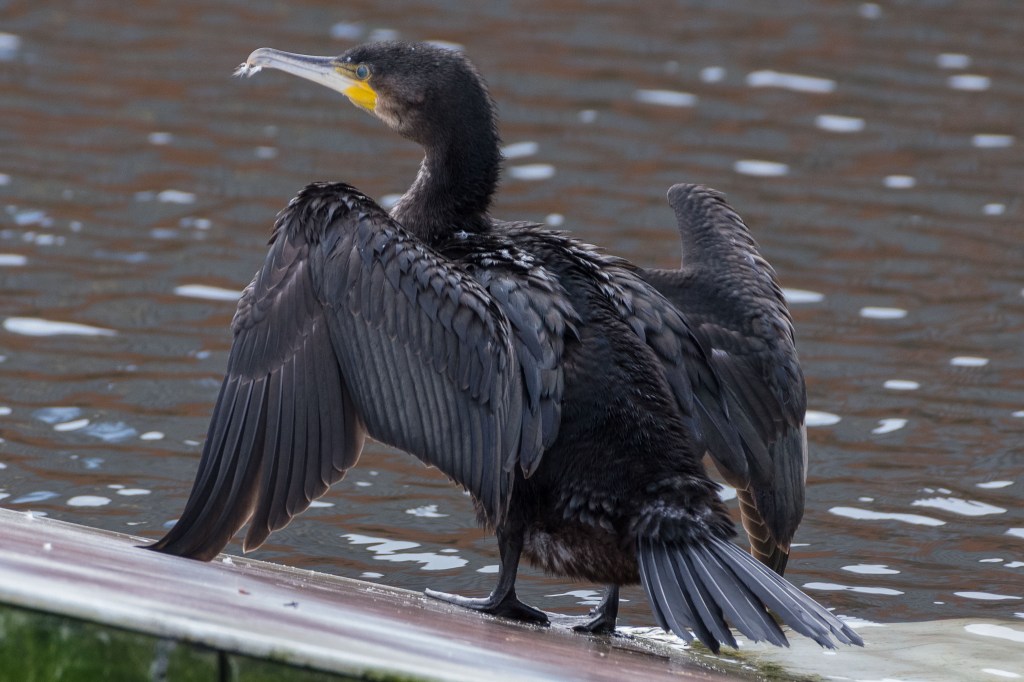
Plumage is being dried off in this image; when dry, the feathers on the back of the bird are beautifully patterned.
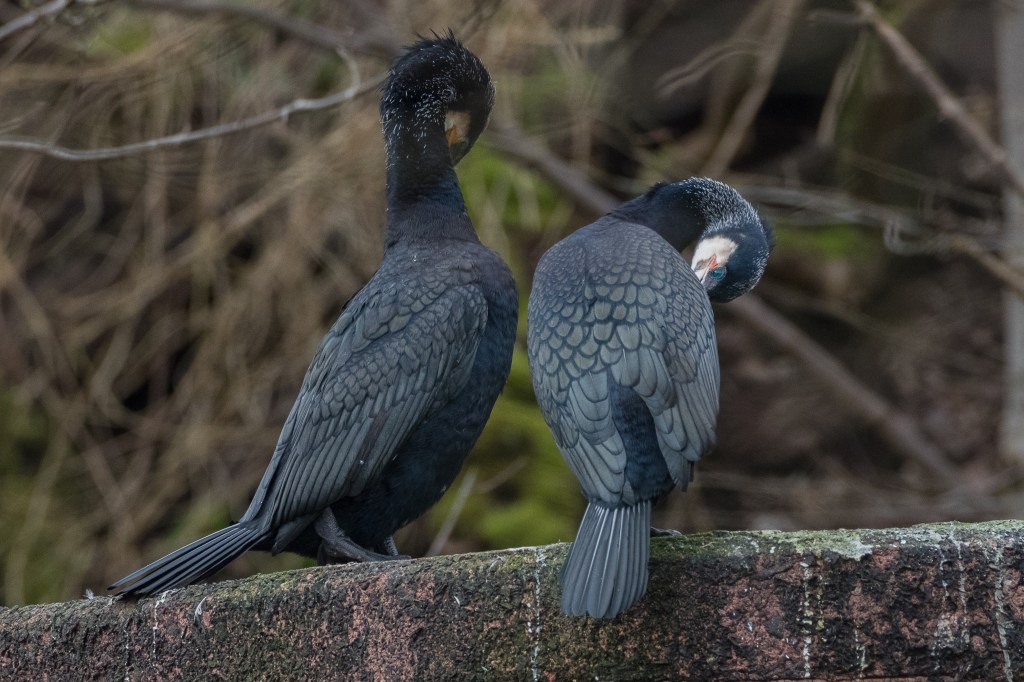
I like the distinct layers of plumage in this image.

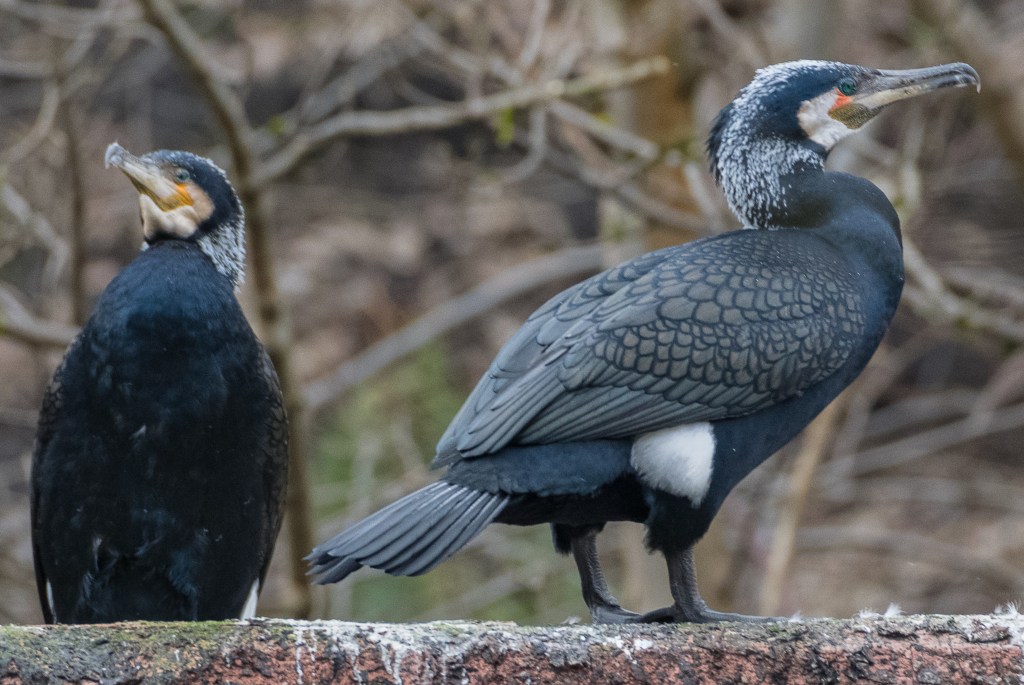
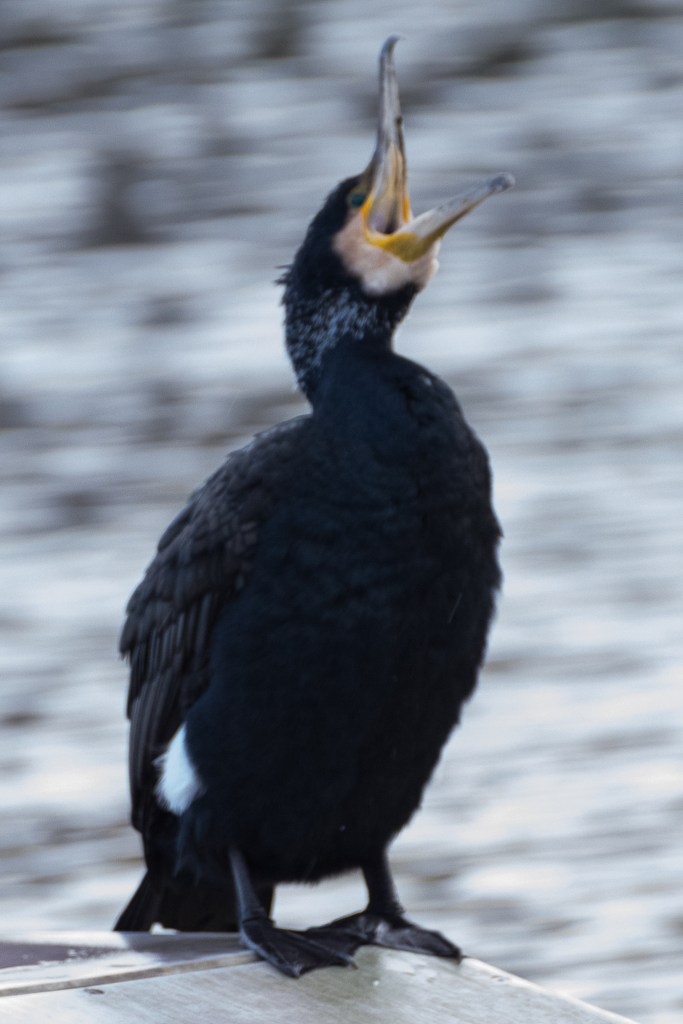
The mask and hooked bill are so reptilian; the facial colours (the eye, the base of the bill) are very striking. Thinking of Cormorants as essentially black, I was surprised to see the white stubble on these birds.
Seeing numbers means a trip to the seaside; a recent visit to Stevenston revealed a large group. We had gone there hoping to see this old pipeline decorated with Sandwich Terns but it was taken by Cormorants this time.
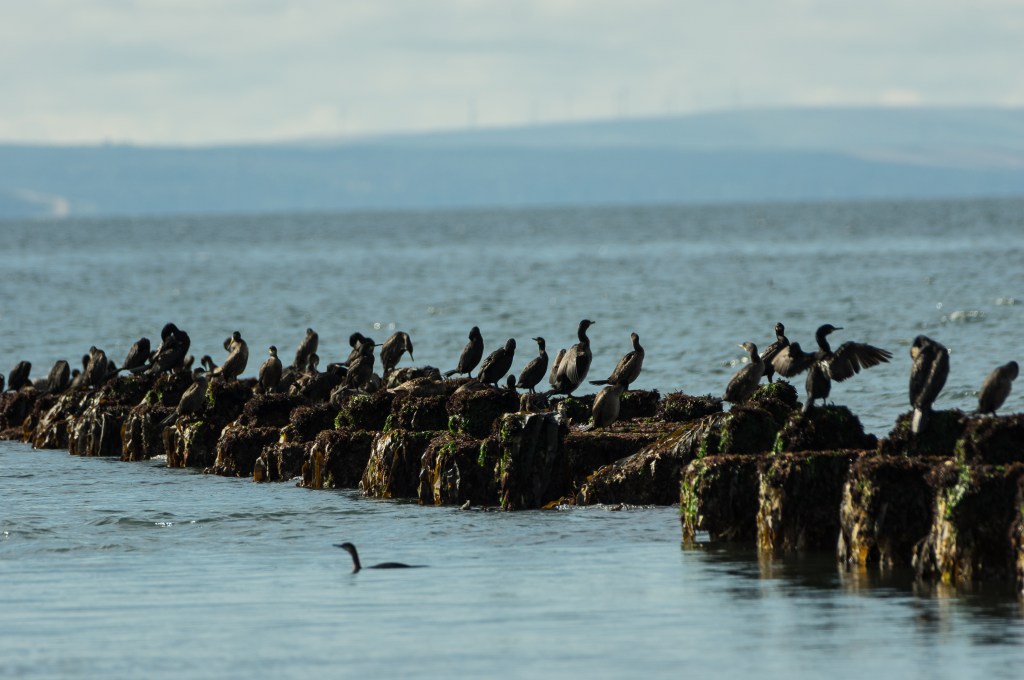
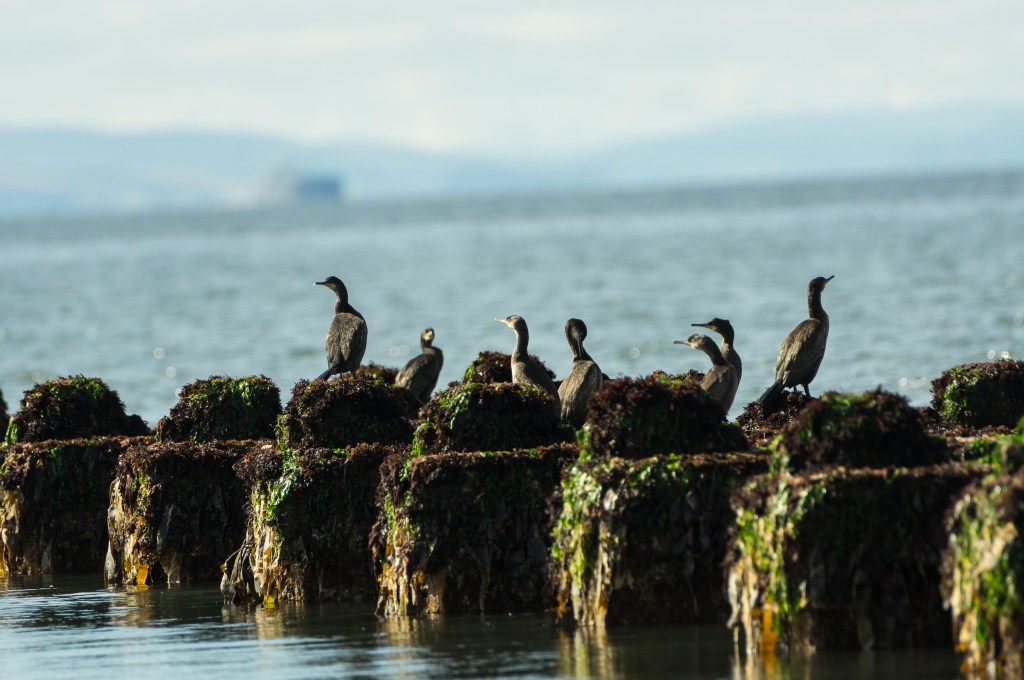
The only confusion species for the Cormorant is the Shag, but there’s no point looking for a Shag in the Toon (well not this kind, ho ho) because they have not colonised inland. I have pored over these recent Stevenston images and believe that they are a mixture of adult and immature Cormorants. The immature birds of both species are paler than the adults and have quite a bit of white around the head, but the adult Shags have no white on the face. This group I saw on Mull seems to be made up entirely of Shags – none of the (darker) adult birds have any white at all and their foreheads rise more steeply from the bill than do those of Cormorants.

The Avon Roach Project has restored the Roach to the river through an innovative DIY breeding programme, as reported in The Torygraph in 2018, with large specimens being caught again. Being a huge fan of make-do-and-mend myself, I am so impressed that the project managed to set up an effective fish breeding programme using bits of old keepnets. I don’t know how the Cormorant issue was resolved in this corner of Hampshire. The Project’s last posting on the birds can be found here.
I am now tangled in a thicket of ideas about naturalness, invasiveness and wildness, and about biodiversity versus monoculture, and the balance between management and laissez faire, which arises from the change in Cormorant habits. It may be some time before I can emerge.
 backwoodsman.org