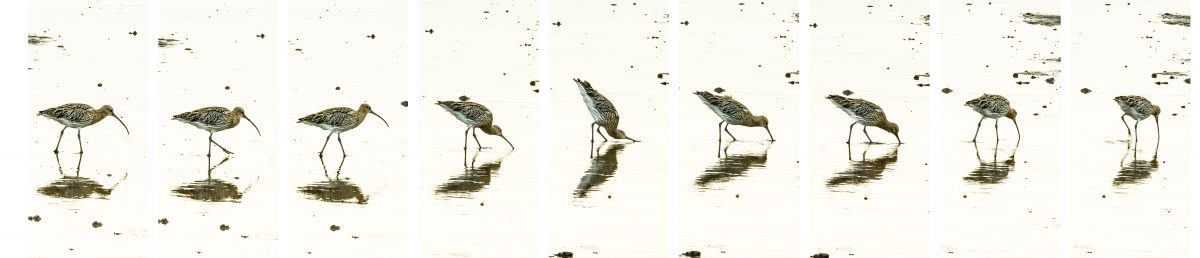
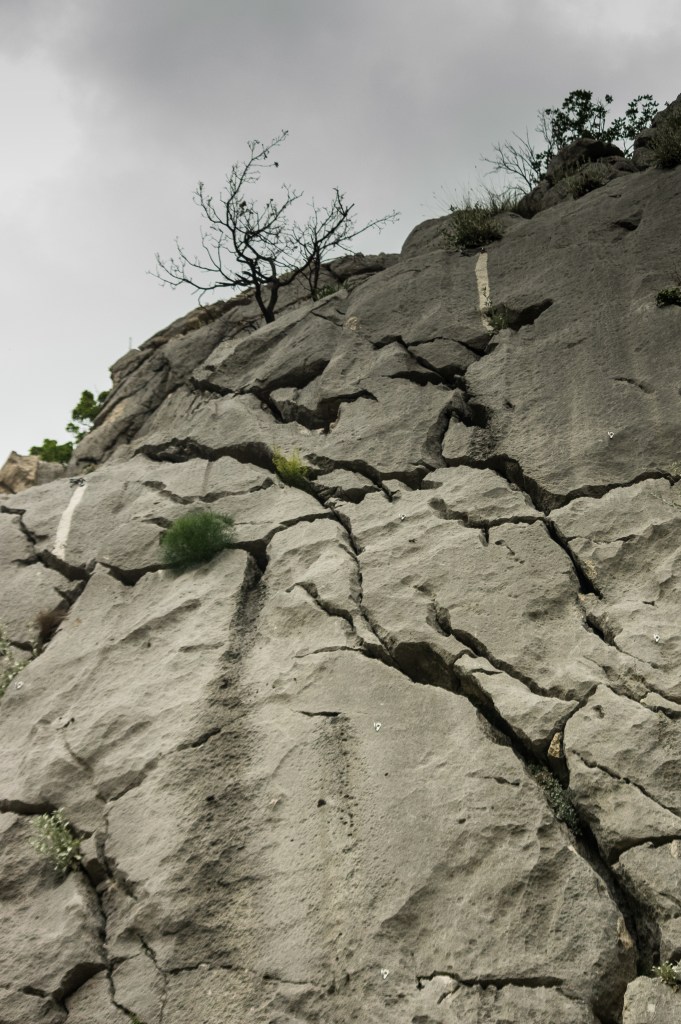
Omiš lies about half-an-hour’s drive south of Split in Croatia. The Cetina River cuts a spectacular gorge through a coastal limestone escarpment to reach the sea in the town. A second band of upland, this time exceeding Munro height, lies several miles inland and runs parallel to the coastal escarpment. The Omiška Dinara, a long finger of Corbett-height upland runs away for miles from Omiš to the South-East. None of the heights are particularly intimidating but when the sun comes out, the limestone heats up fast; when the rain comes, the stone gets very smooth indeed. We chose our walks quite carefully (I mean, it’s a holiday, right, not the Duke of Edinburgh Award Scheme) and were really pleased with the range of wildlife we could find on the limestone pavement or Karst. The region had experienced two weeks of proper rain just before we arrived – this wet spell had probably extended the lifetime of some of the vegetation and possibly delayed some flowering. We were very lucky with what we saw, but I must say at the outset that only my lighter zoom lens made the trip to Croatia so my depth-of-field and general crispness are not what we’re used to. There are no great rarities here but I’m celebrating the diversity (by which I mean the many species) to be found in the Croatian countryside. Our worst day for seeing stuff was on an educational trail and the better experiences began just about where the houses stopped.
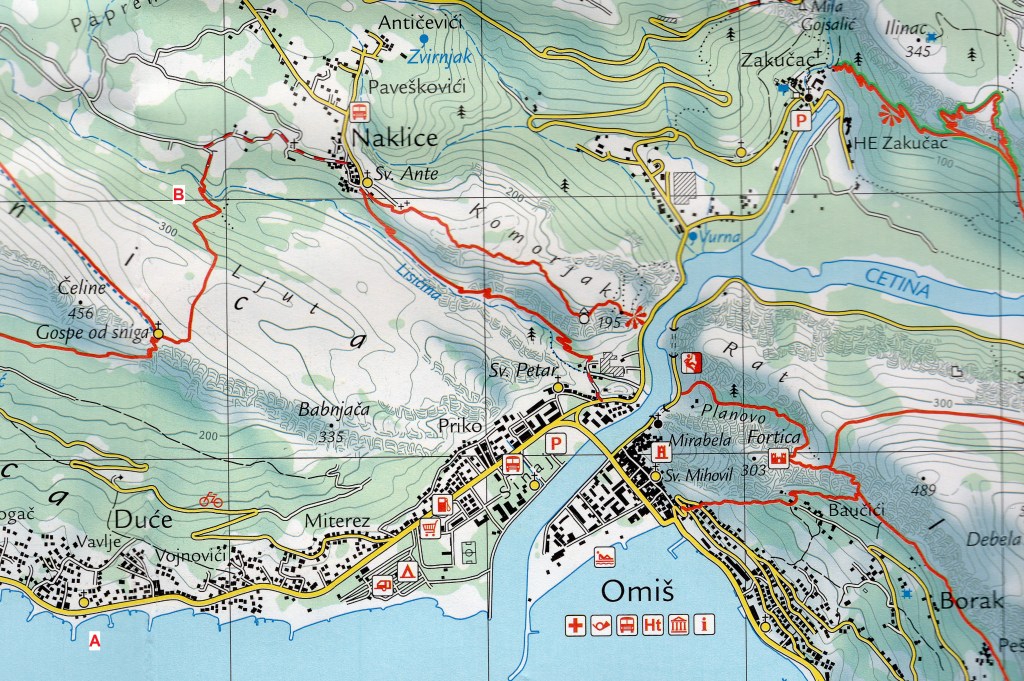
We stayed on the beach, just about where the A is by Vavlje (the map is standard Landranger scale, one square is one Km); our first walk took us East and then North east along the yellow road heading for the town past the slightly grim Camp Galeb in Miterez (Ms Braverman would fill it with migrants given half a chance). Around Sv. Petar, a laid stone path (just like an old drovers’ road) climbs the Lisicina Gorge up to Naklice. From there, a track, then a narrow path heads West, then drops South into a wooded valley, fording the Lisicina before climbing back up the limestone to the little chapel at Gospe od Sniga.
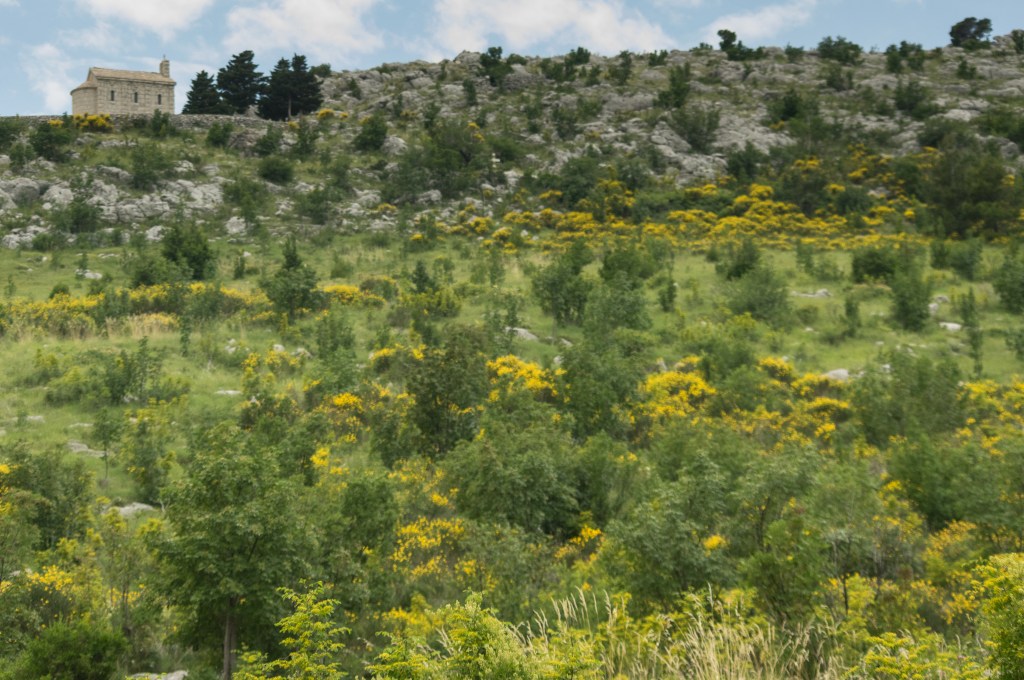
The return to A looks short and there is an interesting path which picks its way down steeply off the limestone cliffs but it then heads West for a long time – we tried this on a previous visit and found it attritional in the full sun. On the recent visit, simply retracing our steps from the chapel allowed a couple of beers to be had in Konoba Palacio in Naklice before the descent of the Gorge in warm rain.
It was also possible to walk up out of the houses behind our hotel onto the hillside below Gospe od Sniga. Access was helped by an old footway to the cemetery which crossed a numbered cycleway (162 I believe) heading North west. We followed the cycleway – no mamils, but some superb habitat with fauna and flora. What material I have is divided between on the wing and on the ground, in that order.
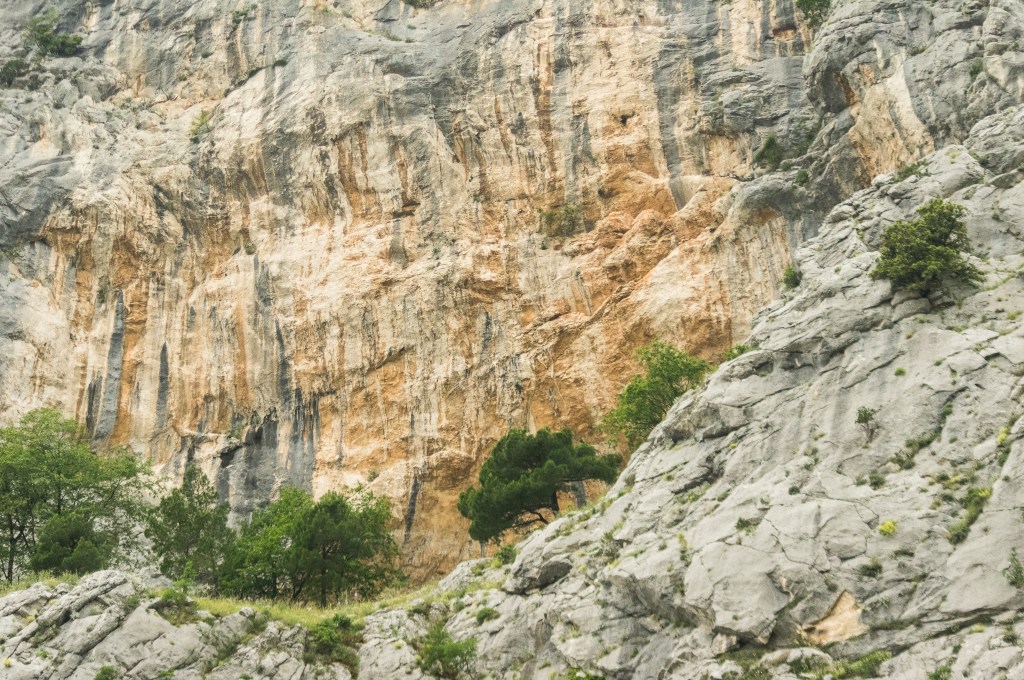
So, we’re heading up the Gorge and there is a nice view of the fortress (Starigrad) above the town and at the low end of the Omiška Dinara.
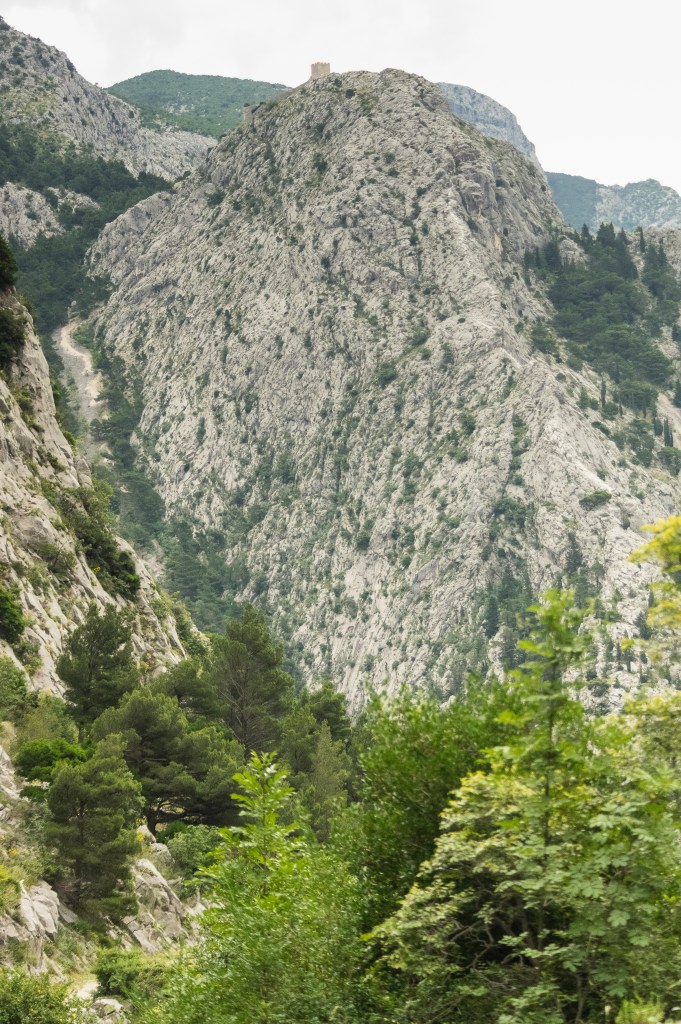
I always look at these sheer cliffs and hope to see a Wallcreeper – one day.
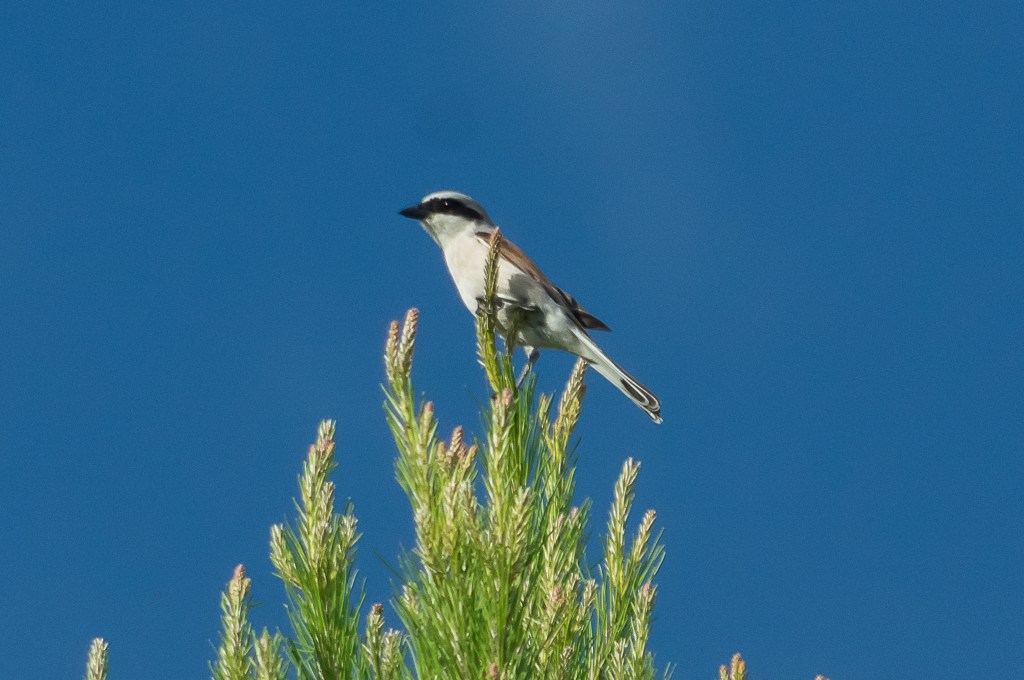
As we left Naklice, we spotted a Red-backed Shrike; I’ve used an image from a later walk which is the best I can do with this species.
The descent to the ford took us through woodland which was just alive with birds, including one or more Nightingales (according to the Merlin App).
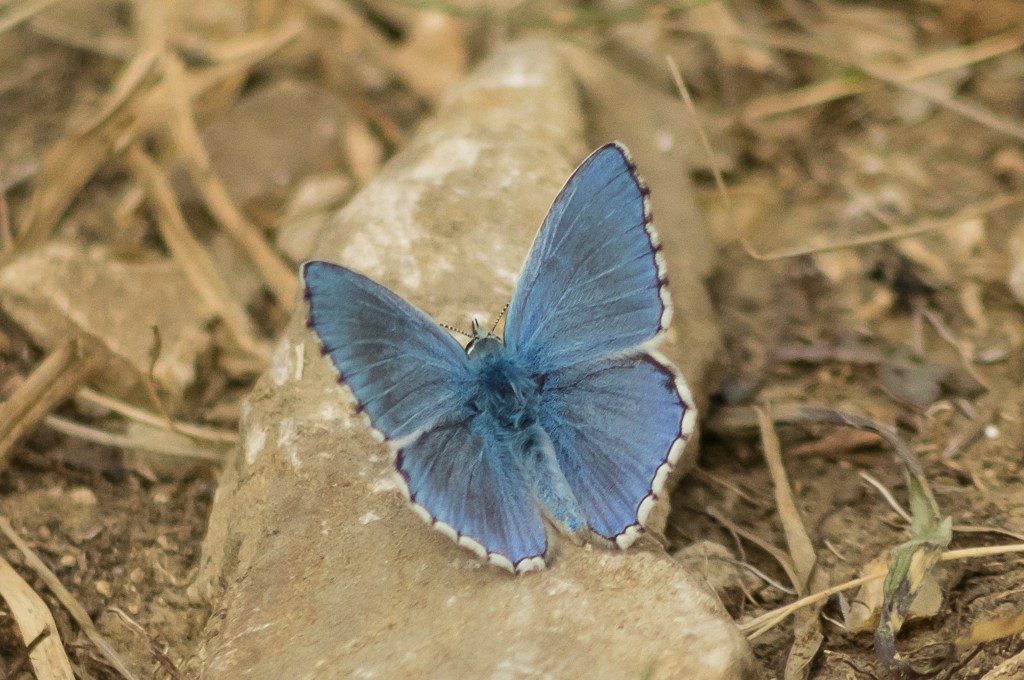
The Karst scenery began when we left the woodland and it was alive with flowering plants, many attended by butterflies. The photography of butterfIies in a hot place is a sure route to a headache and a great way to burn an afternoon with no outcome (Backwoodsman is very keen on getting an outcome). There were Clouded yellows on the wing but they were so fast and always seemed to want to be somewhere else. Some individuals seemed happy to sit. I found a male Adonis blue (rather than a Common blue) – species assignments are difficult to make on the basis of colour (sky blue versus violet blue in this case) but the UK Butterflies site drew my attention to the Chequered fringe of the wing of the male Adonis (the Common’s fringe is plain). I looked hard and in vain for the chocolate-brown female Adonis.
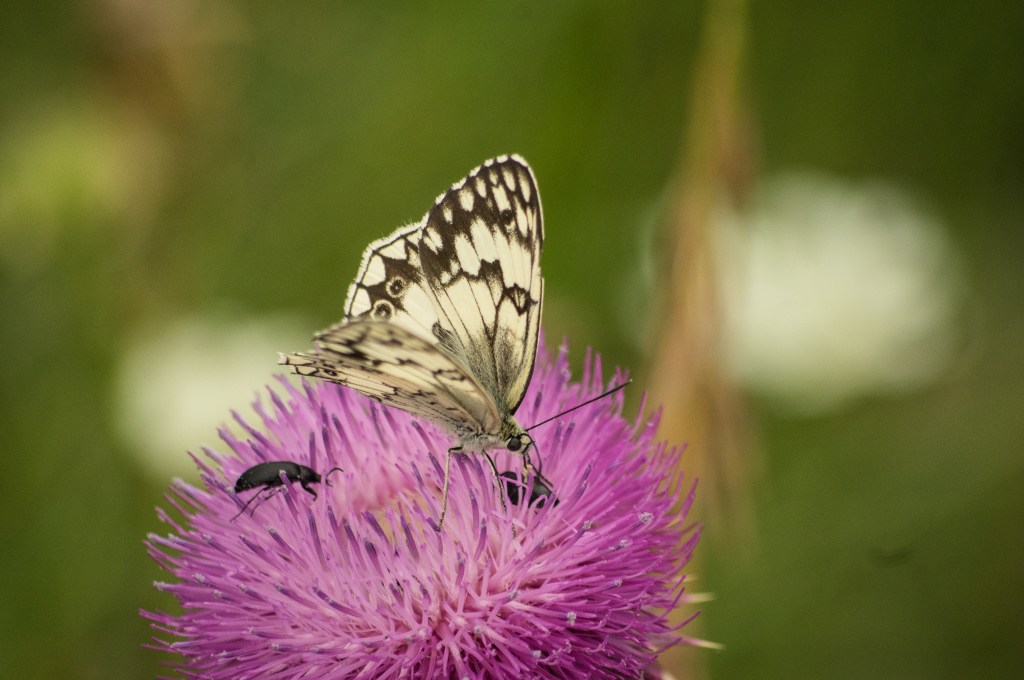
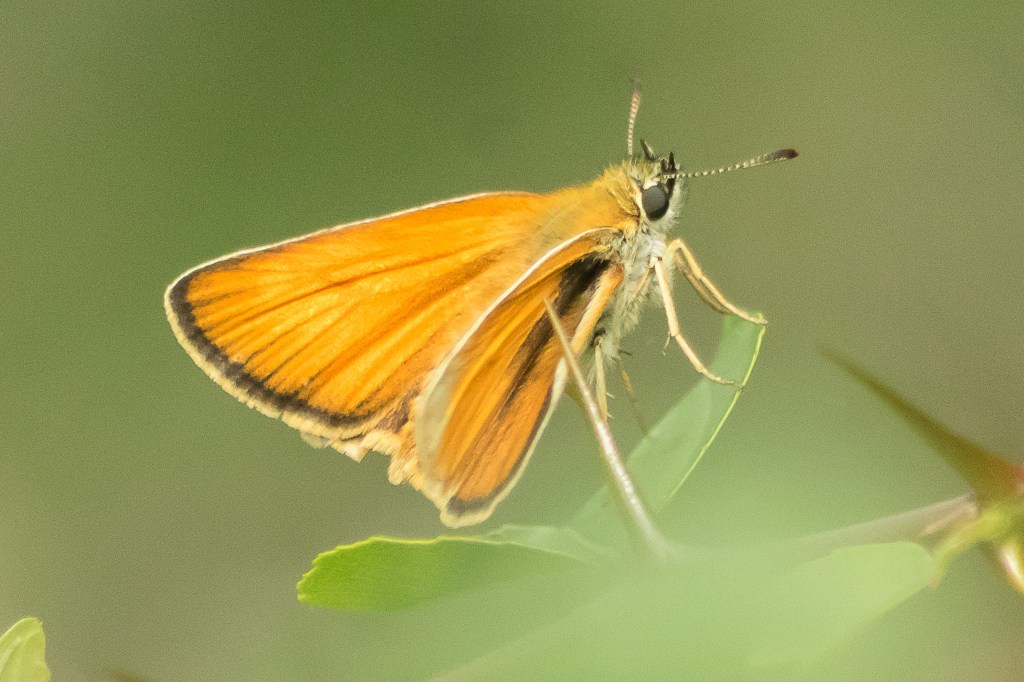
Marbled whites were looking to feed and helpfully chose plants which provided a nice colour contrast. A female Small skipper also chose to sit in a good exposed position for an unusually long time.
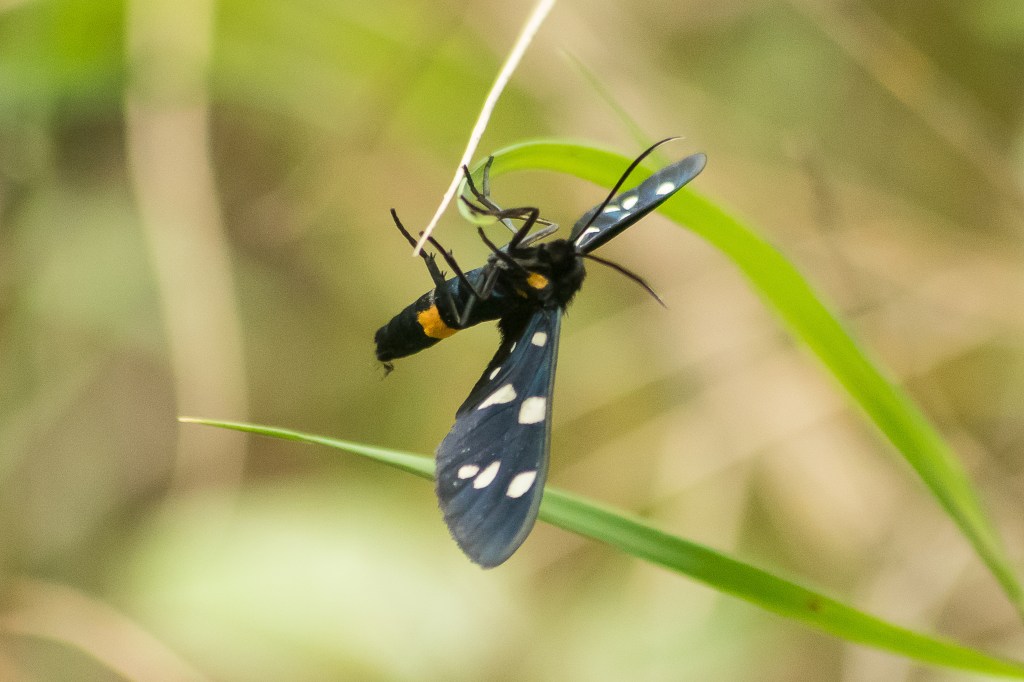
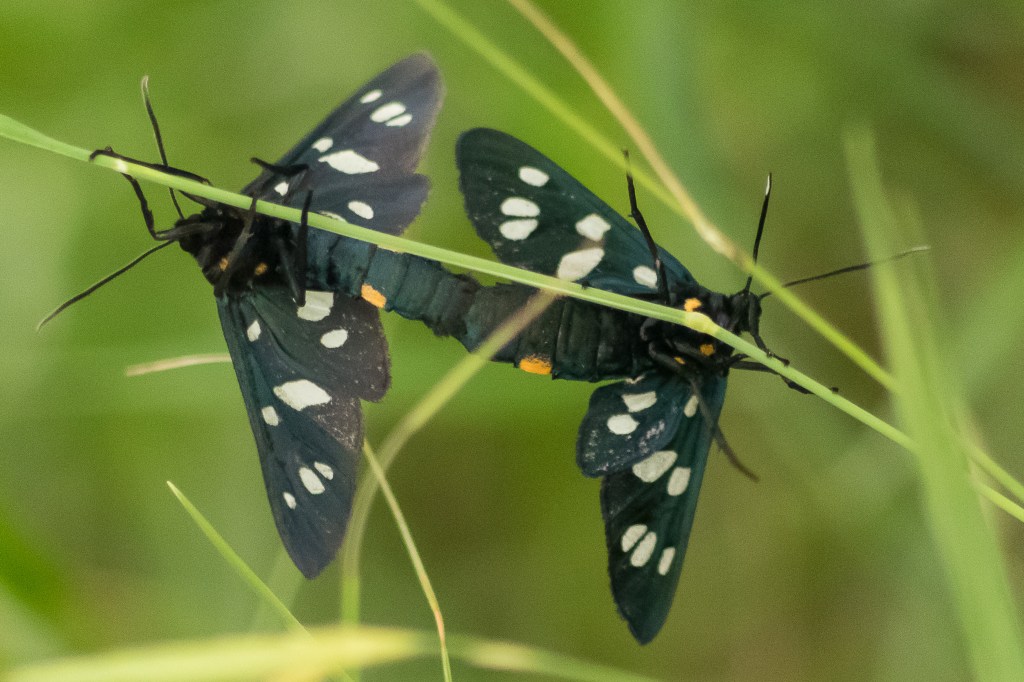
The Nine-spotted moth or Yellow-belted burnet (Amata phegea) was on the wing and mating. Zygaena ephialtes is a similar looking species, though with fewer spots. My moths seem to have eight white spots, matching the count from the images of the Nine-spotteds in the literature. If you follow the links, you’ll find some interesting material about different types of mimicry in insects.
Just before we dropped back into the woodland on the descent, we heard a distant fluting call, which was recorded. The Merlin App said Golden oriole and in the distance across the valley (ca. 100m away), we spotted a couple of brilliant yellow birds flitting in the canopy. We hoped to catch up with them – any image of these exotics would do but they were not to be found, alas.
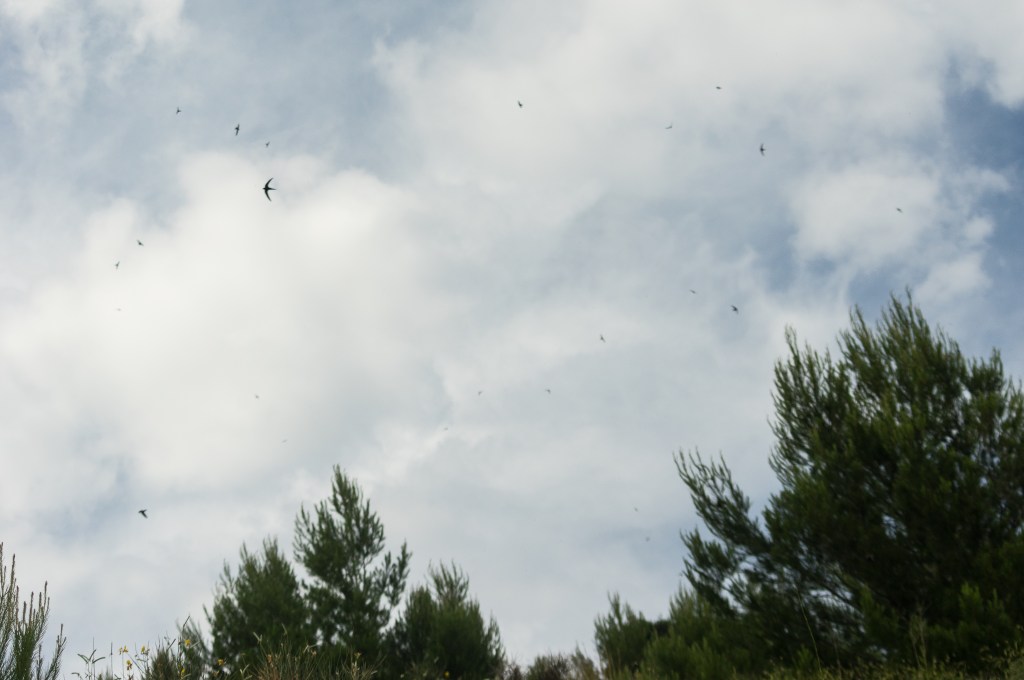
The walk behind the houses afforded our second sighting of Swifts (a visit to Split providing the first). We were very pleased to see a large group, though they are very hard to photograph. My best effort does at least have a recognisably Swift-shaped bird in the foreground. I think there were a couple of dozen in this group, exceeding my UK tally for the year by a good distance (one in Prescot, three in Callander).
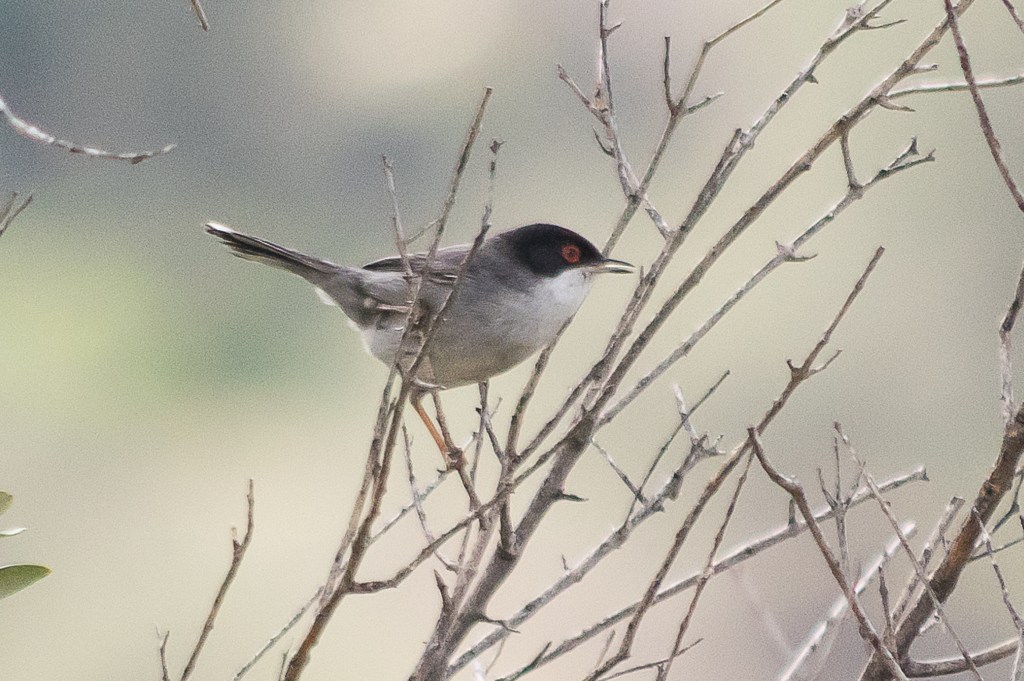
We also caught up with some very active Sardinian warblers; I’m using an image of a Majorcan cousin taken last year.
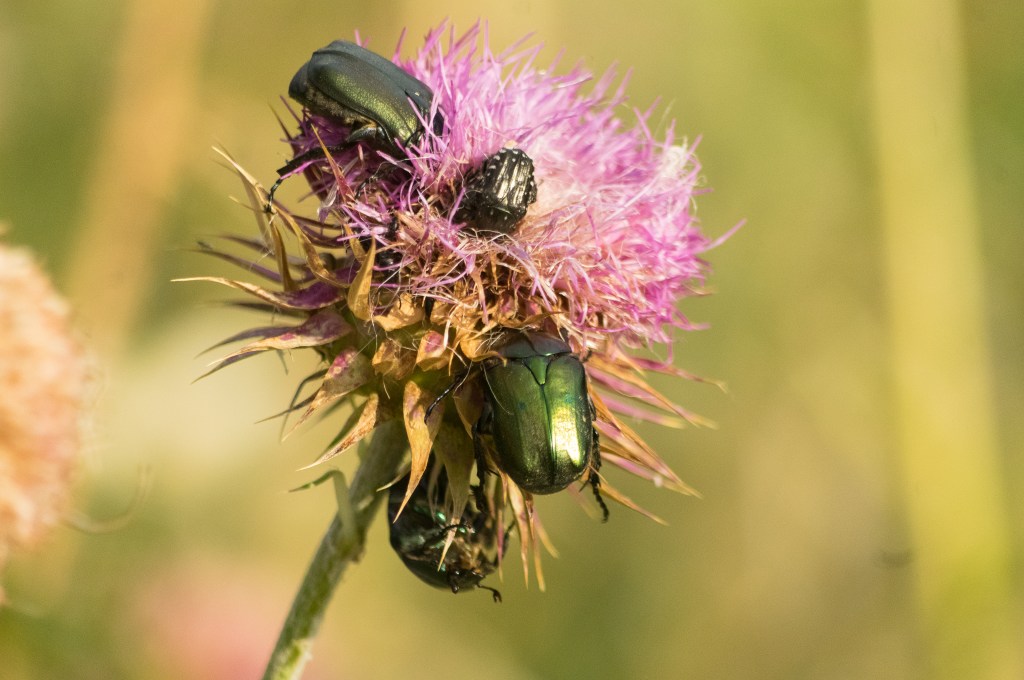
There were some good beetles too but the first is a bit confusing. My beetle book (A Field Guide in Colour to Beetles, K. W. Harde, ed. by P. M. Hammond, Octopus Books, London, 1984, ISBN 0 7064 1937 5) identifies the big green chaps in the next image as Cetonia aeruginosa but my searches suggest that the Cetonia has been superseded in the accepted nomenclature by Protaetia or Cetonischema. Cetonia aurata, the Rose chafer appears to be similar. The smaller chap in the picture may be Tropinota hirta.
There isn’t much doubt about this chap; he flew unsteadily and noisily past us, and we went in pursuit.
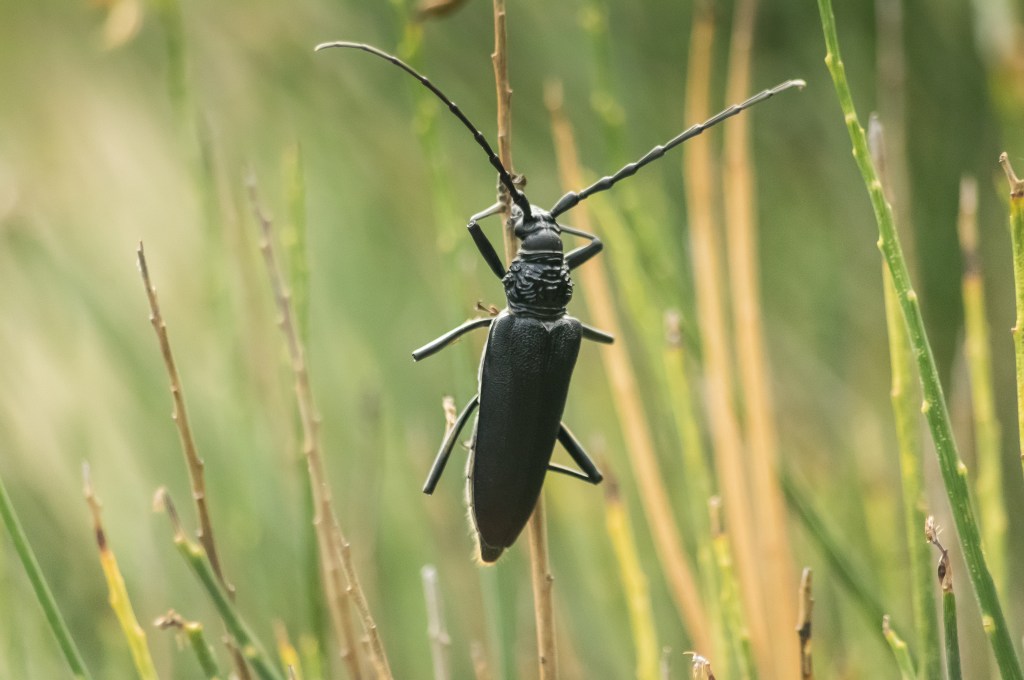
He’d only gone a few metres and was now swaying on a stem, all 5cm or so of him (antennae excluded). My beetle book identifies him as Cerambyx cerdo, The Capricorn beetle. I’ve included the beautiful graphic by František Severa, a prolific book illustrator about whom I can find absolutely nothing. The photographic image is of sufficiently high quality to reveal the illustrator’s powers of observation and technique.
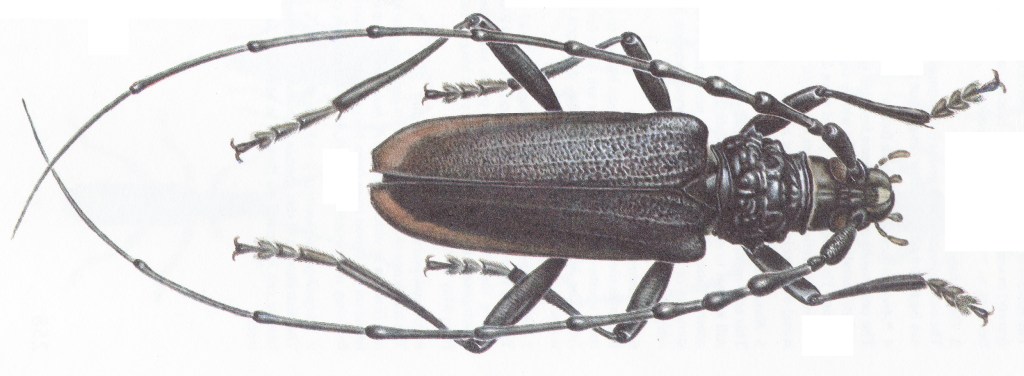
While the species seems to be quite vulnerable in wild woodland (and useful, its tunnelling larvae open up old trees to a wider range of species), this longhorn can be a bit of a pest in Holm oak trees in urban environments. I always hope to come across some really outrageous beetles in the wild and this one will do very nicely. Those antennae! Longhorns use them to detect kairomones, signalling molecules with a wide range of functions.
We’d had two very rewarding walks and were thankful that the natural season was possibly a little late this year, and that we had travelled to Croatia some weeks earlier than for previous visits. The second post from Croatia will look at species on the ground and I suspect it will be Saturday July 1st before I can make it happen. I’m sorry if the images are slightly less crisp than usual but I hope you get a sense of the abundance of wildlife in this beautiful country.
 backwoodsman.org